Do You Need a Green Sticker on Private Land?
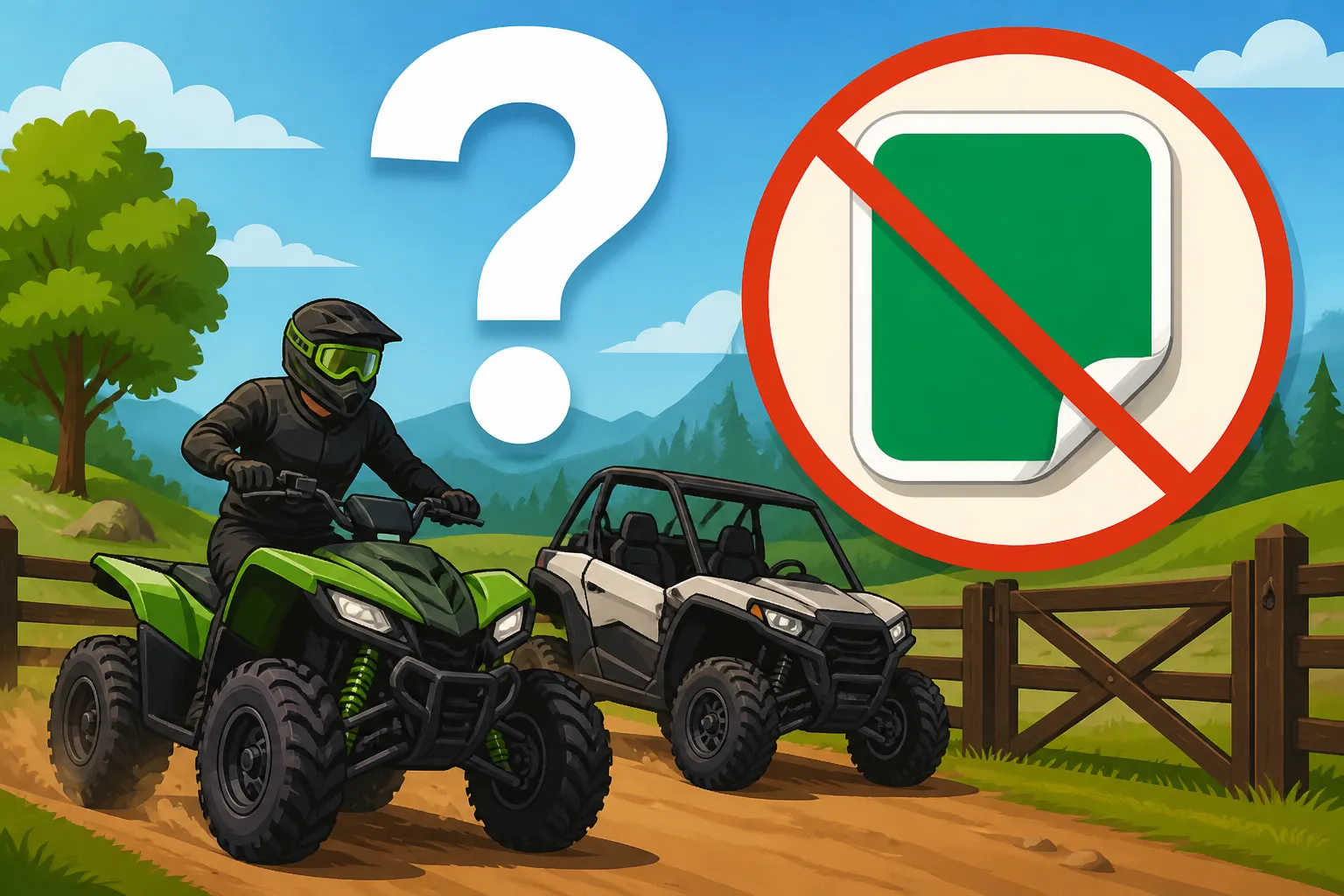
A California ATV or UTV used only on private land may not need a Green Sticker, but “private land” is not a blanket exemption for every ride. The answer can change if you cross public land, use a public road, or take the machine to a trail system. Here’s how to tell which situation you’re in and what to check before riding.
When a Green Sticker may not be required
California generally requires off-highway vehicle identification for machines operated in places covered by the state’s OHV registration rules. A machine that is used exclusively on private property may qualify for an exception. In practical terms, if you ride only on land that is genuinely private and you do not take the ATV or UTV onto public routes or riding areas, you may not need a Green Sticker for that use.
The key word is “exclusively.” A machine does not remain private-land-only just because most of its riding happens on a ranch or private recreation property. If you ride it onto a public trail, cross public land, or use a public road to get from one part of a ride to another, the private-property exception may no longer fit. A machine can be used on private land one day and need proper identification for a later public-land ride.
A Green Sticker is California’s familiar term for the state identification associated with many OHVs. The exact registration category depends on the machine and its emissions classification, so don’t assume every eligible vehicle receives a green sticker. For an overview of the system, see California’s Green Sticker Explained and Green, Red and Tan: California’s Three Stickers.
The exemption also does not mean that you own a machine free of all paperwork obligations. Registration, title, ownership records, insurance, and permission to ride are separate matters. A machine may not need a Green Sticker for private-only use while still being subject to ownership, sales-tax, or other requirements. Titling an Off-Highway Vehicle in California explains why title status is a separate question from where you ride.
Private land has to be private in practice
The label on a property or the fact that a gate is closed does not, by itself, settle whether a route is private. Land can be privately owned while also having a public easement or a designated public route across it. Likewise, a road that looks like a ranch road might be open to public travel or controlled by a government agency.
Before relying on the exemption, confirm that the riding area and every route you plan to use are private and that you have permission to ride there. If the property is leased, rented, or managed for recreation, check the terms of access with the owner or manager. A lease allowing you to ride on one parcel does not necessarily grant access across adjoining land.
| Where you ride the ATV or UTV | Is the private-land exception likely to apply? | What to check |
|---|---|---|
| Only on private land you own | It may apply | Confirm the land and routes are private and that the machine stays there |
| On private land with the owner’s permission | It may apply for that private-land use | Confirm access terms and whether any route crosses public land |
| On a private recreation property | It depends on the property and routes | Ask the operator whether routes are private or connect to public riding areas |
| On a public trail, public OHV area, or public land | Generally not as a private-only use | Check the machine’s identification and any required permit |
| On a public road or public route | Do not assume the exemption applies | Check whether the route is legally open to the machine and what identification is required |
The table is a starting point, not a ruling on a particular parcel. When the property boundary or road status is unclear, ask the land manager or relevant agency before riding. For situations involving a machine that will remain on private property, Registering a Private-Land Machine in California covers the registration question more specifically.
When private-land riding stops being private-only
The most common mistake is treating the trip to the riding area as separate from the ride. If an ATV or UTV is transported on a trailer and unloaded on private property, that is different from riding it along a public road to reach the property. Riding on a public route can bring registration and road-use rules into play even if the destination is a private field.
The same issue comes up when private parcels are connected by a dirt road. A road’s surface does not determine whether it is private or public. Some dirt roads are public routes, some are private access roads, and some cross a mix of public and private land. Get the route status confirmed rather than relying on a map appearance, a gate, or what another rider has done.
Public OHV areas are another clear boundary. If you take the machine to a state riding area, national forest trail, desert recreation area, or other public riding location, you should check the identification requirements for that location and machine. A private-land exception is not a substitute for public-land registration or a visitor permit. For an out-of-state machine, California’s reciprocity rules matter too; an out-of-state plate or decal is not automatically accepted for every purpose. See California OHV Reciprocity: Only Two States before planning a public-land ride.
Crossing a road is not the same as riding along it
A short crossing and traveling along a road are different situations, but neither should be treated casually. California has specific conditions for crossing public roads with an OHV, and a crossing does not make the vehicle street legal or grant permission to travel on the road. The route, road type, signage, and applicable rules matter. Read [California Rules for Crossing Private Land] and California Rules for Crossing a Public Road if a ride involves roads or property boundaries.
If the machine needs to travel on a road to reach another part of the property, ask whether the road is actually private and whether you are authorized to use it. If it is a public road, check the applicable vehicle requirements before riding. A Green Sticker alone does not make an OHV legal for ordinary street travel, and an OHV plate should not be mistaken for a conventional license plate.
The rule of thumb is straightforward: trailer the machine to the private riding area when possible, and do not ride it on a public route unless you have confirmed that the route and the machine meet the requirements for that use.
What the exemption does not answer
Even when the machine qualifies for private-only use, the Green Sticker question is just one part of planning a ride. You still need permission to use the land. You may also need to follow conditions set by the owner, property manager, event organizer, or local authority.
Private property can have posted restrictions on riding hours, speed, noise, passenger use, vehicle types, or where machines may go. Local rules can also apply. Ask about these requirements before unloading, especially on a large property where different parcels have different owners or access rules.
Do not assume that private land removes every environmental or safety restriction. Rules can depend on the specific conduct, location, and applicable law. For example, a riding event open to the public may involve different permissions or requirements from a family using a closed private parcel. A private owner’s consent is not necessarily permission to use a public road, cross neighboring land, or ignore a public-land closure.
It is also useful to distinguish a machine’s title from its registration. A title helps establish ownership; registration or OHV identification concerns operation under the relevant vehicle rules. If you buy a used quad for private riding, keep a bill of sale and any ownership documents the seller provides. Don’t treat the lack of a Green Sticker as proof that the seller has clear ownership. Buying a Used Quad in California and California OHV Bill of Sale Requirements can help with the transaction side.
If you later decide to ride in public areas, check the machine’s eligibility and paperwork before the trip. A bike, quad, side-by-side, and other off-highway machine can have different details to sort out. The process may involve a title, vehicle verification, and registration paperwork, depending on the vehicle and its history. See Registering an OHV in California for the broader process and California OHV Registration for a Side-by-Side for UTV-specific considerations.
Keep records even if you do not register for private-only use
Good records can prevent confusion if the machine is sold, moved, or later registered. Keep the purchase documents, identifying information, and any title or prior registration records with your ownership paperwork. Photograph the vehicle identification number and the machine’s identifying labels so you have them available if you need to ask the DMV or another agency about its status.
If you are buying a machine that has never been registered, or one with missing documents, resolve the ownership and identification questions before assuming the private-land exception makes the paperwork irrelevant. The exception concerns the use of the vehicle; it does not automatically resolve ownership disputes or make a machine’s history immaterial.
A practical check before you ride
Use this sequence before relying on a private-land exception:
- Identify the full riding area. Confirm the property boundaries, not just the field or trail where you plan to ride.
- Check every route. Find out whether access roads, connecting trails, and crossings are private, public, or subject to an easement.
- Confirm permission. Get approval from the owner or manager and ask whether the permission covers your machine, passengers, and intended routes.
- Decide whether the ride is truly private-only. If you will use public land, a public trail, or a public road, check the registration and route rules before riding.
- Keep ownership records. Save purchase and title documents even if the machine is not registered for private-only use.
- Recheck if your plans change. A machine kept on private land may need different paperwork before a public riding trip.
If the answer is uncertain, contact the California DMV or the agency responsible for the route and describe the actual use: where the machine will be operated, how it reaches the property, and whether any public land or road is involved. General descriptions like “it’s on a ranch” can leave out the detail that determines the answer.
The safest summary is this: private-land-only use may qualify for an exception from California OHV identification requirements, but the exception depends on the actual land and routes used. Once a ride includes a public route or public riding area, check the rules for that use rather than assuming the private-land status carries over.
Disclaimer
This article is for general informational purposes only and does not constitute professional advice. Laws, prices and regulations vary by location and change over time. Consult a qualified professional for guidance on your specific situation.