California OHV Reciprocity: Only Two States
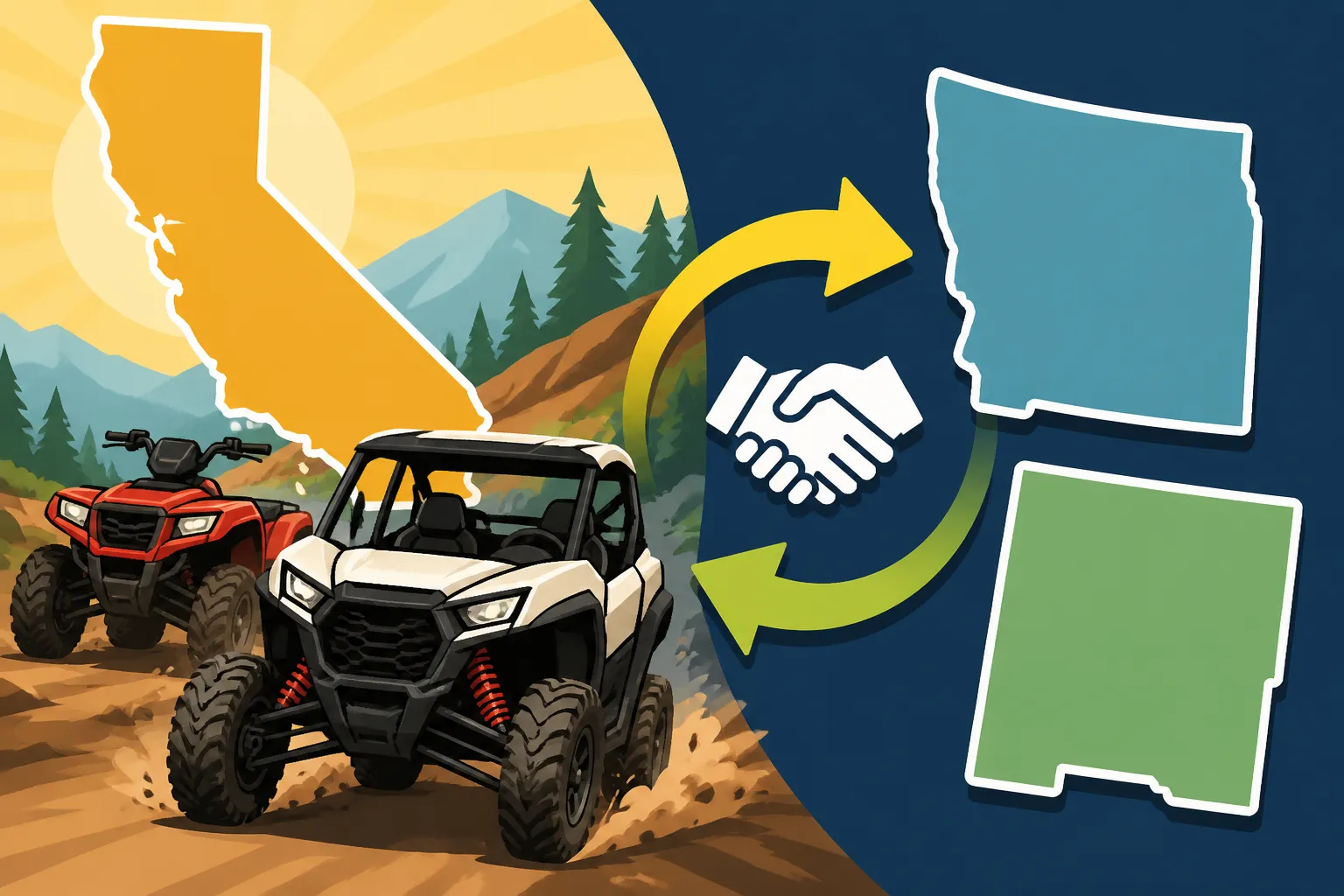
A rider can arrive at a California trailhead with a properly registered ATV and still be unsure whether its home-state decal counts. That uncertainty matters because California recognizes OHV credentials from only two states for reciprocity purposes. This guide explains which credentials qualify, when visitors need a California permit, and what to check before unloading at a riding area.
What California OHV reciprocity means
Reciprocity is about an OHV credential, not just an out-of-state plate
Reciprocity is an agreement to recognize certain off-highway vehicle credentials issued by another state. For California riders visiting from elsewhere, the practical question is whether the machine’s home-state OHV registration or permit is one California recognizes for riding on public lands.
This is different from simply having a license plate on a tow vehicle or carrying paperwork showing that the ATV or UTV was purchased and registered somewhere. The credential needs to apply to the off-highway machine, be valid for that machine, and meet California’s reciprocity rules. A street-legal plate or ordinary vehicle registration does not automatically do the job.
That distinction can be frustrating when a machine is fully legal at home. A rider might reasonably think, “It’s registered, so I’m covered.” But states use different systems: one may issue an OHV decal, another may require a separate trail permit, and another may register an off-road machine through a different process. California does not treat all those systems as interchangeable.
California recognizes OHV credentials from Oregon and Nevada
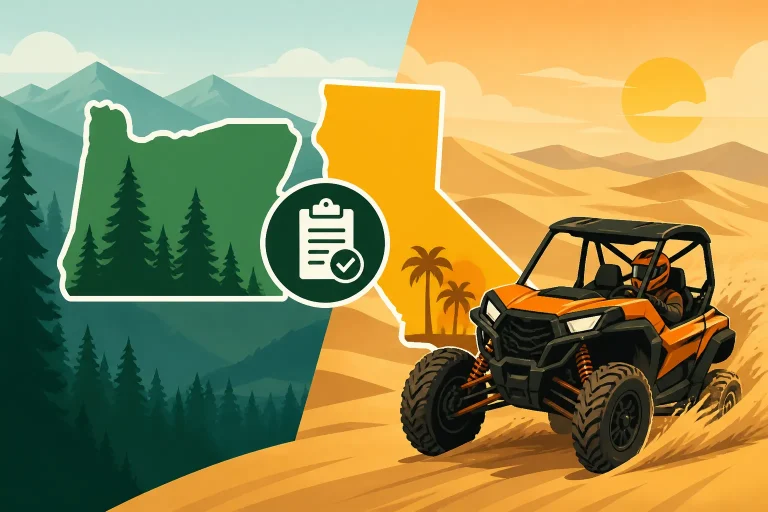
For reciprocity, the key states are Oregon and Nevada. A qualifying Oregon OHV permit or Nevada OHV registration decal can satisfy the applicable California credential requirement for a visiting machine, provided it is valid, properly associated with the vehicle, and displayed as required.
That limited recognition is why a visitor should check the actual credential rather than rely on a vague description such as “my quad is registered.” The relevant decal or permit should be easy to identify on the machine, and the rider should be able to show the supporting documentation if asked. Keep the paperwork together even when the decal is properly attached.
Reciprocity does not mean that Oregon or Nevada machines are exempt from every California rule. It addresses the OHV credential requirement; it does not grant access to every trail, excuse safety requirements, or override a local closure. For the broader framework, see California OHV Reciprocity: Only Two States.
A credential is not permission to ride everywhere
A recognized registration or permit is only one part of a legal ride. The land manager may limit which vehicle types can use a route, close an area seasonally, require a separate entrance or camping arrangement, or prohibit riding outside designated routes. A valid decal does not turn a closed road into an open trail.
This is easy to overlook when a trip involves a long drive. Someone arriving near Glamis, Hollister Hills, or a national forest trail system may be focused on getting the machine off the trailer and starting the ride. It is worth taking a few minutes first to check both the machine’s credential and the riding area’s access rules.
Think of the credential as one item on a pre-ride checklist, not a universal pass. Before setting out, verify the riding area, vehicle eligibility, route status, and any additional permit needed for the activity. The same habit is useful whether you are visiting a California State Vehicular Recreation Area, federal land, or another public riding area.
Which out-of-state credentials California recognizes
Oregon OHV permits
An Oregon rider should check that the machine carries the applicable Oregon OHV permit, rather than assume that any Oregon plate or registration document is enough. Oregon’s system has requirements for off-highway machines, and the credential must be valid for the vehicle being brought into California.
Before a trip, confirm that the permit is current and displayed according to Oregon’s requirements. If the machine has recently been bought, transferred, or modified, make sure the permit and associated records still match the vehicle. A mismatch between the machine and its documentation can create confusion at a checkpoint or during a roadside inspection.
A rider who is uncertain about the Oregon credential should resolve that at home, not in a crowded staging area. California’s recognition depends on the qualifying Oregon OHV permit being in order. For a practical example focused on a destination, see An Oregon Permit on California Sand.
Nevada OHV registration decals
Nevada visitors should confirm that the OHV registration decal is current and attached to the right machine. Carry the supporting registration paperwork as well. A decal that is expired, missing, damaged beyond recognition, or associated with another vehicle can make it difficult to show that the machine qualifies for reciprocity.
The Nevada decal is not the same thing as a Nevada street-legal plate. The decal is the relevant OHV credential; the plate alone may not establish that the machine has the off-highway registration California expects. If a machine has both a street-legal plate and a separate OHV decal, check the rules that apply to its intended use and the specific route.
It also helps to take a clear photo of the decal and registration paperwork before departure, while keeping the originals available. Photos can be a useful backup if papers are misplaced, but riders should not assume a digital image replaces any document they are required to carry. For a California riding-area example, see A Nevada Decal at a California SVRA.
Credentials from other states do not automatically qualify
An out-of-state OHV sticker or registration may be valid at home without being recognized as a substitute for California’s nonresident permit. Arizona is a common source of confusion: a valid Arizona registration does not automatically give a visiting rider the same reciprocity treatment as an Oregon or Nevada credential.
The same caution applies to other states. Do not infer reciprocity from a neighboring state’s location, from the fact that the machine is registered, or from what another rider said at a staging area. California’s recognition is limited, and the credential must fit the rule that applies to the machine and its use.
If your home state is not Oregon or Nevada, begin by checking the California nonresident permit requirement. That is safer than arriving and hoping a home-state sticker will be accepted. Related guidance is available in Why an Arizona Registration Will Not Do in California and Does California Honor Arizona OHV Registration?.
| Home-state credential | California reciprocity treatment | What to check before the trip |
|---|---|---|
| Qualifying Oregon OHV permit | Recognized for the applicable OHV credential requirement | Confirm it is current, belongs to the machine, and is displayed as required |
| Qualifying Nevada OHV registration decal | Recognized for the applicable OHV credential requirement | Confirm the decal and records are current and match the machine |
| Arizona OHV registration | Not automatically accepted as reciprocity | Check whether a California nonresident permit is required |
| Credential from another state | Do not assume California recognizes it | Confirm the California requirement for the machine and riding area |
| Street-legal plate from any state | Not automatically a substitute for an OHV credential | Check whether the route allows the vehicle and what off-road credential applies |
When a California nonresident OHV permit may be needed
Visitors from states other than Oregon and Nevada
If your machine is from a state other than Oregon or Nevada, plan on checking California’s nonresident OHV permit requirement before riding on public land. A home-state registration may still be important for legal operation at home, but that does not necessarily satisfy California’s separate requirement for a visiting off-highway vehicle.
The most common mistake is to treat the permit question as an afterthought. A group may arrange a campsite, coordinate trailers, and plan a full weekend, then discover that one machine has a different registration situation from the others. Check each ATV or UTV individually. A household with three machines may have three different credential histories.
Start with the California-specific guidance at California’s Nonresident OHV Use Permit and California OHV Permit for Out-of-State Riders. Confirm the current permit process and display instructions through the relevant official program before leaving. If you are unsure whether a machine’s home-state credential qualifies, do not rely on a retailer’s general explanation or a friend’s recollection.
The distinction between OHV use and road use
An OHV permit requirement concerns off-highway use; it does not grant permission to use public roads. Conversely, a street-legal registration may not replace an OHV credential for riding in an area where one is required. These are separate questions, and a machine can face different rules depending on where and how it is being operated.
For example, a UTV with a street-legal plate might be allowed on a particular road under applicable road-use rules, but that does not automatically mean it can ride on every off-highway trail or public recreation area without the required OHV identification. A quad with an OHV decal may be eligible for designated off-road routes while remaining prohibited from ordinary public roads.
Before planning a route that moves between pavement and dirt, verify both sides of the issue: whether the vehicle is authorized for the road segment and whether it has the right credential for off-highway use. A permit is not a conversion to street legality, and a plate is not a universal off-road pass.
Machines used only on private property
A rider may use a machine exclusively on private land and never take it to a public riding area. That situation can involve different registration and access considerations from a visit to a public trail system. The important point is not to assume that a private-property situation answers the reciprocity question for a later trip.
A machine that has been used only on a ranch or private acreage may have no current off-road credential. If its owner later decides to visit a California public recreation area, the owner should check the applicable California requirements before the trip. The same applies to a machine stored for years and brought out for a weekend ride.
Private land also has its own permission and safety considerations. The landowner’s approval does not make adjacent public routes open, and a machine’s private use does not establish that it qualifies for reciprocity. See Do You Need a Green Sticker on Private Land? for a related discussion of the private-land distinction.
How to prepare your machine and paperwork
Check every vehicle separately
Make a list of each ATV, dirt bike, and UTV in the group. Record the machine’s state of origin, its OHV credential, its expiration status, and whether the credential is visibly attached. Do not assume the family’s machines all follow the same rule; one may have been bought in a different state or may carry an older registration.
This is especially useful when several people are towing separate trailers or borrowing machines from relatives. A rider may be able to show that one quad has a qualifying Nevada decal while the second machine has only an Arizona credential. Sorting that out at home is far easier than trying to solve it after arriving at a busy recreation area.
Use the vehicle identification information on the machine and paperwork to confirm that the records correspond. If a machine was recently sold, transferred, or replaced, check that the credential was updated as required. For a useful overview of what to have ready, see California OHV Registration Paperwork Checklist.
Keep documents accessible and in good condition
Carry the documents that support the machine’s credential, along with any permit or registration records the applicable rules require. Put them somewhere protected from dust, water, and sun. Paperwork left loose in a truck door can become unreadable after a dusty drive, while papers tucked beneath riding gear may be difficult to find when a ranger asks to see them.
A simple document sleeve or waterproof pouch can reduce that hassle. Some riders keep a copy in the tow vehicle and another with the riding gear; others scan documents as a backup. If you shop on Amazon for a pouch or organizer, choose one that protects paper without making it hard to retrieve the originals when needed. A photo is useful backup, but do not assume it replaces an original credential if the rules call for one.
Make sure the machine’s decal is legible and securely displayed. If it is peeling, faded, or damaged, address that before travel. A credential that is technically valid but impossible to identify can turn a straightforward check into a delay. For guidance specific to a California-issued plate, see How California OHV Plate Differs From a Sticker.
Build a pre-trip credential check into the plan
A reliable pre-trip check can be simple: identify each machine, verify its home-state credential, determine whether California recognizes that credential, and confirm the permit or documentation needed for the intended riding area. Then check the area’s operating status and any separate access requirements.
Do this well before departure if a credential needs renewing or replacing. Waiting until the night before a trip can create unnecessary stress, particularly if the vehicle is stored away from home or several people share responsibility for the paperwork. A checklist kept with the trailer documents helps make the process repeatable.
For groups, assign one person to confirm each machine rather than relying on a general “we’re all registered” message. One person can photograph the decals and make a roster; another can confirm that paperwork is packed. If you use Amazon to order a small waterproof document wallet, keep it with the trailer checklist so papers do not drift between vehicles. The goal is not elaborate administration—it is avoiding an avoidable interruption at the start of a ride.
What reciprocity does not cover
It does not override trail and land-management rules
A valid Oregon permit or Nevada OHV decal does not guarantee that a particular California route is open. Public lands have different managing agencies and operating rules. A trail may be restricted by vehicle width, designated use, seasonal conditions, fire activity, habitat protections, or a temporary closure.
This matters especially when a group uses a navigation app or an old printed map. A route shown as rideable may have changed, or a nearby path may cross land with different access rules. Check current official maps and notices for the specific area rather than treating a valid registration as proof that every visible dirt road is open.
At a State Vehicular Recreation Area, check the area’s requirements as well as the vehicle credential. At federal or other public lands, consult the relevant land manager’s route information. For dune trips, the credential question is only one part of a larger preparation list; California Rules for Riding Imperial Sand Dunes covers the broader setting.
It does not replace safety requirements
Reciprocity does not exempt a visiting rider from California safety requirements that apply to the rider or machine. Rules may concern age, supervision, protective equipment, helmets, sound, spark arresters, or the use of particular vehicle types. The applicable rule depends on the activity and location, so riders should not assume that following their home state’s rules is enough.
Families should pay particular attention to youth requirements. A child’s ability to ride at home does not settle the California rules for riding on public land. Adults should confirm the age, supervision, and safety-certificate requirements before handing over a machine or planning a group ride.
Likewise, a machine that meets home-state sound or equipment rules may still need to meet California requirements where those rules apply. A valid decal does not cure a prohibited exhaust setup or missing safety equipment. Build the safety check into the same planning routine as the reciprocity check.
It does not make a machine street legal
An OHV credential and a street-legal registration serve different purposes. Reciprocity for off-highway use does not authorize a machine to travel on a public road, and it does not guarantee that another state’s street-legal status will be accepted for every California road or trail.
This can be particularly confusing with side-by-sides. Owners may see a plate and assume the vehicle can use any road that connects two recreation areas. In California, the legality of road use depends on the vehicle, the road, and applicable state and local rules. A valid OHV credential does not answer those questions.
Before including a road segment in a ride plan, verify that the specific road is open to that class of vehicle and that the machine meets the requirements for using it. If the route is not clearly authorized, trailer between riding areas rather than improvising on the day. Keep the questions separate: “Does the machine have an accepted OHV credential?” and “Can it legally use this road?”
Common reciprocity mistakes and how to avoid them
Treating every state sticker as equivalent
A sticker on an ATV can look official without being the particular credential California recognizes. Riders sometimes rely on the visual fact that a machine has a decal, rather than checking the issuing state, the decal’s purpose, and whether it remains valid. The design alone is not enough.
Before travel, identify the credential by name and issuing agency. If the paperwork says it is a general registration, make sure it applies to off-highway use. If it is a trail permit, check the permit’s term and display requirements. When the credential is from a state other than Oregon or Nevada, check California’s nonresident permit rules instead of guessing.
This is a good time to separate the tow vehicle’s documents from the OHV’s documents. The truck’s plate and registration do not establish the ATV’s status. Keep each machine’s papers together so the right credential can be found quickly.
Assuming that a previous trip proves current eligibility
A rider may have traveled to California before without being asked for a permit and conclude that the same setup is always acceptable. That is risky. A past checkpoint experience does not establish the rule, and a machine or credential may have changed since the previous visit.
Credentials expire, decals become damaged, and vehicles are bought or transferred. A route or riding area may also change its operating conditions. Recheck the machine’s status each season and before a major trip, rather than carrying forward assumptions from a weekend years ago.
A useful routine is to check documents when servicing the machine or preparing the trailer. Confirm the decal is still attached, the paperwork matches the vehicle, and any required permit remains valid. Repeating a small check is less frustrating than discovering the problem at the gate.
Confusing permit compliance with entry requirements
Even when the machine carries the right credential, the riding destination may have separate entry procedures, fees, reservations, or event rules. Those requirements are not the same as reciprocity. A rider who has handled the OHV permit question still needs to check the destination.
For example, an area may have its own operating schedule or campground rules, while a special organized event may involve additional requirements. A permit that satisfies the vehicle-identification rule does not automatically reserve a campsite or authorize participation in a closed event.
Make a two-column planning list: machine requirements and destination requirements. Under the first, record the registration, permit, and display items. Under the second, record access, route, camping, and event details. That small distinction helps prevent the familiar “we’re legal, but we can’t do the thing we came for” problem.
A practical decision process before riding in California
Step one: identify the machine’s home-state credential
Start with the vehicle, not the rider’s home address. Determine what OHV permit, decal, or registration is issued for that specific machine. Check the expiration date, vehicle identification details, and display condition. If the machine’s paperwork is unclear, contact the issuing state program before traveling.
Do not use the tow vehicle’s registration as a substitute for the ATV or UTV’s records. Do not assume that a plate means the machine has a qualifying OHV credential. If a machine was recently purchased, check whether the previous owner’s permit remains valid or whether the new owner must obtain a replacement or updated credential.
For a fleet or family group, repeat the check for each vehicle. A mixed group may include Oregon and Nevada machines that qualify for reciprocity alongside vehicles from other states that need a California permit.
Step two: apply California’s reciprocity rule
If the machine has a qualifying Oregon OHV permit or Nevada OHV registration decal, confirm that it is current and properly displayed. Carry supporting documentation. If it comes from another state, do not assume that it receives the same treatment; check whether a California nonresident OHV permit is required.
When in doubt, consult the official California program information and the relevant home-state agency. Pay attention to the credential itself, not just a dealer’s summary or a social media comment. Rules can be misunderstood when riders use “registration,” “decal,” and “permit” interchangeably.
This is also where timing matters. If you discover a gap, give yourself room to resolve it before the trip. Do not count on being able to buy the right permit at the trailhead unless the official program specifically confirms that option and process.
Step three: confirm the destination and riding plan
Once the machine’s credential is settled, check the intended riding area. Confirm that it is open, that the vehicle class is allowed, and that the planned route is designated for the kind of machine you are bringing. Look for separate instructions on camping, entry, events, or temporary closures.
If the plan includes a road connection, verify road legality separately. If children are riding, confirm the age and supervision requirements. If the terrain involves dunes or brush-covered land, check the relevant safety and equipment rules. One credential check cannot answer all of these questions.
Finally, pack the documents, inspect the decals, and make sure everyone in the group knows where the paperwork is kept. A clear plan means less time searching through a glove box or debating at the staging area—and more time starting the ride with the right expectations.
Disclaimer
This article is for general informational purposes only and does not constitute professional advice. Laws, prices and regulations vary by location and change over time. Consult a qualified professional for guidance on your specific situation.