What a Rider Under 18 Must Carry in California
A minor heading to a California trail needs more than a helmet and a parent’s permission. The machine needs the right identification, and the rider may need proof of safety training or a qualified adult’s supervision. Here’s what riders under 18 should have with them, what the supervising adult needs, and how the answer changes for out-of-state machines and rentals.
The documents a rider under 18 should have
Start with two separate questions: Is the machine legal to ride there, and is the young rider qualified to operate it? The paperwork is different for each. A safety certificate does not replace machine registration, and a valid sticker does not satisfy a rider-safety requirement.
| What to have or check | Whose responsibility it is | Why it matters |
|---|---|---|
| Proof of OHV safety training, if applicable | Young rider | Shows the rider has met the relevant safety-education requirement |
| Proof of the supervising adult’s safety training, if the rider relies on supervision | Adult supervisor | Helps establish that the adult meets the training condition |
| Registration certificate or permit paperwork | Machine owner or rider carrying the documents | Connects the machine to its registration or permit |
| Required ID plate, sticker, or permit displayed on the machine | Machine owner | Identifies the machine for lawful public-land use |
| A California nonresident OHV use permit, when required | Out-of-state machine owner | Covers a qualifying out-of-state machine that lacks accepted reciprocity |
| Rental paperwork and any required training proof | Renter and rental company | Helps show the rental is authorized and the rider meets applicable conditions |
Safety certificate or qualified supervision
California has safety-training requirements for young OHV operators. Depending on the rider’s age, vehicle type, and circumstances, a young rider may need to have completed the required training or ride under the supervision of an adult who meets the applicable training requirement. Do not assume that being accompanied by any adult is enough.
The practical approach is straightforward: if the rider has completed an approved course, bring the certificate or other proof of completion. If the rider is relying on a supervising adult, have that adult carry proof of their own qualification and stay close enough to provide the supervision the rule requires. A certificate at home is less useful if a ranger asks for proof on the trail.
Requirements can differ between an ATV and a recreational off-highway vehicle, often called an ROV or side-by-side. Before a trip, check the relevant [California ATV Safety Certificate Requirements] and California ROV Operator Age Limit. A safety certificate is not a general license to operate any machine: it does not erase age restrictions, manufacturer guidance, or rules about who may operate a particular vehicle.
Machine registration and permit documents
The machine’s paperwork is separate from the young rider’s training record. For a California-registered OHV, carry the registration certificate or other registration documentation and make sure the required identification plate and sticker are properly displayed. A photo of the documents may be convenient, but do not rely on it as a substitute unless the agency responsible for the riding area confirms that a digital copy is accepted.
If the machine is from out of state, check whether it needs a California nonresident OHV use permit. California’s reciprocity is limited; a machine’s ordinary license plate or registration from another state does not automatically settle the OHV permit question. See [California OHV Reciprocity Rules] and California’s Nonresident OHV Use Permit before loading the trailer. Permit rules attach to the machine and its status, not to the rider’s age.
A rider who is not the machine’s owner should still know where the paperwork is kept. Parents often carry the registration in the tow vehicle and assume that is enough. It is safer to keep the relevant proof with the machine or rider, in a secure, dry place, and confirm the riding area’s requirements before setting out.
What “carry” means in practice
For a young rider, “carry” should mean that the necessary proof is accessible during the ride, not buried in a glove compartment at a distant campsite. Put documents in a waterproof pouch, small zip bag, or another protected holder. Some families use a document sleeve or organizer bought from Amazon, but the important part is that it stays dry, readable, and with the person who needs it.
Keep copies legible. A certificate number that has rubbed away or a registration card soaked beyond recognition may be hard to use when asked for proof. If you keep a digital backup on a phone, treat it as a backup rather than the only copy. Phones can lose signal, run out of battery, or get damaged in dust and water.
Before leaving home, check the machine’s ID plate and sticker as well as the paperwork. If a plate is missing, damaged, or difficult to read, resolve that before riding. The process for Replacing a California ID Plate is different from replacing a registration document, so identify what is actually missing.
How the rule changes with age, vehicle type, and supervision
“Under 18” covers children at very different stages of riding experience. A child on a small ATV, a teenager on a full-size quad, and a teen passenger in a side-by-side do not all present the same safety or legal questions. The certificate is one part of the decision, not the whole decision.
A certificate does not replace age and size limits
Follow the machine manufacturer’s age and size guidance, and check the rules for the public land where you plan to ride. A young person who has completed a safety course may still be too young for a particular machine, or unable to reach and operate its controls safely. Training proves course completion; it does not prove that a rider is physically ready for every vehicle.
Before a minor rides, consider whether they can comfortably reach the controls, operate the brakes, understand the shifting or throttle response, and stop the machine reliably. A machine that is too powerful or too large can overwhelm a trained rider. Begin on suitable terrain and keep the first ride within the young person’s ability.
California also has rules about youth riding and supervision that are distinct from certificate requirements. Review California Rules for Riders Under 18 and, where the rider’s age makes it relevant, [California Supervision Rules for Riders Under 14]. Do not use a broad “under 18” checklist to skip an age-specific requirement.
ATV rider or side-by-side passenger
A person operating an ATV has responsibilities that differ from those of a passenger in an ROV. California restricts passengers on ATVs, and an extra seat or a longer-looking quad does not necessarily make two-up riding legal. Read California ATV Passenger Ban Explained before carrying a child on a quad.
A side-by-side has seating designed for passengers, but that does not mean every child can ride in every seat. The child must be properly seated and restrained according to the vehicle and applicable rules. A helmet and seat belt serve different purposes; one does not replace the other. For more detail, see California Helmet Law for UTV Passengers and A Child Passenger in a California Side-by-Side.
For a minor driving a side-by-side, check the rules that apply to ROV operators specifically. Do not assume that a course or certificate for ATV operation automatically answers every ROV age question. The vehicle category, operator age, adult supervision, and the riding location can all matter.
Supervision means more than being nearby
If the rider is relying on a supervising adult, plan for active supervision. The adult should understand the machine, the terrain, the route, and the rider’s ability. A parent following several bends behind, watching from a parked truck, or riding on a different trail may not be providing the kind of supervision the rule contemplates.
Set clear boundaries before starting: where the young rider may go, how far they may get ahead, what to do if separated, and which signals mean stop. On dunes or busy trails, visibility can change quickly. Stay close enough to respond if the child stalls, falls, or encounters another group.
The supervising adult should carry their own proof of training if the rider is relying on the adult’s qualification. Carrying only the child’s certificate, or only the adult’s, may leave the group unable to show why the rider was permitted to operate. When possible, have both the young rider and supervising adult complete training and bring proof for each.
Helmet and other safety equipment
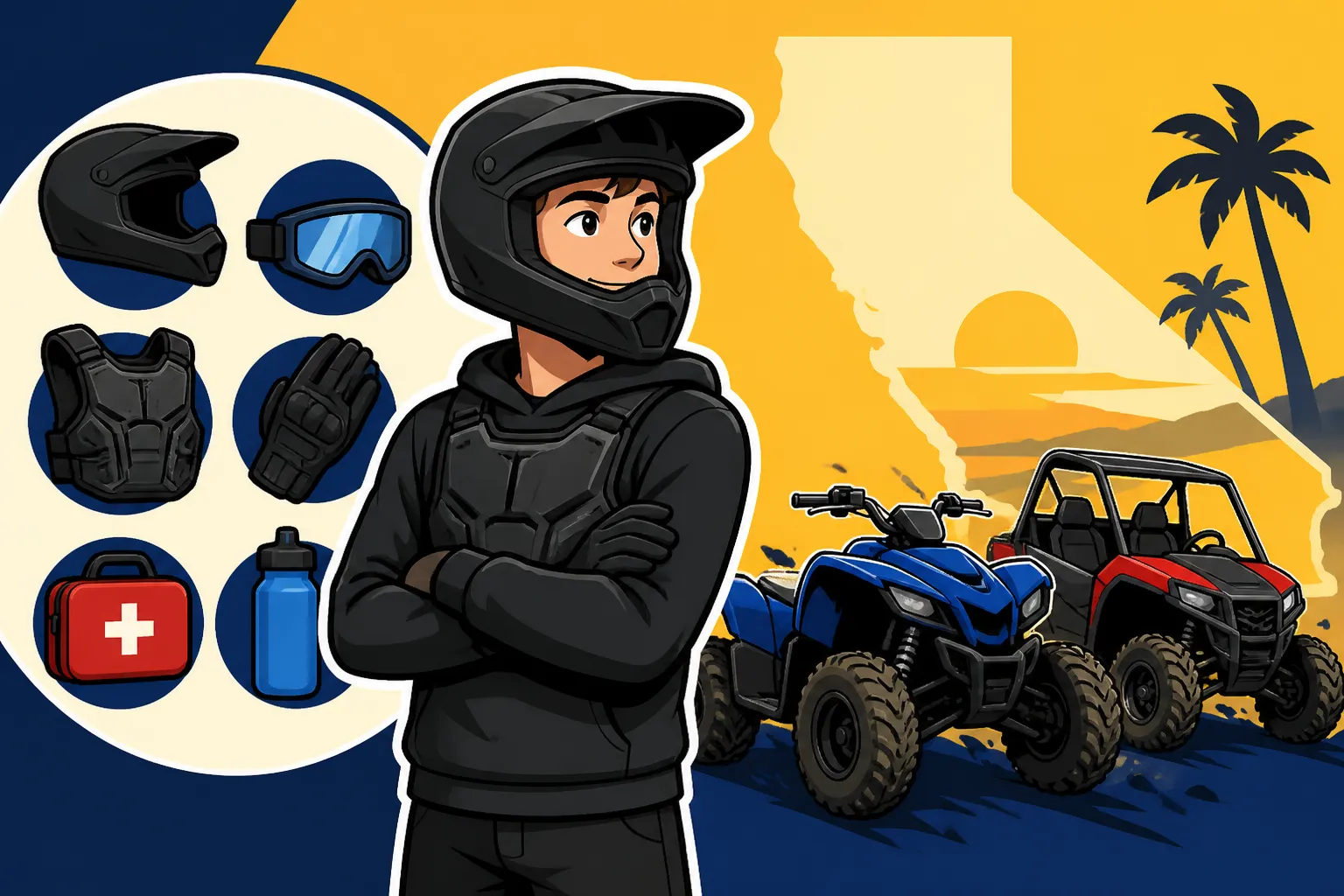
A helmet is something the rider wears, not a document to carry. Make sure it fits properly and is appropriate for the machine and activity. Goggles, gloves, boots, long sleeves, and other protective gear help with dust, branches, heat, and falls, but they do not substitute for required training or paperwork.
For a side-by-side, check seat belts, doors or nets, and passenger seating before moving. Keep children seated and restrained, and do not let them ride in cargo areas or other places not designed for passengers. For ATVs, do not carry a passenger unless the machine and applicable rules allow it.
A young rider should also know how to stop the machine and what to do if they become separated. A short briefing at the truck is useful, but practice basic controls in a safe area before joining a busy trail. Paperwork can demonstrate compliance; it cannot make an inexperienced rider ready for difficult terrain.
Out-of-state machines, permits, and riding areas
A rider’s age does not make an out-of-state machine exempt from California’s identification rules. Check the machine’s permit status separately from the rider’s safety qualification. This is especially important when a family brings several vehicles, because each machine may have a different registration history.
Check reciprocity before the trip
California recognizes qualifying OHV identification from only certain states. If the machine’s state registration or permit is not accepted, the owner may need a California nonresident OHV use permit for riding on public lands. A standard street-legal plate is not, by itself, proof that an OHV meets California’s off-highway identification requirement.
Check the current rules for the machine’s home state and the California riding area before departure. The sticker or permit may need to be displayed on the machine, while supporting paperwork should be available if requested. The rider under 18 still needs to meet the youth safety requirements regardless of the machine’s home registration.
If the family is visiting from Nevada or Oregon, do not assume that every document from that state automatically qualifies. The machine’s registration or OHV permit must meet California’s reciprocity conditions. A permit from another state that is not part of the accepted arrangement may not be enough. Why Only Oregon and Nevada Count in California explains the reciprocity issue in more detail.
Public land is different from private property
The rules discussed here are especially important when riding on public land, including designated OHV areas and trails. Private property does not make every safety or vehicle rule disappear, but public-land identification and access rules may apply differently depending on where and how the machine is used.
Do not assume that a machine used only on private land needs no registration or identification without checking the details of that use. Start with Do You Need a Green Sticker on Private Land? if that is your situation. If the plan includes both private land and a public trail, meet the public-land requirements before the first public ride.
An OHV sticker also does not grant access to every trail. Riders must follow posted closures, route designations, vehicle restrictions, and local area rules. A valid registration card and safety certificate cannot authorize riding behind a closed gate or on a route closed to that vehicle.
Rental machines and organized rides
A rental company may handle some machine paperwork, but that does not automatically settle the rider’s responsibilities. Ask the rental provider what documentation it supplies, what the minor must carry, whether the provider accepts a safety certificate, and what supervision is required. Rental companies may set age and experience conditions in addition to legal requirements.
Do not assume that completing a brief orientation at the counter is the same as receiving a state-recognized safety certificate. Ask clearly what the training document is and whether it satisfies the rule that applies to the rider and machine. For general rental questions, see What a Rental Counter Checks.
For an organized event, the organizer may have additional requirements, and the event’s permitted route or operating area may have its own conditions. Carry the documents requested by the organizer, but do not treat event participation as a substitute for the machine’s registration or the rider’s legal qualifications.
A practical pre-ride checklist for parents and young riders
Use this checklist before every trip, especially when changing machines, riding areas, or supervising adults. It takes only a few minutes and can prevent a frustrating turn-around at the trailhead.
- Identify the machine type. Confirm whether the young person will operate an ATV, operate an ROV, or ride as a passenger. Use the rules for that exact role.
- Confirm the rider’s age and training status. Check whether the rider must carry proof of a safety course or may operate under qualifying adult supervision. Bring proof for both the rider and adult when applicable.
- Check the vehicle’s age and size suitability. Follow the manufacturer’s guidance and verify that the rider can control the machine safely. A certificate does not override an unsuitable vehicle choice.
- Verify registration and permit status. Confirm that the machine has the required California identification or a qualifying out-of-state permit. Do this for every machine in the group.
- Put the documents somewhere accessible. Protect paper proof in a waterproof holder and keep it with the rider or machine. A digital copy can be useful as a backup, but do not depend on it being accepted.
- Inspect displayed identification. Make sure plates, stickers, or permits are present, legible, and mounted as required. Fix missing or damaged identification before the trip.
- Review the riding area’s rules. Check current access, closures, vehicle limits, helmet and passenger requirements, and any local conditions.
- Brief the young rider. Agree on boundaries, hand signals, stopping points, and what to do if the group gets separated.
- Check protective equipment and controls. Fit the helmet, confirm restraints for ROV passengers, and make sure the rider can reach and operate controls.
- Recheck when plans change. A different machine, a different driver, an out-of-state registration, or a new riding area can change what the group needs.
A small waterproof document holder can help keep the certificate and registration readable. Some families buy one through Amazon and attach it to a gear bag rather than leaving it loose in a truck. Keep sensitive personal information to a minimum, and avoid placing paperwork where it can fall off or interfere with the machine’s controls.
The most important habit is to separate the rider’s qualification from the machine’s authorization. Ask, “Can this young person legally and safely operate this vehicle?” and “Is this specific machine properly identified for this location?” Answer both before unloading. If either answer is uncertain, check with the relevant state or land-management authority before riding rather than trying to resolve it at a checkpoint.
Requirements and accepted proof can change, and agencies or riding areas may interpret documentation procedures differently. For a trip involving a minor, confirm current requirements with the official California OHV information source and the agency managing the destination. Keep the confirmation with your trip notes, but carry the documents themselves when required.
Disclaimer
This article is for general informational purposes only and does not constitute professional advice. Laws, prices and regulations vary by location and change over time. Consult a qualified professional for guidance on your specific situation.