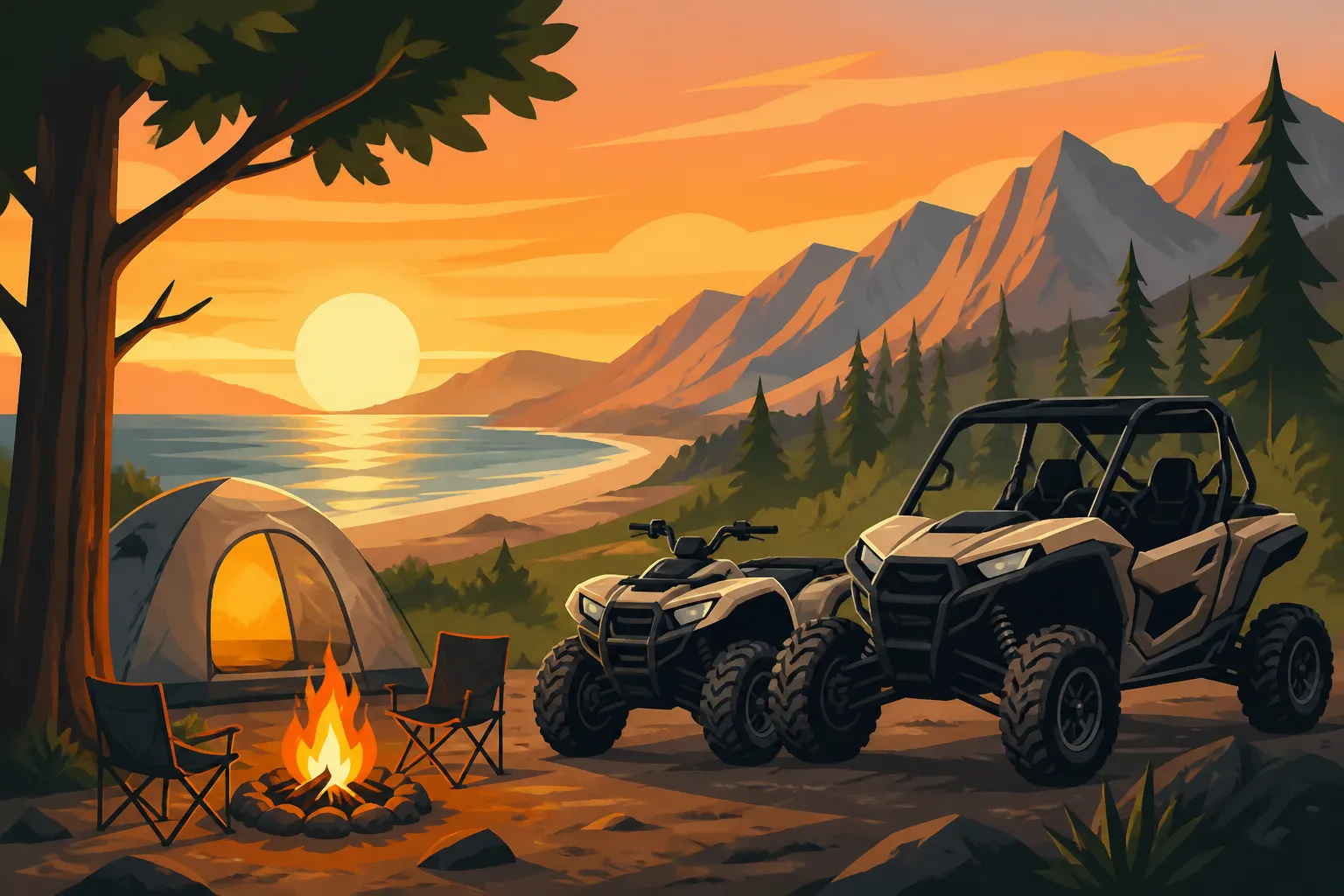
Camping Beside Your Machine in California
Camping beside an ATV or UTV can make a California ride simpler, but the right setup depends on who manages the land and where vehicles may travel. A place that allows dispersed camping may still restrict where you park, and a campsite is not permission to ride every nearby route. Here’s how to check the rules, choose a low-impact spot and keep your machine ready for the ride.
Start with who manages the land
There is no single statewide rule that makes every campsite beside an OHV legal. California riding areas may be managed by different agencies, and each manager sets rules for its land. Before unloading or settling in, identify the land manager and confirm that camping is allowed in the specific area you plan to use.
On Bureau of Land Management land, dispersed and primitive camping is widely permitted in areas showing prior use and without vegetation cover, provided campers stay off closed routes and away from water sources. The Bureau of Land Management lists these conditions for its public OHV areas as of November 2026. That general permission is not a promise that every patch of ground beside a trail is open for camping. A sign, closure, sensitive habitat or local restriction may change what is allowed.
Where camping beside a machine is permitted, the BLM says campers typically need to park within a short distance of an open roadway to limit impacts to habitat and vegetation. The distance can depend on the location: the BLM gives Panoche Hills as an example where the distance is 15 feet. Check the rules for the specific area rather than treating that example as a statewide standard.
The BLM also says campers must follow standard stay limits, usually 14 days, and have a valid California campfire permit when one is required. Ask the local land manager about current restrictions before your trip, especially if fire conditions or seasonal closures may affect access. Do not assume that a fire permit makes a campfire permissible during a closure.
State Vehicular Recreation Areas are a separate option. The Off-Highway Motor Vehicle Recreation Division operates California’s state-owned vehicular recreation areas, but camping and vehicle-placement rules still depend on the area. Check the park’s own directions before planning to camp alongside your machine. Camping at a California SVRA explains the separate planning considerations for those areas.
For a broader overview of where to ride, see California OHV Areas in the National Forests and California Dune Riding Areas. The land manager’s map and current notices should guide your final choice; a route shown nearby does not necessarily make adjacent land open for camping. California Trail Maps and Where to Get Them can help with map planning, while California Trail Closures to Check First is useful before you head out.
Choose a spot that keeps the camp and machine out of trouble
A good camp spot is not just somewhere the machine fits. Look for an established, open area where parking and camping are allowed, and avoid creating a new tire track through vegetation. On BLM public OHV land, the agency’s guidance is to use areas that show prior use and lack vegetation cover, stay away from water sources, and keep clear of closed routes.
Once you have a permitted site, keep the machine in the allowed parking area rather than treating the campsite as a staging point for off-route travel. Do not use a wash, closed track or informal shortcut to reach a more convenient camp. The BLM identifies “Limited Use Area” or “Limited Area” and “Closed Area” as the official designations for public lands where cross-country OHV travel is prohibited. If a route’s status is unclear, check the map or ask the land manager before riding it.
Noise and speed matter around other campers. According to the California Department of Parks and Recreation, the maximum OHV speed within 50 feet of any campsite, campground, group of people or animals is 15 miles per hour. Slow down before entering the camping area and avoid revving the engine beside tents, trailers or other occupied sites.
For a calmer setup, park so you can get in and out without crossing another camp, blocking an open roadway or driving through vegetation. Keep the machine away from tent entrances and shared paths. If you’re using a trailer, plan where it will sit before unhooking, and make sure it does not obstruct access. Those are practical steps, not a substitute for posted parking rules.
A camp beside an OHV also means being deliberate about where riding begins and ends. Agree on the permitted route before anyone starts the engine. Keep children and other campers away from moving vehicles, and do not assume a quiet-looking track is open. If you’re in an area with other riders, choose a clearly visible route back to camp and avoid cutting across occupied sites.
Check registration, permits and who can operate
Camping does not replace the paperwork needed to ride. California OHV registration and nonresident permits are separate from permission to camp, so check both the land rules and the machine’s riding requirements. California OHV Permits Explained is a useful place to start.
The California DMV issues an identification certificate, also called a registration card, as proof of valid OHV registration. Keep the card accessible while riding, and check that the machine’s identifying sticker is properly displayed. On an ATV, the California DMV and Department of Parks and Recreation require the Green Sticker or Red Sticker to be securely fastened to the left rear quadrant on a permanent plastic or frame member, visible from the rear.
If you are visiting from out of state, confirm whether your home-state registration or equivalent documentation allows you to operate without a California permit. The California DMV says nonresident owners must carry a valid out-of-state driver’s license to establish residency and provide proof of current home-state OHV registration or its equivalent to operate without a California permit. The California nonresident OHV use permit program is administered by the Off-Highway Motor Vehicle Recreation Division. See California’s Nonresident OHV Use Permit for more on the permit question.
Do not confuse a place to camp with permission to use an unregistered machine. Before traveling, check what identification the machine needs, whether its existing registration is current and whether the riding area accepts it. If the machine has never been registered, the California DMV says ownership evidence can include an MCO or MSO, out-of-state titling documents, a factory invoice or bills of sale establishing a complete chain of ownership.
Age and supervision rules also matter if young riders are joining the trip. According to California State Parks’ Off-Highway Motor Vehicle Recreation Division, an ATV operator under 18 must have an appropriate safety certificate, be directly supervised by an adult who holds one, or take a prescribed safety course under a certified instructor’s direct supervision. The same division says an ATV rider under 14 must always be accompanied and directly supervised by a parent, guardian or authorized adult. For UTVs, California State Parks says an operator must be at least 16 or directly supervised in the vehicle by a parent or guardian or an adult authorized by them.
A passenger can’t simply climb aboard any ATV for the ride back to camp. California State Parks prohibits passengers on an ATV unless the vehicle was specifically designed and provided by the manufacturer for multiple riders. That restriction applies to operation on public lands.
For a UTV, make sure every occupant uses the required seatbelt or safety harness whenever the vehicle is moving. California State Parks requires all occupants of a recreational off-highway vehicle to wear them. A camp setup can make it tempting to take a quick trip without gearing up, but short trips still count as operating the machine.
Make the camp routine safer and easier
Think through the routine before you arrive: where the machine will park, how you will move between camp and the open route, and how you’ll handle waste, fuel and fire rules. Follow the land manager’s instructions for each. A campsite beside your machine does not authorize fuel storage, fires or other activities that local rules prohibit.
Keep basic camp items secured so wind or a passing vehicle cannot send them into the riding area. Store riding gear where it stays clean and accessible, and keep food and loose equipment organized rather than spread across a shared route. If you travel with a group, agree on a meeting point and a plan for anyone who returns to camp separately.
Before riding away from camp:
- Confirm that the route is open and that the machine is allowed on it.
- Check that registration or permit documents are available.
- Secure loose items and make sure the machine is ready for the ride.
- Remind everyone to stay clear of moving machines and to follow posted speed limits.
- Check any current fire, weather or access restrictions with the land manager.
When returning, slow down well before the campsite and use the permitted access route. If the area is busy, wait for people to clear the path rather than squeezing between camps. A quiet arrival is more considerate and reduces the chance of a collision.
The simplest rule is to treat the campsite and the riding area as related but separate places. The land manager decides where camping is allowed; the route rules decide where you may ride. Confirm both before setting up, keep the machine in the permitted area, and follow local instructions even when a spot looks convenient.
Sources
- California Department of Parks and Recreation Off-Highway Motor Vehicle Recreation Division — ATV Safety Training & FAQs for ROVs (checked November 2, 2026)
- Bureau of Land Management — Panoche Hills (checked November 2, 2026)
Disclaimer
This article is for general informational purposes only and does not constitute professional advice. Laws, prices and regulations vary by location and change over time. Consult a qualified professional for guidance on your specific situation.