Why a Utah Registration Will Not Do in California
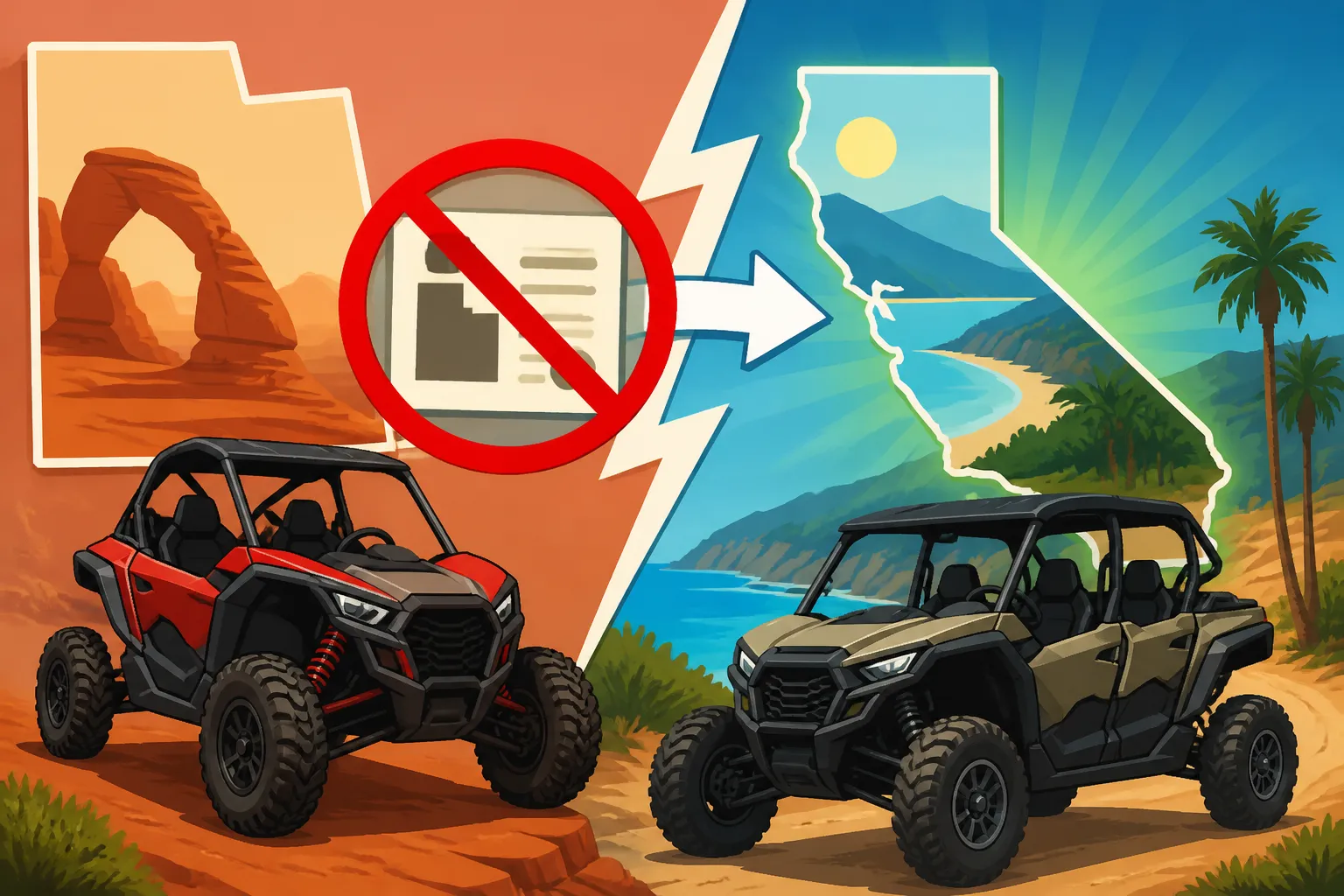
A Utah OHV registration or decal may be valid at home, but it does not automatically satisfy California’s rules for riding off highway. The key issue is reciprocity: California recognizes qualifying OHV permits from only certain states, and Utah is not one of them. Here’s how to tell what your paperwork covers, when you need a California permit, and what to carry before you ride.
Why a Utah OHV registration is not enough
States do not all use the same system to identify off-highway vehicles. One state may issue an OHV registration or decal; another may require a separate permit for visiting riders. Having valid paperwork in Utah does not automatically make it valid for off-highway use in California.
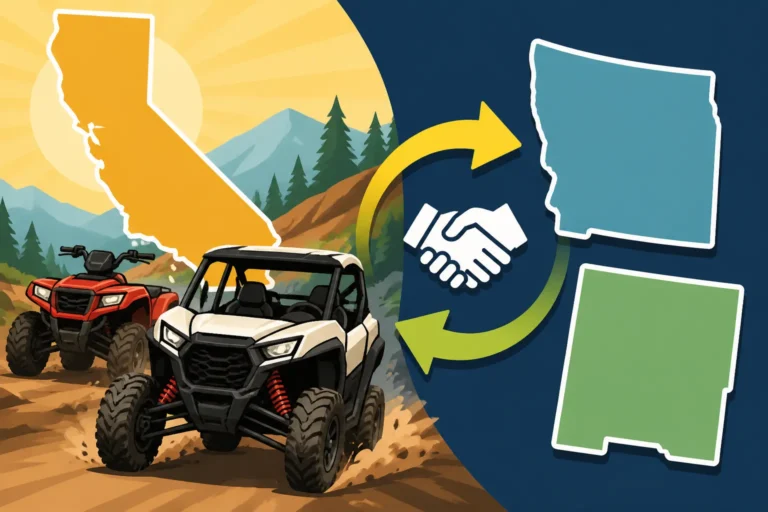
California’s limited reciprocity applies to qualifying permits from Oregon and Nevada. A Utah registration or OHV decal is not a substitute for California’s nonresident OHV use permit when that permit is required. The distinction matters whether you’re heading to a trail, desert riding area, or State Vehicular Recreation Area.
| What your Utah paperwork is | What it generally establishes | Does it automatically cover California OHV use? |
|---|---|---|
| Utah OHV registration or decal | The machine is registered under Utah’s off-highway system | No |
| Utah highway registration and plate | The vehicle is registered for highway use under Utah’s rules | Not by itself; road use and OHV-area requirements are separate questions |
| A qualifying Oregon or Nevada OHV permit | The machine has a permit from a state California recognizes | It may satisfy California’s reciprocity requirement, subject to the permit and machine meeting applicable rules |
| A California nonresident OHV use permit | The visiting machine has the California permit when required | Yes, for the permit requirement, but it does not replace other riding rules or area-specific permits |
The word “registration” can cause confusion. It might mean an off-highway decal, highway registration, or a state record showing ownership. Those documents do not all authorize the same kind of use. Before you leave, check what class of registration Utah issued and whether your plan involves riding off highway, using public roads, or both.
For a broad overview of visitor permits and exceptions, see California’s Nonresident OHV Use Permit and California OHV Reciprocity: Only Two States. If the question is specifically whether a Utah OHV decal counts, Why a Utah Registration Will Not Do in California is the direct issue; the practical answer is that Utah is not among the states whose qualifying OHV permits California accepts through reciprocity.
Reciprocity is narrow, not automatic
Reciprocity does not mean California accepts any out-of-state decal that looks similar to its own. It means California recognizes qualifying credentials issued by particular states under its rules. A Utah decal may show that you have complied with Utah requirements, but that alone does not make it a California-recognized permit.
The same idea works in reverse: a California OHV sticker does not necessarily meet another state’s requirements. When traveling, check the rules for the state where you plan to ride rather than assuming your home-state paperwork travels with you.
Registration is not permission to ride anywhere
Even with the right OHV permit, you still need to follow the area’s access rules. A permit does not open a closed trail, authorize riding across private property, or replace a separate entry or use permit for a particular recreation area. Registration paperwork also does not make an off-highway machine legal on public roads.
Think of your documents as answering separate questions:
- Is the machine identified or registered?
- Is it allowed to be operated off highway in this state?
- Is the route or riding area open to this kind of machine?
- Are there additional rules for age, equipment, sound, or entry?
That separation avoids the common mistake of treating one decal or plate as an all-purpose pass.
When you need a California nonresident OHV permit
If you are visiting from Utah with a machine registered for off-highway use, expect to need California’s nonresident OHV use permit unless your machine or situation qualifies for an exception. California’s reciprocity is limited to qualifying permits from Oregon and Nevada, so a Utah OHV registration is not the alternative.
Start with the machine’s registration class, not just the presence of a plate. An OHV decal and a highway plate can look like evidence of “registration,” but they may relate to different legal uses. If the machine is an OHV registered in Utah, its Utah status does not ordinarily satisfy California’s nonresident permit requirement.
Check what kind of machine you are bringing
The rules can depend on whether the vehicle is an off-highway machine or is registered for highway use. A dirt bike, quad, or side-by-side registered as an OHV is not the same thing as a highway-registered motorcycle or vehicle, even if both have paperwork from Utah.
If you have a machine with a highway plate, do not assume that the plate resolves every question. It may affect whether the vehicle can be operated on roads, but access to a particular off-highway area and compliance with its rules are separate matters. California road-use rules can also differ from Utah’s, especially for UTVs and other vehicles whose home state permits road use. For a related example, see A Utah Plate That Means Nothing in California and An Arizona Street-Legal UTV in California.
When the registration class is unclear, ask the California agency responsible for the area you plan to visit or the state office that administers OHV identification. Be ready to give them the machine’s type, model year, VIN, and the exact wording shown on your Utah registration. “It has a Utah sticker” is not enough information to settle the question.
A California permit does not replace area-specific requirements
The California nonresident OHV use permit is about the state’s off-highway identification requirement. It is not necessarily the only permit needed for a trip. For example, a particular riding area may have its own entry rules, seasonal conditions, or permit system.
Riders heading to the Imperial Sand Dunes should separately check the current ISDRA requirements. A California nonresident OHV permit and an area-specific dune permit address different things. Read California Rules for Riding Imperial Sand Dunes before assuming one permit covers the whole trip.
The same principle applies at other public riding areas: confirm the vehicle is allowed, the route is open, and any local entry requirements are met. A valid permit does not override a closure or authorize use outside designated routes.
How to get ready before leaving Utah
The easiest way to avoid a frustrating stop at the trailhead is to settle the permit question before loading the machine. Do not wait until you reach a California checkpoint to find out that your Utah credential is not recognized.
- Identify the registration type. Check whether your document is for off-highway use or highway use. Look at the registration itself, not just the plate or decal on the machine.
- Confirm the California requirement for your machine. If it is registered as an OHV in Utah, do not rely on Utah reciprocity. Check whether a California nonresident permit is required.
- Check the riding area separately. Confirm that the area is open to your machine and that no additional permit or entry requirement applies.
- Arrange the California permit through the proper channel. Use the current official process and follow its instructions for the permit, machine information, and display.
- Carry the documents the rules require. Keep proof of registration and the relevant permit accessible, and make sure any required decal or permit is displayed where instructed.
- Review the rest of the riding rules. Age, equipment, sound, spark-arrester, passenger, and route rules may apply independently of registration.
Use the official permit instructions for current application methods, charges, and display requirements. Permit details can change, so an old receipt or a friend’s past experience is not a reliable substitute for checking the current process. For an overview of the permit itself, see California’s $30 Nonresident Permit; confirm the current cost and any service charges with the official seller before purchasing.
Keep proof accessible and readable
Carry the documents that apply to your machine, and protect them from water, sand, and damage. A clear document pouch can help keep paper registration and permit information together; Amazon is one place riders may look for a weather-resistant pouch, but the product does not replace any official display requirement. Follow the state’s instructions for where the permit must appear.
It is also sensible to keep a separate record of the VIN and registration details. A photo can be useful as a backup, but do not assume a phone image is accepted instead of a physical document or properly displayed permit. Check what the agency requires and bring the original paperwork where practical.
If you buy a holder or mounting accessory from Amazon, check that it will not cover required information, block a light, or interfere with safe operation. Use only the placement and display method allowed by the permit instructions.
Do not buy a permit based on a similar-looking decal
A Utah OHV decal, a California permit, and an area-specific pass may all be stickers or documents, but appearance does not determine what they authorize. Read the issuing agency, permit type, vehicle information, and validity period. If any detail is unclear, resolve it before riding.
This matters especially when a machine is shared, borrowed, or recently purchased. The paperwork may belong to a prior owner, describe a different vehicle, or have expired. Check that the VIN on the document matches the machine you are transporting.
Utah plates, road use, and off-highway access
Some riders hear that Utah registers certain vehicles for road use and assume that a Utah plate means the machine can be ridden anywhere in California. That conclusion is too broad. A plate may be relevant to highway operation, but California decides whether a vehicle can be operated on a California road and whether it meets the requirements for a particular OHV route or area.
A genuine highway registration and an OHV registration are not interchangeable. If your Utah paperwork is an OHV registration, it does not become highway registration simply because it is displayed on a plate. If it is highway registration, that still does not guarantee that every California road or trail is open to the machine.
Road access is a separate legal question
California has limited rules for certain designated routes, and access depends on the route and vehicle—not merely on whether a machine has a plate from another state. A Utah-registered UTV may not be treated as street legal in California just because Utah allowed it on some roads. The same caution applies to a quad or side-by-side that has been modified for road use.
Before riding any part of a public road, check the route designation and the machine’s California eligibility. The state’s combined-use rules are not a general permission to connect any trail to a store, campsite, or highway. See California’s Combined-Use Highways and Why California Will Not Convert a UTV for more on the distinction.
If your plan is to trailer the OHV to a riding area and operate it only on designated off-highway routes, focus on the OHV permit and the area’s access rules. If your plan includes public roads, verify road legality independently. Do not use an OHV permit as proof of road registration, or a road plate as proof that every off-highway requirement has been met.
A plate does not waive equipment or rider rules
A valid permit or registration does not exempt you from other requirements. Depending on the vehicle and where you ride, rules may address helmets, passengers, safety certificates, sound, spark arresters, flags, or the minimum age to operate. These rules can apply to visitors as well as California residents.
For example, a visiting rider should not assume that a Utah safety credential automatically satisfies California’s requirements. Check California’s Safety Certificate Rules and California Rules for Riders Under 18 if a young rider is coming along. Also review the rules for the specific machine: a quad and a side-by-side may have different passenger and operator considerations.
Common mistakes Utah riders can avoid
Assuming a Utah decal counts because it is current
A current Utah decal proves only what Utah’s credential is meant to prove. It does not turn Utah into a state California recognizes for OHV reciprocity. If your machine is registered off highway in Utah, check the California nonresident permit requirement rather than relying on the expiration date or condition of the decal.
Treating every plate as highway registration
A plate can be confused with a highway registration, particularly when a vehicle has been modified or the state’s registration process differs from California’s. Read the paperwork closely. If it identifies the machine as an OHV, do not assume it is authorized for public-road use in California.
Thinking a California permit guarantees access
A permit addresses the permit requirement; it does not guarantee that a trail is open or that a specific machine is allowed there. Check operating hours, closures, vehicle restrictions, and any area-specific passes before travel. In California, access can vary by location and conditions.
Waiting until arrival to look up the rule
A last-minute search can leave you with limited options, especially if you arrive after the relevant office or authorized seller is unavailable. Confirm the requirements in advance, and retain proof of purchase or issuance as directed. Do not rely on a screenshot alone unless the official instructions say it is acceptable.
Forgetting the tow vehicle may have its own requirements
The OHV permit question concerns the off-highway machine, but some destinations have separate rules for the tow vehicle or for vehicles entering the recreation area. At the dunes, for example, check whether your tow vehicle needs its own permit. See Why Your Tow Vehicle Needs a California Dune Permit for that separate issue.
Amazon may help with practical trip supplies such as a document pouch or a compliant mounting accessory, but buying gear there does not establish that your permit is valid. Confirm legal requirements with the issuing agency, and use Amazon only for equipment that fits the official instructions.
Using an old permit or someone else’s paperwork
A permit issued for another vehicle, a previous owner, or a past riding season may not cover the machine you are bringing now. Match the VIN and vehicle details, check the permit’s validity, and follow any transfer or reissue instructions. If you have purchased a used machine, make sure ownership and registration documents are in order as well.
A simple pre-trip check
Before loading your Utah quad, dirt bike, or side-by-side, answer these questions:
- Is the machine registered as an OHV or registered for highway use?
- Does California recognize that specific credential through reciprocity?
- If it is an OHV-registered machine from Utah, have you obtained the California nonresident permit if required?
- Does the riding area require a separate permit, pass, or entry reservation?
- Are your documents for this exact machine and still valid?
- Does your route involve public roads, and have you confirmed the vehicle may legally use them?
- Do the rider, machine, and equipment meet the area’s other rules?
If you are unsure about the registration category or an exception, ask the appropriate California agency with the exact vehicle details in hand. A VIN, Utah registration, machine type, and intended riding location make it easier to get a useful answer. In practical terms, though, the core rule is straightforward: a Utah OHV registration is not a California OHV permit, and Utah is not one of the states covered by California’s limited OHV reciprocity.
Disclaimer
This article is for general informational purposes only and does not constitute professional advice. Laws, prices and regulations vary by location and change over time. Consult a qualified professional for guidance on your specific situation.