What Happens Without a Dune Permit
A missing dune permit can turn a day at California’s Imperial Sand Dunes into an avoidable enforcement problem. The rules can be confusing when you arrive with a tow vehicle, an off-highway vehicle, or both. Here’s what may happen without the required permit, which paperwork it does—and doesn’t—replace, and how to check your setup before entering the recreation area.
What can happen if you enter without a dune permit
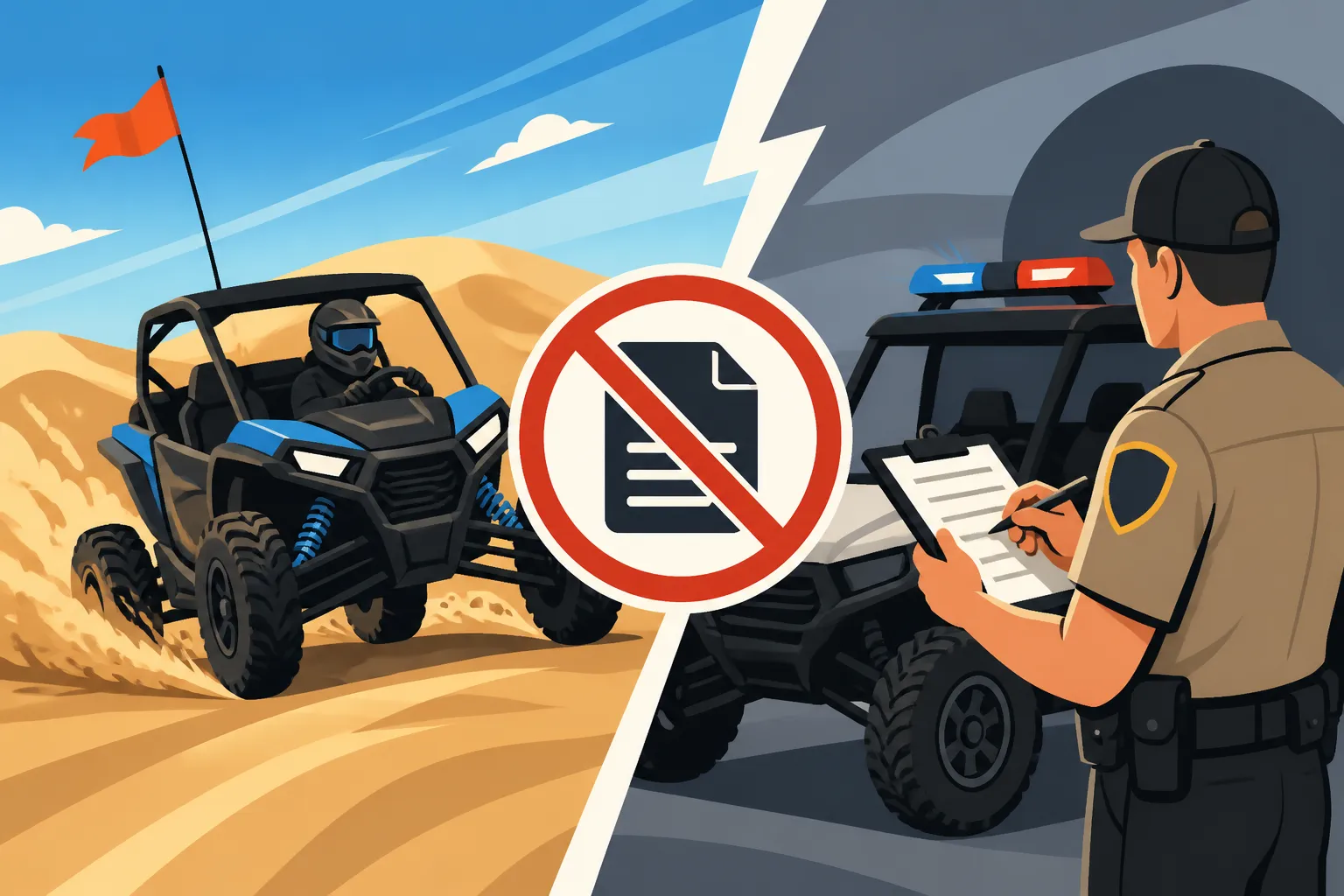
At the Imperial Sand Dunes Recreation Area, a required permit is part of the rules for using the permit-controlled area. If an enforcement officer finds a vehicle there without the required permit, you may receive a citation. Depending on the circumstances, you may also be directed to obtain the proper permit or stop using the area until the issue is resolved.
A citation can mean added expense, time spent dealing with the matter, and an interrupted trip. The exact consequences depend on the applicable rules and the circumstances of the stop; do not assume that buying a permit after being approached will cancel a citation. If you receive one, read the instructions and deadlines on the notice and contact the listed agency with questions.
Enforcement is not limited to someone riding an ATV or UTV across the dunes. A tow vehicle driven into the permit area may have its own permit requirement, even if it is street-legal and the OHV it brought is separately permitted. A passenger car, truck, or other vehicle does not become exempt just because it is there to support the ride rather than to travel over the sand. Check Why Your Tow Vehicle Needs a California Dune Permit before leaving a vehicle in the recreation area.
The permit requirement is also separate from access rules. A valid permit does not make a closed route legal, authorize riding outside designated areas, or replace safety and equipment requirements. Conversely, being properly registered does not automatically satisfy the dune permit requirement.
| Situation | What may be missing | Practical risk |
|---|---|---|
| An OHV is operated in the permit area without the required dune permit | The permit for that vehicle | A citation or interruption to riding |
| A tow vehicle is brought into the area without its own required permit | The tow vehicle’s permit | The truck or car may be cited even if the OHV is permitted |
| A permit is purchased but not displayed as required | Visible proof of the permit | An officer may be unable to verify compliance promptly |
| The rider has a state registration or nonresident OHV permit but no dune permit | The separate recreation-area permit | Registration may not satisfy the area’s permit rule |
| The vehicle has the right permit but is on a closed route | Permission to use that route | A permit does not authorize travel everywhere |
These are common situations, not a guarantee of a particular enforcement outcome. Requirements can depend on where the vehicle is and how the area’s current rules apply. Follow posted signs and verify current instructions before entering.
Which permits and documents are easy to confuse
“Permit” can refer to different things on one trip. The key is to identify what each document authorizes rather than treating any sticker or registration card as a universal pass.
The dune permit
An Imperial Sand Dunes permit is tied to use of the recreation area. The available permit options can include weekly and season permits, with purchase and display rules that riders should check before their trip. A permit for one vehicle should not be assumed to cover every vehicle in the group. In particular, confirm the requirement for the tow vehicle as well as the OHV.
The permit’s validity, the area it covers, and how it must be displayed matter. A receipt or digital confirmation may help establish that you made a purchase, but do not assume it replaces a required decal or other display method. Follow the instructions that come with the permit. See Displaying a Permit on the Windscreen for why display is a separate part of compliance.
OHV registration or identification
California OHV registration or identification is another requirement. It identifies the off-highway vehicle under California rules; it is not automatically an Imperial Sand Dunes access permit. California residents should check that their machine has the correct identification for its type and use. Riders bringing a machine from another state should check the rules that apply to their registration and permit status.
A California nonresident OHV use permit and an Imperial Sand Dunes permit serve different purposes. The first concerns California’s requirements for certain visiting OHVs; the second concerns use of the dunes recreation area. A visitor may need to consider both. California’s Nonresident OHV Use Permit explains the state-level permit, and California OHV Reciprocity: Only Two States covers why out-of-state paperwork does not always replace California requirements.
For the same reason, don’t treat a street-legal plate as a substitute for a dune permit. A plated vehicle may still need the area permit when it enters the permit-controlled recreation area. Likewise, a valid dune permit does not register an OHV or resolve a problem with its identification.
Other trip requirements
Permits are only one part of preparing a vehicle. Depending on the machine and where you ride, you may also need valid registration or identification, proof of purchase or ownership, and required safety equipment. Riders under 18 may have additional safety-certificate or supervision requirements. If you are unsure which documents to carry, Carrying Paperwork on the Sand and What a Ranger Accepts as Proof can help you prepare.
Think of the paperwork as separate layers: one may cover the vehicle’s status, another may apply to a nonresident OHV, and another may cover access to the dunes. Having one does not prove that you have the others.
Check every vehicle before entering
A simple pre-trip check can prevent a permit issue from affecting the whole group. Start with a list of all motor vehicles you plan to bring into the permit area—not just the machines you expect to ride. Include trucks, passenger vehicles, and other vehicles that will be driven or parked there. Then confirm which ones need permits and what must be displayed.
- Identify each vehicle. Record which vehicles are OHVs and which are tow or support vehicles. Don’t assume that the permit for the machine covers the vehicle transporting it.
- Check the current permit options. Review the official Imperial Sand Dunes information for the permit type, validity period, purchase method, and display instructions that apply to your visit. Rules and availability can change.
- Separate area access from vehicle registration. Confirm that each OHV has the required registration or identification, and separately confirm any dune permit requirement. For visiting riders, check whether a California nonresident permit also applies.
- Follow the display instructions. Attach or display the permit as directed, on the correct vehicle and in the specified location. Keep proof of purchase available too, but don’t rely on it instead of a required display.
- Check your route and destination. A permit does not open closed areas or routes. Review posted restrictions and current access information before riding or driving.
- Recheck before departure. Make sure the permit is still valid for the planned trip and has not been lost, damaged, or placed where it cannot be seen.
Some riders prefer to buy a permit in advance; others may be able to purchase one on site. The options and instructions can differ, so check before relying on either approach. Buying an ISDRA Permit Online and On-Site Versus Off-Site Weekly Permits cover those purchase choices. Buying ahead does not remove the need to display the permit properly or to meet other vehicle requirements.
If a permit is missing, damaged, or attached to the wrong vehicle, resolve the problem before entering the permit area whenever possible. Do not assume an officer will accept a screenshot, a permit assigned to a different vehicle, or a purchase receipt as a substitute for the required display. When in doubt, ask the permit provider or the agency responsible for the recreation area before driving in.
If you’re stopped or discover the problem after arriving
Stay calm and be straightforward if an officer asks to see your permit. Provide the documents you have and explain the situation without assuming that a registration card or purchase receipt settles the question. If you are told to stop riding, move, or take another action, follow the instruction and clarify what is needed before continuing.
If you realize the permit is missing before riding, avoid taking the vehicle farther into the recreation area to “sort it out later.” Check whether you can buy the correct permit through an authorized option, and follow the instructions for where and how to display it. If you cannot confirm that you have the required permit, the safer choice is not to use the vehicle in the permit-controlled area until you do.
If you are issued a citation, keep the notice and review it carefully. Pay attention to the issuing agency, the stated violation, response options, and any deadlines. A later purchase may help you become compliant for the rest of the trip, but it may not remove responsibility for an earlier violation. Direct questions about a citation to the agency shown on the notice rather than relying on advice from other riders.
The most reliable way to avoid a permit problem is to check the current requirements for every vehicle before you leave, then verify each permit is valid and displayed as instructed. That takes a little planning, but it is simpler than having to stop a trip to sort out paperwork at the dunes.
Disclaimer
This article is for general informational purposes only and does not constitute professional advice. Laws, prices and regulations vary by location and change over time. Consult a qualified professional for guidance on your specific situation.