A Utah Plate That Means Nothing in California
It's incredibly frustrating, isn't it? You've invested in a fantastic ATV or UTV, perhaps even gone through the hoops in your home state to get it "street legal" with a license plate, only to arrive in California and face a confusing maze of rules. Many riders come here from places like Utah, Arizona, or with a Montana LLC plate, fully expecting to cruise down paved roads between trails, only to find their out-of-state plate means absolutely nothing to California law enforcement. This guide is here to untangle that confusion, explain why your street-legal UTV from another state won't cut it on California pavement, and detail the strict, very limited ways you can operate an Off-Highway Vehicle (OHV) on roads within the Golden State.
The Harsh Reality: Why Out-of-State Street Legalization Doesn't Translate to California
California has a reputation for being tough on vehicle emissions and modifications, and that strictness extends profoundly to off-highway vehicles attempting to join the ranks of street-legal machines. While many states offer pathways, often quite simple, to convert an ATV or UTV for road use, California operates under an entirely different philosophy. Your shiny Utah plate, or a vehicle registered through a Montana LLC, won't magically transform your UTV into a street-legal vehicle here.
California's Unique Definition of a "Street Legal" Vehicle
In California, a "street legal" vehicle isn't just about having headlights, taillights, turn signals, and a horn. While those are certainly necessary components, the fundamental classification of the vehicle itself is paramount. California's Vehicle Code looks at the original manufacturer's designation and how the vehicle was certified for sale within the state. Most ATVs and UTVs are manufactured and sold strictly as Off-Highway Vehicles (OHVs), meaning they were never intended nor certified for highway use by the federal government or the California Air Resources Board (CARB).
Think of it this way: when a vehicle rolls off the assembly line, it's given a specific identity. A car is a car, a truck is a truck, and an OHV is an OHV. In many states, you can take an OHV, add the required safety equipment, get an inspection, and voilà, it's considered street legal. California, however, sees an OHV as fundamentally not a highway vehicle. No amount of aftermarket accessories—even high-quality ones from a brand like SuperATV—or out-of-state paperwork can change that core classification within California's legal framework. This difference in foundational perspective is the root cause of much frustration for visiting riders.
The DMV's Stance on Off-Highway Vehicle Conversions
If you walk into a California Department of Motor Vehicles (DMV) field office with an OHV and ask to make it street legal, you'll likely be met with a polite but firm "no." The DMV is bound by the California Vehicle Code (CVC), and the CVC simply doesn't provide a mechanism for converting an OHV into a street-legal vehicle. It’s not a matter of paperwork or inspections that you might find in Arizona or Utah; the legal pathway simply doesn't exist for the vast majority of OHVs.
This means that even if you've gone to great lengths in another state to acquire a street-legal title and plate, California's DMV won't recognize that transformation for use on its public roads. The original manufacturer's certificate of origin (MCO) almost always classifies these machines as "off-road use only," and California adheres strictly to that. To understand more about this specific hurdle, you might find [Why California Will Not Convert a UTV] a useful read. For a stock UTV, regardless of its features, the answer is a resounding "no" for street plating in California, a topic explored further in [Why a Stock UTV Cannot Be Plated in California].
Understanding California's Limited Road Use Opportunities for OHVs
Given California's firm stance, it's easy to assume OHVs can never touch asphalt here. While mostly true, there are very specific and limited exceptions that are often misunderstood. These exceptions are for connecting trails or accessing services, not for general street cruising.
Combined-Use Highways: The Exception, Not the Rule
California does have a provision for "combined-use highways," which allows OHVs to operate on very specific, short segments of public roads. However, these are exceptions to the general rule and are incredibly restrictive. These segments are typically designated by local authorities (county or city) in conjunction with state agencies, and they exist primarily to connect off-highway trails or to allow OHV riders to access fuel, food, or lodging from a designated riding area.
The crucial points to remember about [California's Combined-Use Highways] are:
- Designated Only: A road must be explicitly designated as a combined-use highway. You can't just pick any paved road. These designations are rare and often found only adjacent to major riding areas.
- 3-Mile Limit: Most combined-use segments are limited to a maximum length of three miles. This means you can't go on a joyride; it's strictly for short, functional connections. [California's 3-Mile Combined-Use Cap] exists for a reason: to minimize the interaction between OHVs and conventional road traffic.
- Proper OHV Registration: Even on a combined-use highway, your OHV must be properly registered in California (with a Green, Red, or Tan Sticker) or have a valid [California's Nonresident OHV Use Permit] if you're visiting. Your out-of-state street plate is irrelevant here.
- Local Ordinances: Always check local ordinances. What's allowed in one county might not be in another. The authority to designate these routes comes from [What California's CVC 38026 Lets an Agency Designate], but the actual implementation is local.
It's critical to understand that these are not "street-legal" zones. They are controlled, limited access points for off-highway vehicles, and they require adherence to all other OHV rules, including helmet laws and speed limits.
Crossing a Public Road: Brief Encounters Only
Beyond combined-use highways, the only other legal scenario for an OHV to be on a paved road is for a brief, direct crossing. This is not about riding along a road for any distance, but simply traversing it to get from one section of an off-highway area to another. [California Rules for Crossing a Public Road] are very clear and strict:
- Right Angle Only: You must cross the road at approximately a 90-degree angle. No riding diagonally or merging into traffic.
- Complete Stop: You must come to a complete stop before entering the roadway and yield to all traffic. Treat it like crossing a railroad track.
- Safely and Quickly: The crossing must be made safely and as quickly as possible.
- Not Divided Highways: Generally, OHVs are prohibited from crossing divided highways (like freeways or major arterials with a median).
- No Fines for Riders Under 14: While illegal, California law states that a parent or guardian of an OHV operator under the age of 14 may not be cited for the child’s operation of an OHV on a highway.
If you violate these rules and ride your OHV on a public road where it's not explicitly allowed or for longer than a direct crossing, you could face significant penalties. Law enforcement is very aware of these distinctions, and the [California Fines for Riding a Public Road] can quickly add up, turning a fun ride into a costly headache.
Common Misconceptions and Out-of-State Plates
This is where much of the confusion and frustration arises for out-of-state riders. The rules in states like Utah, Arizona, or those that allow Montana LLC registrations are often very different from California's. What works there simply does not work here.
The Utah Plate, Montana LLC, and Arizona Street-Legal UTVs
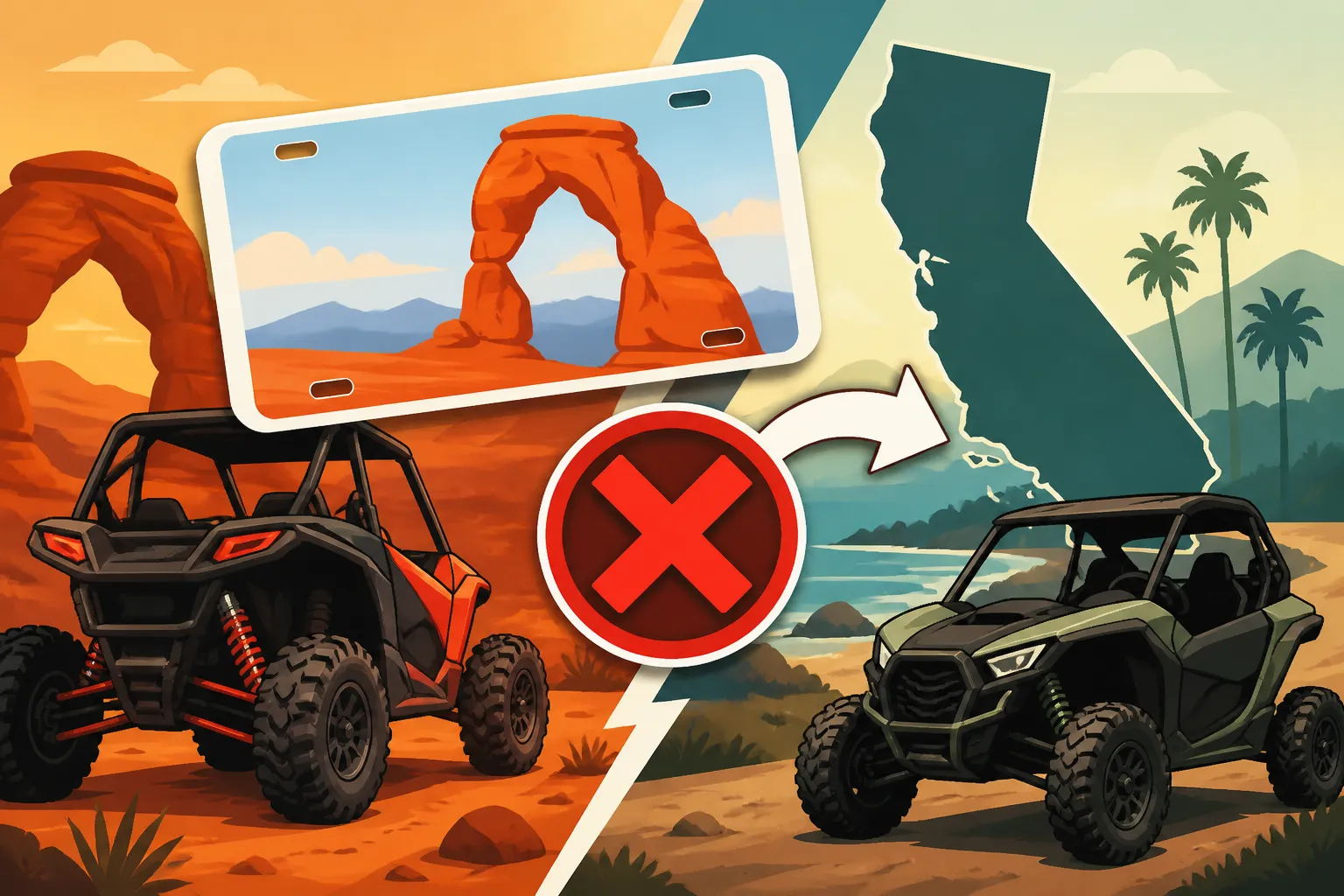
Let's address this head-on: [A Utah Plate That Means Nothing in California]. You've done your due diligence in Utah, converted your UTV, got your plate, and you're feeling good. You pull up to Glamis or Oceano Dunes, planning to ride from your camp to the gas station, and a ranger pulls you over. Why? Because that Utah plate, for all its validity in Utah, confers no street-legal status in California. California law enforcement operates under California law, and your vehicle is still classified as an OHV here.
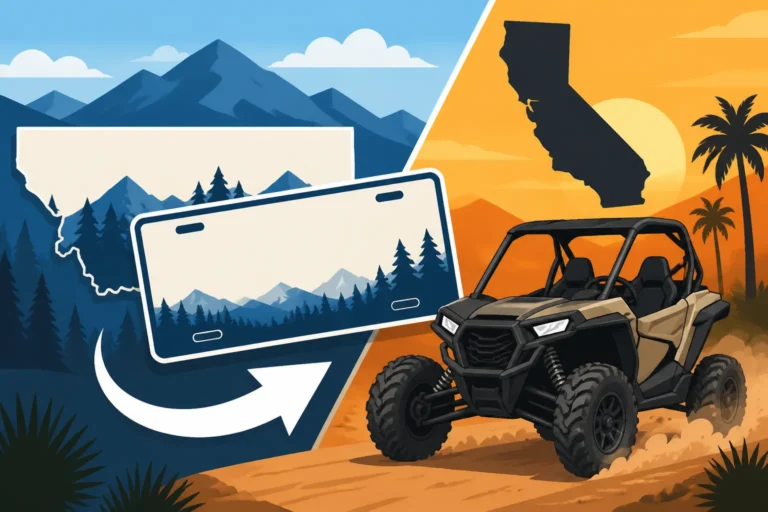
The same goes for [A Montana LLC Plate in California]. Many people use Montana LLCs to register vehicles, often to avoid sales tax or for privacy reasons. While this can work for traditional highway vehicles (cars, trucks, RVs), it offers no street-legal magic for an OHV in California. If the vehicle's original manufacturer's certificate of origin designates it as an OHV, California will treat it as such, regardless of the Montana plate. Law enforcement can, and often will, look beyond the plate to the vehicle's true classification.
And for our neighbors to the east, if you have an [An Arizona Street-Legal UTV in California], unfortunately, it's the same story. Arizona has a well-established process for making UTVs street legal. But when that Arizona-plated UTV crosses the border into California, it reverts to its original OHV status in the eyes of California law. The state simply does not have reciprocity for street-legal OHV conversions from other states. Your OHV registration might be recognized for off-highway use if it's from Oregon or Nevada, but never for on-highway use if it started life as an OHV.
Penalties for Attempting to Ride Street-Legal in California
The consequences of operating an OHV on a California public road without proper authorization are not trivial. Law enforcement, particularly in areas near popular riding spots, is well-versed in the nuances of OHV laws. They regularly see out-of-state riders attempting to use their "street legal" machines on California roads, and they will issue citations.
Potential penalties include:
- Fines: Significant monetary [California Fines for Riding on a Highway] for violating vehicle code sections related to unregistered vehicles, unsafe operation, or operating an OHV on a highway. These can easily run into hundreds of dollars.
- Vehicle Impoundment: In some cases, officers have the discretion to impound your vehicle, leading to towing fees, storage fees, and a long, expensive process to retrieve it.
- Court Appearances: You may be required to appear in court, which can be particularly inconvenient if you're an out-of-state visitor.
- License Points: Depending on the specific violation, it could even lead to points on your driving record.
The bottom line is that while you might feel you're abiding by the letter of the law from your home state, California has its own distinct set of rules. Ignorance of California law is not a valid defense, and the financial and logistical headaches can quickly outweigh any perceived convenience of trying to ride on paved roads. Always prioritize trailering your OHV to designated riding areas to avoid these issues.
What You Can Do: Legally Riding OHVs in California
While the street-legal dream for OHVs in California is largely a mirage, there are incredible, legal, and truly epic opportunities for off-highway riding. California boasts a diverse landscape that's perfect for ATVs and UTVs, as long as you play by the rules designed for off-highway use.
Focus on Designated Off-Highway Vehicle Areas
California is home to a vast network of state vehicular recreation areas (SVRAs), Bureau of Land Management (BLM) land, and National Forests that are explicitly designated and managed for OHV use. These are the places where your ATV or UTV truly belongs and where you can legally unleash its full potential.
Some of California's most famous and beloved riding destinations include:
- Oceano Dunes SVRA: The state's only sand dune riding area where you can drive on the beach. [Oceano Dunes: California's Only Sand Beach Ride]
- Imperial Sand Dunes Recreation Area (Glamis): A world-renowned desert playground, offering immense dunes for all skill levels. [Glamis and the Imperial Sand Dunes]
- Hungry Valley SVRA: A vast network of trails north of Los Angeles, offering diverse terrain.
- Hollister Hills SVRA: California's oldest SVRA, known for its challenging trails and scenic beauty.
- Ocotillo Wells SVRA: A free-to-enter desert riding area with varied terrain and plenty of open space.
To ride in these fantastic areas, your OHV simply needs proper California OHV registration, which involves getting a Green, Red, or Tan Sticker depending on your vehicle's model year and emissions certification. [Registering an OHV in California] is a straightforward process, and if you're visiting from out of state, a [California's Nonresident OHV Use Permit] is your ticket to legally access these lands.
For all your off-highway adventures, don't forget the importance of quality parts and accessories. Brands like SuperATV offer a huge range of aftermarket products, from lift kits and heavy-duty axles to winches and lighting, all designed to enhance your OHV's performance and durability on the trails, not for converting it for street legality in California.
Trailering is Your Best Bet
The simplest, safest, and most legal way to enjoy your OHV in California is to trailer it to and from designated riding areas. This eliminates any ambiguity about street legality and ensures you won't run afoul of the law on public roads. [Trailering Instead of Riding in California] might seem like an extra step, but it's standard practice for virtually all OHV enthusiasts in California.
When trailering, ensure your trailer and tow vehicle are properly registered, licensed, and insured. Secure your OHV properly to prevent shifting during transport. Use appropriate tie-downs, and double-check your lights and tires before heading out.
| Aspect | California Approach | Common Out-of-State Street Legal Approach |
|---|---|---|
| Vehicle Classification | Strict adherence to original OHV designation | Often allows re-classification with modifications |
| DMV Conversion | No legal pathway for OHV to street-legal conversion | Many states offer pathways for conversion |
| Road Use | Primarily off-highway; limited "combined-use" segments | General road use often allowed with plate |
| Plate Recognition | Out-of-state street plates not honored for OHVs | Plates generally recognized for street use |
| Reciprocity | Limited for OHV off-highway registration only | Often reciprocal for street-legal status |
| Focus | Designated OHV trails and parks | Inter-state travel on roads |
This table illustrates the core difference. California isn't saying your machine isn't cool; it's saying it belongs in the dirt, not on the asphalt, unless very specific conditions are met.
Essential Preparations for California Riding
To ensure a smooth and enjoyable off-highway experience in California, a little preparation goes a long way. Understanding the identification requirements and safety regulations is key to avoiding issues with rangers and law enforcement.
Ensuring Proper California OHV Identification
Before you hit the trails or dunes, your OHV needs proper identification. California uses a sticker system, not a traditional license plate, for OHVs, which helps differentiate them from street-legal vehicles. The type of sticker your machine needs depends primarily on its model year and emissions certification:
- Green Sticker: These are for OHVs that meet California's emission standards, typically newer machines or older machines that are "clean" enough. Green stickers allow year-round riding in designated OHV areas. [California's Green Sticker Explained] goes into more detail.
- Red Sticker: For OHVs that do not meet California's emission standards (often older 2-stroke machines or certain 4-strokes), a Red Sticker restricts riding to certain times of the year and specific locations. While changes have occurred, the basics are important to know. [Red Stickers and What Changed in California] and [California Red Sticker Rules Today] provide the specifics.
- Tan Sticker: This newer sticker is for certain model year 2022 and newer machines that meet specific emissions standards, allowing year-round riding. [California's Tan Sticker Machines] and [Tan Stickers on Model Year 2022 Machines] explain its purpose.
If you're a California resident, you'll go through the DMV to [Registering an OHV in California] and obtain your sticker. For visitors, purchasing a [California's Nonresident OHV Use Permit] is mandatory for off-highway use, unless your OHV is registered in Oregon or Nevada, which have limited [California OHV Reciprocity: Only Two States]. Any other state's OHV registration, including Arizona or Utah, will require you to purchase the nonresident permit.
Safety Gear and Other Requirements
Beyond proper identification, California has stringent safety regulations for OHV operation on public lands. These are designed to protect riders and preserve the natural environment:
- Helmets: Helmets are mandatory for all ATV riders, regardless of age, on California public lands. For UTV (ROV) passengers, helmets are also generally required, though there are specific [California Helmet Law for UTV Passengers] and [California Helmet Law for ATV Riders] depending on the vehicle type and if the vehicle meets roll-over protection standards.
- Spark Arresters: All OHVs operating on California public lands, especially those on brush-covered land, must be equipped with a U.S. Forest Service approved spark arrester. This is a critical fire prevention measure. [California Spark Arrester Rules] outlines these requirements.
- Sound Limits: California enforces strict noise limits for OHVs. Machines that are too loud can receive citations. Newer machines must meet a 96-decibel limit, while older machines have a slightly more lenient 101-decibel limit. It's a good idea to check your exhaust system, especially if you have aftermarket modifications. [California Sound Limits for OHVs Explained] provides more details.
- Flags/Whips: When riding in open desert or dune areas like Glamis or Oceano, a safety whip and flag are usually required. The flag must be a certain size and mounted at a specific height to improve visibility. [Flag Rules for California Dune Riding] covers these specifics.
For all these safety and performance needs, remember to source reliable gear. While SuperATV provides fantastic components for improving your OHV's off-highway capabilities, like suspension upgrades, protection, and lighting, ensure any modifications still comply with California's OHV regulations, especially regarding noise and safety features, before you head out. Riding responsibly means being fully prepared for the unique environment and legal landscape of California's off-road world.
Disclaimer
This article is for general informational purposes only and does not constitute professional advice. Laws, prices and regulations vary by location and change over time. Consult a qualified professional for guidance on your specific situation.