A Nevada Decal at a California SVRA
A Nevada OHV decal can save you from buying a separate California nonresident permit, but it is not a free pass to ride anywhere or skip every gate requirement. The key is bringing the right kind of current Nevada registration, displaying it properly and understanding what California rules still apply at a State Vehicular Recreation Area.
What a Nevada decal does at a California SVRA
California generally requires an out-of-state off-highway vehicle to carry California identification or a California nonresident OHV use permit before it is operated on public OHV land. Nevada is one of the two states whose OHV registration California recognizes through reciprocity; Oregon is the other. If your machine is properly registered in Nevada and has its current Nevada OHV decal, you generally do not need to buy the California nonresident permit just to ride it at a California SVRA.
That distinction is useful because riders often use the word “permit” for several different things. A Nevada OHV decal is evidence of the machine’s Nevada OHV registration. A California nonresident permit is California’s way of identifying a visiting machine that does not have recognized registration from another state. And a park entry or camping charge, where applicable, is a separate matter altogether.
If you want a broader overview of the state-to-state arrangement, see [California OHV Reciprocity Rules] and Why Only Oregon and Nevada Count in California. The short version is that a Nevada OHV decal can satisfy the identification requirement because California recognizes Nevada’s system. It does not mean every Nevada plate or sticker automatically qualifies.
The decal must be an OHV registration decal
Make sure you have the Nevada credential for the vehicle you are bringing. A regular road license plate, a title, a bill of sale or proof that you paid sales tax is not necessarily the same thing as a current Nevada OHV registration decal.
This is an easy point to miss when a machine has more than one form of documentation. For instance, a vehicle might have a street registration, an OHV decal, or both. Do not assume that a license plate alone proves the machine has the kind of OHV registration California recognizes. If you are unsure which credential applies to your vehicle, check with the Nevada agency responsible for its registration and California’s official OHV guidance before traveling.
The decal should be current and associated with the machine you are riding. If it is expired, damaged, missing or attached to a different vehicle, the reciprocity argument becomes harder to establish. A Nevada registration card or other official paperwork can help show what the decal represents, so bring it rather than relying only on a photograph of a sticker.
Reciprocity is about identification, not a blanket exemption
A Nevada decal addresses one specific question: whether the machine has acceptable OHV identification for use in California. It does not waive park rules, replace a separate event or area permit, authorize riding on roads, or make a machine legal on every trail.
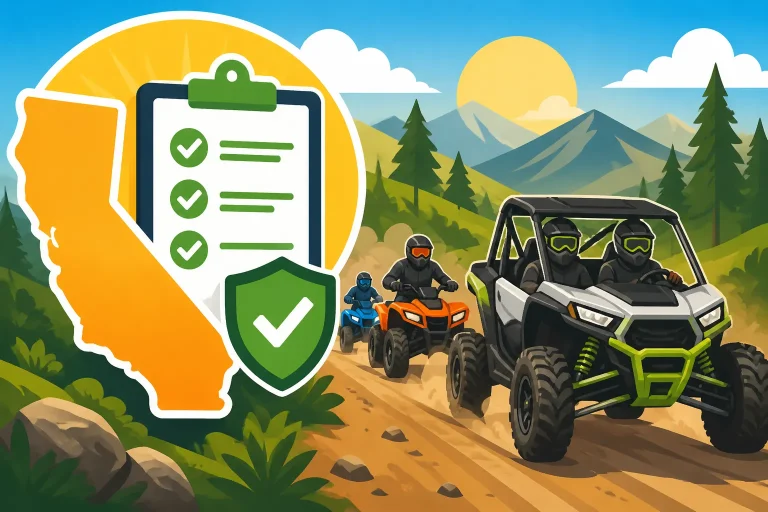
Think of it as satisfying one item on a longer checklist. You still need to ride in an area where your machine is allowed, follow local operating rules, and pay any separate entry, camping or activity charges that apply. California’s nonresident permit system is explained in more detail in California’s Nonresident OHV Use Permit and California OHV Permit for Out-of-State Riders.
| What you have or need | What it generally does | What it does not do |
|---|---|---|
| Current Nevada OHV decal and associated registration | Provides the Nevada OHV identification California generally recognizes through reciprocity | Waive SVRA entry or camping charges, or override California riding rules |
| California nonresident OHV permit | Provides California identification for a qualifying visiting OHV that lacks recognized out-of-state registration | Serve as a park admission ticket or authorize road use |
| Nevada road license plate | Shows road registration status, but may not by itself establish the OHV registration status California expects | Automatically prove that the machine has a qualifying Nevada OHV decal |
| SVRA entry or camping payment | Covers the park activity or access for which it is required | Replace vehicle identification or registration |
| Title, bill of sale or purchase receipt | Helps establish ownership or explain a recent purchase | Substitute for current OHV identification |
The table is a practical guide, not a determination for every unusual machine or registration category. If your vehicle is a dual-purpose machine, a road-registered UTV, a homebuilt vehicle, or a machine with an unusual title history, confirm how California treats that exact type before you make the trip.
What to check before leaving Nevada
A little paperwork preparation can turn a stressful gate conversation into a quick check. Before you load up, confirm that the decal is current, that it belongs to the vehicle on your trailer, and that the relevant registration documents are easy to reach.
Inspect the decal and record
Check the decal itself for obvious problems. It should be legible and attached to the machine in the way Nevada requires. Do not move a decal from one vehicle to another or assume that a damaged, detached sticker will be accepted simply because you can show a receipt.
Then check the registration record. The vehicle description or identifying number should match the machine you are bringing. If the registration card lists information that differs from what you expect, resolve that with Nevada before heading to California. A mismatch can be as confusing for a ranger or park employee as an expired decal.
Carry the original registration card if you have one. A clear digital copy can be useful as a backup, but it is sensible not to rely on a phone alone. Battery problems, a cracked screen, poor signal or an inaccessible account can turn a simple check into a delay. Keep paperwork somewhere protected and reachable, not buried under camping gear.
A waterproof document sleeve can help keep the registration card, insurance details and emergency contacts together. If you need one, an outdoor retailer or Amazon may have suitable options; choose a sleeve that stays closed and does not make the paper difficult to remove if someone needs to inspect it.
Match the registration to the machine
Take a moment to compare the vehicle identification number on your paperwork with the number on the machine. Make sure the number is readable and that the paperwork does not belong to a similar-looking ATV or UTV in your garage.
This is especially important if:
- You recently bought the machine.
- You own several similar machines and share storage space.
- The vehicle was previously registered in another state.
- The VIN is dirty, scratched or difficult to see.
- You have a replacement frame or other unusual registration history.
If the machine has recently changed hands, bring the documents that explain the change as well as the current Nevada registration. A purchase receipt is not a replacement for a valid decal, but it can help make the ownership history clear. For California registration questions after a move or sale, Registering an Out-of-State Machine in California is a useful related guide.
Keep vehicle paperwork separate from park plans
Before the trip, check the specific SVRA’s current access information. Park entry, camping arrangements, vehicle limits, closure notices and hours are separate from reciprocal OHV registration. A Nevada decal does not reserve a campsite or guarantee that a particular route is open.
California has multiple SVRAs, and the facilities and operating conditions differ. Start with California’s State Vehicular Recreation Areas and then check the information for the park you plan to visit. If you are riding at a particular location, a park-focused guide such as What Rangers Check at Hollister Hills can help you think through what may be checked on site, but current park instructions should take priority.
If you are replacing basic trip gear, Amazon can be one place to compare document pouches, tie-downs or a backup light. Check that the item actually fits your setup and meets any applicable requirements; a marketplace listing is not proof that equipment is approved for California use.
What still applies after the gate
Reciprocity does not import Nevada’s riding rules into California. Once you ride in California, comply with the state and site requirements that apply where you are operating. Those can involve routes, helmets, age and supervision, passengers, noise, spark arresters, fire restrictions and seasonal closures.
A Nevada registration does not make an OHV street legal in California. It also does not let you ride on an ordinary public road simply because the machine has a Nevada decal or because the road looks like a convenient connection. Road use has its own narrow rules. If your plan involves riding on pavement, a county road or a designated route, research that separately rather than treating the decal as permission.
Check machine access and route conditions
Not every trail or area is suitable for every vehicle. Width, vehicle type, rider skill and current trail conditions can all matter. A large side-by-side may be barred from a narrow route even when it has valid registration. A route may close after rain, during fire restrictions or for resource protection. A park’s entrance being open does not mean every trail inside it is open.
Before riding, look for current notices at the entrance and follow posted signs. Do not ride around a barrier because another vehicle has left tracks beyond it. A closed trail remains closed even if it appears passable.
Meet California equipment and conduct rules
California rules may apply to safety equipment and vehicle condition. Depending on where you ride, this can include helmet requirements, age and supervision rules, passenger restrictions, exhaust sound limits, and spark-arrester requirements. A machine that was legal to operate in Nevada may still need to meet California requirements while it is on California public land.
If you are bringing young riders, check the age and safety-certificate rules before the trip. If your machine has an aftermarket exhaust, confirm that it meets the relevant noise requirements. If your ride includes brush-covered terrain, check whether a spark arrester is required and whether the component on your machine is acceptable. These are separate issues from registration reciprocity, but they can matter just as much during a site check.
For example, an acceptable Nevada decal will not excuse a loud machine or allow a rider to ignore a posted helmet rule. Likewise, a machine that passes a noise check is not properly identified if its registration has expired. Treat registration, equipment and rider requirements as separate boxes to check.
Pay any separate park or activity charges
A reciprocal Nevada decal does not mean all use of a California SVRA is free. Where the site charges for admission, camping or another activity, those charges remain separate. Rules and payment arrangements can vary by location and change, so confirm them with the park before you go.
There may also be additional requirements for a special event, organized activity or a different kind of riding area. Do not assume that the SVRA’s ordinary entry process covers an event permit or a permit for another public land manager. If your itinerary includes dunes or a federal riding area as well as an SVRA, check the requirements for each place. A credential that works at one location may not satisfy a separate area’s rules.
Common Nevada-decal problems and how to avoid them
Most problems are not caused by the idea of reciprocity itself. They happen because a rider brings the wrong credential, cannot show that it is current, or assumes the decal settles questions it does not cover.
“I have a Nevada plate, so I’m covered”
Not necessarily. A road plate and a Nevada OHV decal are not interchangeable terms. If your machine is registered for highway use, find out whether it also has the OHV identification California expects or whether a specific exemption applies to that exact vehicle. Do not guess based on the vehicle’s appearance or the fact that it can be driven on a road in Nevada.
If you are not sure whether your plate or decal qualifies, contact the appropriate agencies before the trip. It is easier to settle the issue at home than to discover at the gate that the credential you brought does not establish the right status.
“The decal is on the machine, but the registration is expired”
A decal that looks right is not a reliable substitute for current registration. Check the expiration information and renew through Nevada if needed. If you have just renewed, carry proof of the completed renewal in case the decal or paperwork has not yet caught up.
Avoid relying on an old photo or an outdated registration card. A phone image can help explain a situation, but current official documentation is stronger. If something is temporarily pending, get clear guidance on what proof is accepted before traveling.
“I have a receipt, but the decal belongs to the previous owner”
A bill of sale can show that you purchased the vehicle, but it does not automatically transfer a previous owner’s current registration or make the machine properly identified for California riding. Make sure the registration is correctly updated and that the decal is valid for your machine.
This matters most with private purchases, inherited vehicles and machines that have been stored for a long time. If the seller handed over a decal but not the supporting registration documents, ask the Nevada agency what steps are needed to correct the record. For used-machine paperwork questions, What a Seller Must Hand Over and Checking a VIN Before Buying a Used Quad may help you avoid the same confusion on a future purchase.
“I bought a California permit just in case”
If your Nevada OHV registration is current and qualifies for reciprocity, a California nonresident permit may not be necessary for the machine. But buying a permit does not cure every unrelated problem: it does not repair a title mismatch, authorize road riding, waive park charges or override a closure.
If you already have a California permit, keep its paperwork with the machine and follow its display instructions. If you are choosing between using Nevada registration and obtaining a California permit, confirm the current rules for your specific vehicle rather than buying one based on a rumor at a fuel stop.
“I have the right decal, but I cannot show it clearly”
A decal covered in mud, hidden by gear or difficult to identify can invite questions. Keep it visible as required and avoid mounting accessories that obscure it. Carry the registration card in a place where you can retrieve it without unloading the trailer or emptying a tool bag.
A quick pre-ride check helps: look at the decal, make sure the vehicle number is readable, and confirm that the paperwork matches. If you ride in sand or mud, a small cleaning cloth and a secure document pouch are simple items to pack. Amazon may have inexpensive storage and cleaning options, but use gear that holds up to water and dust rather than choosing only by appearance.
A simple pre-trip checklist
Use this list before leaving Nevada, especially if you are taking a machine that has recently been purchased or renewed.
- Confirm the credential. Verify that you have a Nevada OHV decal and registration appropriate to the machine, not only a road plate or title.
- Check that it is current. Review the registration record and resolve an expiration or renewal issue before departure.
- Match the paperwork. Compare the registered vehicle details and VIN with the machine you are towing.
- Display the decal correctly. Make sure it is attached and visible as required.
- Pack proof of registration. Carry the current card or official documentation where it is protected but easy to reach.
- Check the destination. Review the SVRA’s current access, closure, camping and entry information.
- Check California riding rules. Confirm helmet, age, passenger, sound and equipment requirements relevant to your group and machine.
- Plan for separate costs. Budget for any applicable park entry, camping or event charges; reciprocity only addresses OHV identification.
- Keep a backup copy. Store a readable copy of key documents separately, without treating it as a replacement for required originals.
- Ask before you go if anything is unusual. This includes a dual-purpose vehicle, recent ownership change, replacement frame, expired decal or registration record that does not match the machine.
The practical answer is straightforward: a current Nevada OHV decal generally lets a Nevada-registered machine satisfy California’s OHV identification requirement through reciprocity at an SVRA, without purchasing a California nonresident OHV permit for that purpose. The important qualifications are that it must be the correct, valid Nevada OHV credential, and it only addresses identification. Park access, machine eligibility, California operating rules and any separate fees still apply.
Disclaimer
This article is for general informational purposes only and does not constitute professional advice. Laws, prices and regulations vary by location and change over time. Consult a qualified professional for guidance on your specific situation.