Where California Still Allows Beach Riding
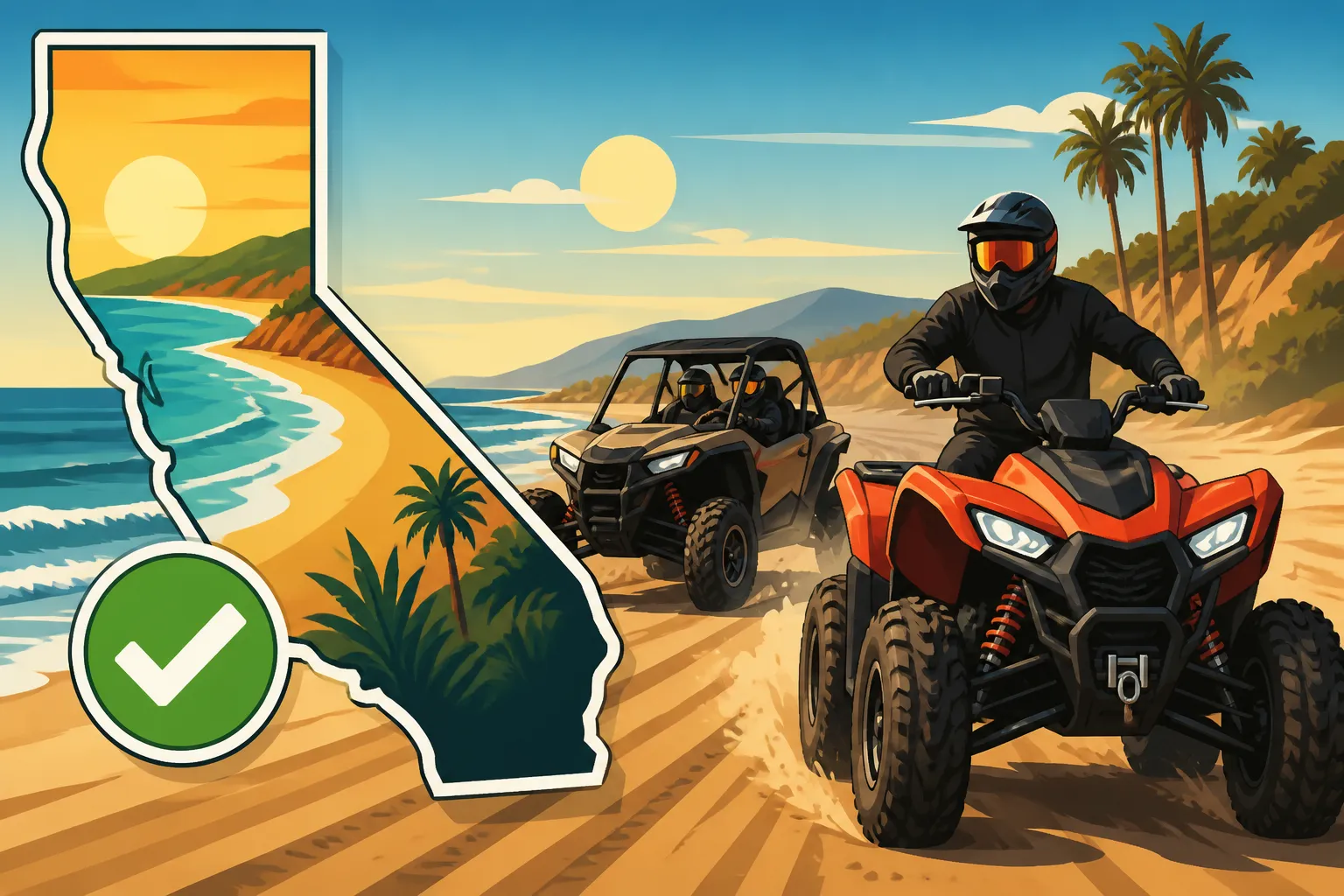
California’s legal beach-riding options are limited, so finding a wide stretch of sand is not enough to know you can ride there. The key is whether riding is specifically allowed at that location and whether it is open under current rules. This guide covers the identified coastal riding areas, what to check before you go, and how permits fit in.
Where beach riding is allowed in California
The Bureau of Land Management identifies Samoa Dunes Recreation Area in Humboldt County as the primary public beach and coastal dune riding location in California besides Oceano Dunes State Vehicular Recreation Area. Those are the two identified public coastal locations in the facts here; that does not mean every beach, dune, or adjoining stretch of shoreline is open to OHVs.
| Location | Managing agency | What to keep in mind |
|---|---|---|
| Oceano Dunes State Vehicular Recreation Area | California Department of Parks and Recreation | Confirm current access, open riding boundaries, and any operating restrictions before traveling. |
| Samoa Dunes Recreation Area, Humboldt County | Bureau of Land Management | Check the managing agency’s current information for access, closures, and area-specific requirements. |
At Oceano Dunes, the California Department of Parks and Recreation manages the recreation area. Start with Oceano Dunes: California’s Only Sand Beach Ride for more background on the location, and check the current information from the managing agency before setting out. A place’s reputation as a riding area is not a guarantee that every part is currently accessible.
Samoa Dunes is managed by the Bureau of Land Management. That agency oversees its own public lands and OHV areas, so its current directions are the relevant reference for the recreation area. Do not assume that permission to ride at a designated location extends to nearby beaches or dunes beyond its boundaries.
These locations are best understood as specific riding areas, not as a general exception for California’s coastline. A beach may be publicly accessible to pedestrians, or have sand that looks suitable for a vehicle, without being open to OHV riding. Before unloading, confirm that the exact area is designated for riding and that no current closure or restriction changes access. For a wider look at options beyond the coast, see Where to Ride an OHV in California and California’s State Vehicular Recreation Areas.
Check the specific site before unloading
Rules and access can be specific to the managed area, and conditions can change. A useful planning step is to check with the relevant agency shortly before the trip rather than relying only on old trip reports, forum posts, or a map that may not reflect current closures.
Oceano Dunes
Oceano Dunes is a state recreation area managed by the California Department of Parks and Recreation. Before going, verify that the area you intend to visit is open to OHV use and review any current access notices or riding restrictions. If a section is closed or restricted, a nearby open stretch of sand is not automatically an authorized substitute.
For planning, separate three questions: Is the recreation area accessible? Is the specific area you intend to ride open to OHVs? Are there current site rules that affect your route or how you use the area? Getting a positive answer to the first question does not necessarily answer the other two.
Use the agency’s current information to plan where to enter, where riding is allowed, and whether the area has restrictions that could affect your vehicle or group. If the site information is unclear, ask the managing agency before unloading rather than trying to interpret a boundary on the ground.
Samoa Dunes
The Bureau of Land Management manages Samoa Dunes Recreation Area in Humboldt County. Check the agency’s current information before traveling, especially for access details, closures, and boundaries. Do not treat the beach or dunes outside the designated recreation area as part of the riding area simply because they look connected.
If your route involves adjoining public or private land, confirm that each portion is open to OHV use. Public ownership by itself is not permission to ride cross-country. The Bureau of Land Management uses the designations “Limited Use Area” or “Limited Area” and “Closed Area” for public lands where cross-country OHV travel is prohibited. Those terms are a reminder to check the land designation and route, not to assume all public ground is available.
Conditions are part of the plan
Even when a riding area is open, conditions can affect whether your plan is sensible. Check the local forecast and any current site notices, and consider how sand, wind, visibility, and changing shoreline conditions could affect your group. Give yourself time to find the permitted riding area and understand its boundaries before starting out.
If you are unfamiliar with the site, avoid treating a phone map or a track from another rider as the final authority. The map may not show a recent closure, and another rider’s route may have crossed a restricted area. Use agency information to confirm access and follow signs or directions at the location.
Permits, registration, and vehicle preparation
Beach riding still requires the right OHV identification or permit for your situation. A location being open does not replace vehicle paperwork, and having a permit does not authorize riding outside the designated area.
For a California-registered OHV, the California Department of Motor Vehicles issues an identification certificate, also known as a registration card, as proof of valid registration. On an ATV, the California Department of Motor Vehicles and the Department of Parks and Recreation require the Green Sticker or Red Sticker to be securely fastened to the left rear quadrant on a permanent plastic or frame member where it is clearly visible from the rear. Review California’s Green Sticker Explained if you need help understanding the sticker system.
Visitors should check whether their home-state registration qualifies them to operate without a California permit. The California Department of Motor Vehicles says nonresident owners must carry a valid out-of-state driver’s license to establish residency and provide proof of current home-state OHV registration or its equivalent to operate without a California permit. If you are unsure whether your paperwork qualifies, review California OHV Reciprocity: Only Two States and the current permit guidance before the trip instead of assuming a road plate or another state’s decal is enough.
The California State Parks Off-Highway Motor Vehicle Recreation Division administers the nonresident OHV use permit program. California State Parks lists the required fee for a nonresident OHV Use Permit as $30 as of November 2026. Check with the agency for current requirements and figures before buying. On an ATV, the California Department of Parks and Recreation requires the nonresident permit to be affixed to the left rear quadrant on a permanent plastic or metal frame member where it can be inspected from outside.
A permit is not a substitute for site access. It addresses the vehicle’s OHV identification requirement; you still need to confirm that the place you plan to ride is open and that your route stays within the authorized area. For more details on visitor requirements, see California’s Nonresident OHV Use Permit and How to Buy a California Nonresident OHV Permit.
Before leaving home, check that the registration card or permit information is available and that the required sticker or permit is attached where it can be seen. Make sure your vehicle is in appropriate working order for sand riding and that your group understands where to meet if it becomes separated. If you are towing, plan to secure the vehicle and gear so nothing shifts during the trip.
Avoid the most common beach-riding mistakes
The easiest mistake is treating “beach” as a type of permission. It is not. Confirm that the agency specifically allows OHV use in the area you intend to ride, then check that the relevant section is currently open. The same caution applies to public land: public access for walking or other recreation does not automatically allow motorized travel.
Another mistake is relying on a permit or registration as proof that any route is legal. Vehicle identification and land access are separate issues. Keep your paperwork in order, but also follow the designated boundaries, closures, signs, and directions from the managing agency.
A few practical checks can reduce confusion:
- Confirm the name of the managed recreation area, not just a nearby town or beach.
- Check current access and closure information with the agency responsible for that area.
- Identify the boundary of the authorized riding area before you start.
- Make sure the OHV’s registration or nonresident permit applies to your situation.
- Keep the required identification visible and have your registration card or permit information available.
- If conditions or signs make the route unclear, stop and verify rather than continuing into an uncertain area.
If your trip includes children or multiple vehicles, review the rules that apply to the machines and riders as well as the location. California’s public-land requirements for ATV supervision and safety certificates differ from the minimum age rule for UTV operators. California Rules for Riders Under 18 and California Rules for a Rented Machine can help with those separate questions.
Finally, remember that a legal riding area is not necessarily an invitation to ride without care. Keep a safe distance from people, respect site directions, and slow down near campsites or groups. The California Department of Parks and Recreation sets a maximum speed of 15 miles per hour within 50 feet of a campsite, campground, or group of people or animals. Check local conditions and follow any site-specific directions as well.
California beach riding is possible, but only at designated locations and subject to current access rules. Start with Oceano Dunes or Samoa Dunes, verify the status and boundaries with the managing agency, and sort out vehicle identification before you unload. That approach helps keep a beach ride within both the riding area and the rules that apply to your machine.
Sources
- California Department of Parks and Recreation — Nonresident OHV Use Permits (checked November 2, 2026)
Disclaimer
This article is for general informational purposes only and does not constitute professional advice. Laws, prices and regulations vary by location and change over time. Consult a qualified professional for guidance on your specific situation.