California Rules for a Rented Machine
California Rules for a Rented Machine
Renting an ATV or UTV can make a California ride easy to arrange, but the rental agreement does not replace state rules. You still need to know who handles the machine’s registration, which permits apply, what safety requirements govern the rider, and where the machine may be driven. This article separates the renter’s responsibilities from the rental company’s—and highlights what to confirm before leaving the counter.
What the rental company handles—and what you still must do
A rental company generally supplies a machine that is ready for its permitted use, along with the paperwork and equipment required by its own rental process. But handing you the keys does not transfer every legal responsibility to the company. You remain responsible for operating the machine safely, following the agreement, and obeying the rules where you ride.
That distinction matters because several different requirements can apply at once:
- Machine identification: The ATV or UTV must have the identification or registration required for its use. In California, the sticker or other identification on an OHV is separate from a permit required for a particular riding area.
- Area access: A park, dune area, or other land manager may require an additional permit or fee. A rental agreement does not automatically include it.
- Rider qualifications: Age, supervision, safety-certificate, helmet, and passenger rules can apply to the person operating or riding on the machine.
- Machine condition: Equipment such as a spark arrester, muffler, seat belt, or flag may be required for the machine or riding area.
- Rental terms: The company can set its own age limits, deposit requirements, route restrictions, and return rules. Those terms may be stricter than the general legal minimum.
It helps to think of the rental as one layer of permission, not an all-access pass. The company authorizes you to use its machine under the contract. The land manager controls where you can ride. State rules govern the machine and the rider.
| Issue | Usually handled by the rental company | What the renter should confirm |
|---|---|---|
| Machine identification | Provides a machine prepared for the rental | Identification is present, legible, and accepted at the riding location |
| Area permit | May include or arrange a permit, depending on the rental | Whether the permit is included, who it covers, and where it applies |
| Rider eligibility | Sets rental age and license conditions | Whether you meet the company’s rules and any separate legal requirements |
| Safety equipment | May supply helmets and other gear | Fit, condition, and whether all required items are included |
| Riding area | May explain an approved route or zone | Current closures, route limits, and rules for the specific location |
| Damage and recovery | Explains charges in the agreement | Who pays for damage, recovery, fuel, cleaning, or late return |
Ask the shop what it handles in writing, especially when the ride includes public land or dunes. If a clerk says a permit is “covered,” clarify whether that means the machine’s registration, a site-access permit, or both. Those are not interchangeable.
For a broader overview of booking, gear, and riding arrangements, see [Renting an ATV in California]. If you are renting a side-by-side, the same general separation between machine, site, rider, and contract rules applies, but passenger and seat-belt requirements deserve particular attention.
Registration, permits, and reciprocity
A rented machine may carry California OHV identification or other documentation that allows it to be used in the relevant setting. Check that the identifying sticker or plate is present and readable. Do not assume the paperwork is unnecessary because you are not the owner; rangers or other officials may still inspect the machine while you are operating it.
At the counter, ask where the registration documents are kept and whether you need to carry them. Do not remove, cover, or alter any identification. If a sticker or plate looks damaged, ask the company to resolve it before you ride.
Machine identification is not the same as an area permit
Some riding areas require a separate permit or access authorization. Dune access is a common example: a dune permit is distinct from the machine’s basic OHV identification. A rental company may arrange the permit, direct you to buy it, or restrict its rentals to a particular area. Confirm the exact arrangement before you depart.
Ask these questions:
- Is the machine’s OHV identification current and appropriate for this ride?
- Does the riding area require a separate permit or fee?
- Is that permit included in the rental price, or do I need to obtain it?
- Does it cover this machine, this rider, or both?
- Where must it be displayed, and what proof should I carry?
- Does the permit cover the entire route I plan to ride?
The last question is easy to overlook. A permit may authorize access to a specific recreation area without allowing travel on every nearby road or trail. A route that appears to connect a campground to a store may still be closed to OHVs or subject to a separate designation. Follow the posted route and the land manager’s current information.
Nonresident rules are a separate question
If you are visiting California, do not assume that an out-of-state registration or permit automatically satisfies California’s rules. Reciprocity depends on the state and the type of identification involved. California recognizes certain arrangements, but not every state’s sticker or registration is treated alike. See California OHV Reciprocity: Only Two States and California Nonresident OHV Use Permit for the distinctions.
With a rental, ask the company whether its machine already has the identification needed for the California location. Do not buy an additional permit simply because you are a visitor until you know whether it is required for that machine and ride. Conversely, do not assume the rental company’s paperwork exempts you from a permit that applies to the rider or to the area.
Keep the rental agreement and any permit confirmation accessible. If the company tells you that a document is stored on the machine or in a shop system, ask what to show if you are stopped away from the counter. For more on carrying proof during a ride, see Carrying Paperwork on the Sand.
Rider age, helmets, passengers, and safety certificates
Rental shops commonly set minimum ages for renting, driving, or riding as a passenger. Those limits are contractual rules and can differ between providers and between machine types. Meeting the company’s minimum does not automatically mean you meet every legal requirement for the riding area.
Before booking for a young rider, ask the shop to identify the rules that apply to the exact machine and location. A child who may ride as a passenger in one type of vehicle may not be eligible to operate another. UTVs and ATVs also have different seating arrangements, so do not treat their passenger rules as interchangeable.
Safety certificates and supervision
California has safety-certificate and supervision requirements that can apply to younger ATV operators on public land. The details depend on the rider’s age and circumstances. Ask the rental company what documents it requires, then confirm that its answer covers the actual riding location—not only the rental transaction. See [California ATV Safety Certificate Requirements] for more detail.
A certificate issued for another state or course may not automatically satisfy California’s requirements. If a younger rider will operate a machine, settle this before arriving at the rental counter. A shop may have a course or certificate option, but availability and acceptance should be confirmed directly.
Do not assume that an adult’s presence is enough. Where supervision is required, the supervising adult may need to meet specific qualifications and remain involved as required by the rule. Keep any required proof with the rider rather than leaving it in a vehicle parked far from the trail.
Helmets and passenger limits
Helmet rules apply to OHV riding on California public land. Rental shops may provide helmets, but the renter should check fit, condition, and whether the supplied helmet meets the applicable requirement. A helmet that is loose, damaged, or the wrong size is not a useful substitute for properly fitted protection.
Before riding, confirm:
- Every person has an appropriately sized helmet.
- The machine has enough designated seats for the number of riders.
- Passengers are allowed on that type of machine and in that location.
- Every occupant can reach and use the required safety equipment.
- A child can sit securely and does not need a restraint or seating arrangement the machine lacks.
California’s rules for ATV passengers are especially important: a quad is not automatically legal for two people just because both can physically sit on it. Check California ATV Passenger Ban Explained. UTVs generally have passenger seats, but each person must use the appropriate seat and safety restraints. See California Seat Belt Rules in a UTV when renting a side-by-side.
When shopping for personal gear, fit and suitability matter more than where it is purchased. A rider may find goggles or gloves through a retailer such as Amazon, but the rental shop should confirm what is permitted and required for its machine and site. Never assume that personal gear replaces a required helmet or other safety equipment.
Where you may ride—and what the machine needs
A rental company may advertise a location or route, but the legal riding area is determined by the land manager and applicable rules. An OHV is not generally free to travel on public roads just because it is registered or rented. Use designated OHV trails and riding areas, and obey closures, signs, gates, and route restrictions.
Do not use a public road as a shortcut between a rental shop, campsite, trailhead, or riding area unless the route is specifically authorized for that use. A road that looks quiet or unpaved is not necessarily open to OHVs. For road access questions, California Rules for Crossing a Public Road explains why crossing rules and riding along a road are different.
A rental company may set narrower boundaries than the public land allows. For example, it may prohibit certain trails, dunes, or operating conditions because of the machine’s size, the rental contract, or recovery concerns. Those restrictions still apply even if another rider is allowed to go there.
Site-specific permits and dune equipment
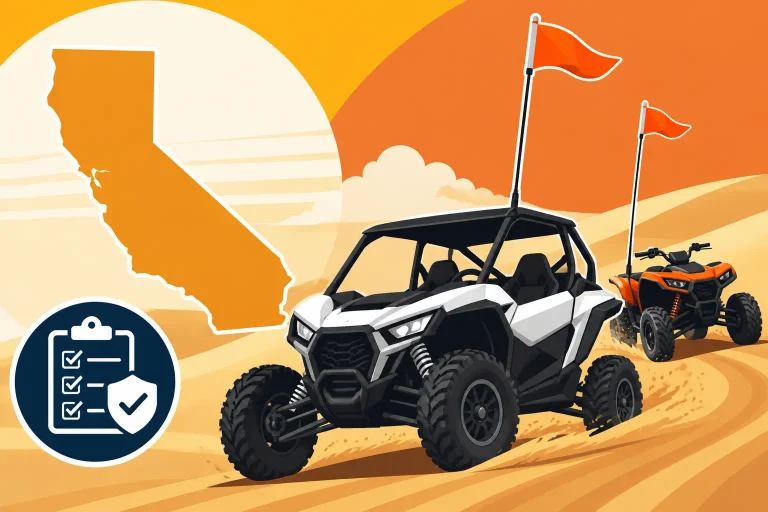
Dune areas can have requirements that do not apply to every trail system. Confirm whether the rental includes access authorization and whether a whip, flag, or other visibility equipment must be fitted. If you are riding dunes, check California Dune Flag Requirements before departure.
Do not remove a flag, lower it, or change its position because it seems inconvenient. Dune visibility equipment helps riders see one another across slopes and around blind crests. Follow the site’s current specifications and the rental company’s directions.
Sound and spark arresters
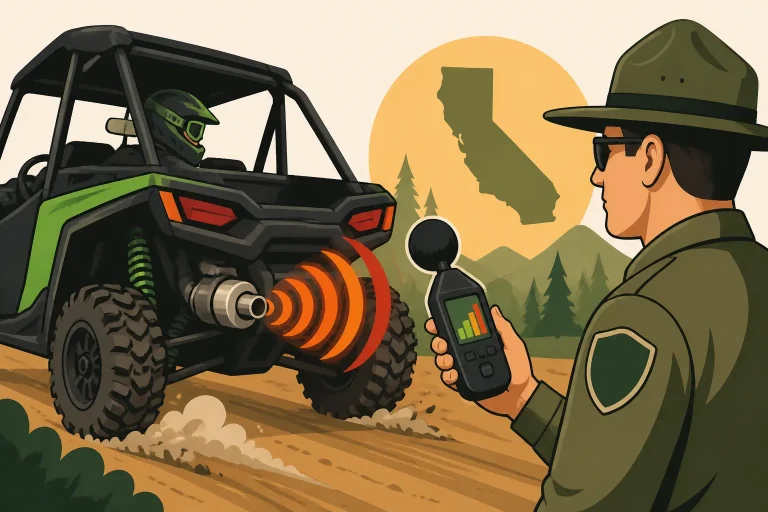
California public-land rules can address exhaust noise and spark arresters. The rental company is responsible for maintaining its machine, but a renter should not ignore an obvious problem. A missing spark arrester, unusually loud exhaust, or damaged muffler can create a safety issue and may lead to trouble at an inspection or gate.
Ask the shop whether the machine is suitable for the area you plan to ride. If it is checked and does not meet the site’s requirements, the ride may be delayed or stopped. Do not attempt to modify the machine or remove exhaust parts. Read California Spark Arrester Requirement Explained and California Sound Limits for OHVs Explained if those issues are relevant to your trip.
Before setting out, take a few minutes to inspect the machine with the employee:
- Confirm the number of seats and passenger restraints.
- Check that the tires, brakes, throttle, and steering appear in working order.
- Locate the lights, engine stop switch, and any emergency equipment.
- Make sure the required flag or other site-specific equipment is attached.
- Ask what to do if the machine breaks down or becomes stuck.
- Photograph existing damage, following the shop’s policy.
This check does not replace maintenance or a professional inspection. It gives you a chance to report an obvious issue before you accept responsibility under the rental agreement.
What to confirm before you sign and ride
A rushed counter conversation can leave important questions unanswered. Read the agreement, especially the sections about where you may ride, who may operate the machine, and what happens if it is damaged, stuck, or returned late. If the terms are unclear, ask the employee to explain them before signing.
Use this checklist:
- Confirm the permitted riding area. Get a clear description or map, and ask whether the route includes any roads, private property, or closed sections.
- Ask about registration and permits. Confirm what is on the machine, what the area requires, and whether any separate permit is included.
- Check rider eligibility. Confirm minimum ages, license conditions, safety certificates, supervision, and passenger limits for everyone in your group.
- Review the gear. Check helmets and restraints, and ask whether the location requires a flag, spark arrester, or other equipment.
- Understand the contract. Ask about fuel, damage, recovery, cleaning, late returns, and any route restrictions.
- Get the breakdown plan. Know whom to contact, how to describe your location, and whether you should wait with the machine.
- Keep proof available. Find out which papers or electronic confirmations should stay with you during the ride.
The company may require a deposit or place a hold on a payment card. The amount and terms vary by provider, so check the current agreement rather than relying on a listing or an old booking confirmation. The contract may also distinguish ordinary wear from damage, and a damage waiver may have exclusions. Ask what it does and does not cover.
Do not treat a waiver or rental insurance option as permission to ignore safety rules or travel beyond the allowed route. Coverage, responsibility for injuries, and responsibility for machine damage are different questions. If the shop offers an optional protection product, ask what losses are covered, what exclusions apply, and whether it changes your responsibility for recovery or damage.
At the counter, ask for the rental company’s preferred method for reporting a problem. If the machine fails, do not leave it unattended or attempt a repair that the contract prohibits. Contact the shop and follow its instructions. If an injury or immediate hazard occurs, prioritize safety and contact emergency services when needed.
The most reliable approach is to verify three things before riding: the machine is properly identified, the riding area allows the trip you plan to take, and every rider meets the applicable requirements. If any part is uncertain, pause and get clarification from the rental company or the land manager rather than guessing.
Frequently Asked Questions
Does renting an ATV mean the machine’s registration is taken care of?
The company should explain the machine’s identification and paperwork, but check that the required identification is present and suitable for the riding area. Ask what documents you need to carry.
Does a rental include a California OHV or dune permit?
Not necessarily. A machine’s OHV identification and a site-specific permit are separate requirements. Ask whether any required area permit is included, who it covers, and where it is valid.
Can I ride a rented OHV on a public road?
Do not assume so. Use designated OHV areas and authorized routes. Road crossings and limited designated routes have their own rules; a rental agreement does not make an otherwise closed road legal.
Can a child ride or drive a rented machine?
It depends on the rider’s age, the machine, the location, the company’s contract, and any certificate or supervision requirements. Confirm all of these before booking.
Is the rental company responsible if the machine is too loud or lacks required equipment?
The company should provide a machine suitable for the agreed use, but the renter should report apparent problems and avoid riding a machine that seems unsafe or noncompliant. Clarify responsibility and the remedy with the shop before leaving.
Disclaimer
This article is for general informational purposes only and does not constitute professional advice. Laws, prices and regulations vary by location and change over time. Consult a qualified professional for guidance on your specific situation.