Dry Lakes and California Riders
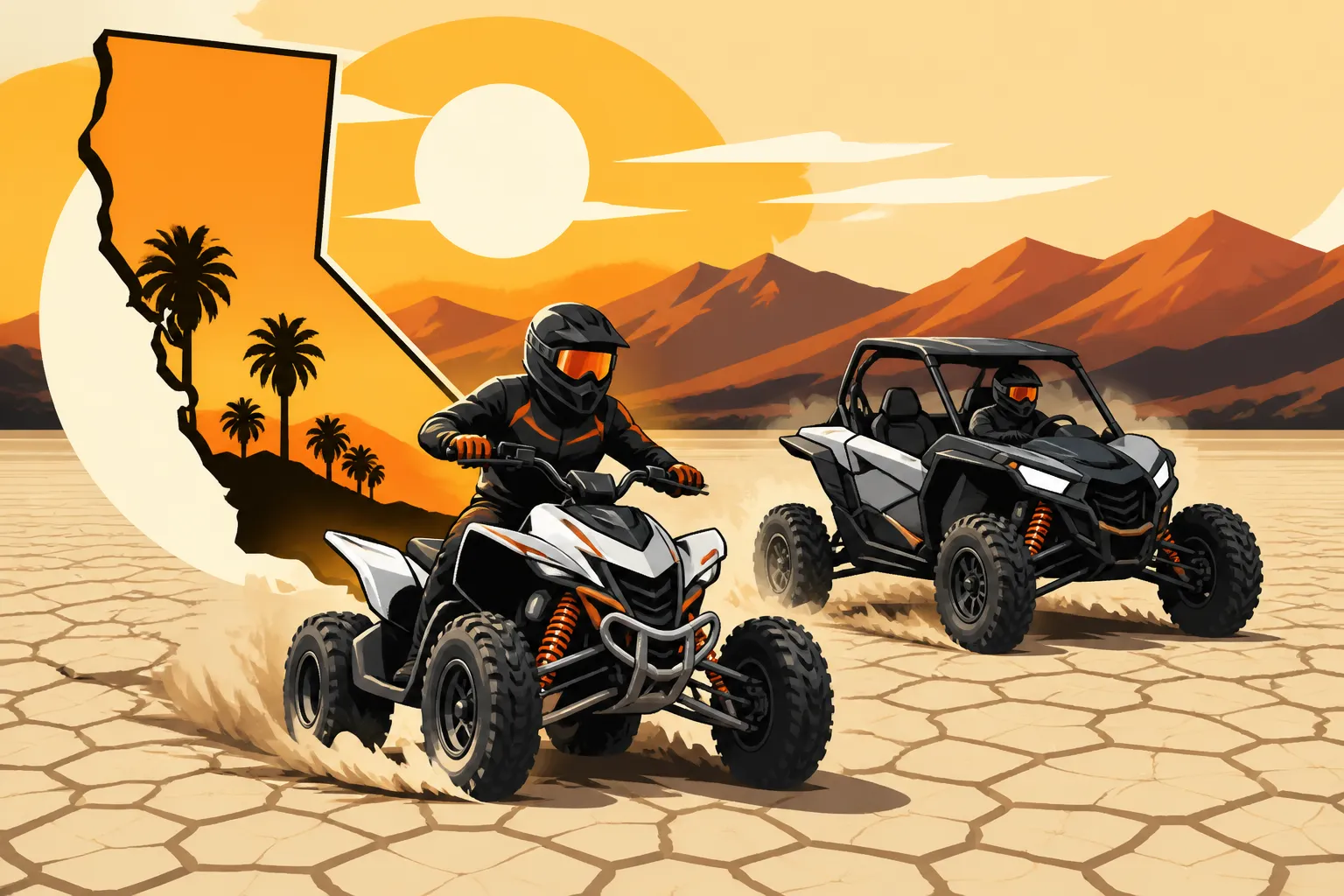
Dry lakebeds can look like open desert, but that does not mean every part is open to riding. California riders need to know which areas allow OHV use, what registration or permit to carry, and how to avoid damaging fragile terrain. The safest approach is to verify access before unloading, then stay within designated recreation areas and follow posted controls.
Where riding is allowed on a dry lake
A dry lakebed is not automatically an OHV riding area. Land ownership, recreation designations, closures, and environmental controls determine where riding is allowed. The Bureau of Land Management oversees its own public lands and OHV areas, so check the land manager’s current information for the specific lakebed before you go.
The Bureau of Land Management identifies El Mirage Dry Lake, within the El Mirage OHV Recreation Area, as an example of a dry lakebed with an area designated for high-intensity recreation. That does not mean every part of the lakebed or surrounding land is open. Follow signs and maps, and do not assume that a visible track, tire mark, or other vehicle’s route is legal.
Public land may include areas where cross-country OHV travel is restricted. The Bureau of Land Management uses the designations “Limited Use Area” or “Limited Area” and “Closed Area” for public lands where cross-country travel is prohibited. These designations matter on broad, apparently empty lakebeds: riding across an unmarked-looking surface may still take you into a restricted area.
Before setting out, check the land manager’s current map and closure notices, and identify the boundaries of the open riding area. A route map can help you avoid relying on tire tracks as a guide; see California Trail Maps and Where to Get Them and California Trail Closures to Check First. If a map or sign conflicts with what other riders are doing, follow the official designation.
Dry lake surfaces can also change with weather and use. A firm-looking surface may be soft, muddy, or uneven in places, and a lakebed can have dust or visibility issues. Keep your route within the designated area and leave room to stop when conditions change. For broader planning and desert precautions, California Desert Riding Safety covers practical issues that can affect a ride away from paved roads.
Registration and permits to have ready
California’s dry-lake rules call for an OHV to be properly registered and for riders to stay in designated open recreation areas. The Bureau of Land Management also identifies environmental controls, including dust and air-quality requirements, as part of riding responsibly on dry lakebeds. Confirm the local requirements before you travel, especially if you are bringing a machine from outside California.
| Your situation | What to check before riding |
|---|---|
| California-registered OHV | Confirm that registration is current and that the machine displays the correct identification sticker. |
| Out-of-state OHV | Check whether the machine’s current home-state registration or equivalent is accepted, or whether you need a California nonresident permit. |
| Newly purchased or previously unregistered machine | Confirm what ownership documents and registration steps apply before taking it onto public land. |
| Any rider on a dry lake | Confirm that the specific area is open to riding and that you understand its boundaries and environmental controls. |
For a California-registered machine, the California DMV issues an identification certificate, also called a registration card, as proof of valid OHV registration. On an ATV, the Green Sticker or Red Sticker must be securely fastened to the left rear quadrant on a permanent plastic or frame member, where it remains clearly visible from the rear, according to the California DMV and the California Department of Parks and Recreation. Carry the registration card with you rather than relying only on the sticker as proof.
The California DMV lists the standard two-year OHV registration fee as $54 as of November 2026. The applicable registration type depends on the vehicle and its circumstances; a sticker color alone does not tell you whether the riding area is open to that machine. For help with the registration process, see Registering an OHV in California and Green, Red and Tan: California’s Three Stickers.
A nonresident’s home-state paperwork may affect whether a separate California permit is needed. The California DMV says nonresident OHV owners must carry a valid out-of-state driver’s license to establish residency and must provide proof of current home-state OHV registration or its equivalent to operate without a California permit. Do not assume that a registration card or decal from any state automatically satisfies California’s requirements. Check the current rules for your home-state credential and the land you plan to visit.
The California nonresident OHV use permit program is administered by the Off-Highway Motor Vehicle Recreation Division of California State Parks. The required fee for a permit purchased from the department is $30 as of November 2026. If you need one, confirm how to obtain it and display it before leaving for the riding area. On an ATV, the California Nonresident OHV Use Permit must be affixed to the left rear quadrant on a permanent plastic or metal frame member visible to outside inspection, according to the California Department of Parks and Recreation. For permit details, see California’s Nonresident OHV Use Permit and California OHV Reciprocity: Only Two States.
A machine with no current registration or permit is not ready for public-land riding just because it is transported on a trailer. If the machine is newly purchased or has never been registered, the California DMV says proof of ownership may include a Manufacturer’s Certificate or Statement of Origin, out-of-state titling documents, a factory invoice, or bills of sale that establish a complete chain of ownership. Sort out paperwork before the trip rather than at the entrance. Registering an Out-of-State Machine in California explains the related registration issue.
Protecting the lakebed and following local controls
Dry lakebeds can be sensitive places even when they appear empty. California’s rules for dry lakes require riders to use designated open recreational areas and follow environmental controls intended to protect fragile desert ecosystems and air quality. The Bureau of Land Management identifies creating new tracks, disturbing wildlife habitats, and violating dust-control or regional air-pollution standards as prohibited conduct.
In practical terms, stay on authorized riding surfaces and do not make a shortcut across an area that is closed or not designated for riding. Avoid driving over vegetation or through habitat, and do not treat a route across the lakebed as open simply because the surface is flat. If dust controls, closures, or other restrictions are posted, follow them even when they change the route you expected to take.
Dust can affect other riders, nearby communities, and air quality. Ride in a way that limits unnecessary dust, leave space between machines when visibility is poor, and slow down if you cannot clearly see the route or people ahead. The land manager’s instructions take priority over informal advice from other visitors.
There may be separate rules for other parts of a trip, including roads, campgrounds, and nearby recreation areas. For example, the California Department of Parks and Recreation sets a maximum speed of 15 miles per hour within 50 feet of a campsite, campground, or group of people or animals. That speed rule does not replace posted signs or any more restrictive local instruction. If your dry-lake trip includes camping, review the rules for the specific site as well as the riding area.
Do not assume that access on one side of a boundary applies on the other. A legal route may end at a marked edge, and land beyond it may be closed, privately managed, or subject to different restrictions. Use official signs and current maps to identify boundaries rather than following tracks that appear to continue past them. Riding Off a Designated California Trail explains why staying on an authorized route matters.
Plan the machine, riders, and trip
A dry lake can put a lot of space between a rider and help, so planning should cover the machine as well as the route. Check that the vehicle is in sound operating condition, that required protective equipment is available, and that everyone understands the area’s boundaries before riding. Carry registration or permit documents where they can be found, and keep a map or other route information protected from dust and moisture. A document case from a retailer such as Amazon may help keep paper copies together, but it does not replace required original or official proof.
For night riding on public land, California requires an OHV to have at least one headlight capable of illuminating objects 200 feet ahead and one red taillight visible from 200 feet, according to the California Department of Parks and Recreation. Avoid assuming that a machine suitable for daytime use has the lighting needed for riding between sunset and sunrise. Confirm that the lights work before the trip and check whether the site has additional restrictions.
Riders also need to follow the rules that apply to their vehicle and age. California State Parks’ Off-Highway Motor Vehicle Recreation Division says an operator under 18 must have an appropriate ATV safety certificate, be directly supervised by an adult who holds one, or take a prescribed course under the direct supervision of a certified instructor. The same division says a child under 14 must always be accompanied and directly supervised by a parent, guardian, or authorized adult. An ATV safety certificate may be issued through a course supervised by a certified instructor and an approved organization, such as the ATV Safety Institute, or under another state’s authority.
For a recreational off-highway vehicle, also called a UTV or ROV, California State Parks’ Off-Highway Motor Vehicle Recreation Division says the operator must be at least 16 or directly supervised in the vehicle by a parent or guardian, or an adult authorized by them. All occupants must wear seatbelts or safety harnesses whenever the ROV is moving, according to the California Department of Parks and Recreation. On an ATV, a passenger is permitted only if the vehicle was specifically designed and provided by the manufacturer for multiple riders; a single-rider ATV cannot legally carry a passenger on public lands.
Equipment rules can vary by where you ride. The USDA Forest Service requires a properly installed, approved spark arrester for an OHV operated on National Forest lands. California’s noise limits also apply: the California Department of Parks and Recreation sets a maximum of 96 dBA for OHVs manufactured on or after January 1, 1986, and 101 dBA for those manufactured before that date, measured from 20 inches. These requirements are worth checking if your trip includes forest routes or other public land beyond the lakebed.
Finally, do not ride under the influence. The California DMV says California Vehicle Code Section 23152 applies to OHV operation both on and off highway. Keep the ride focused on the route, the surface, and other people using the area.
A well-planned dry-lake ride comes down to a few reliable habits: confirm access with the land manager, carry the registration or permit that applies to your machine, stay inside designated open areas, and respect environmental controls. If you cannot confirm that an area is open, do not treat it as a riding route until you have checked.
Sources
- California Department of Motor Vehicles — OHV Registration | California State Parks – OHMVR Division (checked November 2, 2026)
- California Department of Parks and Recreation, Off-Highway Motor Vehicle Recreation Division — OHV Sound Regulations (checked November 2, 2026)
- Department of Motor Vehicles — Section 9: Alcohol and Drugs (checked November 2, 2026)
- California Department of Parks and Recreation, Off-Highway Motor Vehicle Recreation Division — Operation / Equipment Requirements (checked November 2, 2026)
- California Department of Parks and Recreation — Nonresident OHV Use Permits (checked November 2, 2026)
- California Department of Parks and Recreation Off-Highway Motor Vehicle Recreation Division — ATV Safety Training & FAQs for ROVs (checked November 2, 2026)
Disclaimer
This article is for general informational purposes only and does not constitute professional advice. Laws, prices and regulations vary by location and change over time. Consult a qualified professional for guidance on your specific situation.