Flags Within 10 Inches of the Mast Top
A dune flag can look properly mounted and still sit too low on its whip mast. In California sand dunes, the placement rule is specific: the safety flag must be within 10 inches of the mast’s top. Here’s how to understand that requirement, set up the flag, and check the mount before riding.
What the mast-top rule means
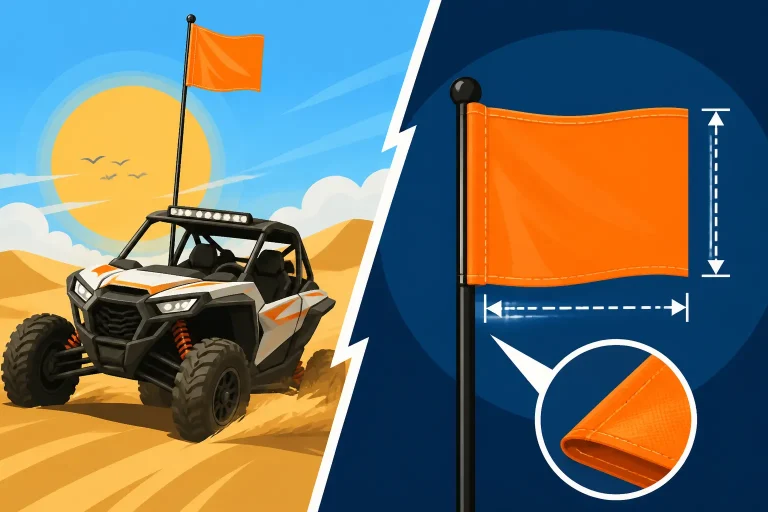
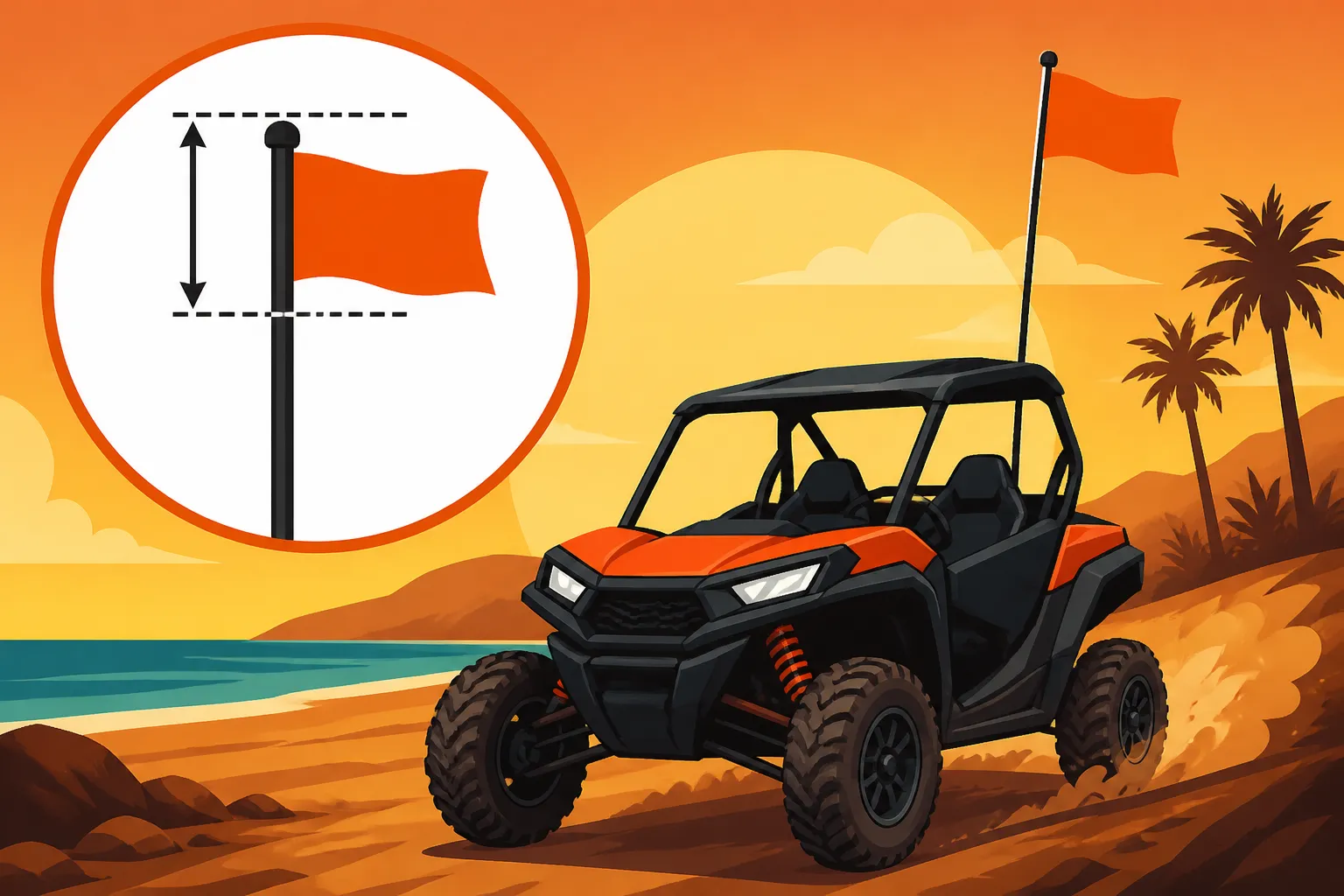
In California sand dunes, the safety flag must be positioned within 10 inches of the top of the whip mast, according to the Bureau of Land Management and the California Department of Parks and Recreation. The key reference point is the mast’s top. The rule is not a measurement of the entire whip, and it does not mean the flag can be mounted anywhere along the pole.
That distinction matters when a whip is made of several sections or when the flag attaches with a sliding clamp. A flag may be firmly attached yet still sit below the permitted area. Check where the flag is fixed relative to the top of the assembled mast, rather than judging its location by how tall the whip looks on the vehicle.
The rule concerns the flag’s position on the mast. It does not, by itself, specify every part of a flag setup, such as a particular flag shape, color, or mast height. Avoid assuming that meeting the placement rule automatically settles every other requirement for riding in a particular dune area. For broader requirements, see California Dune Flag Requirements and California Whip Height Requirements.
| Part of the setup | What to check |
|---|---|
| Mast | Identify the top of the fully assembled whip mast |
| Flag position | Keep the safety flag within 10 inches of the mast top, as required by the Bureau of Land Management and the California Department of Parks and Recreation |
| Attachment | Make sure the flag mount is secure and does not slide down the mast |
| Overall setup | Check any additional requirements for the riding area and vehicle |
The requirement is easy to misread if you focus only on the flag’s visibility. A flag can be easy to see from a distance and still be mounted too far from the mast top. Conversely, correct placement does not help if the flag is loose, folded around the pole, or hidden by part of the vehicle. Treat mast-top placement and a sound, usable setup as separate checks.
A practical approach is to assemble the whip first, find its actual top, then position the flag near that upper end. If the mast’s design or flag hardware makes the correct reference point unclear, consult the equipment instructions and check with the land manager before riding. Do not rely on a seller’s generic description as proof that a setup complies with the local rule.
Choosing a flag and mount that hold their position
A flag’s placement can change while a vehicle is being transported, loaded, or ridden. A clamp that initially sits near the top may slip down the pole, especially if it is not suited to the mast’s diameter or is not tightened as its manufacturer directs. Choose hardware intended for the mast you have, and check that its grip holds the flag at the intended position.
Before buying a replacement flag or mount, compare the product’s attachment method with the whip mast already installed on your ATV or UTV. Check the mast diameter, the shape of the mounting surface, and whether the flag’s sleeve or clamp can sit securely near the top. If you are shopping through a retailer such as Amazon, verify those details in the product information rather than assuming that a listing described as a dune flag will fit every mast.
Avoid modifying a mount in a way that makes it difficult to keep the flag in place. A clamp that is forced onto an incompatible pole can loosen, damage the mast, or leave the flag sitting at an unintended height. If the mount will not hold securely at the required position, replacing it with compatible hardware is a better fix than relying on repeated adjustment.
The right setup also depends on the whole vehicle arrangement. A whip mount should not be obscured by cargo or other equipment, and the flag should remain visible when the vehicle is ready to ride. Check that the flag is not wrapped around the mast or folded in a way that prevents it from serving as a visible marker.
For related guidance on the wider flag setup, see Flag Size on California Dunes and Whip Mast Height on the Sand. Those topics address different parts of the equipment question; they do not change the mast-top placement rule.
How to install and check the flag
Use a consistent setup routine so the flag is not mounted by guesswork. The details of attaching the hardware depend on the mast and flag design, so follow the product instructions for assembly and tightening.
- Assemble the whip mast. Put the mast together as it will be used on the vehicle. A partially assembled pole can make it harder to identify the actual top.
- Find the mast’s top. Use the upper end of the assembled mast as the reference point for the placement rule.
- Position the flag near the top. The Bureau of Land Management and the California Department of Parks and Recreation require the safety flag in California sand dunes to be within 10 inches of the top of the whip mast.
- Secure the mount according to its instructions. Tighten the clamp or other attachment as directed for that equipment. Do not assume that a mount is secure simply because it feels tight at first.
- Check the flag’s position again. Look at the location of the flag on the assembled mast and confirm it has not slipped while the hardware was tightened.
- Check the setup on the vehicle. Make sure the flag remains visible and the mast is attached as intended before you head onto the riding area.
Keep this check brief but deliberate. It is easy to focus on whether the flag is present and forget to inspect its position. Looking at the mast from the side makes it easier to judge whether the flag is mounted near the top, while a second look after loading or handling the vehicle can catch a clamp that has moved.
Recheck the flag if the mast sections are taken apart and reassembled, if the flag or mount is replaced, or if the vehicle is transported in a way that could shift the hardware. A mark on the mast might help you notice movement, but it is not a substitute for checking the position against the mast’s top.
Common mistakes and when to confirm the rules
One common mistake is measuring from the vehicle rather than the mast. The rule refers to the top of the whip mast, not the vehicle’s body, rack, or mounting point. Another is treating the flag’s height above the ground as the deciding measurement. The stated requirement is about where the flag sits on the mast.
A second mistake is relying on a setup that has not been checked since it was installed. A clamp can loosen or slide, and a replacement part may fit differently from the one it replaced. Check after adjustments, transport, and repairs instead of assuming a previous position is still correct.
It is also easy to confuse mast-top placement with other flag specifications. A discussion of flag dimensions or whip height may help answer those separate questions, but neither should be treated as a substitute for checking the location of the flag on the mast. For area-specific riding context, see California Rules for Riding Imperial Sand Dunes. For situations where compliance is checked at an access point, Rangers at a Dune Checkpoint may also be useful.
Requirements can depend on where you ride and which land manager oversees the area. The Bureau of Land Management oversees its own public lands and OHV areas, while California State Parks manages state-owned vehicular recreation areas. If you are unsure whether a particular location follows the same guidance, confirm with the agency responsible for that riding area before setting out.
The straightforward takeaway is to identify the top of the assembled mast, keep the safety flag within the required distance, and make sure the mount stays put. A correct flag position is a small check that can prevent a last-minute adjustment at the dunes.
Sources
- California Department of Parks and Recreation — Oceano Dunes State Vehicular Recreation Area (checked November 2, 2026)
- Bureau of Land Management — Off-Highway Vehicles | Bureau of Land Management (checked November 2, 2026)
- Bureau of Land Management / California Department of Parks and Recreation — Imperial Sand Dunes Rules and Regulations / Oceano Dunes State Vehicular Recreation Area (checked November 2, 2026)
Disclaimer
This article is for general informational purposes only and does not constitute professional advice. Laws, prices and regulations vary by location and change over time. Consult a qualified professional for guidance on your specific situation.