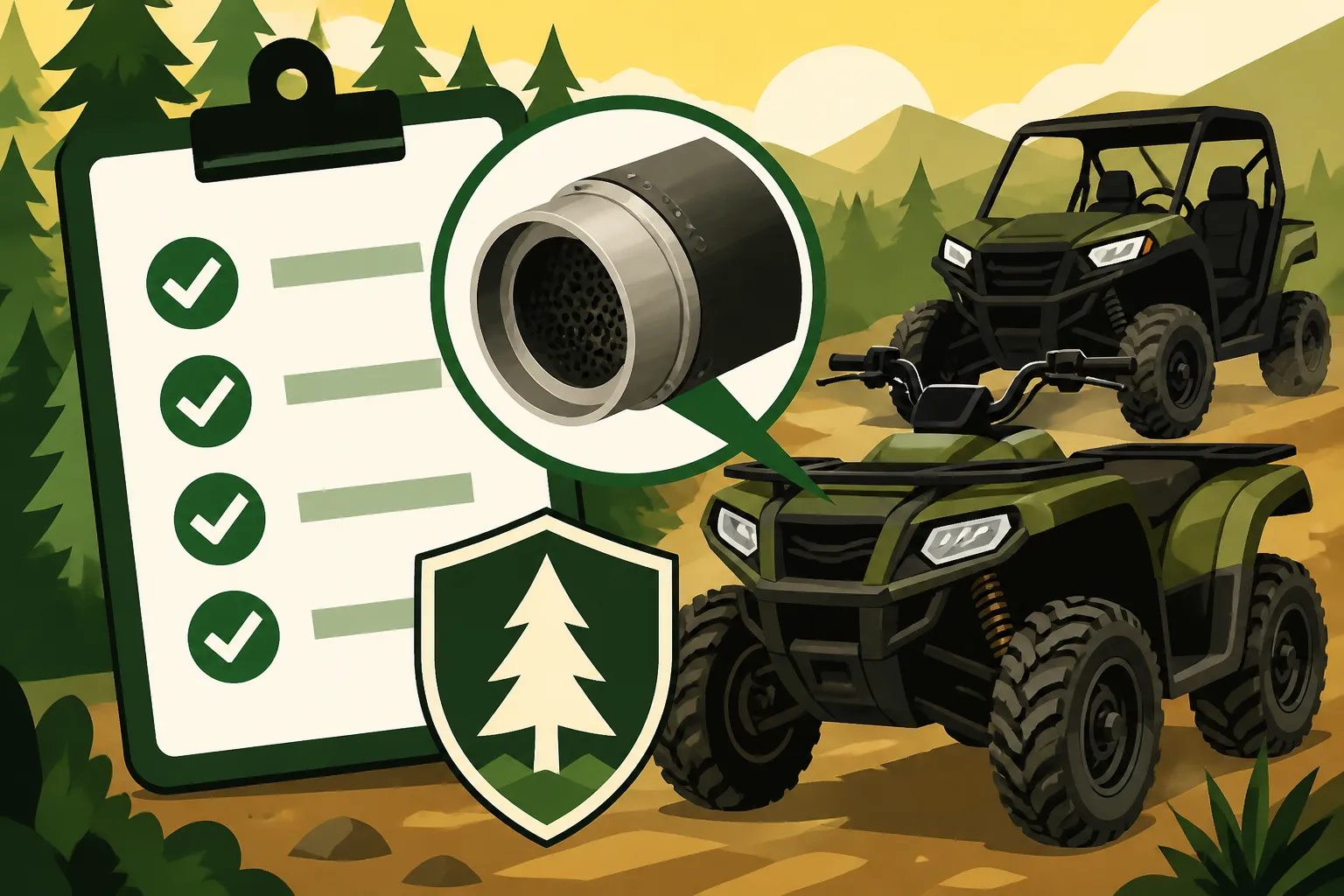
Checking the Forest Service Spark Arrester List
A spark arrester can look like a small part of an ATV or UTV exhaust, but riding without a suitable one can mean a failed inspection or a fire risk. The challenge is confirming that the arrester on your machine matches an approved design—not just that the exhaust is labeled “spark arresting.” Here’s how to check the Forest Service list and what to do if the match is unclear.
What the Forest Service spark arrester list tells you
The U.S. Forest Service publishes information about spark arresters that have been tested or qualified for use on small engines. Riders and land managers use this information to help verify that an exhaust system has an effective arrester. The document is often referred to as the Forest Service spark arrester guide or approved spark arrester list.
The key point is that approval generally relates to a particular arrester design or model, not simply to a vehicle brand or the fact that a machine is an ATV or UTV. A manufacturer may offer different exhaust configurations, and an aftermarket system may not use the same arrester as the original equipment. Even two machines from the same model family can have different exhaust parts.
The list is a useful verification tool, but it is not a universal permit to ride. Requirements depend on the land, the route and the rules of the agency managing the area. A list entry also does not prove that the arrester is still installed, intact or in working condition on your machine. For a broader explanation of where these requirements apply, see Spark Arresters on California Public Land and California Spark Arrester Requirement Explained.
A spark arrester is designed to reduce the chance that hot particles from an engine will escape through the exhaust and ignite dry vegetation. It does not make a machine fireproof. A damaged exhaust, loose connection, missing screen or poorly maintained system can still create problems. Riding practices matter, too: avoid stopping in dry grass, follow fire restrictions, and use designated routes.
What the list does not establish
The list should not be treated as a complete catalog of every machine that may be ridden, nor as proof that any exhaust advertised as “USFS approved” is appropriate for your specific vehicle. It also does not establish whether a route is open, whether a seasonal fire restriction is in effect, or whether a particular California riding area requires an arrester.
A spark arrester and a muffler serve different purposes. The muffler reduces exhaust noise; the arrester controls escaping hot particles. Some exhaust assemblies combine both functions, but one does not automatically prove the other. A quiet exhaust may still be missing a required arrester, and an approved arrester does not guarantee that the machine meets applicable sound limits. For sound rules, see California Sound Limits for OHVs Explained.
How to check the list for your ATV or UTV
Start with the machine’s exact identity and the exhaust system currently installed. Do not search only by brand name or engine size. You need enough information to distinguish your specific setup from similar vehicles and aftermarket parts.
- Identify the machine. Record the manufacturer, model, model year and engine details. Check the owner’s manual, identification label or manufacturer documentation. If the year or model is uncertain, confirm it before relying on a search result.
- Identify the exhaust and arrester. Look for the exhaust manufacturer, part number, model marking or other identification on the muffler and arrester. The arrester may be integrated into the exhaust or installed as a separate component. Do not assume the original equipment is still on the vehicle.
- Find the current Forest Service document. Search the official U.S. Forest Service website for its spark arrester guide or approved spark arrester information. Prefer a current document hosted by the agency over a copied file on a retailer’s page, forum or social media post.
- Check the document’s date and scope. Confirm that you have opened the applicable guide, not an old saved copy or a document for a different kind of equipment. If the page lists revisions or updated editions, use the latest applicable version.
- Search for the exact maker and model. Use the document’s search function if it is a searchable file. Compare the listed manufacturer and arrester identification with the markings on your part. A close name or similar number is not enough when the document distinguishes models or configurations.
- Verify the full setup. Check whether the entry applies to a specific assembly, engine type, screen or configuration. Make sure the part on your machine is the listed item, not merely a product from the same company.
- Confirm uncertain matches. If the marking is unreadable, the part number differs, or the guide does not make the fitment clear, contact the exhaust manufacturer or ask the land manager what documentation it accepts. Do this before riding.
This process helps avoid the common mistake of searching the machine model and assuming that every exhaust fitted to it is covered. The list may identify arrester models without listing every ATV or UTV application. In that case, the manufacturer’s fitment information is important: it should connect the specific arrester to your exact machine and exhaust configuration.
| What you have | What to compare | What a match can tell you |
|---|---|---|
| Original equipment exhaust | Markings, model and machine configuration | Whether the identified arrester appears to correspond to the approved design |
| Aftermarket exhaust | Exhaust brand, part number and included arrester model | Whether the supplied arrester is the one identified in the guide |
| Replacement screen or insert | Exact replacement part number and exhaust model | Whether the replacement is intended for that assembly |
| Unmarked or modified exhaust | Manufacturer records, part documentation and physical condition | Whether the setup can be verified; if not, seek clarification before riding |
Read the listing carefully
A search result is only a starting point. If the guide has tables, footnotes or separate sections, read the notes connected to the entry. The listing may refer to a part series, a particular screen design or a defined configuration. A number that looks close to yours might be a different model, and a manufacturer name alone is not a complete match.
Keep a copy of the relevant entry and the manufacturer’s fitment information with your registration papers or other ride documents. A printout or saved file may help explain your setup during a check, but it cannot make an incorrect or damaged part compliant. A ranger or other official may inspect the equipment itself and apply the rules of the area.
Check the actual part, not just the paperwork
An approved model can still be ineffective if someone removed its screen, installed the wrong insert or damaged the exhaust. Before a ride, inspect the system and compare what is physically on the machine with the records you used to verify it.
With the engine cool, look for the arrester’s identifying marks and check for signs of tampering or damage. Depending on the design, the screen may be at the outlet, inside the muffler or integrated into the assembly. Follow the owner’s manual for access and inspection. Avoid taking apart a hot exhaust or improvising a repair that changes the system’s design.
Look for practical warning signs:
- The arrester or screen is missing.
- Fasteners are loose or absent.
- The exhaust has a crack, hole or poorly fitted joint.
- A screen is torn, heavily corroded or visibly altered.
- The part number does not match the documentation.
- The muffler or exhaust has been replaced, but the arrester’s identity is unknown.
- The machine has been modified in a way that changes exhaust flow or fitment.
Carbon buildup can interfere with exhaust performance, while damage or alteration can compromise the arrester’s intended function. Clean or service it only as the manufacturer directs. Do not enlarge openings, remove a screen or substitute a visually similar piece. If maintenance requires replacement, use a part specified for the exact exhaust model and verify the replacement against the guide and product documentation.
If you see a label such as “USFS approved,” treat it as a clue, not the end of the check. Labels can be generic, applied to a broader product family, or separated from the part they originally identified. Confirm the actual arrester model and ensure it is installed in the configuration the manufacturer specifies. For more on choosing a correct fit, see Finding an Approved Arrester for Your Model.
What to do when your machine is not listed
Not finding your ATV or UTV by vehicle name does not automatically mean it has no acceptable arrester. The guide may identify the arrester manufacturer and model rather than the vehicle application. The next step is to identify the component and trace its fitment through reliable manufacturer information.
If the machine still has its original exhaust, check the owner’s manual and contact the vehicle manufacturer or dealer with the model year and vehicle identification details. Ask specifically whether the original exhaust assembly includes a spark arrester and how to identify it. A general statement that the vehicle meets emissions or noise requirements does not answer whether the arrester is present and suitable for the land you plan to visit.
For an aftermarket exhaust, contact the exhaust manufacturer using the exact product number. Ask whether it includes a spark arrester, what arrester model is installed, whether the part is listed in the current Forest Service guide, and whether it is compatible with your ATV or UTV’s engine and exhaust. Keep the written answer and the product documentation.
If you are considering an online replacement, including one sold through Amazon, verify the seller’s description against the manufacturer’s own fitment information. Product titles can group several versions together, and a photo may not show the part number or included insert. Confirm the complete product number, the exact machine application and whether the arrester is included rather than sold separately. If the listing cannot answer those questions, ask the manufacturer before ordering.
When neither the guide nor manufacturer documentation gives you a clear answer, contact the land agency managing the riding area. Explain what machine and exhaust you have and ask what evidence or equipment it requires. Do not rely on a retailer’s claim or a forum post as the final authority. Agency rules can differ, and an official may be able to tell you what it will accept for that location.
If the machine has a non-stock exhaust and the arrester cannot be verified, the practical choices are to install a documented compatible system, restore the original exhaust if it is suitable and intact, or postpone riding until you can confirm compliance. Riding first and sorting it out at a gate can lead to a denied entry or a citation, depending on the rules.
California riding: verify the land rules separately
Checking the Forest Service guide is one part of preparation, not a replacement for checking the riding area’s rules. California has a mix of state recreation areas, national forests, Bureau of Land Management land and other public and private properties. The agency, site conditions and fire restrictions can affect what equipment is required and whether riding is allowed at all.
Before leaving, check the official information for the specific destination and the agency responsible for it. Confirm:
- Whether spark arresters are required for the machine and route.
- Whether there is a temporary fire restriction or closure.
- Whether the area has equipment inspections or other entry checks.
- Whether the machine meets applicable noise requirements.
- Whether the route is open to your vehicle type.
- Whether your registration or permit documents are valid for that ride.
An arrester check does not replace registration, a sticker or a required visitor permit. Likewise, having current paperwork does not excuse missing safety equipment. If you are unsure which identification applies to your machine or your visit, use California OHV Permits Explained and California’s Nonresident OHV Use Permit as starting points.
Carry documents that help identify the exhaust and arrester, but keep them organized and easy to show. Useful records include the owner’s manual, a product specification sheet, the current guide entry and a receipt or manufacturer confirmation that identifies the installed part. Photos can help if markings are difficult to access, although they do not replace the equipment itself or override an agency’s inspection.
The best time to resolve a questionable match is before the trip. A quick check in the driveway is easier than trying to identify an unmarked component at a trailhead, campground or inspection point. If the exhaust has been modified since the last ride, repeat the check rather than relying on old paperwork.
Frequently Asked Questions
Does the Forest Service list every ATV and UTV?
Not necessarily. It may identify arrester models or components rather than provide a complete vehicle-by-vehicle fitment catalog. Use the exact part identification and manufacturer fitment information to connect the arrester to your machine.
Is an exhaust labeled “USFS approved” enough?
Not by itself. Verify the arrester model, confirm that it matches the guide and check that it is installed correctly and undamaged. A label does not prove that the correct component is still inside the exhaust.
Does an approved spark arrester make my UTV legal everywhere in California?
No. The rules depend on the land and route, and other requirements may apply. Check the managing agency’s current rules, closures and fire restrictions before riding.
What if I cannot find the arrester model in the guide?
Check the manufacturer’s documentation and contact the manufacturer or the land manager with the exact part number. If you cannot verify the setup, do not assume it qualifies; resolve the question before riding.
Disclaimer
This article is for general informational purposes only and does not constitute professional advice. Laws, prices and regulations vary by location and change over time. Consult a qualified professional for guidance on your specific situation.