California Sound Limits for OHVs Explained
California OHV sound limits can be confusing: your ATV or UTV may sound quiet to you and still fail a sound check, especially after an exhaust change or a worn muffler. This guide explains the common decibel limits, how testing works, what to inspect before riding, and how to respond if your machine is tested at a California riding area.
California OHV sound limits at a glance
The common 96-decibel and 101-decibel limits
California’s commonly applied off-highway vehicle sound limits depend in part on when the machine was manufactured. Many newer OHVs are subject to a 96-decibel limit, while some older machines fall under a 101-decibel limit. The machine’s category and applicable test procedure matter, so don’t assume a limit based only on how loud it sounds or the date you bought it.
The higher limit for an older machine is not permission to remove the muffler or ride with an exhaust leak. A machine still needs an appropriate exhaust system and must meet the applicable noise standard when tested. An ATV or UTV that is unusually loud, has damaged muffler packing, or has been modified may attract attention even if its owner believes it qualifies for the older threshold.
When you’re unsure which limit applies, check the machine’s model and manufacturing information and ask the relevant riding-area authority what standard it applies to your vehicle type. The distinction can be especially important for competition machines and older models, which may be treated differently from a newer recreational ATV. The 96-Decibel Limit on a California Trail and One Hundred One Decibels for Older Machines explain the two limits in more detail.
Why the number alone does not tell the whole story
A decibel limit is meaningful only when it is paired with a defined test method. A phone recording, a sound meter held several feet away, or a comparison with another rider’s machine does not reproduce a standardized measurement. Distance, angle, engine speed, background noise, and the testing procedure can all affect the result.
That’s why two machines that seem equally loud at camp can produce different readings under a formal test. One may have a damaged exhaust joint that creates a sharp burst of noise under acceleration; another may have a deeper tone that seems loud to a person nearby but performs differently during the prescribed measurement. What matters for compliance is the applicable test—not a rider’s impression.
Treat 96 or 101 decibels as a limit to understand, not a number you can reliably judge by ear. If you are preparing for a ride, focus on the machine’s exhaust condition and on using the correct testing method if you choose to measure it. A passing reading from an informal check is useful as a warning signal, but it is not a guarantee that an official test will produce the same result.
| What to check | Why it matters | Practical next step |
|---|---|---|
| Machine category and manufacture information | The applicable limit may depend on the vehicle and its age | Confirm the machine’s details before relying on a particular threshold |
| Exhaust condition | Leaks, missing parts, or worn packing can increase noise | Inspect joints, muffler, and outlet before the trip |
| Measurement method | Distance, angle, and engine speed affect the reading | Use the prescribed procedure rather than a casual phone recording |
| Riding-area rules | Enforcement and procedures can vary by site | Check the area’s official rules before unloading |
| Test result | A test failure can interrupt a ride or lead to enforcement | Address the cause before riding again |
How a California OHV sound test works
Testing uses a prescribed position and procedure
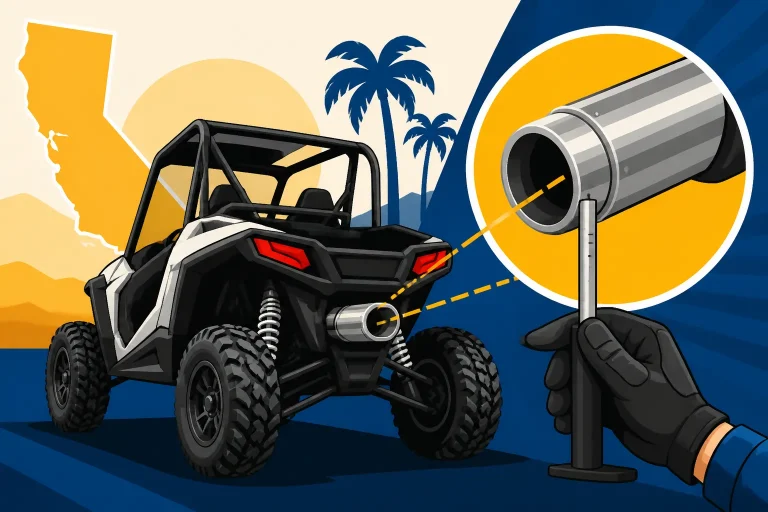
California OHV sound checks use a defined testing procedure rather than a general roadside estimate. A key detail is that the sound meter is positioned a set distance from the exhaust outlet—commonly described as 20 inches—and at a specified angle. The engine is operated at a prescribed speed for the test, and the reading is compared with the applicable limit. Measuring Sound at 20 Inches covers why that distance matters.
This is not the same as measuring from the rider’s seat, standing behind a parked UTV, or checking the sound level from the edge of a trail. A meter placed farther away will often show a different reading. So will a meter pointed toward a different part of the machine, or a test conducted while other engines are revving nearby.
The relevant procedure also specifies how the engine is run during measurement. The appropriate engine speed can depend on the test standard and machine details; guessing at the throttle position can produce a result that is not comparable to an official test. If you are doing a pre-trip check, follow the applicable procedure closely or have the test performed by someone familiar with it. California Sound Test Procedure explains the testing steps.
Why informal sound checks can mislead
A phone app can help you notice that one exhaust setup is louder than another, but it is not a dependable substitute for a calibrated sound meter and prescribed test. Phone microphones vary, and the app may not account for the conditions required for an official reading. A phone can be an early warning tool—not proof that a machine complies.
A handheld meter can also mislead if it is set up incorrectly. For example, a rider might stand at the wrong distance, aim the meter toward the muffler at the wrong angle, or test at an inconsistent engine speed. A low reading under those conditions may create false confidence; a high reading may send the owner chasing the wrong problem.
If you want a rough pre-trip screen, a sound meter sold through retailers such as Amazon may help you spot a change after an exhaust repair or modification. Check what the instrument is designed to measure and how it handles sound levels, but don’t treat a consumer meter reading as an official pass. Use the prescribed procedure and the relevant authority’s instructions when compliance is in question.
Which machines and exhaust setups need extra attention
Older, newer, and competition machines
The common age-based sound limits are a useful starting point, but a machine’s classification can matter. Two vehicles from similar eras may not necessarily fall under the same rule if one is a recreational ATV and the other is a competition machine. A manufacturer’s description, model year, or racing use alone may not settle the question.
Keep the machine’s identifying information available, including its model and manufacturing details. If a test official or riding-area manager asks which category applies, being able to provide accurate information can make the conversation simpler. When the classification is uncertain, don’t insist that the higher limit applies based on a guess; ask which standard the site uses for that machine.
Competition motorcycles and other specialized vehicles can have distinct compliance considerations. If you ride a machine built for closed-course competition, review Competition Machines and California Decibels before assuming that the standard for a recreational ATV or UTV applies. It is better to clarify the rule before a weekend trip than discover a classification issue at the gate.
Aftermarket exhausts and common noise problems
An aftermarket exhaust is not automatically too loud, and a stock exhaust is not automatically quiet enough. The condition of the muffler and the way the system is installed matter. A damaged packing core, loose fastener, missing baffle, poor fit, or leak at an exhaust joint can change both the sound and the test result.
Modifications can also produce an unexpected outcome. A rider may install a system that sounds more refined at idle but becomes much louder under the test conditions. Another may replace a worn component with a part that restores the machine to a quieter condition. Either way, judge the finished setup by its condition and applicable test—not by the product’s description or how it sounds in the driveway.
Before buying a replacement or modification, read the product information carefully and confirm that it fits the exact machine. Listings on Amazon can include products for different years, models, and intended uses, so a part that looks right in a photograph may not be the right fit. For a deeper look at exhaust modifications and testing, see Aftermarket Exhaust and California Sound Checks.
Exhaust leaks, worn packing, and loose parts
A small exhaust leak may be easy to overlook, especially if it appears only when the machine is hot or under load. Listen for a sharp ticking, popping, or hissing sound near a joint, and look for soot marks around connections. These clues don’t establish whether a machine will pass a test, but they can point to a problem that needs attention.
Muffler packing can deteriorate with use. If the exhaust becomes noticeably louder over time, or the tone changes after a hard season of riding, the muffler may need service. A loose heat shield or mounting bracket can add rattles that are not the same as exhaust noise, but the overall sound can still make it harder to identify the real issue.
Do not solve a noise concern by removing required exhaust components or improvising a repair that could come loose on the trail. Use parts intended for the machine, secure the system properly, and have a qualified mechanic inspect damage you cannot diagnose. If the machine has recently been repaired, a careful check before departure is much easier than trying to sort it out at a busy riding area.
How to prepare your ATV or UTV before a ride
Inspect the exhaust at home
Start with a visual inspection while the machine is cool. Check the muffler body, exhaust outlet, joints, clamps, mounting points, and any baffle or insert designed for the system. Look for missing fasteners, cracks, dents, loose connections, or visible evidence of exhaust escaping from a joint.
Next, consider whether the machine’s sound has changed. A sudden increase in volume after a ride, repair, or impact deserves attention. So does an exhaust that rattles, blows smoke or soot around a connection, or sounds different when the engine warms up. Those observations can help you describe the problem to a mechanic, even though they cannot replace a formal test.
If you recently installed an exhaust component, double-check that it is installed according to the manufacturer’s instructions and intended for your exact model. Keep paperwork or product details available if you need to confirm what is fitted. A quick pre-trip check is particularly worthwhile if the machine has been stored for a long time or has just come out of a repair shop.
Measure consistently if you are screening at home
If you use a sound meter before a trip, make the setup as consistent as possible. Use the prescribed measurement distance and angle, minimize background noise, and follow the correct engine-speed procedure for the machine. A repeatable process can help you notice whether a repair or adjustment changed the reading.
Avoid comparing numbers from unrelated situations. A reading taken beside a garage wall is not directly comparable with one taken outdoors. Nor is a test conducted at one engine speed comparable with a reading taken at another. Record the conditions if you are tracking changes, and treat surprising readings as a reason to investigate rather than as a final legal determination.
A consumer meter from a retailer such as Amazon may be useful for this kind of preliminary comparison, but product descriptions and displayed readings do not establish official compliance. If the test result is close to the applicable limit, or if you need confidence before traveling a long distance, arrange a more reliable check using the prescribed method. How a Ranger Measures Your Exhaust Noise describes what riders may encounter during an on-site test.
Plan for the riding area you are visiting
Check the riding area’s rules before the trip, especially if you are visiting a California State Vehicular Recreation Area, public land, or a place where sound checks are conducted. Rules and enforcement practices can differ by site. A rider who is prepared for one area should not assume every other location follows the same inspection process.
A few minutes of checking can prevent an avoidable problem after you have already loaded the trailer. Review the area’s official guidance, confirm whether it has sound-check information, and make sure the machine’s exhaust is in good condition. If your group includes several machines, check each one rather than assuming that similar models will all produce similar readings.
Sound compliance is only one part of getting ready. If you ride on public land, you may also need to consider registration, spark arresters, safety rules, and access restrictions. For example, California Noise Rules at an SVRA Gate focuses on site-level expectations, while California Spark Arrester Requirement Explained covers a separate equipment issue that may also affect whether a machine is ready to ride.
What happens during a sound check
What an official or ranger may look for
A sound check may begin with an inspection of the exhaust system and the machine’s identifying information. The person conducting the test may check whether the system appears complete, whether any parts are loose or missing, and whether the machine is appropriate for the category being tested. An obvious exhaust leak or an unusually loud setup can lead to closer attention.
If a meter test is conducted, the machine should be positioned and operated according to the required procedure. The tester may ask the rider to hold a particular engine speed while the meter is placed in the correct position. Follow instructions carefully; revving harder than requested or moving the machine during the measurement can make the process less reliable.
Stay calm and ask respectful questions if you do not understand what is happening. It is reasonable to ask which test procedure is being used or what category the machine is being evaluated under. Avoid arguing from a phone-app reading or from the fact that another vehicle sounds louder. How a Ranger Measures Your Exhaust Noise offers more context on the encounter.
If your machine fails or is asked to leave
If a machine exceeds the applicable sound limit, the immediate priority is to understand what the riding area requires next. The machine may need to be repaired, tested again, or removed from the riding area, depending on the circumstances and the site’s rules. Ask what options are available before attempting to continue riding.
A failed result is not the time to make an improvised trail-side modification that could cause another problem. If a loose part or obvious leak is the issue, make the repair safely and only if you have the correct components and tools. If the cause is not clear, stop operating the machine and get it inspected rather than repeatedly revving it in an effort to change the reading.
Write down what you were told and what test conditions were used, particularly if you plan to have the exhaust repaired or checked again. A clear account—such as which machine was tested, whether the muffler had recently been serviced, and what noise symptoms you noticed—can help a mechanic focus on the likely cause. For practical next steps, see Failing a Sound Check at a Gate.
Citations and other consequences
A sound-limit violation can have consequences beyond an interrupted ride. Depending on the circumstances and applicable rules, enforcement may involve a citation or other action. The exact outcome can depend on the location, the finding, and the rule being enforced, so do not assume that every site handles a failed test the same way.
If you receive a citation, read it carefully and follow the instructions printed on it. Keep records of any repairs, follow-up testing, and conversations with the relevant authority. If you are uncertain about your options or the legal effect of the citation, ask a qualified professional rather than relying on a rider’s anecdote from a different location.
It is also sensible to avoid treating enforcement as a negotiation over how loud the machine seems. A rider may feel that the test was unfair because the machine is quieter than a friend’s vehicle, but sound is evaluated against the applicable procedure and limit. For an overview of possible enforcement issues, see California Fines for a Loud Machine.
Common misunderstandings about California sound limits
A loud sound is not always a failed test, and a quiet sound is not proof
People hear sound differently. A sharp exhaust note may seem more irritating than a low rumble even if the two machines produce different test results. A rider standing beside the vehicle may also experience the sound differently from a person positioned at the test microphone.
The reverse is true too: a machine that seems quiet around camp could produce a higher reading when operated under test conditions. Engine speed, exhaust direction, and the exact measurement position matter. That is why a casual “it doesn’t sound that loud” judgment is not a dependable way to confirm compliance.
Use your ears to notice changes, not to certify the machine. If the ATV suddenly becomes louder, investigate it. If it sounds normal but you are uncertain about the setup, check the system and test it properly. Treat a reading from an informal test as information—not as permission to ignore a formal result.
Decibels are not a simple volume scale
Decibels are measured on a logarithmic scale, so a small numerical change does not translate into a simple, proportional change in perceived loudness. This can make readings seem counterintuitive to riders who expect each number to represent an equal step in everyday volume.
The reading also depends on the environment and instrument. A meter’s placement, calibration, and settings influence what it records, as can wind, nearby vehicles, and reflective surfaces. Even an apparently precise number is not very useful if the equipment or test setup is wrong.
Focus on the required threshold and test method rather than trying to estimate loudness by comparing numbers from unrelated machines. If you need to understand an official result, ask how the measurement was taken and whether it used the applicable procedure. That is more useful than arguing that the difference between two readings “sounds small.”
A new muffler or an advertised product is not a compliance guarantee
A product description may say that an exhaust is designed for a particular riding style or machine, but that alone does not prove it meets the sound limit for a California OHV test. Fitment, installation, condition, and the actual test result still matter. A component made for racing use may not be suitable for the sound requirements where you plan to ride.
The same caution applies to replacement packing, inserts, and other exhaust parts. Confirm the part is appropriate for the machine, install it as directed, and inspect the system afterward. If you shop on Amazon, verify the exact model compatibility and read the product details carefully rather than relying on a generic listing title.
Keep any product documentation, but don’t treat a receipt or marketing claim as a substitute for testing. A properly installed and maintained exhaust is a sensible starting point; the relevant measurement is what determines whether the machine meets the applicable sound standard.
A practical compliance checklist
Before buying or modifying exhaust parts
- Identify the machine’s make, model, and manufacturing information.
- Confirm which sound-limit category and procedure apply to that vehicle.
- Check that the exhaust component is intended for the exact machine and year.
- Review whether the system includes all required parts, inserts, or baffles.
- Avoid choosing a component solely because it is advertised as louder, quieter, or competition-ready.
- Keep installation instructions and product details for reference.
If you are unsure whether a proposed change will be suitable, ask a qualified mechanic or contact the riding area before making the purchase. This is particularly helpful when the machine has an unusual exhaust setup or may fall under a specialized category.
Before leaving for the riding area
- Inspect the muffler, outlet, joints, clamps, and mounting hardware.
- Look for cracks, soot marks, missing components, or loose parts.
- Listen for a new rattle, leak, or change in exhaust tone.
- If you use a meter, follow the prescribed test procedure and treat the result as a preliminary check.
- Confirm the site’s current sound-check instructions and other equipment rules.
- Bring the machine’s identifying details and repair information if they may help explain its setup.
A short inspection at home can save time and frustration on arrival. It is much easier to discover a loose clamp in the garage than after unloading among other riders and finding out that the machine needs attention before it can be used.
If you receive a high reading
First, ask what limit and test procedure were applied. Confirm that the machine was placed and operated correctly, and make a note of the result and circumstances. A clear explanation is more helpful than a confrontation, particularly if the machine’s category is unclear.
Next, look for straightforward causes such as an exhaust leak, loose connection, missing insert, or deteriorated muffler packing. Do not assume that the meter is wrong, but do not assume that every high reading means the muffler itself is the only problem. Have the system inspected and repaired as needed.
Finally, retest using the applicable procedure before returning to ride. If you want a replacement meter or exhaust component, a retailer such as Amazon may offer options, but verify the product’s specifications and suitability. A retail listing cannot decide which California limit applies or guarantee that the completed machine will pass an official sound check.
Disclaimer
This article is for general informational purposes only and does not constitute professional advice. Laws, prices and regulations vary by location and change over time. Consult a qualified professional for guidance on your specific situation.