Spark Arresters on California Public Land
California’s spark-arrester rules can be confusing because “public land” covers places managed by different agencies, and an OHV’s stock muffler does not automatically prove it has an approved arrester. This guide explains what the device does, where requirements may apply, how to check your ATV or UTV, and what to inspect before riding—so you can avoid arriving at a trailhead with equipment that does not meet the rules.
What a spark arrester does and why it matters
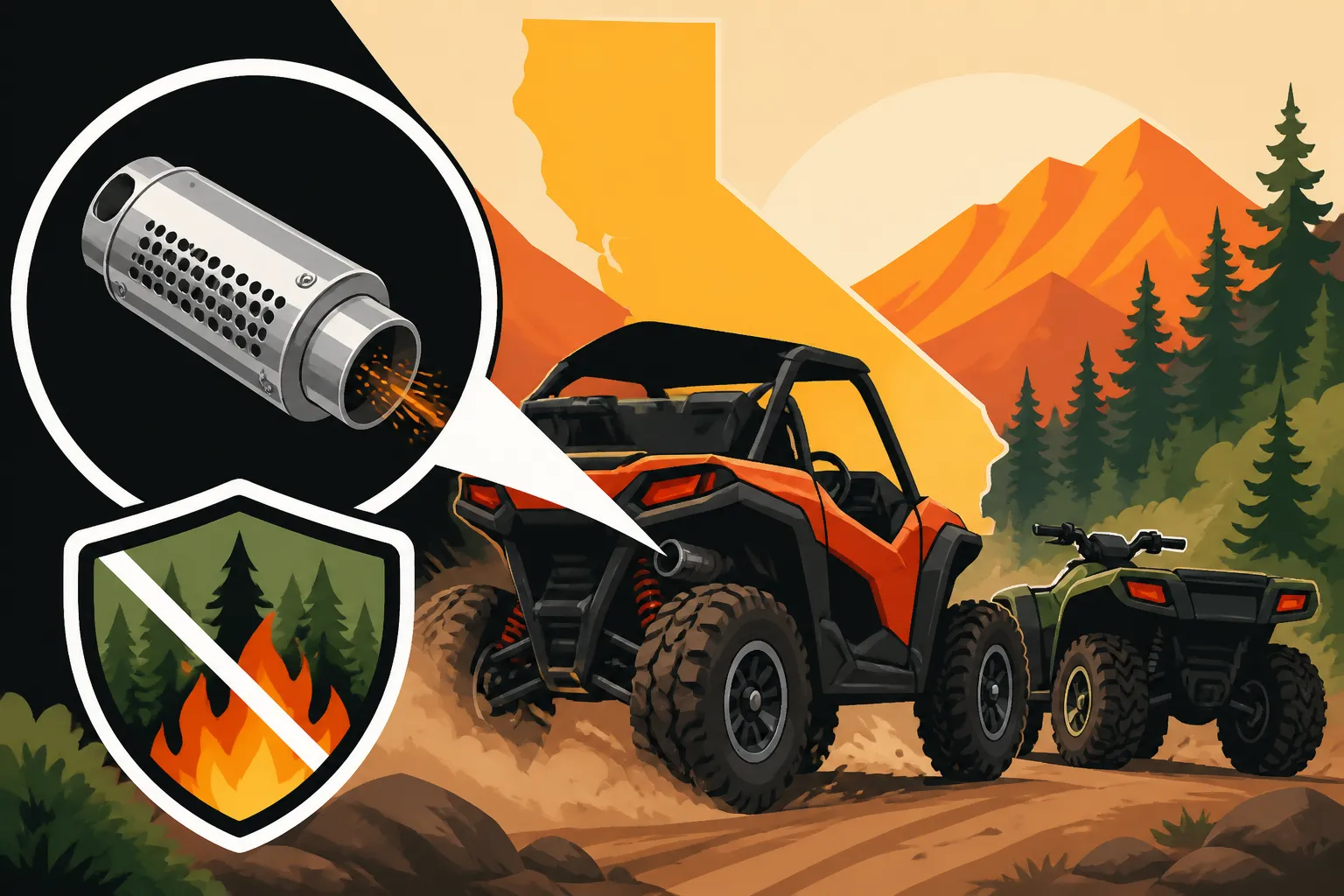
A spark arrester is a device in an engine’s exhaust system designed to prevent hot carbon particles from escaping. Those particles can ignite dry grass, brush, leaves, or other vegetation. An arrester reduces that risk, but it does not make a vehicle fireproof or eliminate every way an OHV can start a fire.
In California, the concern is especially practical during dry and windy conditions. A vehicle may travel through vegetation, park beside dry grass, or stop on ground where heat from the exhaust can become a hazard. A damaged or missing arrester can also let hot particles escape when an engine is under load.
The device is usually part of, or fitted inside, the exhaust system. Depending on the machine, it may be integrated into the muffler, installed as a screen or insert, or supplied as a separate component. You may not be able to identify it just by looking at the outside of the muffler.
A muffler and a spark arrester are not the same thing:
- A muffler reduces exhaust noise. Its basic purpose is to quiet the engine.
- A spark arrester stops or traps hot particles. Its purpose is to reduce the chance that sparks or burning carbon leave the exhaust.
- One exhaust assembly may do both jobs. That does not mean every muffler contains an arrester.
- A quiet exhaust is not proof of compliance. A machine can sound restrained and still have no working spark arrester.
Likewise, a screen that looks like mesh is not automatically an approved arrester. The design, construction, condition, fit, and applicable approval standard all matter. A homemade screen or an insert that happens to fit in the tailpipe may not satisfy the land manager’s requirements.
Spark-arrester rules are one part of riding legally and responsibly. They do not replace registration, permits, route restrictions, sound requirements, or fire-closure orders. For a broader look at the equipment rule, see California Spark Arrester Requirement Explained. If you are riding in brush or other dry vegetation, Riding Brush Land in California covers why conditions and land-manager rules deserve extra attention.
Where California’s public-land requirements may apply
There is no single “public land” rule that should be assumed to cover every trail, park, forest, or recreation area in the same way. Public land in California is managed by different agencies, and the requirements that apply to an OHV can depend on who manages the area, what kind of route you are using, and whether additional fire restrictions are in effect.
For example, a route on National Forest System land may be subject to Forest Service requirements. A state recreation area, a route managed by another agency, and land administered by a different public entity may have their own rules or posted conditions. Some locations also impose temporary restrictions when fire danger is elevated.
That means “I ride there all the time” is not a reliable substitute for checking current requirements. A rule can apply at a particular trailhead, on a particular route, or during a temporary closure even if a nearby area has different conditions. Start with the agency responsible for the place you plan to ride, and check posted notices as well as online information before traveling.
National Forests and other federal land
On National Forest System land, spark arresters are an important equipment and fire-prevention issue. The Forest Service maintains information about qualified spark arresters, and a device’s fit and condition matter as much as its presence. Before a ride, check the relevant forest’s current requirements and confirm that your arrester meets the applicable standard. You can start with Checking the Forest Service Spark Arrester List and California OHV Areas in the National Forests.
Do not assume that a Forest Service list is a universal approval list for every public-land manager. It is useful for checking Forest Service qualification, but a different agency may refer to different requirements or documentation. If you are riding across land managed by more than one agency, check each agency’s rules for the segment you intend to use.
State recreation areas and other managed sites
California’s State Vehicular Recreation Areas and other managed riding areas may have equipment, safety, or fire-prevention requirements. The rules can be presented in regulations, park information, entrance materials, or signs at the location. Check the specific destination rather than relying on a general statement about California riding.
A sticker, registration, or permit does not establish that your machine has the required exhaust equipment. Those documents address different questions. A valid OHV identification or nonresident permit may be needed for riding, while the arrester requirement concerns the condition and configuration of the machine itself. For help sorting out riding credentials, see California OHV Permits Explained.
Temporary fire restrictions
Fire restrictions can change the practical rules for a ride. An area may limit or close certain activities when conditions become hazardous, and a compliant spark arrester does not override a closure. Check the current notices for the land you plan to visit, especially during dry, windy periods or after a change in fire conditions. California Fire Season and Trail Access explains why checking access before leaving home is part of trip planning.
A quick comparison helps clarify what to verify:
| Where you plan to ride | What to check | Why the check matters |
|---|---|---|
| National Forest System land | Forest-specific rules and the applicable qualified-arrester information | Forest Service requirements may apply, and approval is not established by appearance alone |
| State recreation area | Current rules and notices for that location | Site requirements and operating conditions may differ |
| Land managed by another public agency | The managing agency’s equipment and fire rules | “Public land” does not identify one universal set of requirements |
| A route crossing multiple jurisdictions | Rules for each segment and any temporary closures | Compliance in one area does not guarantee compliance in the next |
| Any public riding area during elevated fire danger | Current restrictions, closures, and posted notices | An arrester does not authorize riding during a closure |
When in doubt, contact the land manager before the trip. Give them the machine type, model year, and exhaust or arrester details you can identify. A specific question about your configuration is more useful than asking only whether “ATVs need spark arresters.”
How to confirm your ATV or UTV has the right arrester
Start with the machine’s owner’s manual, then inspect the exhaust and identify the exact muffler or arrester configuration. Do not rely on the model name alone: an exhaust may have been replaced, modified, damaged, or removed by a previous owner.
Check the manual and the parts information
Look for terms such as “spark arrester,” “spark arrestor,” “USFS approved,” or a description of a removable screen or insert. Manufacturers may use different spellings and may refer to the component in a parts diagram rather than in the maintenance section.
If the manual says the stock exhaust includes an arrester, that is a helpful starting point. It is not enough if the machine no longer has the original exhaust or if the arrester has been removed. Compare the installed components with the manual and parts diagram. If there is any mismatch, ask the manufacturer, dealer, or a qualified repair shop to identify what is fitted.
For older machines, secondhand machines, and heavily modified machines, take extra care. An aftermarket muffler may be built for performance or noise reduction without including an approved arrester. The seller’s description, a sticker on the machine, or a claim that “it came that way” is not conclusive.
Look for identification, but do not treat a stamp as the whole test
Some devices or exhaust assemblies have markings that help identify the manufacturer, model, or approval. Record those details and compare them with the appropriate official information. If a mark is absent, hard to read, or inconsistent with the installed part, do not guess.
An identification mark can help establish what the component is, but it does not prove that the arrester is still intact. A qualified device can be damaged, clogged, altered, or replaced with a noncompliant part. Likewise, a generic “spark arrestor” label in a product listing does not necessarily establish that the part is approved for your machine or accepted where you plan to ride.
Use the applicable agency information to verify the device. [California Approved Spark Arrester List] is a useful place to understand the lookup process, while the Forest Service information should be checked when your ride includes National Forest System land. If the model or part number is difficult to identify, ask a dealer or the manufacturer rather than relying on a visual guess.
Verify that the part matches the machine
A device that is approved for one vehicle or exhaust configuration may not be the right part for another. Confirm all of the following before deciding that a replacement is suitable:
- The exact make, model, and model year of the ATV or UTV
- Whether the exhaust is original equipment or aftermarket
- The muffler or exhaust part number
- Whether the arrester is integral or a separately installed insert
- Whether the device is listed or otherwise accepted under the relevant standard
- Whether the machine has been modified in a way that affects exhaust fit or function
This matters because a part can physically fit while still being inappropriate for the machine or the riding location. A universal-looking insert may not have the needed approval, and a correct arrester for the stock muffler may not fit a replacement exhaust.
If the arrester is installed internally, ask a qualified mechanic to verify it rather than dismantling the exhaust without the right tools or service information. If the component is removable, use the manufacturer’s instructions. Improper installation can leave a gap, loosen the insert, or damage the exhaust.
Checking, cleaning, and maintaining the arrester
A spark arrester is not a “fit it once and forget it” component. Heat, vibration, soot, corrosion, repeated cleaning, and exhaust modifications can affect its condition. Build a quick inspection into regular maintenance and repeat it before a trip if the machine has been stored, worked on, or ridden in demanding conditions.
Inspect before the ride
With the engine cool, check the exhaust outlet and any accessible arrester component. Look for signs that the device is missing, loose, bent, cracked, rusted through, or visibly altered. If the machine has a removable screen, check that it is correctly seated and retained according to the manufacturer’s instructions.
Do not inspect a hot exhaust. Exhaust components can remain hot long after the engine has been switched off. Give the machine time to cool, and use the service procedure in the owner’s manual.
A pre-ride check should include more than a glance at the tailpipe:
- Confirm that the installed exhaust is the one you believe it to be.
- Check the arrester’s identification or part details if accessible.
- Look for missing fasteners, gaps, damage, or signs of tampering.
- Confirm that any removable insert is seated and secured.
- Check for heavy carbon buildup or blockage.
- Stop and seek a proper inspection if the condition is uncertain.
If a previous owner removed the arrester to increase exhaust flow, reinstalling a similar-looking screen may not restore compliance. Identify the right approved component for that exhaust and machine.
Clean according to the manufacturer’s instructions
Carbon buildup can obstruct a screen or insert. A blocked arrester can affect exhaust flow and engine performance, while an aggressive cleaning method can damage the mesh or coatings. Follow the manufacturer’s maintenance procedure and use the correct tools and replacement parts.
Do not drill, cut, enlarge, or otherwise alter a screen to improve flow. Do not remove the arrester for a ride because it seems dirty or because the engine runs differently with it out. If cleaning does not restore the device or the screen is damaged, replace it with a compatible part.
After cleaning, reinstall the component exactly as specified and confirm that it is secure. If you cannot tell whether the screen is intact or correctly seated, have a qualified shop inspect it. Replacing a Worn Spark Arrester provides more detail on deciding when cleaning is no longer enough.
Treat modifications as a reason to recheck
Changes to a muffler or exhaust can change whether the original arrester remains in place or whether a different part is required. This includes aftermarket mufflers, replacement end caps, exhaust repairs, and modifications made to improve sound or performance. Ask the manufacturer or installer to identify the exact arrester that works with the modified setup.
A machine that passes a sound check is not necessarily equipped with an approved spark arrester. Sound and spark control are separate issues, and some areas may enforce both. Avoid treating one as evidence of the other.
Similarly, a machine that has a spark arrester may still violate a noise requirement if its exhaust is too loud or modified improperly. Check the local sound rules separately and keep the exhaust in good working order.
Choosing and replacing an arrester
If the arrester is missing, damaged, or uncertain, do not ride on the assumption that a temporary fix will be accepted. Identify the exhaust system and find a replacement designed for that exact configuration. The right purchase is the one that matches the machine, satisfies the relevant approval requirement, and can be installed and maintained as directed.
Find the exact exhaust configuration first
Before ordering, record the machine’s make, model, and model year. Then identify whether the muffler is original or aftermarket. Look for labels, stamped numbers, receipts, service records, and part markings. If you cannot identify the muffler, a dealer or repair shop may be able to help from photographs and the machine’s details.
A replacement arrester should be checked against more than the vehicle’s brand. Verify that the part fits the installed muffler, not merely the original equipment. Also confirm that the part is appropriate for the land manager’s standard. If your ride includes federal land, use the relevant Forest Service information rather than assuming that a product’s retail description is enough.
When using an online marketplace such as Amazon, treat the listing as a lead, not as the final authority. Confirm the manufacturer’s part number and compatibility details, then compare those details with the official or manufacturer information. Marketplace listings can be incomplete or combine fitment information for several models. If the listing does not clearly identify the exact part and machine configuration, contact the seller or manufacturer before ordering.
Amazon search results can help you locate a part or compare listings, but a phrase such as “spark arrester” in a title does not prove qualification. Read the full specifications, check whether the seller identifies the actual manufacturer and part number, and make sure the return terms work for a part that must match a particular exhaust. For a safety-critical or compliance-related component, buying directly from a dealer or the exhaust manufacturer may make identification and fitment easier.
Avoid common replacement mistakes
Some mistakes are easy to make when you are trying to get a machine ready quickly:
- Buying by appearance: Two inserts can look alike but differ in dimensions, retention, or approval.
- Buying only by vehicle model: The machine may have an aftermarket exhaust that needs a different component.
- Assuming “universal” means accepted: A universal fit description is not proof of qualification.
- Using a homemade screen: A mesh insert made from spare material is not a reliable substitute for an approved device.
- Trusting a seller’s broad claim: Ask for the exact manufacturer, part number, and supporting compatibility information.
- Reusing damaged parts: A bent, corroded, cracked, or torn screen should not be treated as sound.
- Riding while waiting for a replacement: A short trip or low-speed ride does not remove the equipment requirement.
If the exhaust itself is modified, replacing only the arrester may not solve the issue. Confirm that the complete assembly is suitable, properly installed, and compliant with the requirements at your destination.
Preparing for a ride and handling an inspection
A little preparation makes it easier to answer questions at a trailhead or during an inspection. You do not need to carry a stack of paperwork for every part, but knowing what is installed and being able to identify it can prevent an avoidable delay.
Before leaving, write down or photograph the arrester and muffler details. Keep the owner’s manual or a digital copy available, especially if the arrester is integrated or difficult to see. If an agency publishes an official qualified-product list, check it before the trip and keep a note of the relevant manufacturer and part number. A photo of a listing is useful for your own reference, but it is not a substitute for a compliant device or an agency’s requirements.
At the riding area:
- Follow posted instructions and any temporary fire restrictions.
- Do not start or park a hot machine in dry vegetation.
- Keep the exhaust system clear of combustible material.
- Do not remove or loosen the arrester to make a machine sound louder or run differently.
- If a ranger or land manager raises a concern, ask what specific requirement or component needs attention.
- If you are unsure whether the machine complies, do not argue from appearance; verify the part and resolve the issue before riding.
A ranger may be able to identify an obvious missing or altered component, but it is better not to depend on an inspection to establish what your machine has. Some arrester designs are internal, and a visual check from the outside may not settle the question. Have the part details ready and consult the applicable agency information.
What to do if you discover a problem at the trailhead
If the arrester is missing, damaged, or cannot be identified, the safest practical choice is to keep the machine off the public riding area until you confirm compliance. Do not try to improvise a repair with hardware-store mesh, wire, or a part that was meant for a different machine.
Depending on the situation, you may be able to replace the insert, have a shop inspect the system, or use another machine that is properly equipped. If the problem is an active closure or a land-manager restriction, a replacement part will not make riding permissible until the area is open and the applicable conditions are met.
The same caution applies when traveling between riding areas. A machine that is acceptable on one route may not meet a different manager’s requirement. If a trip crosses multiple jurisdictions, check the rules for the entire intended route and not just the main riding destination.
A practical pre-ride checklist
Use this checklist before a public-land ride, and repeat the checks whenever the exhaust has been serviced or modified.
- Identify the land manager. Confirm which agency manages the trail, recreation area, or route.
- Check current rules. Review equipment requirements, fire restrictions, and closures for that specific location.
- Identify the exhaust. Confirm whether it is original equipment or aftermarket and record the make or part number.
- Verify the arrester. Check the manufacturer and applicable qualified-product information, particularly for National Forest System land.
- Inspect condition. Look for damage, missing parts, loose fasteners, blockage, or signs of alteration.
- Confirm installation. Make sure removable components are installed and secured according to the instructions.
- Check other requirements separately. Registration, permits, sound rules, and route access are not replaced by a spark arrester.
- Do not ride if uncertain. Get the part verified or repaired before entering the public riding area.
The core principle is straightforward: know what arrester is installed, make sure it is the right one for your exhaust, keep it in good condition, and check the rules for the land you plan to ride. A stock muffler may include an arrester, but the only dependable answer comes from confirming the actual configuration and the applicable agency requirement.
Disclaimer
This article is for general informational purposes only and does not constitute professional advice. Laws, prices and regulations vary by location and change over time. Consult a qualified professional for guidance on your specific situation.