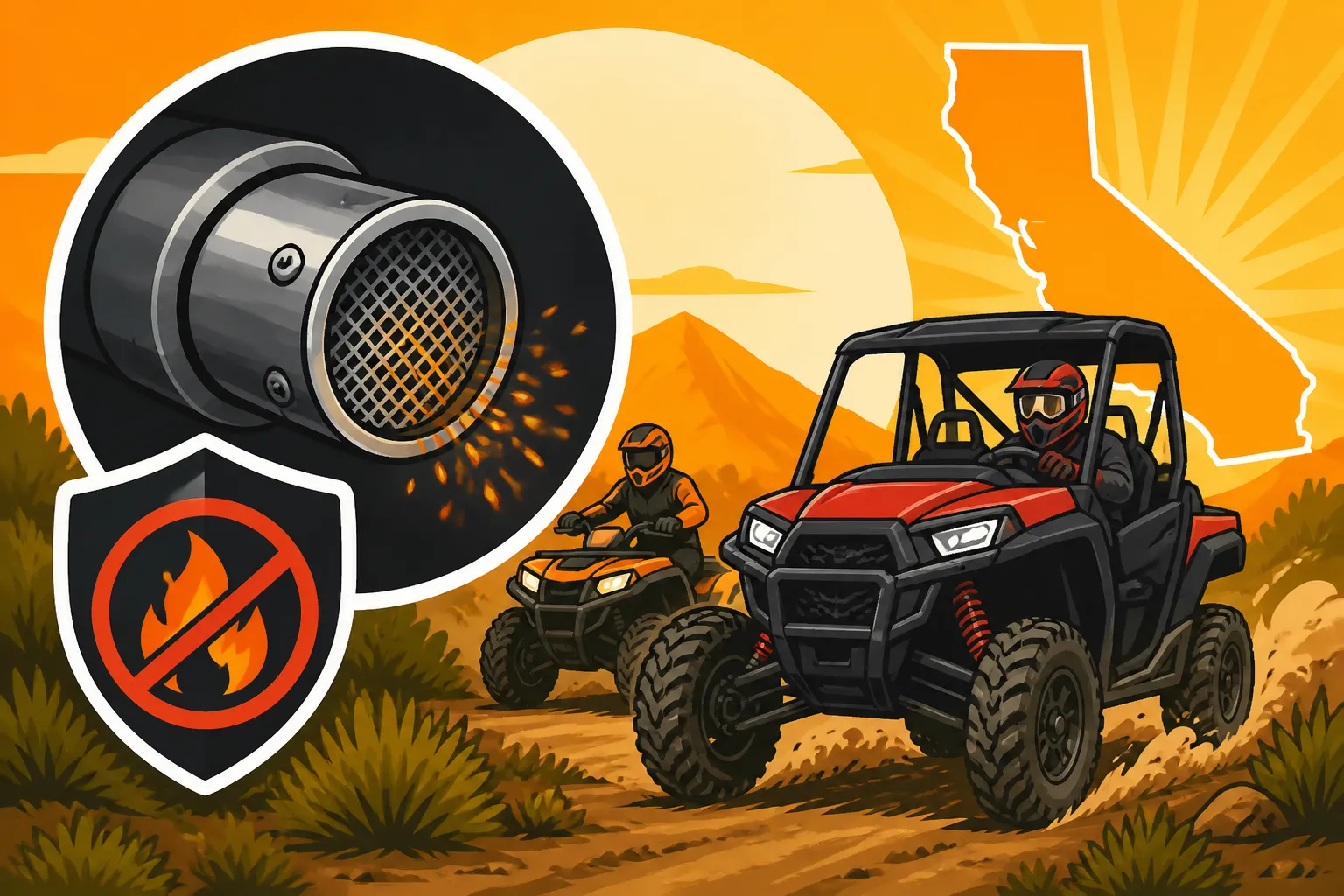
Spark Arresters on California Brush-Covered Land
Spark Arresters on California Brush-Covered Land
A spark arrester can look like a small exhaust part, but riding without an effective one may create a fire hazard and leave you out of compliance on brush-, grass-, or forest-covered land. The confusing part is that requirements can depend on both California law and the land manager’s rules. Here’s how to check your ATV or UTV, keep its arrester working, and avoid assuming a muffler is enough.
When California Requires a Spark Arrester
California’s fire-prevention rules generally require an effective spark arrester on an internal-combustion engine operated on forest-covered, brush-covered, or grass-covered land. That scope matters: the requirement is about the kind of land and the risk of sparks, not simply whether you are riding a named trail or inside a park.
A machine can be on a public or private property and still be subject to fire-prevention rules. Public-land managers may also set their own operating conditions, including requiring a particular type of arrester or checking equipment at an entrance. Treat the statewide rule as a baseline, then check the specific property’s current requirements before riding.
For an ATV or UTV, the key question is whether the exhaust system has an effective device designed to prevent hot particles from escaping. A muffler by itself does not necessarily do that. A stock exhaust may contain a spark-arresting element, but don’t assume that it does—or that a previously installed part is still present and in working condition.
The rule is particularly relevant when a route passes through dry grass, brush, woodland, or other vegetation that can catch fire. A ride may begin on open ground and continue into covered terrain, so checking only the parking area or trailhead can lead to a wrong assumption. If any part of your planned riding area is covered by the rule, verify your machine before you go.
For a closer explanation of the underlying requirement, see California Spark Arrester Requirement Explained. If you ride in vegetation, Riding Brush Land in California can help you think through other fire-related considerations beyond the exhaust system.
Rules differ by land and activity
A state fire-prevention requirement is not the only rule that may apply. National forests, state recreation areas, private riding properties, and other land managers may publish additional restrictions. Seasonal fire conditions can also lead to temporary closures or tighter operating conditions. A machine that was accepted at one location is not automatically compliant everywhere else.
Check the official information for the place you plan to ride, including any alerts or temporary orders. If the rules are unclear, ask the land manager which standard or documentation it expects. Don’t rely only on a forum post, an old trail report, or another rider’s experience from a different site.
It also helps to separate the spark-arrester issue from registration and permit requirements. A Green Sticker, out-of-state permit, or other proof of riding authorization does not establish that your exhaust has an effective arrester. Likewise, having an arrester does not replace any registration, permit, or land-access requirements. For riding in national forests, start with the area-specific information in California OHV Areas in the National Forests.
What Counts as an Effective Arrester
A spark arrester is an exhaust-system component intended to trap or cool carbon particles and other hot material before they leave the exhaust. Its purpose is different from a muffler’s main purpose of reducing exhaust noise. Some exhaust assemblies combine both functions, but one function does not prove the other is present.
Many stock ATV and UTV exhausts include a spark-arresting screen or similar component. Some aftermarket exhausts include one as well. Other replacement systems may not. The only dependable way to know is to identify the exact exhaust and confirm its specifications—not to judge by appearance, sound, or the seller’s broad description of the product.
| What you have | What it tells you | What to check |
|---|---|---|
| A stock exhaust | It may include a spark arrester, but equipment can be removed, damaged, or changed | Check the owner’s manual and the exhaust assembly for your exact model |
| A muffler | It reduces noise, but that alone does not confirm spark-arresting capability | Look for documentation identifying an effective arrester |
| An aftermarket exhaust | It may or may not include a compliant arrester | Confirm the exact part and its approval or standard documentation |
| A removable screen or insert | It may be the spark-arresting element | Check that it is installed, intact, and maintained as directed |
| An exhaust with missing or modified parts | Its original specifications may no longer apply | Restore the specified parts or get clear confirmation before riding |
Approval or compliance information may be printed on the device, included in the manufacturer’s documentation, or listed in an official reference. Markings can be difficult to find, and parts may differ between model years or exhaust versions. If you cannot confirm what is installed, contact the machine or exhaust manufacturer with the model and part details.
The [California Approved Spark Arrester List] and Checking the Forest Service Spark Arrester List can help you understand how to verify a device. A listing is useful only if it matches the part on your machine. Similar-looking products, related model names, and a manufacturer’s general statement about a product line are not a substitute for confirming the exact component.
An arrester is not a noise-control shortcut
A spark arrester does not automatically make a machine quiet enough for the riding area. Noise limits are a separate issue, and a machine can have an effective arrester while still exceeding the applicable sound limit. The reverse is also true: a quiet exhaust is not necessarily equipped with a spark arrester.
Avoid removing an insert or screen to change the exhaust sound or improve flow unless you have confirmed that the resulting setup remains compliant for where you ride. A modification can affect both fire safety and noise compliance. For the separate sound rules, see California Sound Limits for OHVs Explained.
How to Check Your ATV or UTV Before a Ride
Use a model-specific check rather than relying on memory or appearance. This is especially important if the machine is used, has an aftermarket exhaust, or has been serviced by more than one person.
- Identify the machine and exhaust. Record the ATV or UTV make, model, model year, and exhaust manufacturer or part number. If you don’t know whether the exhaust is stock, compare it with the owner’s manual or ask a dealer or qualified repair shop.
- Check the manual and manufacturer information. Look for directions about the spark arrester, inspection, cleaning, and replacement. Confirm whether the exact exhaust assembly includes the required component.
- Inspect the installed parts. With the machine fully cool, check that the arrester or insert is present and secured as specified. Look for a missing fastener, a damaged screen, an altered outlet, or signs that a component has been removed.
- Confirm the relevant standard or approval. If the land manager requires an approved arrester, check its stated requirements and compare them with documentation for your exact device. Don’t assume a part is acceptable simply because it fits.
- Check the riding location. Review rules and alerts for the land you will use. Confirm whether the area has additional requirements, fire restrictions, or a closure.
- Maintain the arrester as directed. Carbon buildup can obstruct a screen or interfere with exhaust flow. Follow the manufacturer’s cleaning instructions and recheck that the device is correctly reinstalled.
A common mistake is to inspect the tailpipe and decide that the machine is fine because there is no obvious damage. An internal screen may be missing, clogged, or replaced with a part that does not meet the relevant requirement. Another mistake is to rely on a label from a different exhaust component. Verify the full assembly and the part that is actually installed.
If you buy a replacement, match it carefully to the machine and exhaust. A dealer or exhaust manufacturer can help confirm fit and compliance. Amazon may have replacement screens and exhaust components, but a product listing is not proof that a specific part is approved or suitable for your machine. Check the manufacturer’s part number and documentation before ordering, then make sure the component is installed as directed.
If documentation is unclear
Do not guess when the part’s identity or status is uncertain. Take clear photos of the exhaust and any markings, record the machine’s model information, and contact the manufacturer or land manager. A repair shop familiar with your machine may be able to identify the exhaust, but ask for the part number or documentation rather than accepting a general assurance.
If you cannot confirm that the machine has an effective arrester, the safer option is to have it inspected or repaired before entering covered terrain. A quick check at home is easier than discovering at a gate that the equipment is missing—or worse, creating a fire risk while riding.
Maintenance, Modifications, and Common Problems
Spark arresters need attention. A device that was compliant when installed may not remain effective if it is damaged, clogged, removed, or altered. Follow the maintenance schedule and procedure in the owner’s manual or exhaust manufacturer’s instructions. Different designs may require different cleaning methods, so avoid improvising with tools or solvents that could damage the screen or housing.
Inspect the component when the engine and exhaust are cool. Look for a screen or insert that has come loose, broken, corroded, or been replaced with an unsuitable part. Check that fasteners are secure and that the component has not been modified. If you find damage or heavy buildup, use the manufacturer’s repair or replacement procedure rather than continuing to ride on the assumption that the arrester still works.
Aftermarket exhausts deserve particular scrutiny. A performance exhaust may be supplied with an arrester, sold with an optional insert, or offered in versions with different equipment. A similar model name does not guarantee the part on your machine is the right one. If the insert is removable, confirm that it is installed whenever the rules require it. Keep the product information and part number with your machine records.
Other changes can complicate the check. A previous owner may have removed a screen, changed the muffler, or altered the outlet. A used machine can look close to stock while having a different internal setup. If you are buying a used ATV or UTV, ask what exhaust parts have been changed and request the documentation. The inspection advice in Checking the Forest Service Spark Arrester List is useful when a component needs to be matched against an official reference.
Noise and spark-arrester rules can also pull in different directions for riders considering an exhaust modification. Changing the exhaust may reduce or increase sound, but it does not excuse a missing arrester. Check both requirements before making a change, and keep the original parts if they are still in good condition. For more on the sound side of that decision, use California Sound Limits for OHVs Explained.
Finally, don’t treat an arrester as permission to ride carelessly. It reduces one potential source of ignition; it does not remove all fire risks. Hot exhaust parts, dry vegetation, leaks, mechanical problems, and changing fire conditions still matter. Follow posted restrictions, stay on permitted routes, and leave the area if conditions or closures make riding unsafe.
What to Do at a Riding Area or Checkpoint
Before loading up, check the area’s official page or contact the land manager. Look for equipment requirements, temporary fire restrictions, and closure notices. If you are traveling to a different kind of property than you usually ride, check its rules separately. A device accepted at one riding area may not satisfy another manager’s requirements.
Bring the machine in the condition you intend to ride. Make sure the arrester is installed and secure, and carry the owner’s manual or product information if the component’s identity may be questioned. Documentation can help explain what is installed, but it does not make a missing or unsuitable part acceptable.
At a checkpoint, answer questions directly and follow the ranger or staff member’s instructions. If the device cannot be verified, ask what documentation or correction is needed. Don’t remove or reinstall parts in the parking area without understanding the manufacturer’s instructions and the land manager’s requirements.
If a ranger or official tells you that the machine does not meet the applicable rule, do not ride into the covered area and hope the issue will be overlooked. Ask whether you may correct the problem or need to leave. A failed check can mean a delayed trip, a citation, or being turned away; the exact consequence depends on the applicable law and site rules.
A spark arrester is one part of being ready to ride, not a substitute for checking access conditions. Confirm your registration or permit, review any seasonal notices, and follow local route restrictions. If you are unsure which rules apply, ask the land manager before the trip rather than relying on assumptions made at the trailhead.
Frequently Asked Questions
Does every ATV or UTV in California need a spark arrester?
The general fire-prevention requirement applies to internal-combustion engines operated on forest-, brush-, or grass-covered land. The rules for a specific place can add requirements, so check the land manager’s instructions as well.
Is a muffler the same thing as a spark arrester?
No. A muffler primarily reduces noise. An exhaust system may combine a muffler and an arrester, but a muffler alone does not confirm that an effective spark arrester is installed.
Does a stock exhaust always have an arrester?
Not necessarily. Equipment can vary by model and may have been removed or changed. Check the owner’s manual and manufacturer information for your exact machine and exhaust, then inspect the installed parts.
Can I ride if I’m not sure whether the screen is approved?
Don’t assume it is acceptable. Confirm the exact part with the manufacturer and check the land manager’s requirements. If you cannot verify it, have the exhaust inspected or corrected before riding in covered terrain.
Disclaimer
This article is for general informational purposes only and does not constitute professional advice. Laws, prices and regulations vary by location and change over time. Consult a qualified professional for guidance on your specific situation.