ROV Operators at Sixteen in California
A 16-year-old may be able to drive a recreational off-highway vehicle (ROV), commonly called a side-by-side, on California off-highway land. But turning sixteen is not the only requirement: youth safety rules, adult supervision, the vehicle’s age label and its permit or registration all matter. Here’s how to check the details before you head out.
Can a 16-Year-Old Drive a Side-by-Side in California?
In general, a 16-year-old can operate an ROV off highway in California if the applicable youth safety requirements are met. A regular driver’s license is not the same as an OHV safety certificate, and having one does not automatically replace the certificate or supervision requirement.
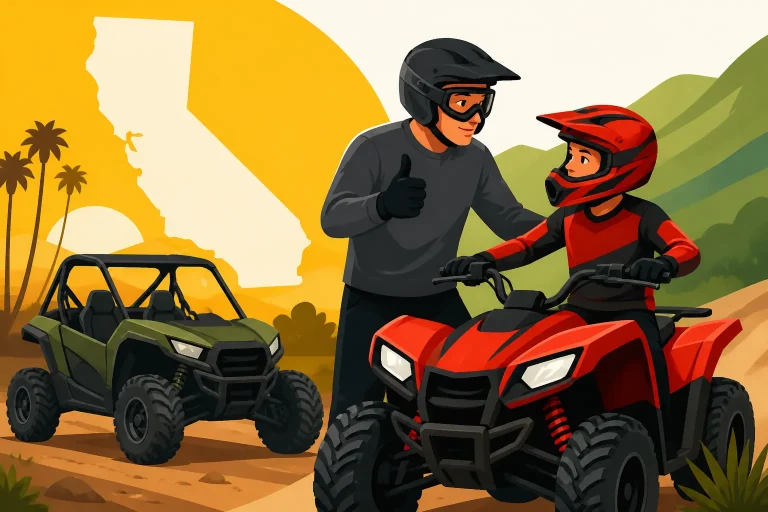
California’s youth rules apply to off-highway riding on public land. For riders under 18, the key question is whether the young operator has the required safety certificate or is riding under the direct supervision of a qualified adult. The details matter: a parent in the camp area or following somewhere on the trail is not necessarily direct supervision.
A practical starting point is to check whether the 16-year-old has a California-recognized OHV safety certificate. If not, find out whether the adult who will supervise meets the applicable requirements and can remain directly involved in the ride. The state’s rules for minors are covered in more detail in [California Rules for Riders Aged 14 to 18] and Direct Supervision by a Certified Adult in California.
| What to check | Why it matters for a 16-year-old |
|---|---|
| Safety certificate | A certificate may meet the youth safety requirement; a driver’s license alone does not establish OHV training. |
| Adult supervision | If the young rider does not have the required certificate, a qualifying adult may need to supervise directly. |
| Vehicle age label | The ROV’s label and owner’s manual may set a minimum operator age for that particular machine. |
| Vehicle identification | The ROV must have the identification, registration or permit required for the land and the rider’s situation. |
| Route and land rules | Permission to drive an ROV does not mean every road, trail or area is open to it. |
Do not treat a birthday as a blanket permission to drive any side-by-side. A machine can be too large, powerful or unsuitable for a young operator even if the rider meets California’s general age and training requirements. Follow the vehicle’s safety labels and the owner’s manual, and choose a machine the rider can control comfortably.
Also separate off-highway driving from driving on a public road. California’s OHV rules do not give a 16-year-old permission to drive an ROV on ordinary streets. Any road use has separate requirements, and most side-by-sides are not made street legal simply by having a permit or OHV registration. For more on that distinction, see Why California Will Not Convert a UTV.
Safety Certificates and Adult Supervision
A safety certificate and adult supervision are not interchangeable in every situation. The certificate shows that the rider has completed recognized safety training. Supervision is an alternative route where the rules allow it, but the adult must qualify and supervise in the required way.
Before the ride, establish which route applies:
- Check the rider’s age and certificate. Confirm that the certificate is for OHV operation and is accepted for the kind of riding planned. A driver’s license, school course or general online safety certificate may not satisfy California’s OHV requirement.
- If there is no qualifying certificate, check the supervision rule. Confirm that the supervising adult holds the required certificate and will be close enough to provide direct supervision, not just available by phone.
- Check the vehicle’s age label. A machine’s manufacturer label and manual may specify the minimum age for operation. Do not disregard that limit because a young rider has a certificate or an adult is present.
- Carry proof. Bring the certificate or other required proof and keep it accessible. A photo may be useful as a backup, but do not assume a digital image will be accepted in every situation.
- Ask the riding area if its rules add conditions. Land managers, organized rides and rental companies can have additional requirements.
The certificate requirement is about safe operation, not the vehicle’s registration. A sticker or permit on the ROV does not prove the person driving it has met youth training rules. Likewise, a safety certificate does not make an unregistered machine legal to ride on public land.
Visitors should check whether a certificate earned outside California is accepted before traveling. Recognition can depend on the course and credential; do not assume that any card from another state or a general internet course will qualify. The practical steps are explained in Out-of-State Safety Certificates in California and [California ATV Safety Certificate Requirements].
The certificate requirement is also distinct from an area’s age rules for specific activities. A park, event organizer or rental operator may set stricter conditions than the statewide baseline. Ask about those conditions when booking or planning, especially if the young driver will be using a rented machine.
Match the Rider to the ROV
A legal minimum age is not the same as a recommendation that a particular machine is appropriate for a particular teenager. ROVs vary considerably in weight, size, power, handling and passenger capacity. A 16-year-old who can operate a smaller machine may not yet be ready for a larger, faster one.
Start with the manufacturer’s label and owner’s manual. Look for the stated age recommendation, passenger limits, seat-belt instructions and any restrictions on intended use. If the label sets a minimum age above the rider’s age, do not try to work around it with adult supervision. If the label permits the rider’s age, that still does not guarantee the rider is ready to handle the machine.
Before riding, the young operator should be able to:
- Reach and use the controls without stretching or losing a secure seating position.
- Fasten and adjust the seat belt correctly.
- Understand how the steering, throttle, brakes and gear selection work.
- Follow instructions about speed, terrain, passengers and stopping.
- Recognize when a slope, rut, soft surface or crowded trail is beyond their ability.
- Stop and ask for help rather than continuing after a problem.
The adult should also explain where the ROV may go and where it must not go. A teenager should know how to respond if the machine is stuck, damaged, low on fuel or separated from the group. Agree on simple signals and stopping points before entering a busy trail area.
Passengers need special attention. Do not carry more people than the ROV is designed and equipped to carry, and make sure every passenger uses the seat belt and seat provided. A passenger’s presence does not make an inexperienced operator safer; it can add distraction and change how the vehicle handles. California has separate rules and safety concerns for ROV passengers, so review Side-by-Side Passengers and California Rules before taking a group out.
Protective equipment and operating habits matter even when the rider has completed a course. Use a properly fitted helmet where required, along with eye protection, sturdy clothing and footwear. Keep hands and feet inside the vehicle, use the seat belts, and never let a rider operate after drinking alcohol or using drugs. An adult should supervise the ride, not assume that a certificate means the teenager needs no guidance.
For a rented machine, confirm the rental company’s minimum operator age and paperwork requirements before paying or arriving. A rental business can set conditions that are stricter than the general legal minimum, and the person named on the rental agreement may remain responsible for the machine. See California Rules for a Rented Machine for related rental considerations.
Permits, Registration and Reciprocity
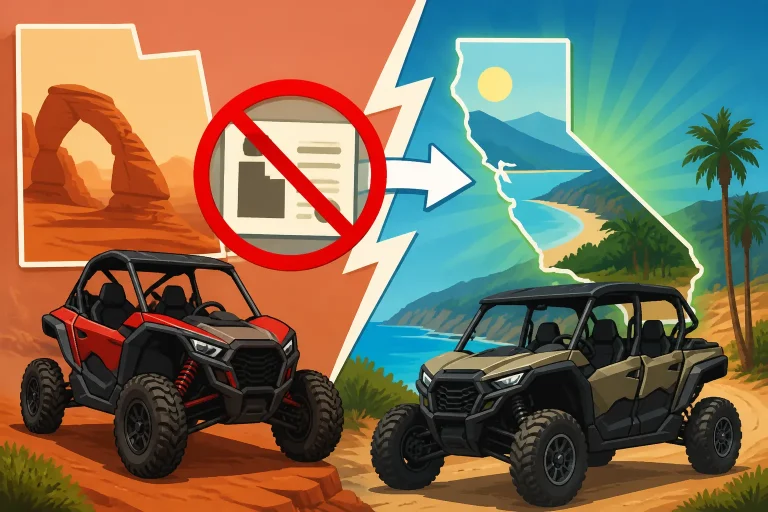
A young operator’s safety qualification is only one part of being ready to ride. The ROV itself also needs the correct identification or permit for its status and the place where it will be used. California’s OHV identification rules can differ for California-registered machines and machines brought in from another state.
For a nonresident, do not assume that an out-of-state registration, plate or decal automatically satisfies California’s off-highway identification rules. California’s reciprocity is limited. Valid OHV identification from Oregon and Nevada is treated differently from identification from other states; riders whose machines do not qualify may need a California nonresident OHV use permit. Check the requirements for the specific machine before traveling. California Nonresident OHV Use Permit and Why Only Oregon and Nevada Count in California explain the distinction.
A few points help keep the paperwork straight:
- A vehicle permit is not an operator certificate. It relates to the machine’s identification or permission to use it, not the driver’s age or training.
- A safety certificate is not registration. It does not replace the identification required for the ROV.
- A license plate is not always enough. A street-legal plate from another state does not necessarily satisfy California’s OHV rules or allow the machine on a particular trail.
- A valid permit does not open closed land. Trail designations, closures, vehicle-width limits and local restrictions still apply.
Bring the machine’s registration or identification paperwork, the required permit if applicable, and the young operator’s certificate or supervision documentation. Keep the documents available during the trip rather than leaving them at home or in a vehicle parked far from the riding area. For a broader list of items to carry, see What a Rider Under 18 Must Carry in California.
Before leaving, verify the requirements with the official source or land manager for the place you plan to ride. Registration status, permit rules and access conditions are separate questions, and a change in one does not automatically resolve the others. If a trip includes more than one state or riding area, check each destination rather than assuming the same documents will work everywhere.
A Pre-Ride Check for Families
For a family planning a ride with a 16-year-old at the wheel, a short check before departure can prevent a wasted trip or a risky mismatch between rider and machine.
- Confirm the riding area is open to the ROV. Check route designations, closures, width limits and any area-specific restrictions. Do not rely on a general map or a previous visit if conditions may have changed.
- Confirm the operator requirement. Identify whether the teenager will use a safety certificate or ride under qualifying direct supervision. Check that the certificate or adult qualification meets California’s requirements.
- Read the machine label and manual. Verify age guidance, passenger capacity and operating instructions for the exact model.
- Confirm the machine’s identification. Check its California registration or OHV identification, or determine whether a nonresident permit is needed.
- Agree on boundaries and supervision. Set a route, a pace and a clear plan for staying together. Make sure the young driver understands that the supervising adult can stop the ride at any time.
- Inspect the equipment. Check seat belts, brakes, tires, steering and lights as appropriate. Fit helmets and eye protection before starting.
- Carry the documents. Keep required certificates, permits and vehicle papers where they can be produced if requested.
If any part of the plan is unclear, resolve it before riding. The safest time to discover that a permit is missing, a course is not recognized or a machine is unsuitable is before the trailer is unloaded.
Frequently Asked Questions
Does a 16-year-old need a driver’s license to drive an ROV off highway?
A regular driver’s license is not a substitute for an OHV safety certificate or the supervision required for a young operator. Off-highway operation and public-road driving have different rules. Do not assume an OHV permit authorizes road use.
Can a 16-year-old drive a rented side-by-side?
Possibly, but the rental company may set a higher minimum age or require particular documents, training or adult involvement. Confirm the company’s rules for the exact machine and rental location before booking.
Does an out-of-state safety card count in California?
It may, depending on the credential and course. Check whether the specific card is accepted before the trip; a generic online course or driver’s license should not be assumed to qualify.
Does the ROV’s permit mean the teenager can drive it?
No. The vehicle’s permit or registration concerns the machine. The operator must separately meet the applicable age, safety training and supervision rules.
Disclaimer
This article is for general informational purposes only and does not constitute professional advice. Laws, prices and regulations vary by location and change over time. Consult a qualified professional for guidance on your specific situation.