Why an Arizona Registration Will Not Do in California
An Arizona registration can make your quad or UTV properly registered for use in Arizona, but it does not automatically meet California’s off-highway identification rules. If you’re bringing an Arizona machine to ride California trails or dunes, the key question is whether California recognizes the credential you have. Here’s how reciprocity works and what to sort out before you unload.
What Arizona registration does and does not prove
“Registration” can mean different things. A highway license plate, an Arizona off-highway decal, and a California nonresident OHV permit are not interchangeable documents. Each has a specific purpose, and having one does not necessarily satisfy the rules for another state or type of riding.
For an Arizona quad or side-by-side, registration may show that the machine has met Arizona’s requirements for the kind of use covered by that registration. It does not, by itself, establish that California has accepted the machine’s off-highway identification.
A road plate is not an OHV permit
A street-legal plate is for highway use. It does not give you permission to ride a public OHV trail, cross closed land, or take an otherwise off-highway machine onto a California route. Nor does a plate automatically replace any off-highway permit required where you plan to ride.
The reverse is true as well: an OHV permit does not make a quad or UTV street legal. It is not a substitute for the registration, equipment, insurance, or licensing requirements that may apply when a vehicle is operated on a public road.
If your Arizona machine has both a highway plate and an off-highway credential, check which credential California requires for your planned use. If you intend to ride off-road, a plate alone is not a safe assumption. Why a Street-Legal Plate Does Not Substitute
Off-highway riding is the part that changes the answer
California generally requires an OHV to display valid California identification or a qualifying nonresident permit when it is operated in places where off-highway identification is required. The permit question is separate from whether the machine can be driven on a road.
Think about your trip in two parts:
- Getting to the riding area: You may need to transport the machine on a trailer, or operate it on roads only if it is legally equipped and registered for that use.
- Riding off-road: You need the appropriate off-highway identification for the machine and the area, along with any separate park or land-use permissions.
A street-legal Arizona UTV may be allowed to travel on certain roads under applicable rules, but that does not mean its Arizona plate covers the off-highway portion of the trip. California OHV Permit for Out-of-State Riders
Why Arizona registration does not qualify for California reciprocity
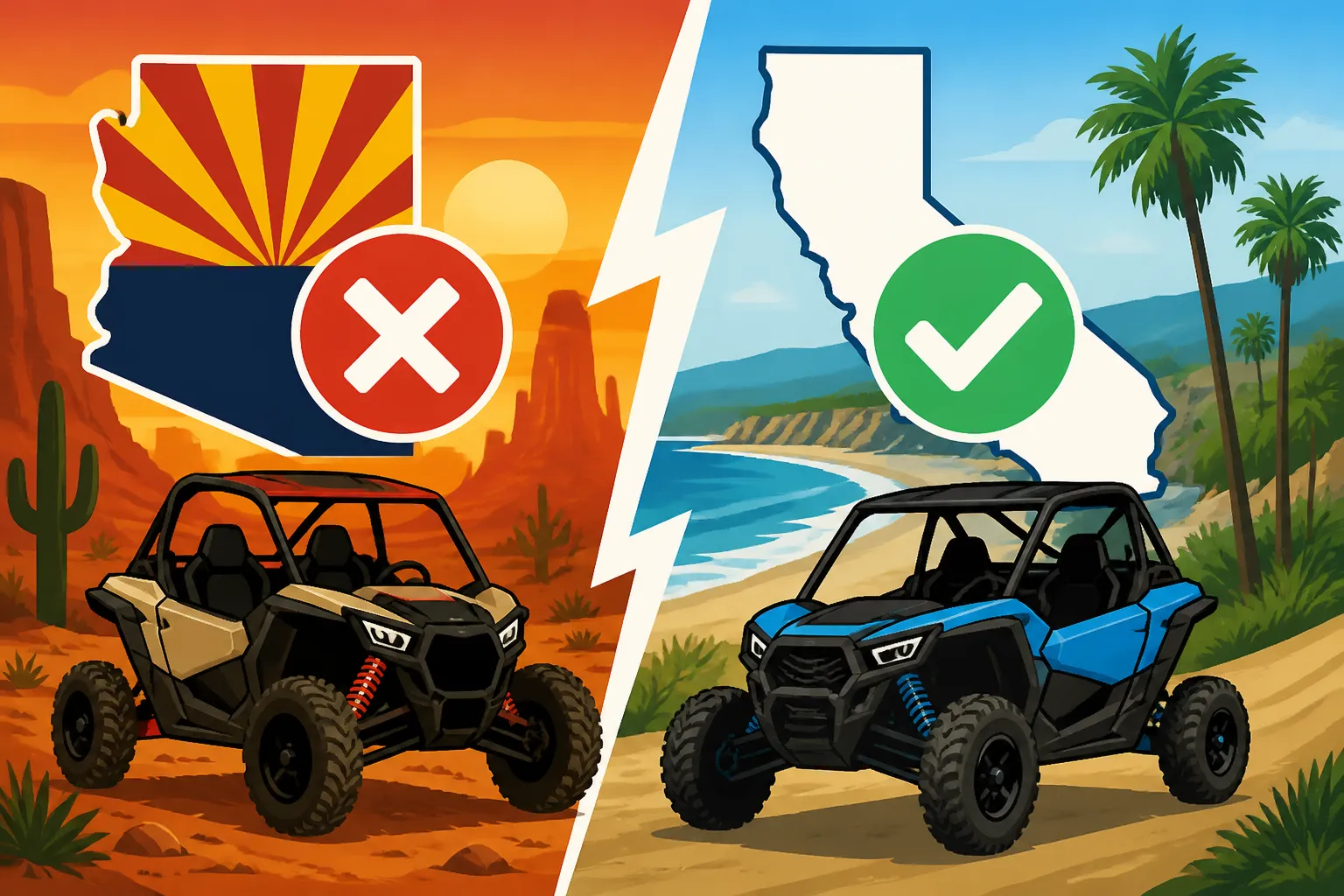
California does not accept every state’s ATV or UTV credential as a substitute for its own nonresident permit. The state’s reciprocity arrangement is limited. Qualifying Oregon and Nevada OHV credentials may be recognized under the applicable rules, but Arizona registration is not included in that reciprocity.
That distinction catches visitors who assume that a state-issued plate or decal must be accepted everywhere. Reciprocity is not a general agreement to honor any state’s vehicle paperwork. It depends on which states and which types of OHV credentials California recognizes. California OHV Reciprocity: Only Two States
The Arizona document may still be valid in Arizona
If your Arizona paperwork is current and valid, it can still serve its purpose at home. The problem is not necessarily that the document is invalid. The problem is that California does not treat Arizona registration as one of the qualifying credentials for satisfying its nonresident OHV identification requirement.
For example, an Arizona highway plate may support lawful road use under the rules that apply to the vehicle. An Arizona OHV credential may support off-highway use under Arizona’s system. Neither should be assumed to replace the California permit required for an Arizona machine ridden off-highway in California.
| What you have | What it generally establishes | Does it replace California’s nonresident OHV permit for Arizona visitors? |
|---|---|---|
| Arizona highway plate | Highway registration for the uses covered by that registration | No, not for off-highway identification where California requires it |
| Arizona OHV credential | An Arizona off-highway credential | No, Arizona is not among the qualifying reciprocity states |
| Qualifying Oregon OHV identification | A state OHV credential that may qualify under California reciprocity rules | Potentially, if the credential and machine meet the applicable requirements |
| Qualifying Nevada OHV identification | A state OHV credential that may qualify under California reciprocity rules | Potentially, if the credential and machine meet the applicable requirements |
| California nonresident OHV permit | California’s required nonresident identification for qualifying out-of-state machines | Yes, for the OHV identification requirement it covers |
The word “potentially” matters for reciprocal state credentials. A state plate is not necessarily the same thing as that state’s OHV permit or decal. Make sure the credential is the specific type California recognizes, is current, and is displayed as required. Why Only Oregon and Nevada Count in California
A California permit does not make every machine or route eligible
Getting the right nonresident permit solves one part of the problem: the machine’s California OHV identification. It does not automatically settle questions about where the machine may ride, whether a route is open, or whether the vehicle meets other applicable rules.
Land managers can close routes or impose restrictions for reasons unrelated to registration. A permit also does not override equipment requirements, age and supervision rules, sound limits, spark-arrester rules, or restrictions for a specific riding area. If you’re going to a particular park or desert, check its current requirements separately.
How to prepare an Arizona quad or UTV for California
The practical fix is usually straightforward: determine whether California’s nonresident OHV permit applies to your machine, obtain the correct permit if required, and confirm the riding area’s separate rules. Do this before the trip rather than counting on a ranger or gate attendant to interpret your Arizona paperwork on the spot.
A step-by-step check
-
Identify how the machine is registered.
Separate highway registration from off-highway identification. If you have more than one document or decal, note exactly what each one is for. -
Confirm whether you’ll ride off-highway.
If you’re only transporting the machine, the permit question may differ from a trip where you plan to ride it on a trail, in a riding area, or across public off-highway land. Don’t confuse towing a machine with operating it. -
Check whether your credential qualifies for reciprocity.
Arizona is not one of the states whose qualifying OHV identification California recognizes through its limited reciprocity arrangement. If you’re unsure whether a particular credential counts, check California’s official OHV permit information rather than relying on a seller’s description or a friend’s experience. Does California Honor Arizona OHV Registration? -
Get the California nonresident permit if required.
Use the official program information or an authorized seller to confirm the current application process, cost, validity period, and display instructions. Requirements and fees can change, so verify the details for your trip. How to Buy a California Nonresident OHV Permit -
Check the riding area’s own rules.
The permit may not cover day-use charges, camping, vehicle-entry requirements, or a separate area permit. If your destination is the Imperial Sand Dunes, for example, check its current permit requirements as well as the California OHV identification rules. California Rules for Riding Imperial Sand Dunes -
Carry proof and make the permit easy to inspect.
Keep the required permit displayed as instructed and carry any paperwork the program tells you to retain. A clear photo or digital copy can be useful backup, but don’t assume it replaces a physical decal or document if the rules require one.
A third-party listing on Amazon or another marketplace is not proof that an item is an official California permit. Buy or obtain the permit through the official process or an authorized seller, and confirm that it is the right permit for your machine.
Keep different permits separate in your planning
Visitors sometimes use “permit” to mean several different things. It helps to name each one:
- California nonresident OHV permit: Covers the applicable California OHV identification requirement for an eligible out-of-state machine.
- Riding-area or recreation permit: May be required by a particular site or land manager.
- Day-use, camping, or parking authorization: Covers access or a stay, not vehicle identification.
- Highway registration: Applies to road use under the rules for that vehicle, not as a blanket OHV authorization.
A California nonresident OHV permit does not turn into a parking pass, campsite reservation, or permission to ride a closed route. When checking an area’s rules, ask specifically about the permit for the machine, the permit for the site, and any extra requirements for the tow vehicle.
If you need a simple way to keep paperwork together, a waterproof document sleeve can help protect registration papers and permit instructions from sand or mud. Amazon may be one place to look for a sleeve, but the sleeve itself does not replace any document or decal the rules require.
Common Arizona-to-California riding situations
The right answer depends partly on how you’re using the machine. These examples show why it is worth separating highway status, OHV identification, and access rules instead of treating “registered” as a complete answer.
You have an Arizona plate and are heading to a California trail
If you plan to unload the quad and ride an OHV trail, do not assume the plate alone is enough. Check whether the vehicle needs California’s nonresident OHV permit and whether the destination has additional requirements. A plate can be relevant to road operation without satisfying off-highway identification rules.
Your UTV is street legal in Arizona
A street-legal configuration may matter when you’re operating the UTV on roads where it is permitted. It does not create a general right to ride on California trails or public land. Confirm the road rules for any route you plan to use, then separately confirm the OHV identification and land-access rules for the off-road portion.
If your plan involves riding directly from a road onto a trail or open area, make sure the connection is actually legal. A route that looks passable on a map may be closed, private, or limited to a different class of vehicle.
You’re towing the machine to a riding area
If the ATV or UTV stays on the trailer, that is different from operating it off-road. Once you unload and ride, the applicable OHV identification rules come into play. Keep the machine’s documents with your trip paperwork so you can check them before unloading rather than discovering a problem at the entrance.
You’re riding on private property
Private land is not a universal workaround. Permission from the landowner matters, and local requirements or other restrictions may still apply. A private property owner’s invitation does not grant access across neighboring property or onto a public route that is closed to OHV use. When in doubt, ask the property owner and check the rules that apply to the specific land.
You’re renting rather than bringing your own machine
With a rental, ask the rental company what identification and permits are supplied, what is included in the rental agreement, and where the machine may be operated. Don’t assume that the rental company’s paperwork covers every separate access or recreation permit for the destination. Riding a Rented Quad in California
You’re taking a child or teen along
The machine’s registration and permit are only part of the preparation. California has separate rules for younger riders, supervision, and safety certificates. Check those requirements for the rider’s age and the type of vehicle before the trip. What a Rider Under 18 Must Carry in California
Avoiding a permit problem at the gate
A little preparation can prevent a frustrating trip, especially if you’re towing a long distance or traveling with several machines. Use this checklist before leaving Arizona:
- Confirm whether each machine will be ridden off-highway in California.
- Check whether the credential you have is a highway plate, an OHV credential, or both.
- Do not treat Arizona registration as qualifying California OHV reciprocity.
- Obtain the California nonresident OHV permit when required, using the official process or an authorized seller.
- Read the permit instructions for how it must be displayed and what proof to carry.
- Check the destination’s current access, parking, camping, and recreation-permit rules.
- Make sure the route to the riding area is open to your type of vehicle.
- Review any separate requirements that apply to riders, equipment, or the machine itself.
A small attachment kit can be useful if a decal or plate needs secure mounting, and Amazon may offer general hardware or protective accessories. But do not improvise the required location or covering: follow the permit’s display instructions so it remains visible and legible. Keep a spare fastener or two with your tools, especially for a sandy or rough trip.
Likewise, buying a flag, goggles, or other riding gear online—including through Amazon—can help you get prepared, but gear does not correct a registration or permit gap. Treat safety equipment and vehicle authorization as two separate checklist items.
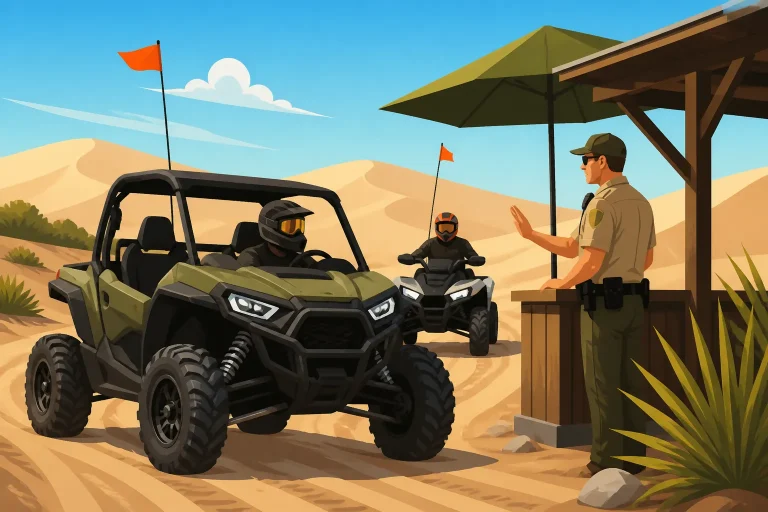
If a gate attendant or ranger asks for proof, present the credential that applies to the machine’s current use. A highway plate may answer a question about road registration; it does not necessarily answer whether the machine has the required California off-highway identification. Carrying Registration Paper on the Sand
The bottom line
An Arizona registration may be valid for the uses Arizona allows, but California does not treat Arizona as a reciprocity state for its OHV identification requirement. For an Arizona quad or UTV that will be ridden off-highway in California, check whether you need a California nonresident OHV permit, then confirm the separate rules for the riding area.
The simplest rule of thumb is: a road plate covers road registration, not every off-highway requirement. Verify the machine’s documents, the California permit, and the destination rules before you tow.
Disclaimer
This article is for general informational purposes only and does not constitute professional advice. Laws, prices and regulations vary by location and change over time. Consult a qualified professional for guidance on your specific situation.