Idaho Riders Arriving at Glamis
Idaho registration may be valid at home, but it does not give an Idaho rider reciprocity in California. If you’re taking an ATV or UTV to Glamis, the practical question is what you need before unloading—not whether your Idaho paperwork looks official. Here’s how to handle the California permit, display it correctly, and prepare for the rules that still apply once you’re riding.
Why Idaho registration does not replace a California permit
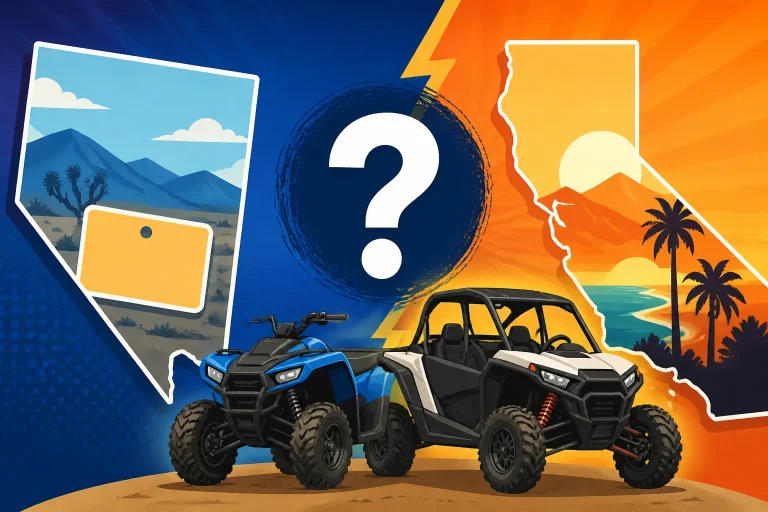
California does not grant registration reciprocity to Idaho OHVs. The reason is that Idaho requires California residents to buy a nonresident sticker to ride there. As a result, Idaho riders visiting Glamis or another California public OHV area must buy and display a California Nonresident OHV Use Permit, according to California State Parks’ Off-Highway Motor Vehicle Recreation Division.
An Idaho registration card, plate, or decal does not change that requirement. Nor does a valid out-of-state driver’s license. The license helps establish that you are a nonresident, but it is not a substitute for the California permit.
That distinction is easy to miss because a machine can be properly registered in Idaho and still need a separate permit for California riding. California’s program is administered by the Off-Highway Motor Vehicle Recreation Division, which oversees the state’s nonresident OHV permits. The Bureau of Land Management manages its own public lands and OHV areas, including land where riders may go around Glamis; a California permit does not mean every route or area is open.
For a broader explanation of the state’s reciprocity approach, see California OHV Reciprocity: Only Two States and Why Only Oregon and Nevada Count in California. Those rules explain why an Idaho registration alone won’t satisfy California’s requirement. For the permit itself, California’s Nonresident OHV Use Permit and How to Buy a California Nonresident OHV Permit cover the related process.
| What you have | What it does for a Glamis trip | What to do |
|---|---|---|
| Idaho OHV registration | Shows your machine is registered in Idaho, but does not provide California reciprocity for Idaho riders | Obtain and display the California nonresident permit |
| Idaho driver’s license | Helps establish nonresident status | Carry it with your riding paperwork |
| California nonresident OHV permit | Meets the California permit requirement for an Idaho rider visiting public OHV areas | Follow the permit’s current purchase and display instructions |
| California OHV registration | A separate California registration category, not the same thing as the nonresident permit | Don’t assume you need a Green Sticker; confirm which identification applies to your situation |
The nonresident permit is different from a California Green Sticker or Red Sticker. California’s DMV administers Green and Red Sticker identification plates for OHVs, while the California Air Resources Board sets the emissions standards behind those programs. A visitor should not assume that an Idaho sticker can stand in for California’s permit, or that every visiting machine needs California registration. Start with the nonresident-permit requirement that applies to Idaho riders.
Buy and display the permit before riding
According to the California Department of Parks and Recreation, the required nonresident OHV permit fee is $30 as of November 2026. Check with the department for current purchase instructions and figures before you travel, because fees and procedures can change.
A straightforward preparation process helps prevent a last-minute paperwork problem:
- Confirm the machine’s home-state paperwork. Make sure the Idaho registration is current and bring documents that identify the machine and its registered owner.
- Bring proof that you are a nonresident. The California DMV says nonresident OHV owners must carry a valid out-of-state driver’s license to establish residency. An Idaho license supports that purpose, but it does not replace the California permit.
- Purchase the California nonresident permit. Use the current instructions from California State Parks’ Off-Highway Motor Vehicle Recreation Division. Don’t assume a receipt or an Idaho registration decal is the required permit.
- Attach the permit where it can be inspected. On an ATV, California State Parks requires the permit to be affixed to the left rear quadrant on a permanent plastic or metal frame member, visible to outside inspection.
- Keep your paperwork accessible. Carry the permit information and Idaho registration documents while riding, rather than leaving them at home or buried in camp gear.
The placement rule is specific to ATVs. If you’re bringing a UTV, check the permit’s current instructions for how it must be displayed on that vehicle instead of guessing that the ATV placement rule applies in exactly the same way.
The California DMV issues an identification certificate, also called a registration card, as proof of valid California OHV registration. That card is not the same document as the nonresident use permit. If you’re unsure what a ranger or other official may ask to see, keep the documents that apply to your machine and permit together. Carrying Paperwork on the Sand and What a Ranger Accepts as Proof offer more detail on preparing for an inspection.
Take a moment to check the permit after attaching it. It should be secured to the machine, visible, and positioned as the instructions require. A permit tucked in a pocket may be difficult to verify during an inspection, while a loose permit can be lost in transport or riding. If you’re replacing an old sticker or permit, remove or cover anything that could make the current identification hard to distinguish.
Also avoid treating a purchase confirmation as proof that all display requirements are satisfied. The permit program’s current instructions determine what must be affixed and what paperwork to carry. If you purchase close to your departure, confirm that you will have the permit itself and enough time to attach it properly.
Check the riding rules that still apply at Glamis
Having the permit addresses the California nonresident requirement. It does not exempt you from California’s operating rules or make every piece of public land open to riding. The Bureau of Land Management says public-land designations that prohibit cross-country OHV travel include “Limited Use Area” or “Limited Area” and “Closed Area.” Follow posted restrictions and use the routes or areas that are open.
For more context on riding in the dunes, read California Rules for Riding Imperial Sand Dunes. You can also review Rangers at a Dune Checkpoint and Registration Checks at a Glamis Checkpoint to understand why having your permit displayed and your documents ready matters.
Before heading out, check the machine and the people riding in it:
- ATV passengers: California does not allow a passenger on an ATV unless the machine was specifically designed and provided by the manufacturer for multiple riders. A passenger on a single-rider ATV is prohibited on public lands, according to the California Department of Parks and Recreation’s Off-Highway Motor Vehicle Recreation Division.
- Young ATV riders: California requires operators under 18 to have an appropriate ATV safety certificate, be directly supervised by an adult who holds one, or ride under direct supervision while taking a prescribed safety training course. A rider under 14 must always be accompanied and directly supervised by a parent, guardian, or authorized adult, according to California State Parks’ Off-Highway Motor Vehicle Recreation Division. The division also says an ATV rider may operate without adult supervision from age 14 if they have an appropriate safety certificate.
- UTV drivers and occupants: A UTV operator must be at least 16 years old or be directly supervised in the vehicle by a parent or guardian, or an adult authorized by them, according to California State Parks. California also requires everyone in a moving UTV to wear a seatbelt or safety harness.
- Helmets: The National Highway Traffic Safety Administration says a helmet meeting the federal safety standard adopted by California must display the “DOT” symbol showing the manufacturer’s certification to Federal Motor Vehicle Safety Standard No. 218.
- Noise: California limits OHVs manufactured on or after January 1, 1986, to 96 dBA and those manufactured before that date to 101 dBA, measured from 20 inches, according to California State Parks’ Off-Highway Motor Vehicle Recreation Division. An aftermarket exhaust may not meet the applicable limit.
- Night riding: For an OHV operated between sunset and sunrise on California public lands, California State Parks requires at least one headlight capable of illuminating objects 200 feet ahead and a red taillight visible from 200 feet.
- Near campsites and people: California State Parks sets a maximum OHV speed of 15 miles per hour within 50 feet of a campsite, campground, or group of people or animals.
- Alcohol and drugs: Operating an OHV under the influence is illegal both on and off the highway under California Vehicle Code Section 23152, according to the California DMV.
A National Forest trip involves a separate equipment check: the USDA Forest Service requires a properly installed, approved spark arrester for OHVs operated on National Forest lands. That requirement is specifically about National Forest lands, so don’t treat it as a substitute for checking the rules that apply at your destination.
The main takeaway for an Idaho rider is simple: keep the Idaho paperwork, but don’t rely on it as California reciprocity. Get the California nonresident permit, display it as instructed, and check the route and machine rules before riding. That small amount of preparation makes it easier to focus on the trip instead of sorting out missing paperwork at the dunes.
Sources
- California Department of Parks and Recreation, Off-Highway Motor Vehicle Recreation Division — FAQs for ROVs (checked November 2, 2026)
- California Department of Parks and Recreation, Off-Highway Motor Vehicle Recreation Division — OHV Sound Regulations (checked November 2, 2026)
- Department of Motor Vehicles — Section 9: Alcohol and Drugs (checked November 2, 2026)
- California Department of Parks and Recreation, Off-Highway Motor Vehicle Recreation Division — Operation / Equipment Requirements (checked November 2, 2026)
- California Department of Parks and Recreation — Nonresident OHV Use Permits (checked November 2, 2026)
- California Department of Parks and Recreation Off-Highway Motor Vehicle Recreation Division — ATV Safety Training & FAQs for ROVs (checked November 2, 2026)
Disclaimer
This article is for general informational purposes only and does not constitute professional advice. Laws, prices and regulations vary by location and change over time. Consult a qualified professional for guidance on your specific situation.