How a Nevada Decal Saves You $30 in California
A Nevada OHV decal can spare an out-of-state rider from buying California’s nonresident use permit, but only when the Nevada registration is valid and you can show it. The practical savings are straightforward: avoid the California permit purchase. The part worth checking before you tow is whether your paperwork and machine meet the requirements for the ride you have planned.
How a Nevada decal saves you the California permit cost
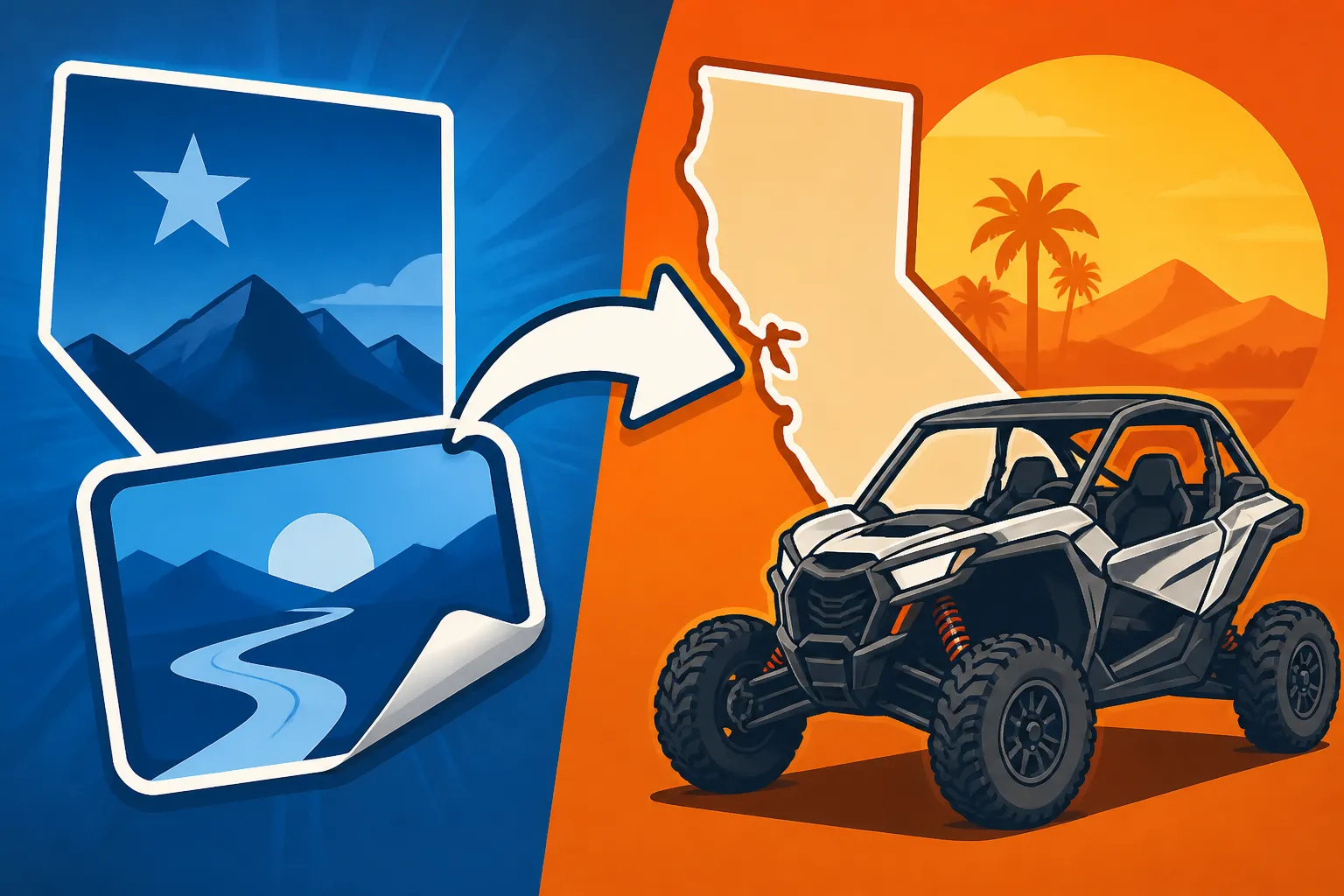
California’s reciprocity rule recognizes a valid Nevada OHV registration decal. According to the California Department of Parks and Recreation’s Off-Highway Motor Vehicle Recreation Division, a rider with a valid Nevada decal is exempt from purchasing California’s nonresident OHV use permit.
The California permit costs $30, according to the same division. If your Nevada registration is current and qualifies for reciprocity, you do not need to buy that permit just to meet California’s nonresident OHV permit requirement. That is the $30 saving: an avoided permit purchase, not a credit, refund, or discount on a Nevada registration.
| Your situation | California nonresident permit |
|---|---|
| You have a valid Nevada OHV registration decal | Not required under California’s reciprocity rule, according to the California Department of Parks and Recreation’s Off-Highway Motor Vehicle Recreation Division |
| You do not have qualifying out-of-state registration or an equivalent | The California nonresident permit may be required; California State Parks sets the permit fee at $30 |
| You have a California Green Sticker registration | This is California registration, not the nonresident permit; the California Department of Motor Vehicles sets the standard two-year OHV registration fee at $54 |
The distinction between registration and a permit matters. A Nevada decal represents registration under Nevada’s program. California’s nonresident permit is a separate requirement for riders who do not have qualifying home-state registration. California’s standard Green Sticker registration is another category altogether. A Nevada decal does not turn into a California Green Sticker, and avoiding the nonresident permit does not mean you have paid California registration fees.
For an overview of the broader rule, see California OHV Reciprocity Rules. The details of which states qualify are also covered in Why Only Oregon and Nevada Count in California. Reciprocity is specific: a decal from a different state should not be assumed to work just because it is a valid registration there.
The exemption depends on the Nevada registration being valid, not simply on the machine having a sticker that looks like a Nevada decal. California’s Off-Highway Motor Vehicle Recreation Division identifies a valid Nevada registration decal as the basis for reciprocity. If the registration has expired, belongs to another machine, or cannot be supported with the appropriate documents, do not rely on the decal alone to establish that you qualify.
This is why it helps to sort out the paperwork before the trip. The California Department of Motor Vehicles says nonresident OHV owners must carry a valid out-of-state driver’s license to establish residency. To operate without a California permit, they must also provide proof of current home-state OHV registration or its equivalent. A Nevada decal can be important evidence, but carrying the underlying registration document gives you stronger proof that it is current and applies to your vehicle.
If you are unsure whether your Nevada sticker counts as the registration decal California recognizes, review Does a Nevada Decal Work in California? and California’s Nonresident OHV Use Permit. Those topics address the key distinction: the California permit is not necessary when the rider meets the out-of-state registration reciprocity rule, but it remains relevant when they do not.
What to carry and check before riding
Treat the decal as one part of your proof, not as a substitute for the paperwork that explains it. Before leaving Nevada, make sure the registration is current, the decal is actually associated with the ATV or UTV you are bringing, and you can produce the registration record if asked. Keep the machine’s documents together and accessible rather than packed somewhere that is difficult to reach during a stop.
A practical preparation process is:
- Check the Nevada registration status. Confirm it is current for the machine you plan to use. If you have more than one OHV, check each vehicle separately rather than assuming one decal or document covers the group.
- Bring proof of Nevada residency status. The California Department of Motor Vehicles says a nonresident must carry a valid out-of-state driver’s license to establish residency.
- Carry proof of current OHV registration. The DMV says proof of current home-state registration or its equivalent is needed to operate without a California permit.
- Make the decal easy to inspect. Keep it displayed as required by Nevada, and avoid placing equipment or cargo where it hides the identification.
- Check the destination’s own requirements. Reciprocity addresses California’s nonresident OHV use permit. It does not answer every question about access, camping, events, or rules set by the land manager.
Keep registration documents where you can reach them while riding. Carrying Paperwork on the Sand and What a Ranger Accepts as Proof offer more detail on handling documents and showing evidence during a check. A clear photograph may be useful as a backup, but do not assume a photo replaces the original registration document or other proof a particular official may request. Carry the official paperwork when possible.
There is also a difference between an OHV use permit and a fee or permission tied to a particular recreation area. The California nonresident permit is administered by the Off-Highway Motor Vehicle Recreation Division of California State Parks. The division also operates state-owned vehicular recreation areas and manages designated trails within California State Parks. Separately, the Bureau of Land Management oversees the public lands and OHV areas it manages. A Nevada decal does not guarantee free entry or replace every site-specific requirement. Check with the agency managing your destination before traveling.
For example, Oceano Dunes State Vehicular Recreation Area is managed by the California Department of Parks and Recreation. That management responsibility is separate from the reciprocity question. Before a trip, check the area’s current access and use instructions rather than assuming that avoiding the nonresident permit covers all requirements. The same approach applies when a route or riding area is managed by another agency.
If you are bringing a machine that has no current Nevada registration, do not assume you can use a decal from another vehicle or rely on a bill of sale as a substitute. The DMV says ownership proof for a previously unregistered OHV can include a Manufacturer’s Certificate or Statement of Origin, out-of-state titling documents, a factory invoice, or bills of sale that establish a complete chain of ownership. Those documents may be relevant when sorting out registration, but they do not by themselves establish that a machine has qualifying current Nevada registration for reciprocity.
For riders arriving with more than one machine, verify each machine’s status separately. The exemption is tied to qualifying registration, so do not assume that a registered lead vehicle covers an unregistered ATV or UTV traveling with it. When any paperwork is unclear, checking with California State Parks before the trip is safer than buying a permit at the last minute or arriving without proof.
What the Nevada decal does not cover
The Nevada decal’s benefit is narrow: it can remove the need to buy California’s nonresident OHV use permit when the Nevada registration is valid. It does not exempt a rider from California’s operating rules, vehicle requirements, or rules for a particular riding area. A rider can be properly registered and still be in violation of a separate safety or land-use requirement.
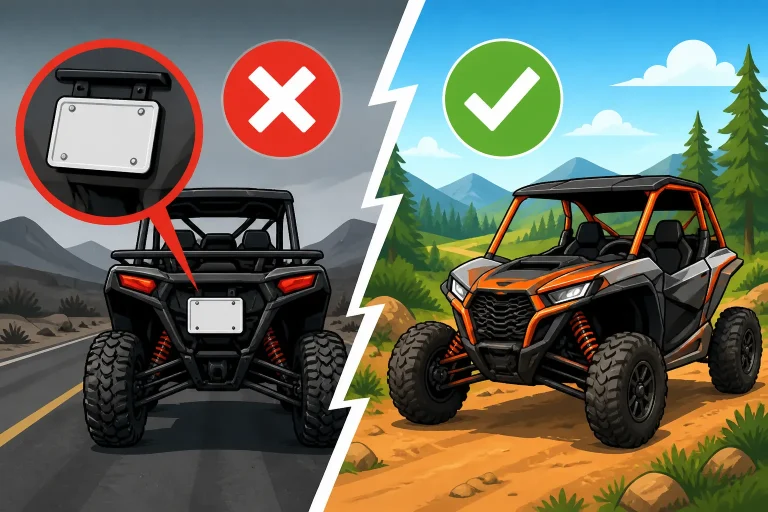
For example, California State Parks requires ATV Green or Red Stickers to be securely attached to the left rear quadrant on a permanent plastic or frame member and clearly visible from the rear. That placement rule is for California stickers. California State Parks separately says the California nonresident permit goes on the left rear quadrant of an ATV, on a permanent plastic or metal frame member visible to outside inspection. Do not confuse those California display instructions with Nevada’s own decal-placement rules; follow the applicable Nevada instructions for the Nevada registration decal.
A Nevada decal also does not make a machine street legal or authorize riding on a route where OHVs are not allowed. Land managers control access to the areas they oversee. The Bureau of Land Management identifies public areas where cross-country travel is prohibited as “Limited Use Area” or “Closed Area.” Check the route designations and local rules for the exact area you plan to ride.
Safety requirements remain in effect, too. California State Parks requires occupants of a recreational off-highway vehicle, including a UTV, to wear seatbelts or safety harnesses whenever it is moving. It also says an ATV may carry a passenger only if the vehicle was specifically designed and provided by its manufacturer for multiple riders. A Nevada registration decal does not change either rule.
California has other requirements that may matter depending on the machine and where you ride. The California Air Resources Board governs emissions for off-highway recreational vehicles under state regulations. The USDA Forest Service requires a properly installed, approved spark arrester for OHVs operated on National Forest lands. California State Parks sets noise limits for OHVs, with the applicable limit depending on when the vehicle was manufactured. These are separate from the permit question, so check the rules that apply to your machine and destination.
Night riding and rider eligibility also call for separate checks. California State Parks requires a headlight capable of illuminating objects ahead and a red taillight visible from the required distance when an OHV is operated between sunset and sunrise on public lands. California has separate rules for children operating ATVs and for UTV operators. A permit exemption does not waive those requirements. Before bringing a young rider, review California Rules for Riders Under 18 and California ROV Operator Age Limit.
The best way to avoid an unnecessary permit purchase is to confirm the paperwork, not to assume every out-of-state sticker is interchangeable. The deciding questions are whether the machine has a valid Nevada OHV registration decal, whether you can establish your nonresident status, and whether you can show current home-state registration or its equivalent. If the answer is yes, California’s reciprocity rule can save you the $30 nonresident permit cost. If the registration is expired or unclear, contact California State Parks and resolve it before riding.
Sources
- California Department of Motor Vehicles — OHV Registration | California State Parks – OHMVR Division (checked November 2, 2026)
- California Department of Parks and Recreation — Nonresident OHV Use Permits (checked November 2, 2026)
Disclaimer
This article is for general informational purposes only and does not constitute professional advice. Laws, prices and regulations vary by location and change over time. Consult a qualified professional for guidance on your specific situation.