Why a Street-Legal Plate Does Not Substitute
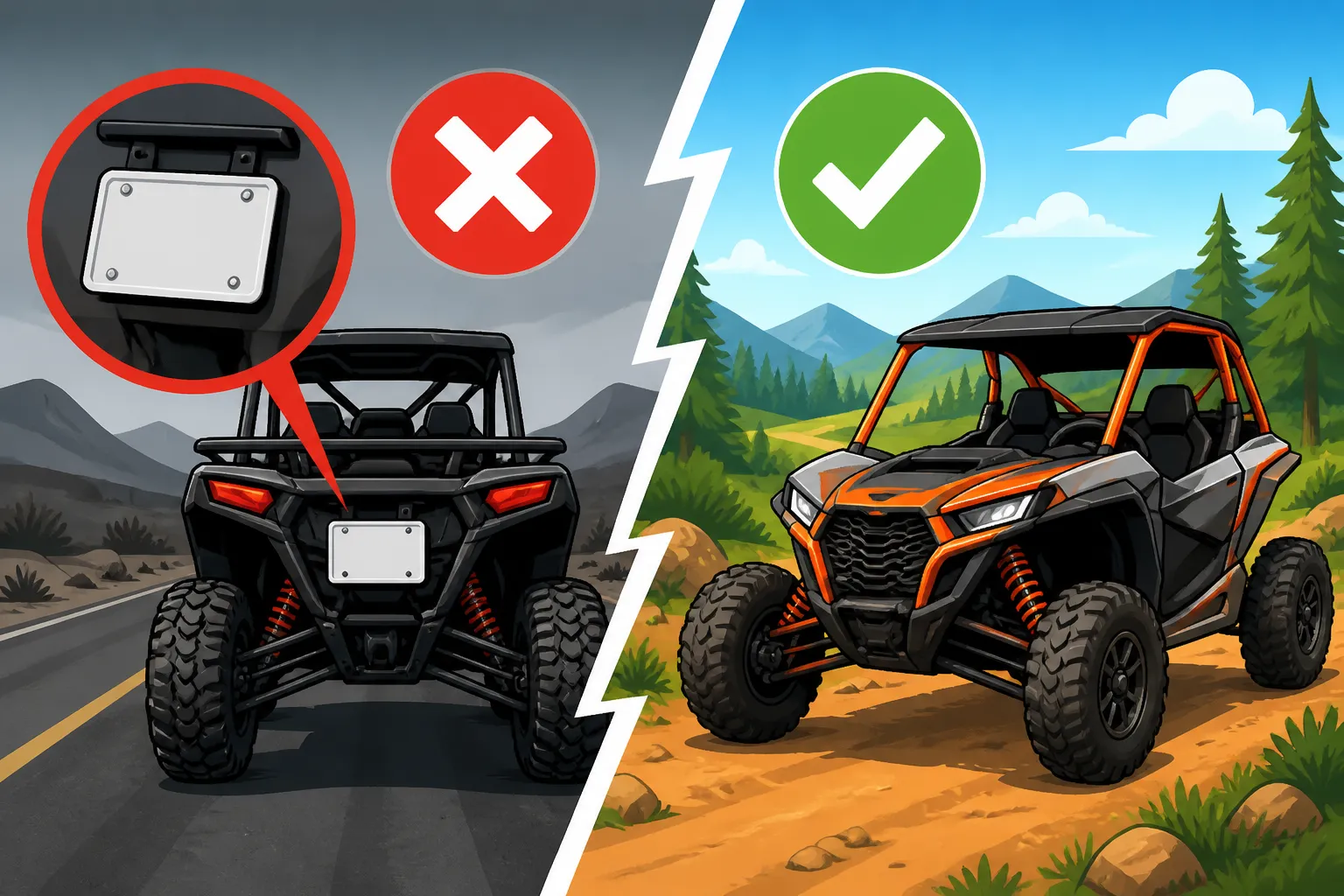
A street-legal plate can make an ATV or UTV look ready for the road, but it does not automatically show that the machine meets California’s off-highway identification or permit requirements. The key is the paperwork behind the plate: nonresidents need qualifying proof of current home-state OHV registration or an appropriate California permit.
A street-legal plate and OHV permission are different things
A license plate is a visible identifier associated with a vehicle’s road-use registration. California’s off-highway rules focus on whether the machine has valid OHV registration or qualifies to operate under the nonresident permit rules. Those are related to how the vehicle is registered, but the plate alone does not establish which kind of registration you have.
For a nonresident, the important distinction is between carrying a plate and being able to show that the machine has current OHV registration, or its equivalent, from the home state. The California Department of Motor Vehicles says nonresident owners must carry a valid out-of-state driver’s license to establish residency. To operate in California without a California permit, they must also provide proof of current home-state OHV registration or its equivalent. A street-legal plate does not, by itself, demonstrate that this requirement is met.
That does not mean every machine with a street plate necessarily needs a California nonresident permit. The question is what the home-state documents actually establish and whether they satisfy California’s requirements. If the vehicle has an OHV registration document in addition to a plate, keep that document available and check whether it is accepted as proof. If all you have is a road-registration card or a plate, do not assume it qualifies.
The practical takeaway is simple: treat the plate as an identifier, not as a substitute for the registration proof or permit you may need. For the broader state-by-state framework, see California OHV Reciprocity Rules and California’s Nonresident OHV Use Permit.
What California expects a nonresident rider to show
California’s nonresident rules turn on both the rider’s residency and the machine’s paperwork. The California Department of Motor Vehicles says a valid out-of-state driver’s license establishes residency, while proof of current home-state OHV registration or its equivalent is needed to operate without a California permit. One document does not automatically replace the other: a driver’s license identifies the rider’s residency, and vehicle documents show the machine’s registration status.
Before heading out, gather the paperwork that lets you explain the vehicle’s status clearly. That may include the home-state registration card or comparable document, along with the vehicle’s ownership and identification records. Keep the documents together and make sure they refer to the machine you are bringing. A photo of a plate may help you identify the vehicle, but it is not a substitute for registration paperwork if an official asks you to show proof.
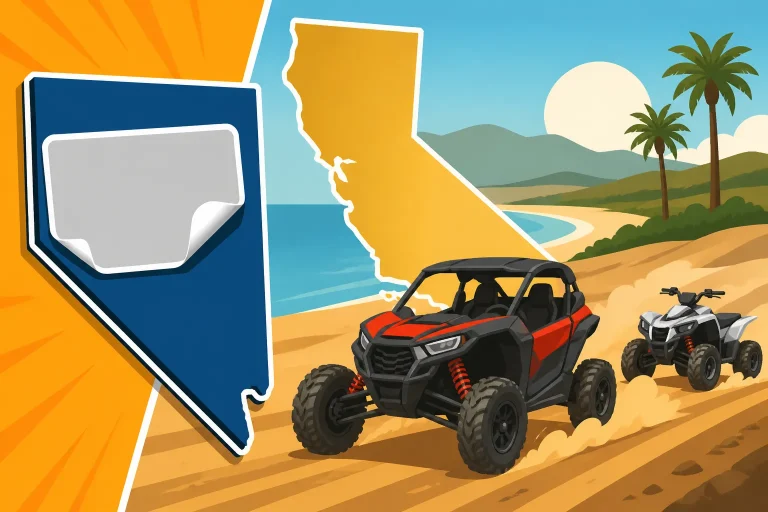
If the paperwork does not clearly establish current OHV registration or an equivalent, the California nonresident OHV use permit is the alternative to investigate. California State Parks’ Off-Highway Motor Vehicle Recreation Division administers the nonresident permit program. The required fee for a nonresident permit purchased from that division is $30 as of November 2026, according to the California Department of Parks and Recreation. Check the division’s current instructions before buying or traveling, since eligibility and permit procedures matter as much as the fee.
For an ATV, the permit has a specific display location. The California Department of Parks and Recreation says a California Nonresident OHV Use Permit must be affixed to the left rear quadrant on a permanent plastic or metal frame member where it can be seen during an outside inspection. That is a different practical step from simply displaying a road plate. Confirm that the permit is attached as directed, and keep the associated paperwork available.
If the machine is newly purchased or its registration history is incomplete, sort out ownership documents before relying on the plate. The California DMV says proof of ownership for a previously unregistered OHV may include a Manufacturer’s Certificate or Statement of Origin, out-of-state titling documents, a factory invoice, or bills of sale that establish a complete chain of ownership. These records address ownership; they should not be confused with proof of current home-state OHV registration. See Registering an Out-of-State Machine in California and Nonresidents and California OHV Identification for related registration questions.
| What you have | What it helps establish | What not to assume |
|---|---|---|
| Street-legal plate | The vehicle’s road registration may be identifiable from the plate | That California accepts it as proof of OHV registration |
| Out-of-state driver’s license | Residency for the nonresident rules, according to the California DMV | That the machine has qualifying OHV registration |
| Current home-state OHV registration or equivalent | The vehicle paperwork California requires for operating without a California permit, according to the California DMV | That a separate document is unnecessary if the registration status is unclear |
| California Nonresident OHV Use Permit | An alternative to qualifying home-state OHV registration for a nonresident | That the permit can be left loose or displayed in the wrong place on an ATV |
How to decide whether you need a California permit
Use a paperwork-first check rather than deciding from the plate style. The answer depends on the vehicle’s actual registration documents and your nonresident status.
- Check what the vehicle is registered as in its home state. Look at the registration document, not just the plate. Does it identify current OHV registration or a registration California may treat as equivalent? If the document describes only road registration, or the status is uncertain, seek confirmation rather than guessing.
- Check your residency documents. The California DMV identifies a valid out-of-state driver’s license as evidence of residency for nonresidents. Keep it with the machine’s paperwork.
- Decide whether the documents are clear enough to rely on. If you cannot show current home-state OHV registration or its equivalent, investigate the California nonresident permit before riding.
- Follow the display instructions. If you use a California nonresident permit on an ATV, the California Department of Parks and Recreation requires it to be attached to the left rear quadrant on a permanent plastic or metal frame member visible to outside inspection.
- Carry the supporting paperwork. A properly displayed plate or permit may help identify the machine, but having the registration documents available makes it easier to show why you believe the vehicle is eligible.
If you are still unsure, contact the California State Parks Off-Highway Motor Vehicle Recreation Division or the California DMV and describe the documents you actually have. Ask whether those documents establish current home-state OHV registration or its equivalent for California use. Avoid asking only whether a plate from your state is accepted; the useful question is whether the underlying registration status qualifies.
This distinction matters even when a machine is fully equipped for road use. A road registration can address requirements for operating on roads, while OHV identification and permit rules address off-highway use. Being legal for one type of use does not, by itself, prove eligibility for the other. For more on the separate permit framework, see California OHV Permits Explained. If your paperwork suggests the vehicle may need California registration rather than a visitor permit, Registering an Out-of-State Machine in California is a useful next step.
Where the distinction matters on a ride
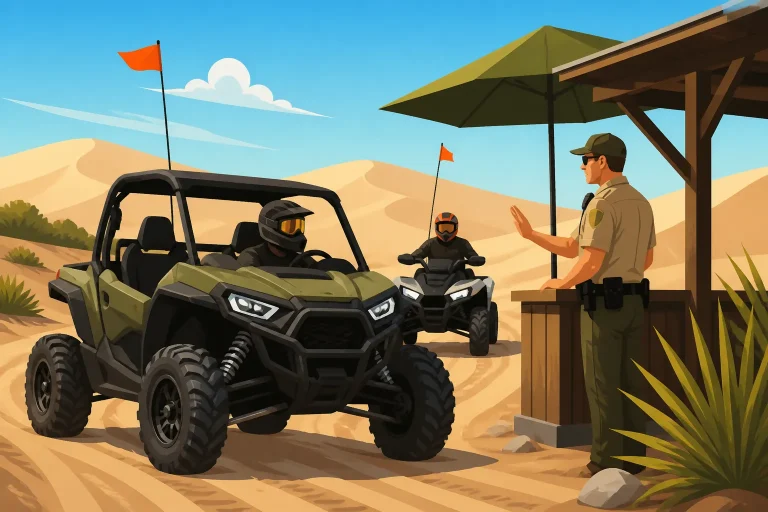
The type of land you plan to ride on affects which agency’s rules and paperwork apply. California State Parks’ Off-Highway Motor Vehicle Recreation Division operates state-owned vehicular recreation areas and manages designated trails within California State Parks. The Bureau of Land Management oversees its own public lands and OHV areas. A plate that seems adequate for getting to a destination does not settle the separate question of whether the vehicle is properly identified for riding at the destination.
For example, Oceano Dunes State Vehicular Recreation Area is managed by the California Department of Parks and Recreation. If you are going there with an out-of-state machine, check the relevant California permit or registration requirements before arrival rather than relying on the visible plate as proof. The same cautious approach applies when planning to ride on other public lands: check the land manager’s rules as well as the vehicle’s paperwork.
Do not confuse vehicle eligibility with the other requirements that may apply once you are riding. A permit or registration does not make a closed area open to riding, and it does not replace safety requirements. The Bureau of Land Management identifies “Limited Use Area” or “Limited Area” and “Closed Area” as designations for public lands where cross-country OHV travel is prohibited. Check maps and route restrictions for the specific riding area.
Likewise, registration and permits do not make an otherwise unsafe or unlawful ride acceptable. California State Parks requires seatbelts or safety harnesses to be worn by all occupants whenever a recreational off-highway vehicle is in motion. The same division says passengers may not ride on an ATV unless the manufacturer specifically designed and provided that vehicle for multiple riders. For an ATV, the California DMV says a Green Sticker or Red Sticker must be securely fastened to the left rear quadrant on a permanent plastic or frame member, clearly visible from the rear. These requirements are separate from the question of whether an out-of-state plate proves qualifying registration.
The safest approach is to sort out three things before leaving: what the home-state documents establish, whether a California permit is needed, and what rules apply at the destination. A street-legal plate can be part of the vehicle’s identification, but it should not be treated as a universal pass for California OHV use. If you cannot show current qualifying home-state OHV registration or its equivalent, check the California nonresident permit option before riding.
Sources
- California Department of Parks and Recreation — Nonresident OHV Use Permits (checked November 2, 2026)
Disclaimer
This article is for general informational purposes only and does not constitute professional advice. Laws, prices and regulations vary by location and change over time. Consult a qualified professional for guidance on your specific situation.