California Approved Spark Arrester List
A spark arrester can look like a small exhaust detail, but riding without the right one can mean a failed inspection or a citation on public land. The tricky part is that “California approved” does not necessarily mean there is one state list covering every ATV and UTV. Here’s how to identify the relevant listing and check that the part fits your machine.
Is There a California Approved Spark Arrester List?
California does not have one simple, all-purpose list that guarantees every spark arrester is accepted everywhere in the state. For many off-highway riding situations, the key reference is the U.S. Forest Service’s list of qualified spark arresters. Land managers may also set requirements for the areas they control, so riders should confirm local rules before heading out.
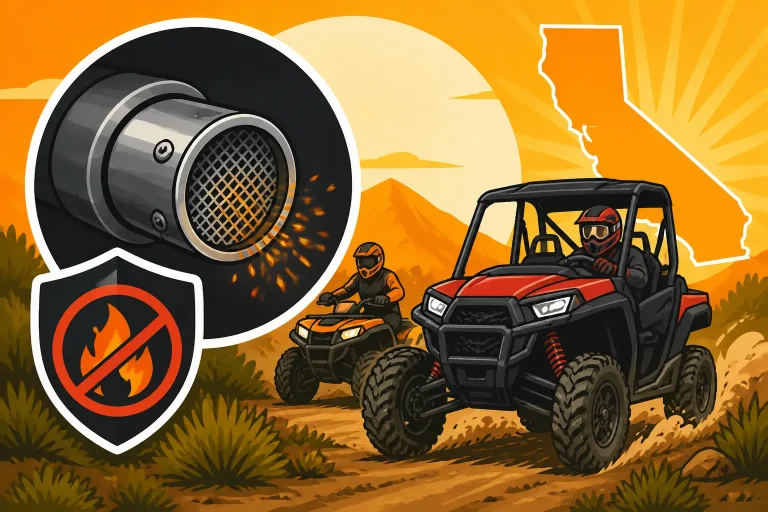
A spark arrester is designed to keep hot particles from escaping an engine’s exhaust. It is not the same thing as a muffler: a muffler reduces noise, while an arrester helps reduce the risk of starting a fire. A muffler may contain an arrester, but having a muffler alone does not establish that it does.
For a closer look at where the equipment requirement applies, see California Spark Arrester Requirement Explained and Spark Arresters on California Brush-Covered Land. Requirements can depend on the land and the machine, so do not assume that a part accepted at one riding area will meet the rules at another.
What the Forest Service listing tells you
The Forest Service qualifies spark-arrester models based on testing standards. Its listing can help you check whether a particular product has been tested and qualified; it is not a blanket approval of every exhaust from a manufacturer. The exact product or model matters.
When checking a listing, look for details such as:
- The manufacturer or brand name
- The arrester model or part number
- Any specified engine type or application
- Notes about the product’s configuration or use
Match those details to the actual arrester on your ATV or UTV. A similar-looking product, a different part number, or another exhaust from the same company may not be covered by the same qualification.
Why “California legal” can be misleading
A product description might say “spark arrester,” “off-road legal,” or “USFS approved.” Those words alone are not enough to confirm that the exact part on your machine is listed and installed as required. Listings and product details can also change, so verify current information rather than relying only on an old receipt, a seller’s description, or a previous owner’s assurance.
An online marketplace, including Amazon, can help you find a product, but a marketplace listing is not proof of Forest Service qualification. Use the manufacturer’s documentation and the current official listing to verify the part number and application before buying.
How to Check Whether Your ATV or UTV’s Arrester Is Listed
The most reliable approach is to identify what is installed first, then compare it with the current qualification information. Checking only the vehicle’s make and model is not enough: the same machine may have its original exhaust, an aftermarket exhaust, or a separate add-on arrester.
- Find the exhaust and arrester identification. Look for a stamped or engraved manufacturer name, model, part number, or qualification marking on the muffler or arrester. The location varies. Check the product documentation too, especially if the marking is difficult to see.
- Record the machine details. Note the ATV or UTV make, model, engine type, and year. These details can help you confirm that the arrester is intended for the machine, but they do not replace checking the part itself.
- Search the current Forest Service qualification information. Compare the manufacturer and exact model or part number against the listing. Do not rely on a match to the brand name alone.
- Check the manufacturer’s fitment information. Confirm that the listed arrester is approved for your machine’s exhaust configuration and is installed according to the manufacturer’s instructions.
- Confirm local requirements. If you are visiting a state vehicular recreation area, national forest, Bureau of Land Management area, or other managed land, check the managing agency’s current rules or contact the site before riding.
- Keep useful documentation with the machine. An invoice, installation record, product instructions, or a clear photo of the identification marking can make it easier to answer questions. Documentation does not substitute for a compliant, properly installed arrester.
For help comparing a particular part number with the applicable listing, see Checking the Forest Service Spark Arrester List and Finding an Approved Arrester for Your Model.
| What to check | What to match | Why it matters |
|---|---|---|
| Arrester identification | Exact maker and model or part number | A brand name alone may cover several products |
| Machine application | Make, model, engine, and exhaust configuration | A qualified part may not fit every machine |
| Installation | Manufacturer’s instructions and required components | A correct part can fail to do its job if installed incorrectly |
| Condition | No damage, blockage, or unauthorized changes | A worn or altered arrester may not perform as intended |
| Riding location | Current rules from the land manager | Requirements and enforcement can vary by site |
If there is no visible marking
A missing marking does not automatically prove that the arrester is unqualified, but it makes verification harder. Check the owner’s manual, original purchase paperwork, installation records, and the manufacturer’s product information. If the part cannot be identified, ask the manufacturer or a knowledgeable dealer to help identify it before relying on it for a ride.
Be especially cautious with a used machine that has an aftermarket exhaust. A seller may know the exhaust brand but not the exact muffler or arrester model. If you cannot confirm what is installed, treat that as an unresolved equipment question rather than assuming it is compliant.
Choosing, Installing, and Maintaining a Qualified Arrester
Start with the exhaust manufacturer or a dealer familiar with your exact machine. Ask for the part number and documentation for the arrester, and check that it appears in the current qualification information. If the machine has a modified exhaust, confirm compatibility with the entire setup rather than buying a generic insert based only on the exhaust outlet’s diameter.
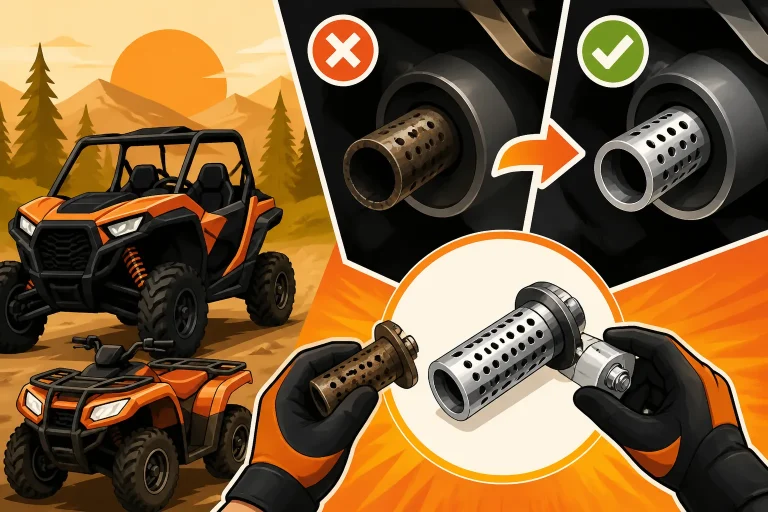
Some exhaust systems have an arrester built in; others use a removable screen or insert. Do not assume that a removable part is qualified just because it fits, or that a stock-looking muffler still contains all its original components. Follow the manufacturer’s instructions, use the specified parts, and do not modify or remove the arrester to change sound or performance.
An arrester also needs routine attention. A damaged, loose, clogged, or heavily worn component may not work properly. Maintenance steps vary by design, so use the manufacturer’s instructions rather than applying a cleaning method that could damage the screen or other components. If the arrester is missing or cannot be restored to the manufacturer’s specification, replace it with a confirmed compatible part before riding where an arrester is required.
Keep spark-arrester checks separate from sound checks. An exhaust can have a qualified arrester and still be too loud under the rules for a particular riding area. Conversely, a quiet exhaust is not necessarily equipped with a qualified arrester. For the sound side of the issue, see California Sound Limits for OHVs Explained and Aftermarket Exhaust and California Sound Checks.
| Situation | Practical next step |
|---|---|
| The original exhaust is still installed | Check the owner’s manual and identification markings; verify the arrester rather than assuming every stock system is unchanged |
| The exhaust is aftermarket | Find its exact model and part number, then confirm qualification and fitment for your machine |
| The machine was bought used | Inspect the exhaust, ask for records, and verify the installed part before riding |
| The arrester is damaged or altered | Stop relying on it; check the manufacturer’s repair instructions or replace it with a confirmed compatible part |
| You cannot identify the part | Contact the manufacturer or dealer, and confirm the riding area’s rule before the trip |
If you are unsure whether a replacement is listed, do not rely on a retailer’s search result or a broad claim such as “fits most ATVs.” A seller can help with fitment, but the qualification check should still be based on the exact product identification. For practical replacement guidance, see Replacing a Worn Spark Arrester.
Before You Ride on Public Land
A confirmed arrester is only one part of being ready to ride. Check the current rules for the exact area, because a route may pass through land managed by more than one agency, and local restrictions can change with fire conditions or other closures. California OHV Areas in the National Forests can help with the broader setting; for brush-covered terrain, Riding Brush Land in California explains why equipment and route rules deserve extra attention.
Before leaving, confirm that:
- The installed arrester is identifiable and matches the qualification information.
- It is intended for your machine and exhaust configuration.
- It is securely installed, undamaged, and maintained as directed.
- The riding area’s current requirements do not add conditions beyond the general equipment check.
- Your exhaust meets any separate sound requirements that apply.
If an official or land-manager inspection raises a question, be prepared to show the product identification and supporting documentation. Do not assume that a sticker, a seller’s claim, or an arrester from a different machine settles the question. When the part cannot be verified, the practical answer is to contact the manufacturer, check with the managing agency, or replace it with a documented compatible unit before riding.
Disclaimer
This article is for general informational purposes only and does not constitute professional advice. Laws, prices and regulations vary by location and change over time. Consult a qualified professional for guidance on your specific situation.