Aftermarket Exhaust and California Sound Checks
We all love the idea of customizing our ATVs and UTVs, making them sound and perform exactly how we envision. But here in California, the dream of a throaty, powerful aftermarket exhaust system often collides head-on with the very real and very strict sound regulations that govern our public riding areas. This guide is here to walk you through exactly what those "California sound checks" entail, the laws you need to know, and what to consider before you even think about swapping out your stock exhaust.
The Allure and the Reality of Aftermarket Exhaust Systems
There's a natural pull towards upgrading your off-road machine's exhaust. For many of us, it’s not just about raw horsepower, though that's certainly a factor. It's about the sound – that deep, resonant growl that signifies power and performance. It’s about the aesthetics, too, with sleek, custom headers and mufflers that look as good as they sound. We envision tearing through the dunes or rock crawling with that perfect exhaust note echoing through the trails.
However, the reality of hitting California's trails with a non-compliant aftermarket exhaust can quickly turn that dream into a frustrating, and often expensive, nightmare. The state's commitment to reducing noise pollution, especially in sensitive environmental areas and near residential zones, means that off-highway vehicles (OHVs) are under constant scrutiny. What sounds fantastic in your garage or on private land can get you a swift citation and a mandatory fix-it ticket the moment a ranger pulls you over on public land. The frustration is real; you've invested your hard-earned money and time, only to be told your machine is too loud to legally enjoy. It feels like a constant battle between performance desires and regulatory hurdles, and navigating it requires careful consideration and a clear understanding of the rules.
Why Riders Seek Performance Exhausts
Beyond the "cool factor," there are tangible reasons why riders want to change their exhaust. Many stock exhaust systems are designed for quiet operation and emission compliance, which sometimes means they can be restrictive. An aftermarket exhaust is often engineered to improve exhaust gas flow, which can lead to a slight increase in horsepower and torque, making your machine feel more responsive. For some, it's about shedding weight; aftermarket systems can be significantly lighter than their factory counterparts. Then there's the sound itself. While California tries to curb excessive noise, many riders simply prefer a more aggressive or sportier sound that they feel matches the nature of their powerful machines. It becomes an integral part of the riding experience, signaling power and presence on the trail.
The California Conundrum: Performance vs. Compliance
Here's where the rubber meets the road, or rather, the exhaust pipe meets the decibel meter. California has some of the strictest OHV noise regulations in the nation, and they are actively enforced across all State Vehicular Recreation Areas (SVRAs), Bureau of Land Management (BLM) lands, and national forests. The challenge for manufacturers and riders alike is creating or finding an exhaust system that offers the desired performance and sound characteristics while still meeting the stringent decibel limits. Many high-performance aftermarket exhausts are designed for "closed-course competition only," meaning they are not legal for use on California's public lands. This often leaves riders in a difficult position: do you risk a citation for that extra horsepower and aggressive sound, or do you stick with a quieter, less exciting stock setup? It's a choice many struggle with, feeling caught between what they want from their machine and what the law allows.
California's Strict Sound Limits and How They're Checked
California's approach to OHV noise is not just about having a loud muffler; it's about specific decibel limits and a standardized testing procedure. These rules are applied uniformly across the state, from the sand dunes of Glamis to the trails of Hungry Valley, and ignoring them can lead to significant consequences. Understanding these regulations is the first step toward staying compliant and avoiding penalties. The system is designed to be clear-cut, but it often catches riders off guard, especially those new to California or unfamiliar with the nuances of its OHV laws. [California Sound Limits for OHVs Explained] provides a great overview if you're looking for more details.
Decibel Limits: The Numbers You Need to Know
When it comes to California OHV noise, there are two primary decibel limits you'll encounter, based on the model year of your machine:
- 96 Decibels (dB): This is the limit for all OHVs manufactured in 1998 or later. This standard applies to the vast majority of modern ATVs and UTVs you see on the trails today. This limit is very restrictive, and many aftermarket exhaust systems, even those claiming to be "quiet," can exceed it if they aren't specifically designed and tested for California compliance. You can learn more about this specific limit in [The 96-Decibel Limit on a California Trail].
- 101 Decibels (dB): For machines manufactured in 1997 or earlier, there's a slightly more lenient, but still strict, limit of 101 decibels. While these older machines are fewer and further between, if you're riding a vintage quad or UTV, this is your benchmark. Don't let the higher number fool you; 101 dB is still quite loud and can be easily exceeded by a worn-out or heavily modified exhaust. For context on these older machines, check out [One Hundred One Decibels for Older Machines].
It's important to note that these limits are measured under specific conditions, not just by a ranger's ear. This standardized test ensures fairness and consistency in enforcement.
The Sound Test Procedure
So, how do rangers and vehicle verifiers actually measure your machine's sound level? It's not arbitrary; there's a prescribed procedure to ensure accurate readings. [How a Ranger Measures Your Exhaust Noise] goes into great detail, but here's the gist:
- Preparation: The test is usually conducted with the engine at a specific RPM, typically half of the engine's maximum RPM for that specific machine. The machine needs to be warmed up.
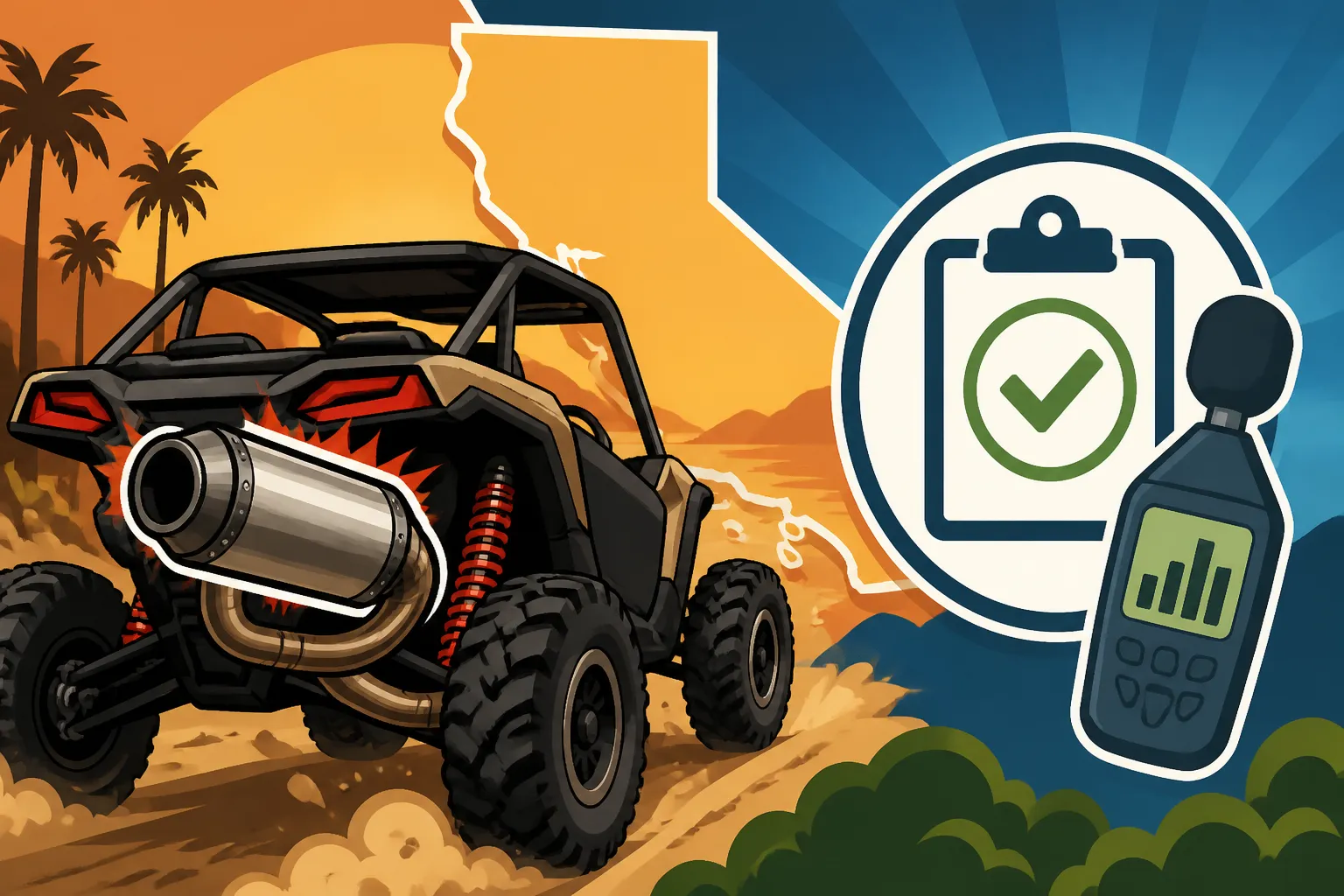
- Positioning: The sound meter is placed 20 inches from the exhaust outlet, at a 45-degree angle to the exhaust flow. The exhaust must be pointed away from any large reflective surfaces like buildings or other vehicles, which could skew the reading. This precise placement is critical to getting an accurate measurement of the exhaust's direct output. You can find more information about this in [Measuring Sound at 20 Inches].
- Measurement: The engine RPM is held steady, and the highest decibel reading is recorded. This reading is then compared to the legal limit for your machine's model year.
This procedure, while seemingly technical, is designed to give an objective measure of your machine's noise output. Many riders are surprised by how quickly their aftermarket exhaust, which sounded fine to them, fails this standardized test.
What Happens if You Fail a Sound Check
Failing a sound check on California public lands isn't just an inconvenience; it can lead to immediate consequences and a mandatory fix-it process.
- Citation and Fine: The most immediate consequence is a citation, often accompanied by a significant fine. These fines are not trivial and are designed to deter non-compliance. [California Fines for a Loud Machine] outlines what you might be facing financially. It's a harsh reality that can quickly sour a fun day of riding.
- Fix-It Ticket: In many cases, you'll receive a "fix-it ticket" or a notice to correct the violation. This means you'll be required to either replace your aftermarket exhaust with a compliant one, modify it, or otherwise reduce the sound level to meet the state's requirements. You'll then need to have your machine re-inspected by a certified vehicle verifier or a law enforcement officer to prove compliance. Failing to address a fix-it ticket can lead to further fines and complications, including potential registration holds.
- Impoundment (in severe cases): While less common, in extreme cases of egregious noise violations or repeat offenses, a ranger might have the authority to impound your machine until it's made compliant. This is the absolute worst-case scenario and one that every rider wants to avoid.
- Future Restrictions: A history of noise violations could potentially lead to increased scrutiny in the future, especially if you're a regular at specific SVRAs or riding areas known for strict enforcement.
The takeaway here is clear: prevention is far better than dealing with the aftermath of a failed sound check. It's not just about the monetary cost but the lost riding time and the hassle of getting your machine back into compliance.
Spark Arresters: A Different, But Related, Requirement
While not directly about sound levels, spark arresters are often mentioned in the same breath as exhaust regulations because they are another critical component of a legal exhaust system for off-road riding in California. A spark arrester is a device that prevents incandescent particles (sparks) from exiting the exhaust system and potentially starting a wildfire. Given California's severe fire risks, spark arresters are mandatory on all OHVs operated on public lands.
Even if your aftermarket exhaust meets the sound limits, if it doesn't have a U.S. Forest Service approved spark arrester, you're still in violation. Many performance exhausts are sold without spark arresters, or with removable ones, so it's crucial to ensure yours is installed and in good working order. A ranger will typically check for the presence of an approved spark arrester during any vehicle inspection. [Spark Arresters on California Public Land] highlights the importance of this vital safety feature.
Navigating Aftermarket Choices in California
So, you still want to upgrade your exhaust, despite California's strict rules? It's not impossible, but it requires careful research and an understanding of specific terms like "CARB compliant" and what "competition only" truly means. The market is flooded with options, and many manufacturers cater to a national audience, not just California riders. This means you can easily purchase a system that's perfectly legal in another state but will get you sidelined the moment you cross into a California SVRA. Brands like SuperATV offer a wide range of accessories, including exhaust components, but riders must be diligent in checking the specific product's California legality.
"CARB Compliant" vs. "For Competition Only"
These two terms are perhaps the most crucial distinctions to understand when shopping for an aftermarket exhaust in California.
- CARB Compliant: CARB stands for the California Air Resources Board. When an exhaust system is "CARB compliant" or has a CARB Executive Order (EO) number, it means it has been tested and certified to meet California's strict emission and noise standards. This is the gold standard for legal operation on public lands. Products with a CARB EO number have gone through rigorous testing to ensure they do not increase emissions or exceed noise limits. Finding a CARB-compliant aftermarket exhaust for an ATV or UTV can be challenging, as the market is smaller, and development costs are higher. Always look for a physical label on the product or documentation from the manufacturer explicitly stating CARB compliance and an EO number. This is what rangers are looking for during an inspection, especially when it comes to emission controls.
- "For Competition Only" / "Race Use Only": Many, if not most, aftermarket exhaust systems that promise significant performance gains fall into this category. Manufacturers legally label these systems for "closed-course competition only" or "race use only" to bypass the stringent emission and noise regulations required for public road or public land use. While these systems might deliver impressive horsepower and sound, they are, by definition, not legal for recreational riding on California's public OHV areas, SVRAs, BLM land, or national forests. Using one of these systems will almost certainly result in a failed sound check and a citation. Even if a brand like SuperATV offers an exhaust that boosts performance, if it's designated "for competition only," it's a red flag for California public land use. Understanding [What CARB Compliance Means in California] is essential for making informed decisions.
| Exhaust Type | CARB Compliant | "For Competition Only" |
|---|---|---|
| Legal on CA Public Land | Yes, if it has a valid CARB Executive Order (EO) number | No |
| Emissions | Tested and certified to meet CA emission standards | Not tested for public emission standards |
| Noise Levels | Designed to meet CA decibel limits (96 dB/101 dB) | Often exceeds CA decibel limits |
| Primary Purpose | Replacement for street/trail legal machines | Maximum performance for racing or private land use |
| Risk of Citation | Low, if correctly installed and maintained | High |
Strategies for Compliance
If you're determined to upgrade your exhaust but stay legal, here are a few strategies:
- Research Specific California-Legal Options: Some manufacturers do offer exhausts specifically designed for California compliance. These might not offer the most aggressive sound or the highest performance gains, but they will keep you out of trouble. Look for clear documentation from the manufacturer regarding CARB EO numbers or explicit statements of California legality. Don't assume; verify.
- Stick with OEM or OEM-Style Replacements: The safest bet for compliance is often to stick with a factory-replacement exhaust system or one that explicitly states it's an OEM equivalent. These are designed to meet all factory specifications, including noise and emissions.
- Consider Quiet Core Inserts/Baffles: Some aftermarket exhausts that are borderline legal, or designed for slightly less stringent states, might offer "quiet core" inserts or baffles. These are designed to reduce the sound output of the exhaust system. While they can help, there's no guarantee they will bring a non-compliant exhaust down to California's strict limits. Always test your machine's sound output after installing any such modifications.
- Regular Maintenance: Even a factory exhaust can become louder over time due to wear and tear. A damaged muffler, loose baffles, or exhaust leaks can all contribute to excessive noise. Regularly inspect and maintain your exhaust system to ensure it's functioning as intended and keeping noise levels down.
The Inspection Process: What Rangers Look For
When you're out on the trail, what exactly are rangers looking for? It's more than just a quick listen:
- Visual Inspection: First, they'll check for the presence of an aftermarket exhaust. If it looks significantly different from a stock system, it will likely raise a flag. They'll also check for an approved spark arrester. [California Approved Spark Arrester List] can help you determine if your spark arrester is compliant.
- Emission Labels: For newer machines, they might check for the original emissions label, often located on the frame or engine. This label specifies the machine's factory emissions and noise standards. An aftermarket exhaust could render these labels inaccurate. [California OHV Emissions Label Location] shows where to find this.
- Sound Test: If there's any suspicion of excessive noise, they will conduct a full sound test using the standardized 20-inch, 45-degree method mentioned earlier. This is the definitive test. [Failing a Sound Check at a Gate] is a common scenario for many riders.
- Overall Condition: They'll also look for overall vehicle condition, ensuring no modifications pose a safety or environmental risk. A well-maintained machine, even with a legal aftermarket exhaust, often gives a better impression.
The Impact on Your Riding Experience
Choosing an aftermarket exhaust system, particularly a non-compliant one, has far-reaching implications beyond just the sound it makes. It can drastically impact where and how you can enjoy your machine, leading to financial penalties, legal hassles, and even affecting the future of off-road riding access in California. It's not just about one rider; it's about the collective responsibility we all share.
Where You Can Ride (and Not Ride) with a Loud Exhaust
The biggest impact of a non-compliant exhaust is the immediate restriction on where you can legally ride. California's public lands, including its extensive network of SVRAs, BLM lands, and National Forests, all enforce the state's noise regulations. This means places like the Imperial Sand Dunes (Glamis), Oceano Dunes, Hungry Valley, and Ocotillo Wells are all off-limits if your machine is too loud.
- Public Lands are Out: Forget riding at any designated OHV park or managed trail system. Rangers and law enforcement officers are present and actively conducting sound checks. You might make it through the gate initially, but patrols frequently stop riders for random checks or based on perceived noise levels.
- Private Property Only: Essentially, if your exhaust exceeds California's decibel limits, your machine is relegated to private property where noise ordinances may still apply, but state OHV laws do not. This severely limits your riding options and takes away the joy of exploring California's diverse off-road terrain. For many, this is a deal-breaker, making their investment in a performance exhaust a very expensive paperweight.
Financial and Legal Consequences
We've touched on this, but it bears repeating: the financial and legal fallout from a loud exhaust can quickly add up.
- Fines Galore: A single noise citation can be several hundred dollars. If you get caught multiple times, those fines multiply.
- Repair Costs: Beyond the fine, you'll incur the cost of either re-installing your stock exhaust, purchasing a compliant aftermarket system, or modifying your existing one to pass inspection. This often means buying parts and paying for labor, which wasn't part of your original budget.
- Lost Time and Effort: Factor in the time spent dealing with the citation, getting your machine fixed, and arranging for a re-inspection. This is valuable riding time lost, not to mention the frustration of the bureaucratic process.
- Registration Holds: Unresolved citations or fix-it tickets can lead to holds on your OHV registration, preventing you from renewing it until the issue is cleared. This can essentially make your machine unusable on any land where registration is required, even if you planned to only ride on private property. [California OHV Late Registration Penalty] is something you want to avoid.
Community and Environmental Impact
Beyond personal consequences, riding with an excessively loud exhaust has broader implications for the entire off-road community and the environment.
- Negative Public Perception: Loud OHVs contribute significantly to noise pollution, especially in areas near communities or sensitive wildlife habitats. This creates a negative public perception of off-road enthusiasts as disruptive and irresponsible. This perception fuels opposition to OHV access and can lead to trail closures and stricter regulations for everyone.
- Habitat Disturbance: Excessive noise can disturb wildlife, impacting breeding patterns, foraging, and overall ecosystem health. California's OHV laws are often framed with environmental protection in mind, and noise is a key factor.
- Reduced Access: Every citation issued for a noise violation, every complaint from residents or environmental groups, adds weight to arguments for closing trails or limiting riding seasons. It's a sad reality that the actions of a few can impact the access for many. By choosing compliant exhausts, we help demonstrate responsible stewardship and protect our ability to ride in the future.
Responsible Riding: Making the Right Choice
Ultimately, the choice of an exhaust system is yours, but for those of us who love riding in California, making a responsible choice is paramount. It means prioritizing compliance and preserving access over marginal performance gains or an aggressive sound that can only be enjoyed on private land.
When you're considering an aftermarket exhaust, ask yourself:
- Is it truly California legal? Look for that CARB EO number.
- Does it have an approved spark arrester?
- Am I willing to pay the fines and deal with the hassle if it's not compliant?
- How does my choice impact the future of riding for everyone else?
By asking these questions and making informed decisions, we can continue to enjoy California's incredible off-road opportunities for years to come.
Disclaimer
This article is for general informational purposes only and does not constitute professional advice. Laws, prices and regulations vary by location and change over time. Consult a qualified professional for guidance on your specific situation.