California OHV Reciprocity Rules
An out-of-state ATV or UTV registration does not automatically let you ride in California without a permit. California’s reciprocity is limited, so the key question is whether your machine carries qualifying off-highway identification from Oregon or Nevada. Here’s how to check what applies before you unload, and what to bring if your state’s credentials are not recognized.
Which out-of-state OHV credentials California recognizes
California’s OHV reciprocity is narrow: valid off-highway vehicle identification from Oregon or Nevada is generally recognized for riding in California. A current Oregon OHV permit or Nevada OHV decal can serve in place of California’s nonresident OHV use permit, provided it applies to the machine and is displayed as required.
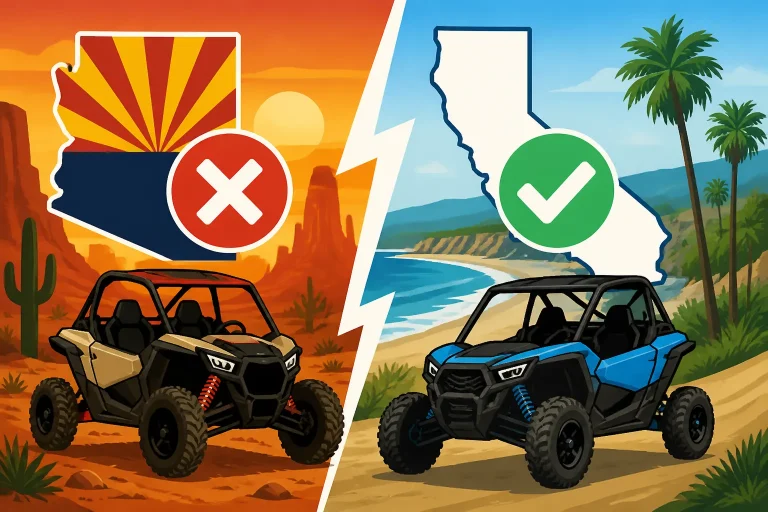
This is not a general agreement with every state. A registration card, permit, or decal from another state does not automatically qualify just because it allows off-road riding at home. For example, an Arizona or Utah OHV registration is not a substitute under California’s limited reciprocity rules. Visitors whose machines carry credentials from states other than Oregon or Nevada will generally need California’s nonresident OHV use permit to ride on California public lands where OHV identification is required.
| What the machine has | What to expect in California |
|---|---|
| Valid Oregon OHV identification | Generally recognized under reciprocity; carry proof and display the identification as required |
| Valid Nevada OHV identification | Generally recognized under reciprocity; carry proof and display the identification as required |
| OHV registration or decal from another state | Do not assume it qualifies; a California nonresident permit may be required |
| No qualifying OHV identification | Obtain the California nonresident OHV use permit before riding where identification is required |
| Ordinary out-of-state license plate | Not a blanket replacement for OHV identification; check how the vehicle is legally registered and intended to be used |
The distinction is between an out-of-state credential that California recognizes for OHV use and one that works only under the rules of the state that issued it. California’s reciprocity does not mean that every state’s decal is accepted, nor does it make one state’s riding rules apply in another.
If you are arriving from Oregon or Nevada, check that the decal or permit is current and belongs to the machine you are bringing. If you have an Arizona, Utah, Idaho, or other state OHV credential, confirm whether you need a California permit rather than relying on a registration card or a screenshot of your home state’s rules. The details of the permit are covered in California’s Nonresident OHV Use Permit.
When you need a California nonresident permit
If your ATV or UTV does not have qualifying Oregon or Nevada OHV identification, plan on obtaining California’s nonresident OHV use permit before riding in areas where an OHV permit or identification is required. The permit is intended for visitors using an out-of-state OHV in California. It is not a way to register the machine in your home state, and it does not replace any state registration or identification you are required to maintain there.
Think about the machine’s status, not just the driver’s residency. A visitor may need the California permit even if the vehicle is properly registered for off-road use at home. Conversely, having a California residence does not make a nonreciprocal out-of-state decal count as California OHV identification. If you have moved to California, your situation may involve California registration rather than a visitor permit; see California Registration After a Move.
The permit also does not grant access to every trail, park, or riding area. It addresses the OHV identification requirement, while the land manager can set separate access, equipment, and use rules. A permit will not open a closed route or make an otherwise ineligible machine legal to ride in a particular location. Check the rules for your destination as well as the permit requirement. California OHV Permits Explained describes the broader permit picture, including requirements that can apply to visitors.
Before setting out, work through these steps:
- Identify the machine’s credentials. Check the decal, permit, or registration documents and note which state issued the off-highway identification.
- Check reciprocity. If it is not valid Oregon or Nevada OHV identification, do not treat it as accepted in California without confirmation.
- Arrange the California permit if needed. Use the official purchase route and follow the instructions for the machine and permit display.
- Carry proof. Keep the permit and relevant registration documents accessible while riding. A photo may help you keep a backup, but do not assume it replaces any required original or visible decal.
- Check the destination’s rules. Confirm the area is open to your type of machine and review any separate fees, access conditions, or equipment requirements.
Do this before departure, especially if you are towing several machines or traveling with riders who have different registrations. Finding out at a checkpoint or trailhead that a decal is not accepted can delay the trip and may leave you unable to ride until the problem is resolved.
Permit cost and purchase details can change, so confirm current requirements with the official California source before buying. For an explanation of the permit’s cost, see California Nonresident OHV Permit Cost. A permit’s validity period and display instructions are also worth checking rather than assuming they match the renewal cycle or sticker placement used by your home state.
Why a plate or another state’s registration may not be enough
A frequent source of confusion is the difference between off-highway identification and ordinary motor-vehicle registration. An OHV decal, an OHV permit, and a license plate are not interchangeable labels. A plate from another state may identify a vehicle for that state’s purposes, but it does not automatically establish that California accepts the vehicle’s off-highway credentials.
That does not mean every vehicle with a plate must buy an OHV permit. A vehicle properly registered for on-highway use raises a different question from an ATV or UTV identified only for off-road use. What matters is the vehicle’s legal registration status and how it is being operated. Do not assume that a plate makes an off-highway-only machine exempt, or that an OHV permit authorizes road use. Confirm the rules for the specific vehicle and route before riding.
A plate also does not make an ATV or UTV street legal in California. Reciprocity for OHV identification is separate from rules about operating a vehicle on public roads. A road route may require a vehicle to meet applicable road-use requirements, and some roads are closed to OHVs altogether. See Are ATVs Street Legal in California? and Can You Make a UTV Street Legal in California? for the separate road-use question.
Similarly, a permit for a particular riding area is not the same as a California OHV identification permit. For example, a dune-use permit may be required for access to a specific riding area, but it does not necessarily replace the machine’s OHV identification requirements. Check both sets of rules if your trip involves a managed riding area. California Rules for Riding Imperial Sand Dunes explains the distinction for a popular destination.
Keep in mind that reciprocity is only one part of riding legally. Even with accepted credentials or a California permit, you may also need to follow rules for helmets, rider age, exhaust sound, spark arresters, and designated routes. A machine that has the right sticker can still be cited for a separate violation. California Rules for Riders Under 18 and California Sound Limits for OHVs Explained cover two requirements that can matter when riding with a group.
A practical pre-trip checklist
The safest approach is to check documents and destination rules together, rather than treating a sticker as an all-purpose pass. Before you leave home, make sure each machine has the correct credential, that it is valid, and that the identification is displayed according to the issuing authority’s instructions.
Use this checklist for each ATV or UTV:
- State of issue: Is the OHV identification from Oregon or Nevada, or from another state?
- Validity: Is the decal or permit current for the machine?
- California permit: If the credential is not qualifying Oregon or Nevada identification, have you confirmed whether the California nonresident permit is required and obtained it if needed?
- Machine identity: Do the documents match the vehicle you are transporting?
- Display and paperwork: Is the required identification visible, and are the supporting documents available?
- Destination access: Is the riding area open to your machine type, and are there separate area permits or entry requirements?
- Other riding rules: Have you checked age, helmet, sound, spark arrester, and route restrictions that apply to your group?
For a group trip, make a separate check for every machine. It is easy to assume that all the vehicles in a trailer have the same status when one belongs to a visitor from another state or has a different registration type. A group leader can keep a simple list of each machine’s issuing state, credential, and permit status, but each rider should also know how to show their own documents if asked.
If a decal is damaged, missing, or difficult to read, resolve that before the trip rather than hoping the registration card will be enough. Keep the permit paperwork protected from sand and water, and do not cover an identification decal with a tie-down, fender accessory, or other equipment. For details on what to carry and how proof may be checked, see Carrying Paperwork on the Sand.
The bottom line is simple: California generally recognizes Oregon and Nevada OHV identification, but does not offer broad reciprocity for every state’s off-road registration. If your machine’s identification comes from elsewhere, confirm whether you need a California nonresident permit. Then check the riding area’s separate rules and make sure your credentials are ready before you arrive.
Disclaimer
This article is for general informational purposes only and does not constitute professional advice. Laws, prices and regulations vary by location and change over time. Consult a qualified professional for guidance on your specific situation.