Can You Make a UTV Street Legal in California?
It's incredibly frustrating when you invest in a capable UTV, picturing all the places you'll explore, only to hit a brick wall when you realize that taking it on public roads in California is a whole different ballgame. Many riders dream of the convenience of driving their UTV from their driveway straight to the trailhead, but California's regulations make this a near-impossible dream for most machines. This guide will meticulously break down why making a UTV truly "street legal" for general road use in California is so challenging, what limited exceptions exist, and how you can still enjoy your machine responsibly.
Why California Draws a Hard Line: The Challenge of Street-Legal UTVs
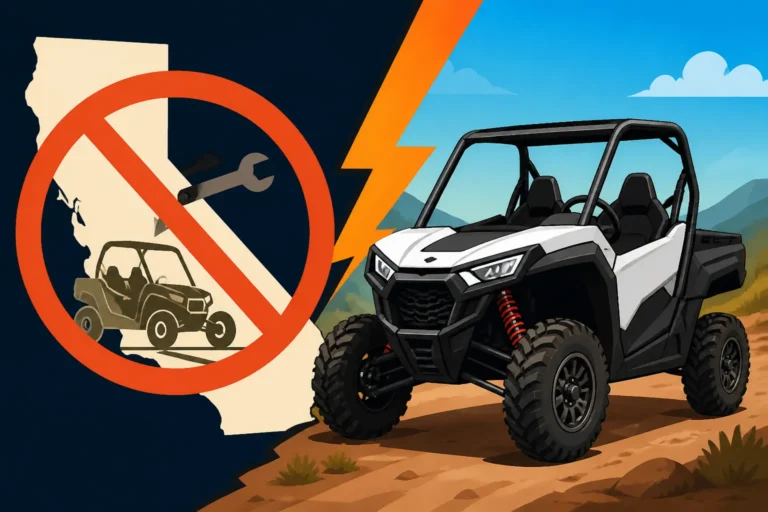
Let's get straight to the point: For the vast majority of UTVs, making them truly "street legal" for general public road use in California simply isn't an option. It's a question that comes up constantly in enthusiast groups, and the answer, unfortunately, is almost always disappointing. California has stringent vehicle classification laws that don't have a clear "street legal UTV" category, unlike some other states that might allow for a conversion process.
The core issue is that UTVs, by their factory design, are classified as Off-Highway Vehicles (OHVs). This means they are manufactured for off-road use, not for highway travel. While you might see people adding turn signals, horns, and mirrors – components readily available from aftermarket suppliers like SuperATV – these additions, while good for safety off-road, don't change the fundamental classification of the vehicle in California's eyes. The state doesn't have a mechanism to convert an OHV into a street-legal vehicle for unrestricted public road use. It's not about what accessories you bolt on; it's about the vehicle's original manufacturer certification and design. This is a common point of confusion and a source of immense frustration for UTV owners, especially those moving from states with more permissive laws.
The Vehicle Code's Stance on UTVs
California's Vehicle Code (CVC) defines different types of vehicles very specifically. An "off-highway motor vehicle" is generally one not designed for operation on a highway. To be street legal, a vehicle must meet a whole host of federal and state safety and emissions standards that UTVs simply are not built to comply with. Think about crash safety, lighting requirements, emissions certifications, and even tire ratings. These are all federal mandates that dictate whether a vehicle can even be sold as street-legal in the first place, and UTVs fall outside these parameters.
For example, a typical UTV lacks the safety features of a passenger car, such as crumple zones, airbags, and reinforced passenger compartments designed for highway impact speeds. Even if you install seatbelts, a roll cage, and good brakes, it doesn't meet the engineering standards for a vehicle intended for general road use. The state also cares deeply about emissions. UTVs are not subject to the same strict emissions standards as passenger vehicles, and trying to retrofit them to meet those standards is practically impossible and cost-prohibitive. This is a fundamental barrier that no amount of aftermarket modification can overcome. This is also why California will not convert a UTV to street legal status.
Decoding California's Vehicle Categories: Where UTVs Fit (and Don't)
Understanding how California classifies vehicles is key to grasping why UTVs face such hurdles. The state has distinct categories, and UTVs primarily land in the "Off-Highway Vehicle" (OHV) camp, which immediately restricts their road use. They are not considered regular passenger vehicles, motorcycles, or even Neighborhood Electric Vehicles (NEVs) or Low-Speed Vehicles (LSVs), all of which have specific, albeit limited, provisions for street use.
Why OHVs Are Different From Street Vehicles
When a vehicle manufacturer produces a UTV, they certify it specifically for off-road use. This certification involves different standards than those for on-road vehicles. For instance, an OHV doesn't need DOT-approved headlights, turn signals, or even a windshield that meets specific safety glass standards in its original configuration. While many UTV owners add these features for better visibility and safety on the trails, they don't magically transform the vehicle into a highway-eligible machine.
The distinction is crucial for registration as well. OHVs in California receive an identification plate and an OHV sticker (Green, Red, or Tan) from the DMV, not a traditional license plate. [Why a California OHV Plate Is Not a License Plate] is an important distinction to understand. This plate and sticker indicate its status as an off-highway vehicle, which comes with specific rules and restrictions on where and how it can be operated. A regular vehicle license plate, on the other hand, signifies that the vehicle has met all federal and state requirements for public road use. You won't be able to get a standard license plate for a UTV unless it was originally manufactured and certified as a street-legal vehicle, which most UTVs are not.
The Myth of "Street-Legal Kits"
You might see "street-legal kits" advertised online or through various vendors. It's important to approach these with a critical eye, especially if you're in California. These kits typically include items like turn signals, a horn, a rearview mirror, and a license plate bracket. While these components are absolutely necessary for any vehicle to be street legal, simply installing them on a UTV does not make it legal for general road use in California.
What these kits can do is make your UTV compliant for very specific, limited road uses permitted in California, such as crossing a highway or riding on a designated combined-use route. [California Rules for Crossing a Public Road] requires certain equipment. However, they do not circumvent the fundamental classification problem. It's a common misconception that if you just add the "right" parts, you're good to go. This is simply not the case in California, and attempting to operate a UTV as a generally street-legal vehicle based solely on these kits can lead to serious fines, vehicle impoundment, and insurance issues. Companies like SuperATV offer robust aftermarket components that enhance your UTV's performance and safety, but they are designed to improve the off-road experience or to meet limited road-use requirements, not to transform an OHV into an unrestricted street vehicle.
Navigating Limited Road Access: Combined-Use Routes and Crossings
While general street legality is largely off the table, California does offer some very specific and limited ways UTVs can legally access public roads. These exceptions are crucial for riders to understand, as they are often the only legal avenues for road use. It's vital to know the rules, as venturing outside these designated allowances can lead to hefty fines.
Designated Combined-Use Highways
California has provisions for what are called "combined-use highways," which are stretches of road, often in rural or unincorporated areas, where OHVs are permitted to travel for a specific, limited purpose. These routes are explicitly designated by local authorities (with CHP approval) and are typically meant to connect trails or access services like fuel or lodging. [California's Combined-Use Highways] provides a good overview. However, there's a catch: these designations are rare, often short, and strictly regulated.
A significant limitation for combined-use routes is the length: California often caps these segments at a maximum of three miles. [California's 3-Mile Combined-Use Cap] outlines this restriction. You can't just drive for hours on these roads; they are meant for connecting points, not for cruising. Also, specific equipment is required, which usually includes a headlight, taillight, brake light, horn, and at least one rearview mirror. While these are components you might get from a SuperATV accessory catalog, the designation of the road itself is key, not just the equipment. Always check local ordinances and signage to confirm if a road is indeed a designated combined-use route before riding on it.
Crossing Public Roads and Highways
A more common scenario for UTV riders is needing to cross a paved public road or highway to get from one section of a trail to another. California law does permit this under very specific conditions. You can generally cross a highway, road, or street if:
- The crossing is made at an angle of approximately 90 degrees to the direction of the highway.
- The crossing is made at a place where no obstruction prevents a quick and safe passage.
- The OHV is brought to a complete stop before entering the highway.
- The operator yields the right-of-way to all traffic on the highway.
- The crossing is made in a safe manner.
This is not permission to ride along the highway, but purely to cross it. It's a quick, direct maneuver from one off-road section to another. Again, safety equipment like lights and a horn are highly recommended, even if not explicitly mandated for every single crossing scenario, as visibility is paramount. [California Rules for Crossing a Public Road] delves into the specifics of this allowance. Remember, if a [What a California Sheriff Checks Roadside] and sees you riding on the road rather than merely crossing, you could be in for a significant penalty.
Agricultural and Private Land Exemptions
There are also very narrow exemptions for OHVs used for agricultural purposes or entirely on private land. If a UTV is being operated strictly for agricultural work on a farm, ranch, or similar property, it might be exempt from certain registration or equipment requirements, and its limited use on adjacent public roads (e.g., to move between fields) might be permissible. However, this is not a loophole for recreational riders. These exemptions are tightly defined and only apply when the primary use is agricultural. For the average recreational UTV owner, these exemptions are irrelevant. If you're riding solely on your own private property and not accessing public roads at all, then California's OHV registration and street-legal questions don't apply to you. However, the moment you put a tire on public land or a public road, the rules kick in.
Equipping Your UTV for Permitted Road Use and Safer Trailering
Since full street legality isn't generally an option for UTVs in California, the focus shifts to making your machine safe and compliant for the limited road uses that are permitted, and for responsible transportation to riding areas. This means thinking about safety gear, accessories, and how you get your UTV to where it can legally be ridden.
Essential Gear for Limited Road Use and Safety
For those rare moments you're legally on a combined-use route or crossing a public road, certain equipment is not just wise, it's often legally required. Many UTVs don't come stock with all of these, so aftermarket additions are common:
- Headlights and Taillights: These are critical for visibility, especially during dawn, dusk, or in low-light conditions. Ensure they are bright and properly aimed.
- Brake Lights: Absolutely essential to signal your deceleration to traffic behind you.
- Horn: A loud horn is necessary to alert others to your presence.
- Mirrors: At least one rearview mirror, typically on the left side, is a minimum requirement for most road-use allowances. Many riders opt for a full rearview mirror (center-mounted) and side mirrors for maximum situational awareness. SuperATV offers a wide range of mirrors, lights, and other accessories that can significantly improve your UTV's visibility and safety.
- Turn Signals: While not always explicitly mandated for every limited road use, turn signals are a huge safety advantage for indicating your intentions to other drivers. They are a smart addition.
- Spark Arrester: If you plan on riding on any forest land or brush-covered areas, a UTV must be equipped with a US Forest Service approved spark arrester to prevent wildfires.
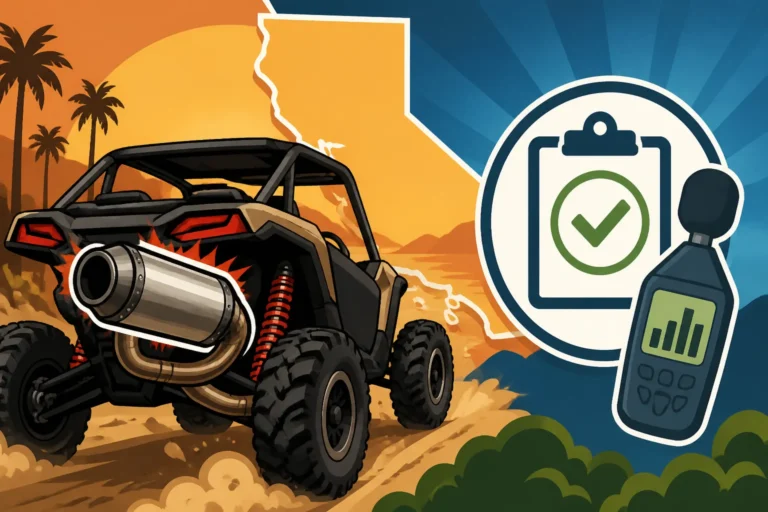
- Muffler: Keep your exhaust system in good repair to comply with noise regulations. California has strict [California Sound Limits for OHVs Explained].
Remember, even with all this equipment, your UTV is still an OHV and not generally street legal. These additions are for enhancing safety and compliance within the narrow scope of permitted road use. [California Helmet Law for UTV Passengers] is also critical to know, as helmets are generally required for all riders, regardless of age, when operating on public lands or routes designated for OHV use.
Trailering: The Most Practical Solution
For the vast majority of UTV owners in California, the most straightforward and legal way to get your machine to an off-road park or trail system is by trailering it. This completely bypasses all the complexities of street legality. You load your UTV onto a trailer, hitch it to your truck, and drive it to your destination. [Trailering Instead of Riding in California] is simply the reality for almost everyone.
When trailering:
- Secure your UTV properly: Use appropriate tie-downs to prevent shifting during transit.
- Check trailer lights and tires: Ensure your trailer is roadworthy and all lights are functioning.
- Respect speed limits: Drive cautiously, especially with a heavy load.
- Proper registration: Your truck and trailer need current registration, but your UTV's OHV registration is valid for transportation, not street driving.
Ultimately, while the dream of a fully street-legal UTV in California remains largely out of reach, understanding the state's specific rules and leveraging the limited exceptions and practical solutions like trailering ensures you can enjoy your UTV safely and legally.
Disclaimer
This article is for general informational purposes only and does not constitute professional advice. Laws, prices and regulations vary by location and change over time. Consult a qualified professional for guidance on your specific situation.