Tribal Roads and California Riders
Tribal roads in California can look like ordinary dirt roads, but that does not mean ATV or UTV riders may use them. Access depends on who controls the road, how it is designated, and the rules of the tribal government and land manager. Before riding, confirm permission and route requirements directly; a California registration or permit may not be enough.
Why Tribal Roads Have Different Rules
California has tribal lands governed by tribal governments. A road on or through tribal land may be managed by a tribe, another public agency, a private landowner, or more than one authority. Its appearance alone does not tell you who controls it or whether it is open to off-highway vehicles.
Tribal sovereignty means a tribe can establish and enforce rules for its land and roads. Those rules may differ from California’s general OHV requirements and from the rules of a nearby county, state recreation area, or federal land. A route that appears on a general map, connects two public roads, or is commonly used by local traffic is not automatically an authorized OHV route.
It also helps to distinguish among three situations:
- A road open to ordinary public traffic: It may still restrict OHVs, require street-legal vehicles, or limit access to certain users.
- A route designated for OHV use: Riders may need to meet the tribe’s conditions as well as applicable state requirements.
- A restricted, private, or closed road: Riding without permission may amount to trespass or violate tribal rules, even if there is no physical gate.
Do not assume California’s rules for county roads or road crossings settle the question. For example, a road’s status under state or county law does not by itself prove that a tribe has opened the route to recreational riding. California’s rules for public-road crossings and designated routes are a separate issue; see California Rules for Crossing a Public Road and What California’s CVC 38026 Lets an Agency Designate for that state-law context.
A tribal road can also cross, border, or connect with land under another agency’s control. Permission for one portion of a ride does not necessarily authorize the whole route. Check each land manager’s rules, especially when a trail crosses a boundary or joins a public road.
Permits, Registration, and Reciprocity
A California OHV registration or nonresident permit addresses California requirements in situations where those rules apply. It does not necessarily grant access to tribal land. Tribal governments may set their own entry, riding, permit, registration, insurance, or safety requirements. They may also close a route or restrict it to residents, authorized visitors, or specific uses.
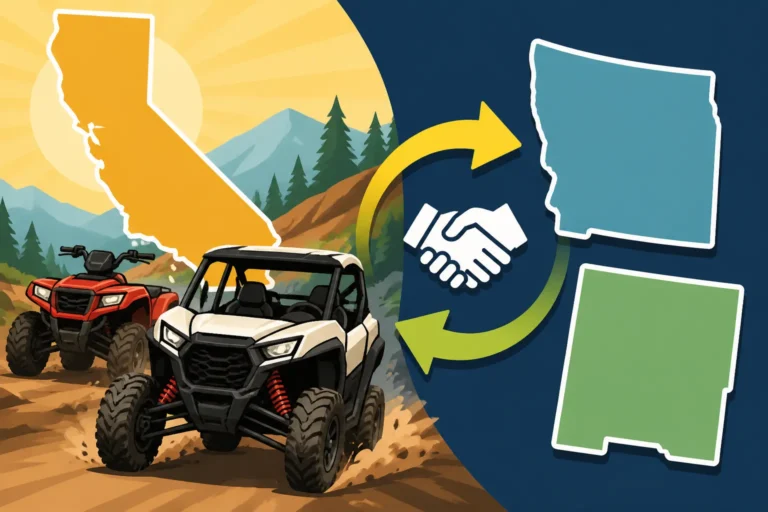
The same distinction matters for out-of-state riders. California’s reciprocity rules determine whether California accepts certain out-of-state OHV credentials for qualifying riding in the state. That recognition does not automatically require a tribal government to accept the same credential for its land. Review California OHV Reciprocity Rules and California’s Nonresident OHV Use Permit as background, then ask the tribe what it requires.
| Question | What California paperwork may address | What to confirm with the tribe |
|---|---|---|
| Is the vehicle registered or identified? | California registration or an applicable permit may satisfy a state requirement | Whether the tribe requires separate registration, a permit, or proof of vehicle identification |
| Is an out-of-state credential accepted? | California reciprocity rules may apply to riding covered by state rules | Whether the tribal government recognizes that credential on tribal land |
| Is the route open to OHVs? | State rules may govern certain public routes or crossings | Whether the particular road or trail is open to recreational OHV use |
| Is riding allowed at this time? | State or land-agency closures may apply | Tribal closures, restricted hours, seasons, events, or other access conditions |
| Are there vehicle-use conditions? | California rules may address equipment, road use, or safety | Any additional tribal requirements for insurance, equipment, passengers, or conduct |
The right paperwork depends on the exact route and the agencies involved. An OHV can be properly identified under California rules and still lack permission to enter a tribal road. Conversely, a tribal permit does not automatically replace a state credential that California requires for a particular type of riding.
A street-legal plate does not settle the access question either. A vehicle authorized for public-road use may still be barred from a tribal road or subject to local limits. See Out-of-State Plates California Will Not Honor for more on the difference between an out-of-state plate and California OHV credentials, and California Insurance Rules for OHV Road Use for insurance considerations when a ride includes roads.
How to Confirm a Route Before You Ride
Ask the government or land office responsible for the land, rather than relying only on a trail app, an old online post, or another rider’s recollection. Rules can differ among tribes and change when access, construction, ceremonies, events, or land-management needs change.
Use this process before loading your machine:
- Identify the road and land manager. Note the road name or route number, the nearest access point, and the location where you intend to enter. If the road crosses a boundary, identify each manager along the route.
- Contact the appropriate tribal office. Ask which office handles roads, land access, natural resources, recreation, or permits. If the tribe directs visitors to a particular department or official page, use that channel.
- Ask about the specific vehicle and activity. Explain whether you plan to ride an ATV, UTV, dirt bike, or another OHV, and whether you will travel through, stop, camp, or join an organized ride.
- Confirm all conditions before setting out. Ask whether the road is open to nonmembers and recreational OHVs, whether permission or a permit is needed, where riding is allowed, and what registration, insurance, safety, or equipment rules apply.
- Check for current closures and entry instructions. Confirm where the route begins, whether a gate or checkpoint applies, and whether permission is valid for the date and area you plan to visit.
- Keep required proof with you. Carry any permit, written authorization, registration, or other documents the tribe requires. Follow the tribe’s instructions about whether digital copies are acceptable.
- Respect signs and directions on the ground. If a road is marked closed, restricted, or private, do not ride past the sign unless the responsible authority has clearly authorized you to do so.
If you cannot verify that a route is open, choose a clearly authorized riding area instead. A public map can help with navigation, but it is not a substitute for permission. A gate being open, a road being graded, or tire tracks being visible does not establish that recreational riding is allowed.
For mixed routes, verify the state and county portions separately. California may have rules for riding on an unincorporated county road, but those rules do not override tribal access restrictions. Riding Unincorporated County Roads in California explains the county-road distinction, while California Rules for Crossing Private Land covers why crossing property is not automatically allowed.
Riding Respectfully and Handling Uncertainty
When access is granted, treat the conditions as part of the permission. Stay on the approved route, obey posted speed and equipment rules, and do not assume that authorization for one road extends to nearby tracks or open ground. Avoid disturbing cultural, archaeological, ecological, or community sites, and do not enter homes, work areas, or restricted facilities without permission.
Follow local instructions about dust, noise, group size, passenger limits, parking, and stopping. These details matter on roads shared with residents, workers, emergency vehicles, and other visitors. If an event or guided ride is involved, confirm that its organizer has arranged the required authorization; an event’s presence does not make every connected route open to independent riders.
If a ranger, police officer, tribal official, or other land manager asks you to stop, do so safely and follow directions. Be prepared to show the documents you were told to carry. If there is a disagreement about whether your permit covers a route, do not continue riding while trying to resolve it on the trail. Contact the office that issued the permission and ask for clarification.
The most reliable rule is simple: confirm both that the road is open to your type of vehicle and that you have the required authorization for that land. California registration, state reciprocity, and a visible trail on a map can each answer only part of the question. The tribal government or land manager is the source to check for access to its road.
Disclaimer
This article is for general informational purposes only and does not constitute professional advice. Laws, prices and regulations vary by location and change over time. Consult a qualified professional for guidance on your specific situation.