Out-of-State Plates California Will Not Honor
It's incredibly frustrating when you've done your due diligence in your home state, decked out your ATV or UTV with all the necessary street-legal bells and whistles, only to arrive in California and find out your efforts might be completely disregarded. Many riders roll into our beautiful state assuming their out-of-state street-legal plates mean they can cruise down combined-use roads or even cross highways with ease, only to face a harsh reality. This guide is here to untangle the often confusing web of California's Off-Highway Vehicle (OHV) laws, specifically addressing why many out-of-state street-legal plates simply won't cut it here and what you absolutely need to know to avoid fines and headaches.
The Harsh Reality of California's OHV Road Rules
California has a notoriously strict and unique approach to off-highway vehicles, especially when it comes to riding them on public roads. What might be perfectly legal and common practice in states like Arizona, Utah, or Montana, often runs head-first into a brick wall of regulations once you cross the Golden State's border. This isn't just about differing vehicle codes; it's about a fundamental philosophical difference in how the state classifies and permits these machines for road use.
Why Your Out-of-State Street Legal Plate Might Be Useless Here
The frustration is palpable for many riders. You've invested time and money, perhaps adding turn signals, a horn, rearview mirrors, and even a windshield to your side-by-side, proudly displaying a license plate issued by your home state's DMV. You've been legally commuting to the grocery store or connecting trails on public roads back home. So, why would California treat your perfectly street-legal machine as a mere off-highway vehicle once you arrive? The core issue lies in how California defines a "vehicle" for highway use versus an "off-highway motor vehicle" for designated dirt routes. Our state's Vehicle Code generally does not consider ATVs, UTVs, or dirt bikes as road-legal vehicles, regardless of their modifications or out-of-state status, unless they meet extremely stringent and specific criteria usually reserved for conventional automobiles. This means your carefully acquired plate from another state often carries no weight on California's paved public roads.
California's laws are designed to categorize vehicles based on their original manufacturer's intent and compliance with specific safety and emissions standards set for highway use. An OHV, by its very nature and construction, is typically not manufactured to meet these highway standards. While other states have carve-outs or conversion processes to grant OHVs street-legal status, California generally does not. This is why even a fully accessorized UTV, registered and plated for the street in Arizona, will often be viewed by a California Highway Patrol officer or county sheriff as an off-highway vehicle illegally operating on a public road, leaving you vulnerable to citations.
Distinguishing Between OHV Registration and Street Legal Plates
It's crucial to understand the difference between an OHV registration (like California's green, red, or tan sticker system) and a street-legal license plate issued for road use. Many states offer a way to register an OHV for general off-highway use, often involving a decal or a small plate, similar to what California requires for its resident machines. This registration typically signifies that you've paid your fees and are allowed to operate on designated off-highway trails and public lands.
However, a street-legal plate goes a step further, permitting the vehicle to operate on public streets and highways. This is where California diverges significantly from many other states. While an Oregon OHV permit or a Nevada OHV decal might offer limited reciprocity for off-highway use here—meaning you won't need to buy a California Nonresident OHV Use Permit if your home state is Oregon or Nevada—it absolutely does not grant street legality. [California OHV Reciprocity: Only Two States] This distinction is vital: your out-of-state OHV registration or permit might allow you to ride on California's off-highway trail systems, but it will not magically transform your UTV into a road-legal vehicle for highway cruising or connecting trails via paved roads in California.
Common Out-of-State Plates That Fail in California
It's easy to get confused because other states have very different laws. What might be a perfectly legitimate practice just across the border often leads to trouble here. Let's look at some of the most common scenarios that trip up out-of-state riders.
The Arizona Street-Legal UTV Trap
Arizona is a popular destination for OHV enthusiasts, and it's also a state known for its relatively permissive laws regarding making UTVs street-legal. Many Arizona residents invest in conversion kits, adding mirrors, turn signals, and sometimes even windshield wipers, and proudly affix an Arizona license plate to their UTV, allowing them to ride directly from their driveway to the trail. It’s a fantastic convenience for riders there.
However, when you bring that same Arizona-plated, street-legal UTV into California, you're entering a different legal landscape. California's Vehicle Code fundamentally classifies UTVs and ATVs as Off-Highway Motor Vehicles (OHVMs), not as vehicles suitable for general highway use. The state has specific regulations for what constitutes a "street-legal" vehicle, and these typically refer to traditional automobiles, motorcycles, and some low-speed vehicles. An aftermarket "street-legal kit" from a company like SuperATV, while excellent for complying with laws in states like Arizona, does not magically make a UTV meet California's rigorous and distinct vehicle code requirements for highway operation. [An Arizona Street-Legal UTV in California] The reality is, a California law enforcement officer seeing an Arizona-plated UTV driving on a paved highway will likely consider it an illegal operation, regardless of its Arizona street-legal status. This often results in a citation for operating an unregistered or unpermitted vehicle on a public highway.
Montana LLC and Utah Plates: A False Sense of Security
For years, some OHV owners, particularly those with higher-end UTVs, have explored options like registering their machines through a Montana LLC or acquiring a Utah street-legal plate. The appeal often lies in perceived lower taxes, simpler registration processes, or the ability to acquire a street-legal plate more easily than in their home state. These methods can indeed be valid and effective in their respective jurisdictions.
However, neither a Montana LLC plate nor a Utah street-legal plate holds sway in California for general highway use with an OHV. California's position is quite clear: if the vehicle, by its original manufacturer's design and adherence to California's own specific vehicle standards, is not deemed suitable for highway use, then an out-of-state plate, regardless of its origin, will not grant that permission. [A Montana LLC Plate in California] The state focuses on the vehicle's inherent classification and compliance with its own stringent codes, not on the registration practices of other states. [A Utah Plate That Means Nothing in California] Relying on these out-of-state registrations to bypass California's strict OHV road rules is a risky gamble that often ends with a ticket and a tow.
Why "Street Legal" in Other States Doesn't Translate
The core issue boils down to the varying definitions and regulations across state lines. What one state considers a simple "conversion" to meet basic street-legal requirements, another state like California might view as an incomplete or non-compliant modification for highway operation. Factors like emissions standards, specific safety equipment (beyond just lights and mirrors), vehicle identification, and overall design are all considered. California's vehicle codes are extensive and very particular.
For example, while a UTV might be equipped with a horn, turn signals, and a speedometer to meet the street-legal requirements of Nevada, California's definition of a "motor vehicle" for highway use is much narrower when it comes to off-highway machines. The intent of California's Vehicle Code is to keep OHVs primarily off public roads designated for conventional traffic, preserving safety and environmental standards. Modifications from companies like SuperATV are fantastic for enhancing your machine, but they are built to a broad market and usually cannot guarantee compliance with California's unique interpretation of highway vehicle standards for OHVs. Unless your vehicle was originally designed and certified by the manufacturer to meet all California highway safety and emissions standards (which most ATVs and UTVs are not), or it falls under very specific, limited exceptions, its out-of-state street-legal status will likely be ignored by California law enforcement on paved public roads.
California's Limited Exceptions for OHV Road Use
While California is generally very restrictive, there are a few, highly specific scenarios where an OHV might legally operate on a public road. These are not broad "street legal" permissions, but rather narrow exceptions with strict conditions. It’s important to understand these nuances to avoid misunderstandings that could lead to fines.
Combined-Use Highways: A Tiny Window of Opportunity
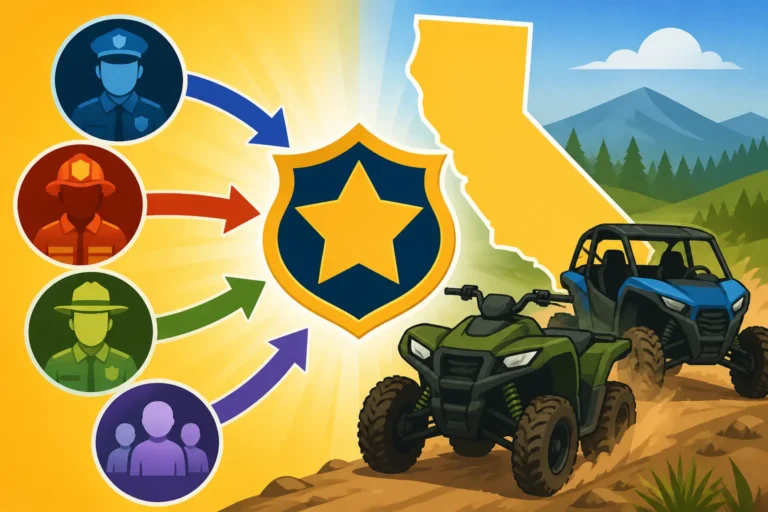
One of the most frequently misunderstood exceptions is the "combined-use highway." The California Vehicle Code (CVC 38026) allows certain public roads to be designated for both conventional vehicle traffic and off-highway vehicle use. This sounds promising, but the reality is far more restrictive than many hope. These are not general permissions for OHVs to cruise on any public road. Instead, they are specific, often short, segments of county roads or secondary state highways that have been formally designated by the Director of California State Parks or a local agency with the approval of the California Highway Patrol (CHP).
Even when designated, these segments are typically capped at a maximum length of three miles and are meant to connect legal OHV riding areas or provide access to amenities like fuel or lodging. [California's Combined-Use Highways] You cannot simply decide to use any road you deem "suitable." The route must be officially designated and clearly marked with signs indicating OHV access. Furthermore, these designations are often temporary or subject to change. [California's 3-Mile Combined-Use Cap] For instance, while some areas might have experimented with longer combined-use routes, like the Inyo County Pilot program, such initiatives are rare and have specific sunset clauses, like [California's Inyo County Pilot Ended in 2025]. The bottom line is, unless you are on a specifically designated and signed combined-use highway, your OHV, even with an out-of-state plate, is not permitted on California's paved public roads.
Crossing Public Roads: The Quick Dash Rule
Another limited exception (CVC 38025) allows an OHV to cross a highway, but again, this comes with strict conditions. This rule is designed for situations where an OHV trail is divided by a paved public road, and riders need to get from one section of the trail to another. It is absolutely not permission to ride your OHV along the public road for any distance.
To legally cross a public road:
- You must come to a complete stop before entering the highway.
- The crossing must be made at an angle of approximately 90 degrees to the highway.
- You must cross at a place where the operation can be conducted safely and without interfering with vehicular traffic.
- The crossing must be at an intersection or another designated crossing point, if specified.
- You must yield the right-of-way to all traffic on the highway.
[California Rules for Crossing a Public Road] This is meant to be a swift, direct crossing, not a brief stint of driving on the road. Any deviation from these rules, such as riding parallel to the road for even a short distance, can result in a citation. [Crossing a Road on an OHV in California] Think of it as merely bridging a gap, not utilizing the road for travel.
Designated County and Forest Service Roads
Beyond state highways, some local county governments and federal agencies, like the U.S. Forest Service (USFS) or Bureau of Land Management (BLM), may designate certain dirt or unpaved roads within their jurisdiction as open to OHV use. These are typically fire roads, primitive access roads, or routes within designated OHV recreation areas.
When riding on these types of roads, it's crucial to understand that their designation is specific to OHV operation within a larger off-highway context, not as part of a street-legal network. You must consult up-to-date Motor Vehicle Use Maps (MVUMs) for National Forests or local county ordinances to confirm which roads are open to OHVs. Just because a road is unpaved doesn't automatically mean OHVs are allowed. [Riding a California Forest Service Road] Even on these designated routes, your out-of-state plate still only indicates your OHV's registration for off-highway use in your home state; it doesn't confer "street-legal" status as California defines it. So, while you might be able to ride a designated dirt county road, that same road might immediately become off-limits to OHVs once it transitions to pavement or exits the designated OHV area. [Riding a County Dirt Road in California] Always verify the rules for specific areas before you ride.
What California DOES Require for Out-of-State OHVs
Okay, so your out-of-state street-legal plate might not give you road access, but what does California expect from you as a visiting OHV enthusiast? It's not a free-for-all; there are still specific requirements you need to meet to legally ride on public lands and designated OHV areas.
The California Nonresident OHV Use Permit
If you're bringing an OHV from out-of-state and plan to ride on California's public lands, chances are you'll need to purchase a California Nonresident OHV Use Permit. This permit is essentially California's way of ensuring that visiting riders contribute to the maintenance and operations of our state's vast network of OHV trails and parks. It's a mandatory requirement for most out-of-state machines to ride on designated OHV areas, including State Vehicular Recreation Areas (SVRAs), National Forest lands, and BLM lands.
The permit is usually valid for two years and costs a reasonable fee. [California's Nonresident OHV Use Permit] You can often purchase these permits online through the California Department of Parks and Recreation's OHMVR Division website, or in person at various vendors located near popular riding areas. [How to Buy a California Nonresident OHV Permit] It's crucial to obtain this permit before you arrive at a riding area, as park rangers and law enforcement actively check for them. Displaying the permit properly, usually affixed to the left front of your OHV, is also essential. Remember, this permit is for off-highway use only; it does not grant street-legal privileges. [California's $30 Nonresident Permit]
Reciprocity Agreements: A Rare Gem
There are only two states that have a specific reciprocity agreement with California regarding OHV registration: Oregon and Nevada. If your OHV is properly registered with a current, valid OHV decal or permit from either Oregon or Nevada, you generally do not need to purchase the California Nonresident OHV Use Permit. This saves you some time and money.
However, it's vital to understand the limitations of this reciprocity. This agreement only covers the off-highway registration requirement. It does not mean that your Oregon-plated UTV is street-legal in California, nor does it mean your Nevada-registered OHV can be ridden on California's paved roads. [An Oregon Permit on California Sand] This reciprocity exclusively applies to the off-highway identification component. So, while you might save $30 by having an Oregon or Nevada decal, you still cannot ride your OHV on any California street or highway unless it falls under one of the extremely rare and limited exceptions discussed earlier. [A Nevada Decal at a California SVRA] Any other state's OHV registration, including popular ones like Arizona or Utah, does not qualify for this reciprocity, meaning riders from those states will still need to buy the California Nonresident OHV Use Permit. [California OHV Reciprocity: Only Two States]
Why Your Out-of-State Registration Still Matters (for off-highway)
Even if your out-of-state plate doesn't grant street legality in California, your home state's OHV registration or permit is still important. Primarily, it serves as proof that your machine is legally owned and identified in your state of residence. While California won't honor it for road use, park rangers and law enforcement may still ask to see proof of ownership and home-state registration, especially if there's an issue regarding stolen vehicles or compliance.
Think of it this way: your out-of-state registration shows you're compliant in your state. The California Nonresident OHV Use Permit (or the Oregon/Nevada reciprocal permit) shows you're compliant for California's off-highway trail system. Both are important pieces of documentation to have when you're riding here. Always carry physical copies of your vehicle's registration, title, and any necessary permits when you're out on the trails.
The Legal and Financial Consequences of Ignoring California's Rules
It's tempting to think you can simply "chance it" or that a street-legal plate from another state will be enough to ward off law enforcement. However, ignoring California's specific OHV road rules can lead to serious legal and financial repercussions that can quickly turn an exciting riding trip into a costly nightmare.
Tickets, Fines, and Impoundment: What Happens When You're Caught
California law enforcement, including the California Highway Patrol (CHP) and county sheriffs, are well-versed in the state's OHV regulations. They frequently patrol areas near popular OHV parks and designated routes, specifically looking for violations. If you're caught operating an OHV on a public road that is not a designated combined-use highway or you're not making a legal crossing, you can face significant fines.
These fines can quickly add up. Operating an unregistered or illegally operated OHV on a public road is typically a violation of the California Vehicle Code. You could be cited for multiple offenses, such as operating an unregistered OHV, operating an OHV on a highway, or even driving without a valid driver's license if you're under age or don't possess the appropriate class of license for the road. [California Fines for Riding a Public Road] In addition to fines, law enforcement has the authority to impound your OHV. This means your machine will be towed to an impound lot, and you'll be responsible for hefty towing and storage fees on top of any citations. Retrieving an impounded vehicle can be a complicated and expensive process, potentially ruining your entire trip.
Insurance Implications: Are You Covered?
Beyond the immediate legal penalties, operating your OHV illegally on a public road in California can have severe consequences for your insurance coverage. Most standard off-highway vehicle insurance policies are specifically designed to cover incidents that occur during off-highway use, in designated riding areas, or during legal transport. They are generally not intended to cover accidents or liability that arise from illegally operating your OHV on public streets or highways.
If you have an accident while operating your out-of-state plated UTV on a California public road where it's not legally permitted, your insurance provider could deny coverage. This means you would be personally responsible for all damages, injuries, and legal costs, which could amount to tens or even hundreds of thousands of dollars. It's a common misconception that if your home state considers your OHV street-legal, your insurance will automatically cover you everywhere. Always check with your insurance provider about out-of-state coverage and specifically ask about their policy on operating OHVs on public roads in California, even with an out-of-state street-legal plate. The financial risk is simply not worth the convenience of taking a shortcut.
Modifications for Compliance: Is It Even Worth It?
Aftermarket companies, including SuperATV, offer a wide range of parts and kits designed to make OHVs street-legal in many states. These often include essential items like turn signals, mirrors, horns, and sometimes even DOT-approved windshields. In states with more lenient conversion laws, these kits are incredibly helpful.
However, making an OHV truly "street-legal" in California, in the same vein as a traditional automobile, is an almost insurmountable challenge. California's emissions standards, particularly for new vehicles, are among the strictest in the nation. Most OHVs, by their very nature, are not designed to meet these on-road emissions standards, nor do they typically possess the crash-worthiness, lighting, braking, and occupant protection features required for highway vehicles. While you might be able to add some equipment to your UTV, you cannot easily convert its fundamental vehicle class or meet the extensive list of California Vehicle Code requirements for full highway operation. [Why California Will Not Convert a UTV] For the vast majority of ATVs and UTVs, it is practically impossible and financially unfeasible to make them street-legal in California in the same way a car is street-legal. Attempting to do so, without satisfying all of California's specific codes, will still leave you vulnerable to citations.
Practical Advice for Visiting California OHV Enthusiasts
Navigating California's OHV rules can feel like a maze, especially if you're coming from out of state. But with a bit of planning and adherence to the rules, you can still have an incredible riding experience. The key is to understand and respect the differences in our state's regulations.
Planning Your Trip: Don't Assume Street Legality
The single most important piece of advice is to never assume your out-of-state street-legal plate grants you permission to ride on California's public roads. Before you even pack your bags, thoroughly research the specific riding areas you plan to visit. Check the official websites for California State Parks' OHMVR Division, the Bureau of Land Management (BLM), and the U.S. Forest Service (USFS) for the most current rules and designated OHV routes. Many areas have very specific regulations regarding which types of vehicles are allowed on which trails, and crucially, how to access those trails.
Always confirm if a California Nonresident OHV Use Permit is required for your machine, unless you have an Oregon or Nevada OHV registration. Remember, even in areas with "combined-use" roads, these are rare, short, and explicitly marked. Plan your entire trip around trailering your OHV to the trailhead and back, rather than expecting to ride it on public roads. This proactive approach will save you immense hassle and potential legal trouble.
Embrace the Trailer: Your Best Friend in California
For most out-of-state OHV riders, your trailer is your most important piece of equipment in California. It is the safest, most legal, and frankly, the only realistic way to transport your ATV or UTV between your lodging and the designated riding areas. Don't view trailering as an inconvenience; view it as a necessary part of enjoying California's incredible off-highway opportunities responsibly and legally.
Whether you're bringing a single ATV on a small utility trailer or multiple side-by-sides on an enclosed toy hauler, ensure your trailer is properly registered and road-worthy. Secure your OHVs properly to prevent shifting during transit. Always prioritize trailering over trying to ride on public roads. [Trailering Instead of Riding in California] This will allow you to enjoy destinations like Oceano Dunes, Glamis, Hungry Valley, and Hollister Hills without the constant worry of an encounter with law enforcement over illegal road use.
| Feature / Scenario | Most Other States (Street-Legal OHV) | California (Street-Legal OHV) |
|---|---|---|
| Out-of-State Plate | Generally recognized for road use if street-legal in home state. | Not recognized for general road use; vehicle classification is paramount. |
| Road Operation | Allowed on most public roads (often excluding interstates/highways). | Generally prohibited; exceptions are extremely limited & specific. |
| Connecting Trails | Common to ride on roads to link trail segments. | Trailering is the norm; riding on roads for connection is usually illegal. |
| Required Equipment | Street-legal kits (horn, signals, mirrors) often sufficient. | OHV must meet all CA highway vehicle codes (emissions, safety standards, original design). |
| "Street-Legal" Kits | Effective for compliance in those states. | Typically insufficient to make an OHV meet CA highway vehicle standards. |
| Nonresident Permit | Not applicable for road use; focus is on home-state compliance. | Required for off-highway use (unless from OR/NV). Does NOT grant road access. |
| Crossing a Highway | Often allowed with similar safety precautions. | Allowed, but strictly regulated: 90-degree angle, complete stop, no driving on the highway. |
| Combined-Use Highways | Broader interpretation, more common. | Very specific, short (max 3 miles), designated by agency & CHP. |
| Enforcement Risk | Low if properly plated. | High if operating on non-designated roads; fines & impoundment likely. |
Consider Rentals for a Hassle-Free Experience
If the thought of navigating California's complex OHV registration and road rules is too daunting, or if you simply want to enjoy a spontaneous ride without bringing your own equipment, consider renting an OHV from a local outfitter. California has numerous rental businesses located near popular riding areas, such as Oceano Dunes, Glamis, and Ocotillo Wells.
These rental companies handle all the necessary California OHV identification (green stickers, red stickers, etc.) and ensure their machines comply with state regulations for off-highway use. [Renting an ATV in California] They often provide helmets, safety briefings, and can even offer guided tours, especially in dune areas. [Renting a Side-by-Side in California] Renting eliminates the headache of permits, trailering your own machine, and worrying about whether your out-of-state plate will cause problems. It's a fantastic option for families, beginners, or anyone looking for a worry-free day of riding on California's spectacular off-highway trails.
Disclaimer
This article is for general informational purposes only and does not constitute professional advice. Laws, prices and regulations vary by location and change over time. Consult a qualified professional for guidance on your specific situation.