Riding a Quad Across a Paved Highway
It’s a scenario almost every off-road rider in California has faced: you're out on the trails, enjoying a fantastic ride, but suddenly, the marked route leads you to a paved road. Maybe it’s a short hop to another section of trail, or perhaps you need to cross to reach a gas station or a designated camping area. The question instantly pops into your head: can I legally just drive my quad or UTV across this paved highway? It’s a frustrating moment of uncertainty that can quickly turn a fun day into a stressful one. This guide is here to untangle the often-confusing rules surrounding crossing paved highways in California on your off-highway vehicle (OHV), helping you stay safe and on the right side of the law.
The Basics of Crossing a Paved Highway in California
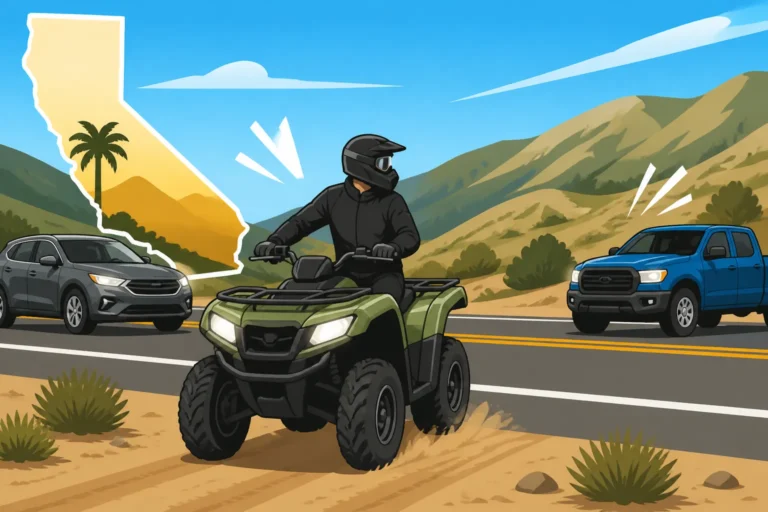
Let's be clear from the start: California is one of the toughest states when it comes to allowing off-highway vehicles on paved roads. The general rule is simple – OHVs are for off-highway use. However, the law does recognize that sometimes a brief, controlled interaction with a paved road is unavoidable to connect legitimate off-road routes. It's crucial to understand that "crossing" is very different from "riding on" a public road.
Why "Street Legal" Isn't the Goal for Most OHVs
Many new riders, or even those coming from other states, often wonder why they can't just make their ATV or UTV "street legal" in California. After all, if it has headlights and taillights, why not? The reality is that for most quads and side-by-sides, true street legality in California is nearly impossible to achieve. These machines are designed and manufactured for off-road environments, not for the rigors of paved road travel with other highway vehicles.
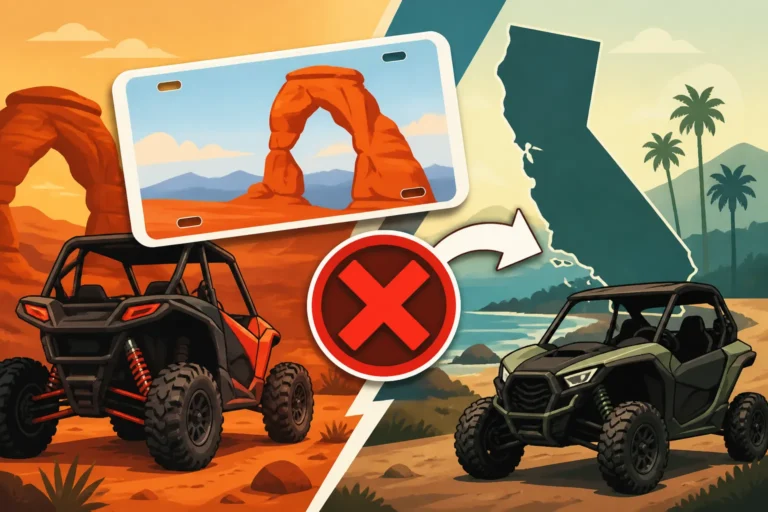
California's vehicle codes are extremely specific about what constitutes a street-legal vehicle, encompassing everything from emissions standards (hello, [What CARB Compliance Means in California]!) to crash safety ratings, tire types, and even seatbelt designs. Most OHVs simply don't meet these stringent requirements. So, while you might see a modified UTV with turn signals and a license plate from another state, understand that [A Utah Plate That Means Nothing in California] here. The focus for California riders, therefore, isn't about making your OHV street-legal for general road use, but rather understanding the very limited circumstances under which you can legally cross or briefly use a public paved road to connect designated off-highway routes.
What California Vehicle Code 38026 Allows
Here's where the nuance comes in, and it's absolutely critical for any California OHV enthusiast to understand. California Vehicle Code (CVC) Section 38026 is the golden ticket, so to speak, for these limited road interactions. This code allows a public agency, such as the U.S. Forest Service, the Bureau of Land Management (BLM), or a county board of supervisors, to designate specific public roads or sections of roads for OHV use for the purpose of connecting trails or providing access to OHV areas.
It's vital to grasp that this isn't a blanket permission for you to choose your own crossing point. The authority to designate these routes lies entirely with the land management agency. This means they've assessed the safety, traffic flow, and environmental impact, and have officially marked or posted these sections for OHV use. So, if you're wondering [What California's CVC 38026 Lets an Agency Designate], it essentially allows these agencies to create those critical links that prevent you from having to load your machine back onto a trailer just for a 200-foot gap in the trail. Always look for official signage or consult current [Motor Vehicle Use Maps and Reading Them] for designated areas before assuming any road is fair game for a crossing. If it's not designated, it's not allowed, plain and simple.
The Specific Rules for Crossing (and Not Riding On) a Highway
Even when you're on a legally designated crossing, there are strict rules of engagement you need to follow to ensure your safety and avoid a citation. Think of it as a highly controlled maneuver, not just another part of your ride.
Stopping Before You Cross
This might seem like common sense, but it’s often overlooked in the excitement of a ride. When you reach the edge of a paved highway you intend to cross, you must come to a complete stop. This isn't just a rolling pause; it's a full stop, just as if you were at a stop sign or pulling out of a private driveway onto a busy street.
Why is this so important? First, it gives you a moment to assess traffic conditions thoroughly. Paved roads, even quiet rural ones, can have vehicles traveling at much higher speeds than you're used to on the trail. Your OHV might also be lower profile or less visible than a car, so you need every second to make sure the coast is absolutely clear. Second, it demonstrates to any observing law enforcement officer that you are aware of the rules and prioritizing safety. A rolling stop, or worse, just zipping across, is a sure way to attract unwanted attention and potentially dangerous situations.
Crossing at a Right Angle and Why It Matters
Once you've stopped and determined it's safe to proceed, you must [Crossing at a Right Angle]. This means you drive straight across the road, perpendicular to the flow of traffic, in the shortest possible distance. Do not angle your machine and drive down the shoulder, even for a short stretch, and definitely do not travel in a traffic lane.
This rule exists for several critical reasons. Legally, it reinforces that you are merely crossing, not traveling on the highway. Driving parallel to traffic, even briefly, can be interpreted as illegal operation on the highway. From a safety perspective, crossing at a right angle minimizes the time you spend in the path of oncoming vehicles. It also makes your intentions clear to other drivers. They see you moving directly across, not potentially merging into their lane. Imagine if you started to angle down the road – a driver might assume you're attempting to join traffic, leading to confusion and potential hazards. This direct approach is the safest and most compliant way to execute a legal crossing.
Crossing a Divided Highway
Encountering a divided highway adds another layer of complexity to the crossing rules. A divided highway has a physical barrier, median, or even just a wide, unpaved strip separating opposing directions of traffic. When you face such a road, the rule is to treat each direction of travel as a separate crossing.
This means you will cross the first set of lanes, come to a complete stop in the median (if it's wide enough and safe to do so), and then re-evaluate traffic before crossing the second set of lanes. You absolutely cannot try to cross all lanes of a divided highway in one continuous movement, even if you think you have time. The gaps in traffic might be different for each direction, and waiting safely in the median provides a crucial buffer. Always ensure you have a clear, unhurried path for both segments of the crossing. Just like any crossing, [Crossing a Divided Highway] requires extreme vigilance. Never assume a driver sees you or will yield; always assume they don't, and wait for an ample opening in traffic.
Essential Requirements and Safety Considerations
Crossing a paved road, even legally, requires more than just knowing where and how to do it. Your machine needs to be properly equipped, and you need to be aware of the bigger picture of enforcement and potential penalties.
OHV Registration and Equipment You Must Have
Before your wheels even touch that pavement, your off-highway vehicle must meet California's fundamental registration and equipment requirements. This isn't just about trail riding; these rules extend to any legal interaction with public roads.
First and foremost, your quad or UTV needs to have valid California OHV registration, typically a [California's Green Sticker Explained] or [Red Stickers and What Changed in California] displayed prominently. If you're visiting from out of state, you'll need a [California's Nonresident OHV Use Permit] unless your state has specific reciprocity with California. Rangers and law enforcement routinely check for current registration, even for brief crossings.
Beyond registration, your machine must be in good working order. This includes:
- Lights: Ensure your headlights and taillights are fully functional. While crossings are ideally done in daylight, unexpected delays or weather changes can occur. For enhanced visibility during any road interaction, you might even consider aftermarket additions like brighter LED lights or wider rearview mirrors, easily found from suppliers like SuperATV, to enhance your presence to oncoming traffic.
- Brakes: Your braking system needs to be responsive and effective. A short-notice stop could be necessary, and you need to trust your machine.
- Spark Arrester: This is non-negotiable, especially in California. All OHVs operating on public lands (which includes designated crossing points) must be equipped with an approved spark arrester. Without one, you're not only risking a fire but also a significant fine. Make sure to understand [California Spark Arrester Rules].
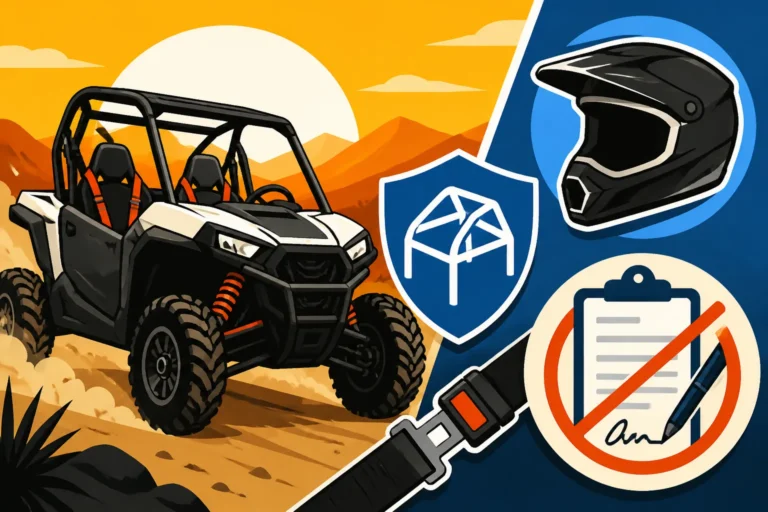
- Helmets: For ATV riders, a helmet is legally required for everyone on board on public lands, including these crossing points. For UTVs, seatbelts are mandatory, and while adult drivers of certain ROVs may have a helmet waiver in some cases, it's generally best practice for all occupants to wear one. It’s always safer to wear one. Review [California Helmet Law for ATV Riders] for specifics.
- Muffler/Exhaust: Your OHV must have a muffler that keeps noise within California's legal limits. [California Sound Limits for OHVs Explained] are strict, and crossing a paved road where residences might be nearby could draw attention to an overly loud machine.
Before you even attempt a crossing, ensure your quad or UTV is in pristine mechanical shape. This means properly inflated tires, functioning brakes, and all required safety equipment, including a proper exhaust with a spark arrester and any extra visibility enhancements, perhaps from a reputable brand like SuperATV, if you feel your stock setup isn't enough. It's not just about compliance; it's about your personal safety.
Where You Can and Cannot Cross
The distinction between where you can and cannot cross is perhaps the most critical piece of information. As discussed, crossings are only permissible on designated routes. This means you need to do your homework before you head out.
- Designated Routes: These will be clearly marked by the land management agency with signs, or explicitly detailed on official maps, such as [Motor Vehicle Use Maps and Reading Them] for National Forests or BLM area maps. These maps are your best friend for planning routes that involve road crossings.
- No Freeways: This is a hard and fast rule. You can never, under any circumstances, cross a freeway (interstate or state route with limited access). [Why Freeways Are Excluded in California] is a matter of extreme public safety, given the high speeds and limited visibility. Doing so is not only incredibly dangerous but carries severe penalties.
- Private Land: If a trail crosses private property, you need explicit permission from the landowner to cross. Designated public road crossings are different from crossing private roads or private land.
- County Roads: Sometimes, local counties might designate specific county roads for OHV use to connect trails. These designations are less common than federal land designations, but they do exist. Always check with the specific county's public works or sheriff's department for their local ordinances if you're uncertain.
The bottom line here is: if it's not explicitly designated, assume it's off-limits. When in doubt, scout ahead, consult maps, or ask the local land management office.
Penalties and Enforcement
Ignoring California's OHV road use laws can lead to significant consequences, far beyond just ruining your day. Law enforcement agencies, including the California Highway Patrol (CHP), county sheriffs, and federal rangers (Forest Service, BLM), actively patrol areas adjacent to OHV trails and are well aware of common illegal crossing points.
The penalties for illegal highway operation or crossing can include:
- Fines: These can range from hundreds to thousands of dollars, depending on the severity of the offense and whether it's a first or repeat violation. [California Fines for Riding on a Highway] can be quite steep.
- Impoundment: Your OHV could be impounded, leading to towing and storage fees on top of any fines. Getting your machine back can be a costly and time-consuming headache.
- Citation for unregistered vehicle: If your OHV isn't properly registered, that's another fine added to the pile.
- License points: Depending on the violation, you might even incur points on your driver's license, affecting your auto insurance rates.
When [What a California Sheriff Checks Roadside] or a ranger performs a stop, they'll be looking for valid registration, required safety equipment, and proper operating procedure. Always carry your [Carrying Registration Paper on the Sand] and be polite and cooperative. Ignorance of the law is generally not considered a valid defense. It’s far better to know the rules, follow them, and enjoy your ride worry-free.
| Action | Do | Don't |
|---|---|---|
| Preparation | Consult official maps for designated crossings. | Assume any road is okay to cross. |
| Ensure OHV is registered (Green/Red Sticker). | Ride an unregistered machine. | |
| Check all lights, brakes, spark arrester. | Operate a machine with faulty equipment. | |
| Wear a helmet (and seatbelt if in a UTV). | Skip safety gear. | |
| At the Road | Come to a complete stop at the road's edge. | Roll through or "California stop." |
| Look thoroughly both ways for traffic. | Rush the crossing without a clear view. | |
| Yield to all oncoming traffic. | Assume vehicles will stop or slow for you. | |
| Crossing | Cross directly at a right angle (perpendicular to traffic). | Drive along the shoulder or merge into traffic. |
| If divided highway, stop safely in median before second crossing. | Attempt to cross all lanes of a divided highway in one go. | |
| Cross as quickly and safely as possible. | Dawdle or engage in any non-crossing activities. | |
| Legal Status | Cross only on officially designated routes. | Cross freeways or undesignated roads. |
| Carry your registration and safety certificate (if applicable). | Forget your paperwork or be unprepared for a stop. |
Disclaimer
This article is for general informational purposes only and does not constitute professional advice. Laws, prices and regulations vary by location and change over time. Consult a qualified professional for guidance on your specific situation.