Clay Pit and Its Short Season
Clay Pit’s compact trail network and seasonal access can make planning an ATV or UTV trip near Oroville feel less straightforward than picking a weekend and heading out. This guide explains what to expect, how to prepare for changing ground conditions, and what to check before you tow your machine to Clay Pit State Vehicular Recreation Area.
What to know about Clay Pit SVRA
Where Clay Pit is and what kind of riding to expect
Clay Pit State Vehicular Recreation Area is near Oroville in Butte County, in Northern California. It is a relatively small riding area compared with sprawling desert destinations such as Ocotillo Wells or the Imperial Sand Dunes. That smaller scale can be a plus for a day trip: you do not need to plan around a huge maze of trails just to get a feel for the terrain.
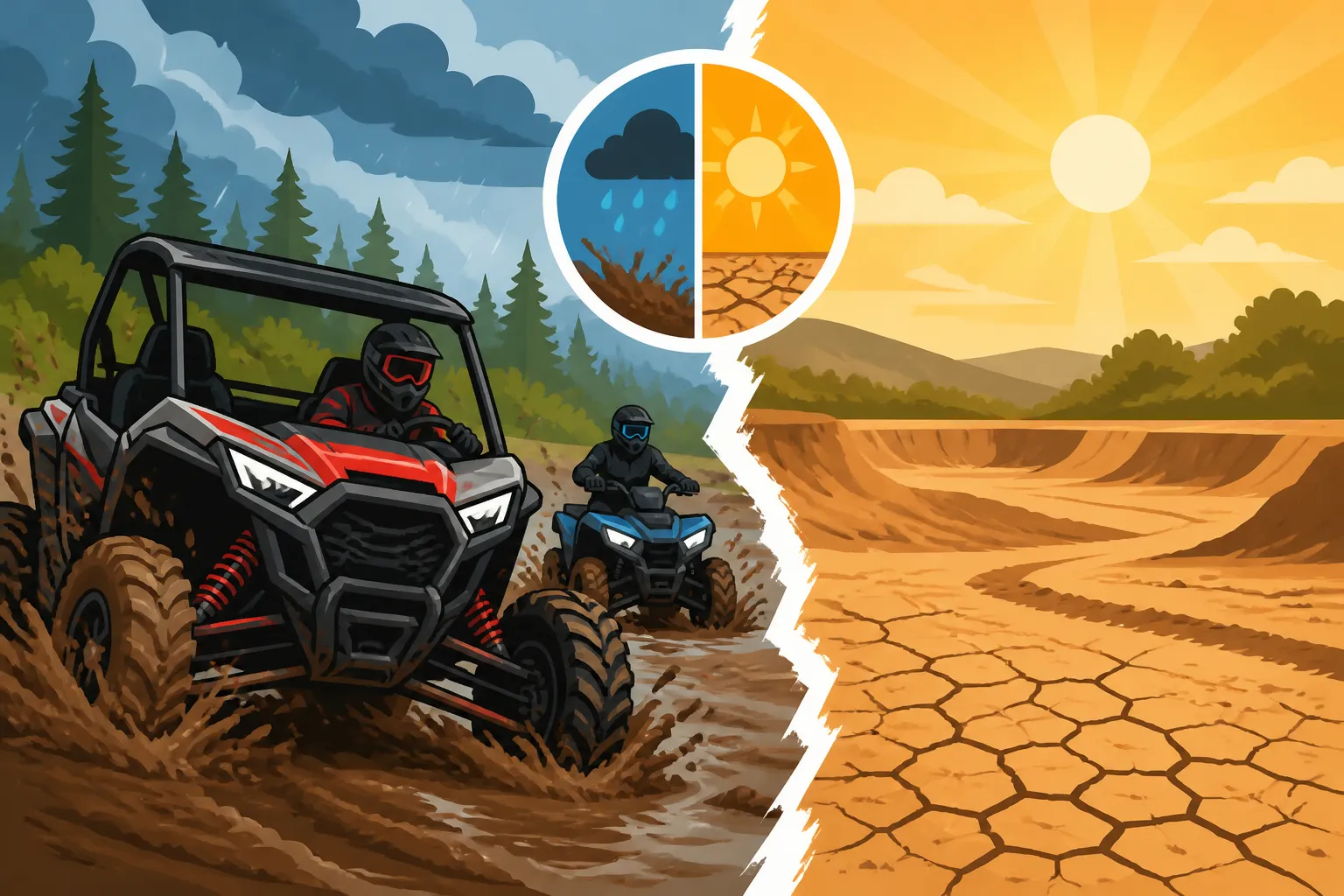
Expect a riding experience shaped by the season and recent weather, rather than a uniform set of dry, predictable trails. Clay-based ground can become slick or soft when wet, then roughen or develop ruts as it dries and gets used. Conditions may differ across the property, so a route that feels manageable in one section could be more challenging a short distance later.
If it is your first visit, resist the urge to treat the area as a place to ride flat-out from the entrance. Take time to get familiar with the layout and surface, and choose routes that match your machine and experience. For a broader picture of the region, Clay Pit SVRA at Oroville, California is a useful companion topic, while California OHV Areas Near Sacramento can help you compare Clay Pit with other Northern California options.
Why the riding season is short
Clay Pit has a limited riding season, so timing matters more than it does at some year-round destinations. Seasonal access is closely tied to the ground: wet clay can be easily damaged by vehicle traffic, and riding on saturated trails can create deep ruts that linger after the surface dries. A closure can be disappointing if you have already loaded the trailer, but it helps protect the trails and the experience for later visitors.
Opening and closing dates, temporary restrictions, and trail availability can change with conditions. Don’t rely on a memory of last year’s season or an old trip report as proof that a gate will be open on your chosen weekend. Before leaving home, check current official park information and any alerts or posted notices. If rain is in the forecast or has recently passed through, take an extra moment to confirm the area is open and that riding is appropriate.
For more context on seasonal access and weather-related closures around the state, see California Riding Seasons by Region and California Trail Closures After Rain. These topics are especially useful if you are deciding between Clay Pit and another destination for a trip with a fixed date.
How to plan a visit around weather and trail conditions
Check conditions before you load the trailer
A dry forecast on the day of your ride does not necessarily mean the trails are ready. Clay can hold moisture after rain, and shaded or low-lying sections may behave differently from exposed ground. On the other hand, a trail that was muddy earlier can dry unevenly, leaving ruts, loose dirt, and firm patches mixed together. Those changes affect traction and how comfortably your vehicle can handle turns and climbs.
A practical pre-trip check should cover three things: whether the park is open, whether any routes or facilities are restricted, and whether recent weather has affected access. Check again shortly before departure, particularly if your plans depend on a narrow seasonal window. If you arrive and the surface appears badly saturated, turning around or choosing a different activity is better than trying to push through and leaving damage behind.
A mapping app can help you understand the general area and organize a route, but it should not be treated as confirmation that a trail is open or legal to ride. Tools such as onX Offroad may help with trip planning and navigation, while park notices and official maps are the place to verify current access. Think of digital mapping as a planning aid, not a substitute for signs, closures, or on-site instructions.
Match your ride to the ground
Clay conditions reward a measured approach. When the surface is wet, tires can lose grip quickly, and steering or braking inputs that feel normal on dry dirt may cause a slide. Avoid sudden throttle, sharp turns, and aggressive braking. If your tires begin to spin, adding more throttle can dig a rut instead of moving you forward. Ease off, reassess the line, and avoid creating a hole that other riders will have to navigate.
After the ground dries, do not assume every route is easy. Ruts and uneven patches can catch a wheel or unsettle a UTV, especially at speed. Slow down where visibility is limited, leave space between machines, and look ahead for surface changes. Riders on smaller ATVs should be particularly cautious about crossing deep grooves at an angle, while UTV drivers should account for the width of their vehicle and keep clear of narrow edges.
| Condition | What you may notice | Sensible approach |
|---|---|---|
| Saturated ground | Slick clay, standing water, soft edges | Avoid riding if conditions are unsafe or the area is closed |
| Drying ground | A mix of firm and soft patches | Reduce speed and watch for changing traction |
| Recently used trails | Ruts, churned soil, uneven lines | Choose a smooth route and avoid riding through deep damage |
| Dry, firm surface | Better traction but possible loose or rough sections | Keep a controlled pace and stay alert for ruts and turns |
For a more specific discussion of how rainfall affects riding at this location, read Clay Pit After the Rains. If you use onX Offroad to save a route or orient yourself, compare what you see in the app with posted signs and current park information before riding.
Preparing your ATV or UTV and choosing a route
Choose a route that fits your machine and experience
A good day at Clay Pit does not require riding every trail. If you are new to the area, start conservatively and give yourself time to understand the terrain. New riders often feel pressure to keep up with a faster group, but the safer choice is to agree on a pace before setting out and to stop somewhere safe if the group spreads out.
For ATV riders, pay attention to traction, ruts, and the way a trail turns. Keep your hands and feet positioned for control, and avoid carrying extra speed into a corner when you cannot see the surface beyond it. UTV riders should account for their vehicle’s width, turning space, and the possibility that a narrow or uneven section will be more challenging than it looks from a distance.
Use an official trail map where available, and check trail signs as you ride. A third-party map can help with orientation, but it may not reflect a recent closure or a route designation. California Trail Maps and Where to Get Them explains why map choice and on-the-ground signs both matter. For visitors using onX Offroad, it can be helpful to save the general area before you go, but keep the park’s official directions and notices accessible too.
Do a practical pre-ride check
A rushed departure is an easy way to discover a problem at the trailhead. Before loading up, check the machine’s tires, brakes, throttle, steering, fluids, and visible fasteners. Bring basic recovery and repair supplies suited to your vehicle and trip, and make sure everyone in your group knows how to contact one another if you become separated. A short local ride still deserves the same basic preparation as a longer desert outing.
Carry the paperwork and required safety equipment that apply to your machine and situation. Registration and identification requirements can depend on the vehicle and where it is being ridden, so do not assume that one sticker or document covers every circumstance. The California OHV Registration Paperwork Checklist is a useful place to review what to bring, and California Spark Arrester Rules covers another piece of equipment that riders should check before heading onto public land.
Pack for a change in conditions, too. A dry morning can turn into a damp or chilly afternoon, and a muddy vehicle can take longer to clean than expected. Bring water, weather-appropriate layers, gloves, eye protection, and a way to secure loose items. If you are towing, check your trailer connection, tie-downs, lights, and spare tire before you leave.
Making the most of a short Clay Pit trip
Build a flexible day plan
A short season can make it tempting to lock in a date and plan every detail around riding. Keep the itinerary flexible instead. Choose a primary riding day, but have a backup plan in case the area is closed, conditions are poor, or access changes. That backup could be another open riding area, a non-riding stop near Oroville, or simply rescheduling rather than forcing a trip onto unsuitable ground.
Give yourself time to arrive, unload, review signs, and take a careful first lap. A compressed schedule can lead to rushed decisions, particularly when a group is unfamiliar with the trails. Agree on a meeting point and a plan for regrouping before you start. If one rider is less experienced or has a different machine, choose a pace and route that work for the whole group rather than splitting up without a clear plan.
It can also help to check nearby alternatives before the trip. Clay Pit’s seasonal schedule may not line up with the weather or your available weekend, and conditions can vary across Northern California. Comparing options ahead of time makes it easier to change plans without making a last-minute decision at the gate.
Ride with care and leave room for the next visit
Riding responsibly is especially important when a trail system has a limited season. Stay on routes open to your vehicle, follow posted restrictions, and do not ride around barriers or closures. A route that looks passable is not necessarily open, and an unauthorized shortcut can damage fragile ground or create a hazard for other riders.
Give other vehicles room, use a controlled speed where sightlines are short, and avoid stopping in the middle of a trail. If you encounter a damaged or muddy section, do not widen the route by riding around the edge. Keep to the designated path and follow any instructions from park staff. Respecting closures and surface conditions helps keep the trails usable and supports access for future visits.
The most satisfying Clay Pit trip is not necessarily the one with the highest number of miles. It is the one where you arrive to an open area, choose routes that suit your group, and leave without damaging the trails or putting anyone in a difficult position. Because access is seasonal, confirming conditions before you go is part of the ride—not an afterthought.
Disclaimer
This article is for general informational purposes only and does not constitute professional advice. Laws, prices and regulations vary by location and change over time. Consult a qualified professional for guidance on your specific situation.