California Rules for Hunting From an OHV
A California ATV or UTV can help you reach a hunting area, but it does not turn the machine into a legal hunting platform. The key distinction is access versus taking game: plan to ride only where permitted, park before hunting, and follow separate rules for firearms, wildlife, land access, and OHV identification.
Use an OHV for access, not as a shooting platform
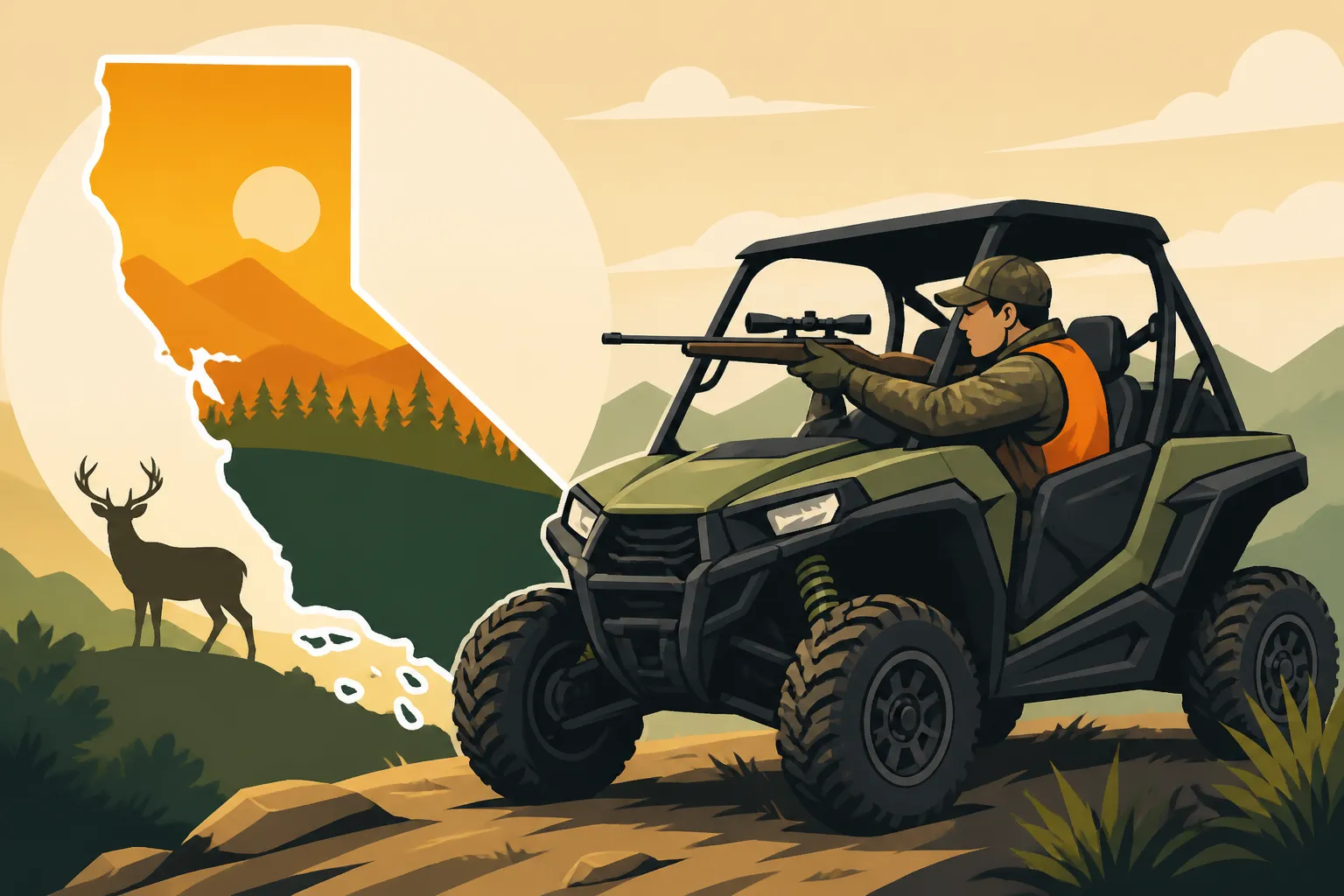
In general, do not shoot from an ATV, UTV, or other motor vehicle. California also restricts hunting conduct that uses a motor vehicle to pursue, drive, or harass wildlife. Riding toward an animal to get a closer shot, following it with the machine, or using the vehicle to push it toward another hunter can create serious legal problems.
A safer approach is to use the OHV to travel to a lawful stopping point, park, and continue on foot. Before doing so, check that you are allowed to leave the designated route and enter the surrounding land. Some areas allow travel only on signed roads or trails; riding or walking off-route may be prohibited, even if the terrain looks open.
The distinction matters because a hunting trip involves two sets of rules:
- Hunting rules cover the species, season, area, weapon, license, tags, and methods of take.
- OHV rules cover where the machine can be ridden, what identification or permit it needs, and how it must be operated.
Meeting one set does not satisfy the other. A valid hunting license does not authorize riding a closed trail, and a properly identified OHV does not authorize hunting out of season or in a closed area.
| Situation | Safer rule of thumb |
|---|---|
| Riding toward a hunting area | Stay on routes open to your machine and check land-specific restrictions |
| Spotting game from the OHV | Do not shoot from the vehicle or use it to pursue or drive wildlife |
| Leaving the route to hunt on foot | Confirm that off-route travel and access on foot are allowed |
| Carrying a firearm on the machine | Transport it in compliance with California firearm and hunting laws |
| Hunting on private land | Get permission from the landowner before entering |
| Crossing a boundary or road | Stop and verify that the crossing and the route beyond it are legal |
For firearm transport, do not assume that a hunting trip creates an exception to rules governing firearms in vehicles. Transport firearms in a lawful condition and manner, and check the rules for the firearm type and the area you will visit. A rifle, shotgun, handgun, and bow may not be governed by identical requirements. The practical details are covered in Carrying a Firearm on a California OHV.
Parking does not automatically make every nearby spot a lawful place to hunt. You still need to be in an open hunting area, comply with the applicable season and method rules, and avoid shooting from or across a road or toward people, buildings, vehicles, or other unsafe locations. Check the current California Department of Fish and Wildlife regulations for the species and hunt area before you leave.
Confirm OHV identification and land access before the trip
An OHV used on public land may need California identification or a permit, depending on the machine, where it is operated, and the rider’s circumstances. Do not assume that a hunting license, a vehicle registration from another state, or a permit for a different activity replaces the OHV requirement.
California OHV identification and hunting authorization are separate. If your machine needs California identification, sort that out before the trip and carry the documents you are required to have. California OHV Permits Explained gives an overview of the different permit and identification questions. Nonresidents should also check California Nonresident OHV Use Permit and California OHV Reciprocity: Only Two States rather than assuming that an out-of-state sticker or plate will be accepted.
The land manager matters as much as the state rule. A route may cross land managed by a national forest, the Bureau of Land Management, a state recreation area, a county, or a private owner. Each may have its own closures, access limits, seasonal restrictions, and hunting rules. Some places allow hunting but restrict motorized access; others may allow OHV riding on a route without allowing hunting nearby.
Before the trip, identify:
- The land manager for the riding area and the hunting area.
- Routes currently open to your type of machine.
- Whether you may leave the route on foot to reach a hunting location.
- Any seasonal closures, fire restrictions, or area-specific hunting limits.
- Whether a separate hunting-area permit, reservation, or access authorization is required.
- Where boundaries fall, especially near private land or restricted areas.
A map or route app is useful, but it is not permission to ride or hunt. Compare it with current land-manager maps and posted signs. A trail that appears on an older map may be closed, rerouted, or limited to a different type of vehicle. For forest routes, Riding a California Forest Service Road explains why the road’s status and land-manager map matter. If a route is closed, do not ride around a gate or assume that a nearby parallel track is an acceptable substitute. See Closed Routes and California Citations.
Private property deserves particular care. A county road or public trail may pass close to private land without giving riders or hunters permission to enter it. Get permission before crossing or hunting on private property, and do not treat an unfenced boundary as open access. California Rules for Crossing Private Land covers the access issue in more detail.
Handle firearms, game, and the machine responsibly
Treat the OHV as a way to get to a lawful access point, not as part of the hunt itself. Once parked, secure the machine so it cannot roll or obstruct a route. Keep it out of travel lanes and away from places where another rider or vehicle could collide with it. If you leave it unattended, follow the land manager’s rules and avoid blocking gates, trail junctions, emergency access, or other users.
When carrying a firearm, plan the transport before loading the machine. A firearm should not be handled casually while riding, and it should not be loaded in a way that violates vehicle or hunting laws. Keep ammunition and firearms arranged so they cannot shift, fall, or interfere with steering, braking, or passenger safety. If you are uncertain whether a particular firearm configuration is lawful in a vehicle, confirm the applicable rule before the outing rather than relying on a general hunting assumption.
Also consider how the machine affects other people and wildlife:
- Slow down near camps, trailheads, livestock, other riders, and areas where people may be hunting on foot.
- Do not use the OHV to flush game toward another person or to follow an animal for a shot.
- Keep noise and dust under control where possible, and do not idle close to other hunters.
- Never leave trash, food, ammunition, or equipment behind.
- If you encounter a closed route, wildlife closure, or temporary restriction, turn around and use an authorized route.
- Make sure every rider knows the meeting point and what to do if the group becomes separated.
A rider may also need to consider where the machine will be parked while hunting. Leaving it on a narrow trail can block emergency access or create a hazard for approaching riders. Parking beside the route may be prohibited if it means driving off the designated surface. Look for a legal, stable place to stop before committing to the route, and be prepared to choose another access point if none is available.
Hunting regulations can change by species, zone, season, and method. Check the current rules for your planned hunt, including license and tag requirements, open areas, legal equipment, and reporting duties. Do not rely on what was allowed during a previous season or on advice from someone hunting a different zone. If the hunt involves a special access program or a restricted area, confirm its conditions directly with the responsible agency.
Plan the trip with a before-you-go checklist
A practical plan starts with the hunt and the route as separate decisions. First confirm that the hunt is open and that you have the correct authorization. Then confirm that the OHV can legally reach the intended access point. If either part is uncertain, change the plan before loading the machine.
Use this checklist:
- Confirm the hunt. Check the current rules for the species, location, season, legal method, license, and tags.
- Identify the land manager. Find out who controls the riding route and the place where you intend to hunt.
- Check the route. Use current maps and closure information, and obey signs and gates on the ground.
- Verify OHV requirements. Confirm whether your machine needs California identification or a nonresident permit, and carry required documents.
- Plan firearm transport. Check rules for your firearm and transport it securely and lawfully.
- Choose a legal stopping point. Avoid blocking roads, trails, gates, and emergency access; do not assume off-route parking is allowed.
- Confirm access on foot. Make sure leaving the route and entering the hunting area are permitted.
- Set a group plan. Agree on boundaries, a return time, and what to do if riders or hunters become separated.
- Check conditions before departure. Closures, weather, fire conditions, and access restrictions can affect a trip even when the hunt itself remains open.
A common mistake is to focus on whether an OHV can reach the general area and overlook the last part of the plan: where to stop, where to walk, and whether the hunting location is open. Another is to assume that a route marked on a map is open to every vehicle or that permission to hunt includes permission to ride across the property. Confirming those details in advance can prevent a citation, a trespass problem, or a dangerous encounter on a shared route.
The simplest rule is to separate transportation from hunting. Ride only where the machine is allowed, stop at a lawful location, and hunt on foot only where access and hunting are both permitted. If a planned shot would require firing from the OHV, using it to chase wildlife, or riding into a closed area, choose a different plan.
Disclaimer
This article is for general informational purposes only and does not constitute professional advice. Laws, prices and regulations vary by location and change over time. Consult a qualified professional for guidance on your specific situation.