What an Oregon Rider Skips Buying in California
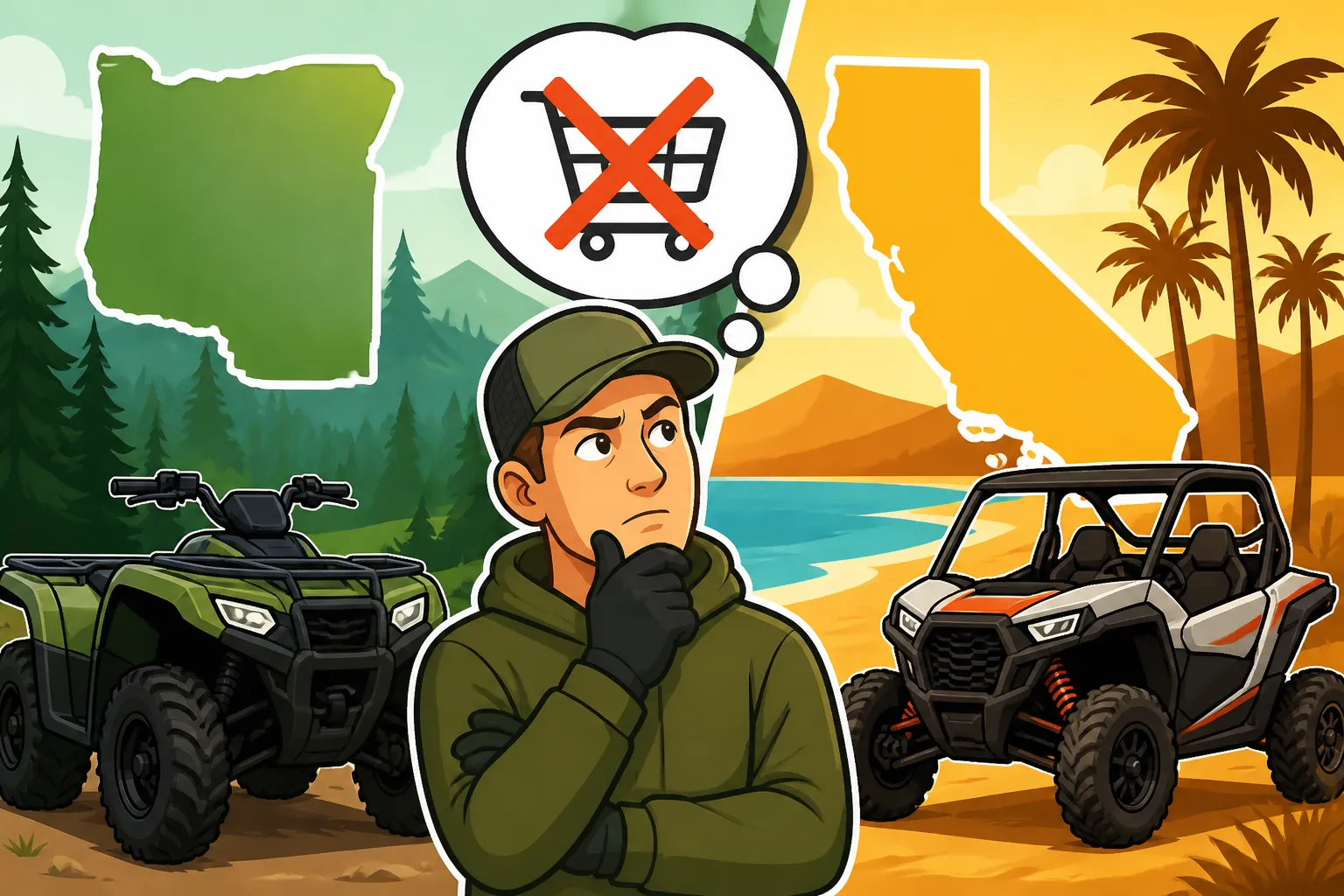
Oregon riders heading to California often wonder whether they need to buy a separate California OHV permit. In many cases, a current Oregon OHV Permit is recognized in place of California’s nonresident permit. The key is to bring proof of the valid Oregon permit, establish that you are a nonresident, and remember that reciprocity does not exempt you from California’s other riding rules.
What an Oregon OHV Permit Lets You Skip
California recognizes qualifying out-of-state OHV programs that provide current registration or its equivalent. California State Parks confirms that an Oregon rider with a qualifying Oregon OHV Permit can use it instead of purchasing a California Nonresident OHV Use Permit.
That is the specific purchase reciprocity addresses. It does not mean your Oregon permit turns into California registration, or that you can ignore the rules for the trail, recreation area, or type of vehicle you are using.
| Your situation | What to expect in California |
|---|---|
| You have a current, qualifying Oregon OHV Permit | You can use it in place of the California nonresident permit. |
| You do not have current Oregon OHV credentials or equivalent proof | You may need to obtain a California nonresident permit before riding. |
| Your Oregon permit has expired or does not apply to the machine | Do not assume it qualifies; check with California State Parks before riding. |
| You are a nonresident relying on Oregon credentials | Carry a valid out-of-state driver’s license and proof of current home-state OHV registration or its equivalent. |
California State Parks lists the fee for a California Nonresident OHV Use Permit as $30 as of November 2026. If your current Oregon permit qualifies, the point of reciprocity is that you do not need to purchase this California permit as well. For details about California’s permit and the broader reciprocity rules, see California’s Nonresident OHV Use Permit and California OHV Reciprocity: Only Two States.
The distinction matters because different credentials serve different purposes. An OHV registration or its equivalent identifies the machine under a state program. A California nonresident use permit is the option for a visitor whose home-state credentials do not meet California’s reciprocity requirements. If your Oregon permit is current and qualifies, California accepts it instead of requiring that extra California permit.
What to Carry and Check Before You Ride
Reciprocity only helps if you can show that you qualify. California DMV guidance says nonresident OHV owners must carry a valid out-of-state driver’s license to establish residency. To operate without a California permit, they must also provide proof of current home-state OHV registration or its equivalent. For an Oregon rider, have the current Oregon permit and your out-of-state license accessible when you ride.
Keep the permit or registration proof with your other vehicle documents, and check that it is readable and applies to the machine you brought. If you have more than one OHV, do not assume that proof associated with one machine automatically covers another. When the permit is digital, make sure you can access it where you plan to ride; keeping an offline copy can help if mobile service is unavailable.
Before setting out, check these points:
- The permit is current. An expired permit is not current home-state proof.
- It applies to the machine. Confirm the Oregon credential covers the ATV or UTV you plan to operate.
- You can establish nonresident status. Keep your valid out-of-state driver’s license available.
- You have proof ready for inspection. Do not rely on being able to explain the permit without showing it.
- You have checked the destination’s requirements. A state’s permit reciprocity does not settle every site-specific access rule.
If you are unsure whether a particular Oregon document qualifies, verify it with California State Parks before traveling rather than waiting until you reach a riding area. The state’s program is administered by the Off-Highway Motor Vehicle Recreation Division. The explanation in Does California Honor an Oregon OHV Permit? is also relevant if you are comparing a home-state permit with California’s own permit.
Reciprocity is not California registration
A California nonresident use permit and California OHV registration are not interchangeable labels for the same thing. The exemption described here is about whether an Oregon rider needs to buy California’s nonresident permit. It does not make a machine California-registered or replace a vehicle’s current Oregon credentials.
If you are moving to California rather than visiting, or you are trying to register a machine there for another reason, a different process may apply. California DMV says proof of ownership for a previously unregistered OHV can include an MCO or MSO, out-of-state title documents, a factory invoice, or bills of sale that establish a complete ownership chain. For that separate situation, see Registering an Out-of-State Machine in California.
Rules That Still Apply to Oregon Riders
A qualifying Oregon permit does not give a rider special permission to ignore California’s operating rules. Once you ride in California, you still need to follow the rules that apply to the vehicle, the rider, and the land. California State Parks, the California DMV, the Forest Service, and the Bureau of Land Management each have roles in OHV recreation and land management, so the exact rules can depend on where you ride.
Rider age and supervision
California State Parks says ATV operators under 18 must have an appropriate ATV safety certificate, be directly supervised by an adult who holds one, or be taking a prescribed safety course under the direct supervision of a certified instructor. California recognizes qualifying safety certificates issued by another state, so an Oregon certificate may help meet the requirement if it is appropriate for the rider and vehicle.
California State Parks also says a child under 14 must always be accompanied and directly supervised by a parent, guardian, or authorized adult. For a recreational off-highway vehicle, commonly called a UTV or ROV, California State Parks requires the operator to be at least 16 or to be directly supervised in the vehicle by a parent, guardian, or adult authorized by them. Check the full details in California ATV Safety Certificate Requirements and California ROV Operator Age Limit.
Equipment and how the machine is operated
California State Parks requires helmets that meet the applicable federal safety standard for OHV riding. The National Highway Traffic Safety Administration says a helmet meeting that standard displays the DOT symbol. For UTVs, California State Parks requires occupants to wear seatbelts or safety harnesses whenever the vehicle is moving.
California also restricts passengers on ATVs. California State Parks prohibits a passenger on an ATV unless the machine was specifically designed and provided by its manufacturer for multiple riders. A passenger sitting on a single-rider quad is not made legal by an Oregon permit.
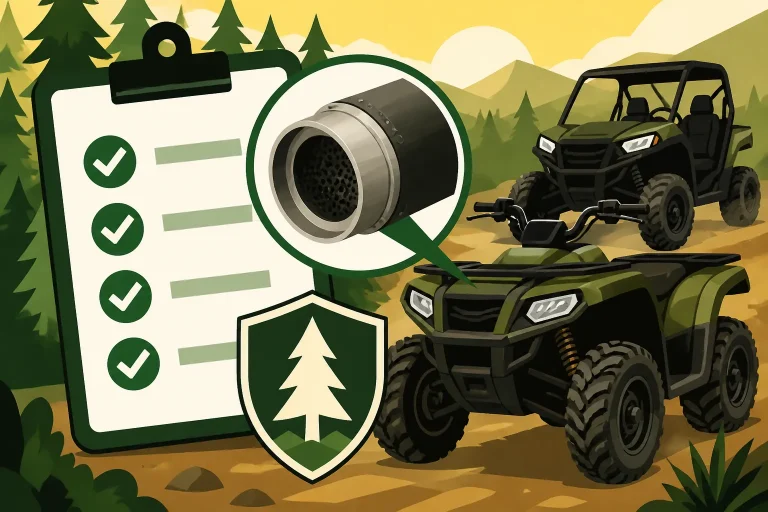
Equipment requirements can vary with the riding conditions and time of day. California State Parks requires at least one headlight capable of illuminating objects 200 feet ahead and one red taillight visible from 200 feet when an OHV is operated on public lands between sunset and sunrise. On National Forest lands, the USDA Forest Service requires a properly installed, approved spark arrester.
Noise, emissions, alcohol, and land rules
California State Parks sets different sound limits based on when the OHV was manufactured: a maximum of 96 dBA for machines manufactured on or after January 1, 1986, and 101 dBA for machines manufactured before that date. The measurement is taken from 20 inches. An Oregon credential does not make a machine exempt from California’s applicable sound rules.
The California Air Resources Board governs emissions standards for off-highway recreational vehicles. A machine’s Oregon permit does not establish that it meets every California emissions requirement. If you are concerned about a vehicle’s emissions label or status, check What CARB Compliance Means in California before assuming that registration in another state resolves the issue.
California DMV says operating an OHV under the influence of alcohol or drugs is illegal both on and off the highway. The legal alcohol limits and related rules depend on the rider’s circumstances, so do not treat a riding area as exempt from DUI laws.
Finally, a valid permit does not let you ride wherever you choose. The Bureau of Land Management identifies public lands where cross-country OHV travel is prohibited as a “Limited Use Area” or “Closed Area.” Check the rules and maps for the land you intend to use, and stay on routes open to your vehicle. State recreation areas, National Forest lands, and BLM-managed areas may have different local directions and restrictions.
A Practical Pre-Trip Check
For a straightforward visit, the useful question is not simply, “Do I have an Oregon sticker?” It is whether you can show current Oregon OHV credentials that qualify for California reciprocity, whether you can establish that you are a nonresident, and whether you have checked the rules for your machine and destination.
Use this checklist before loading up:
- Confirm that your Oregon OHV Permit is current and applies to the vehicle.
- Carry the permit or equivalent proof and a valid out-of-state driver’s license.
- Check California rider requirements for anyone who will operate an ATV or UTV.
- Inspect the machine for the safety equipment and condition required for the places you plan to ride.
- Review the land manager’s current access rules, route designations, and any separate site requirements.
- If you cannot confirm that your Oregon credential qualifies, ask California State Parks about the California nonresident permit before the trip.
The main takeaway is simple: a current qualifying Oregon OHV Permit can spare an Oregon rider from buying California’s nonresident permit, but it does not erase California’s riding, safety, or land-access rules. Keep your proof handy and verify the destination requirements so you do not confuse permit reciprocity with permission to ride anywhere.
Sources
- California Department of Parks and Recreation, Off-Highway Motor Vehicle Recreation Division — OHV Sound Regulations (checked November 2, 2026)
- California Department of Parks and Recreation, Off-Highway Motor Vehicle Recreation Division — Operation / Equipment Requirements (checked November 2, 2026)
- California Department of Parks and Recreation — Nonresident OHV Use Permits (checked November 2, 2026)
- California Department of Parks and Recreation Off-Highway Motor Vehicle Recreation Division — ATV Safety Training & FAQs for ROVs (checked November 2, 2026)
Disclaimer
This article is for general informational purposes only and does not constitute professional advice. Laws, prices and regulations vary by location and change over time. Consult a qualified professional for guidance on your specific situation.