California Rules for a Machine Over 50 Inches Wide
A wide UTV can look as if it fits a narrow trail, but physical clearance is not the same as legal access. In California, the key is the route’s designation and the land manager’s rules—not whether your machine can squeeze between posts. Here’s how to check where a machine over 50 inches wide can go and avoid treating registration or an open-looking gate as permission.
What a 50-inch trail designation means
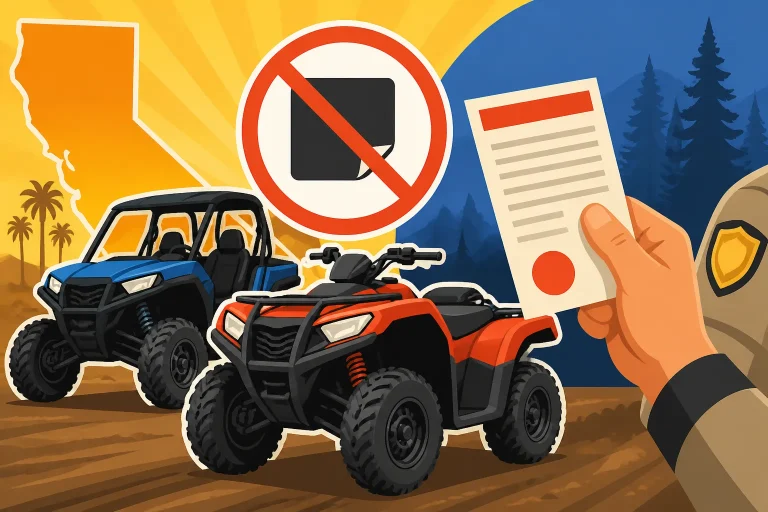
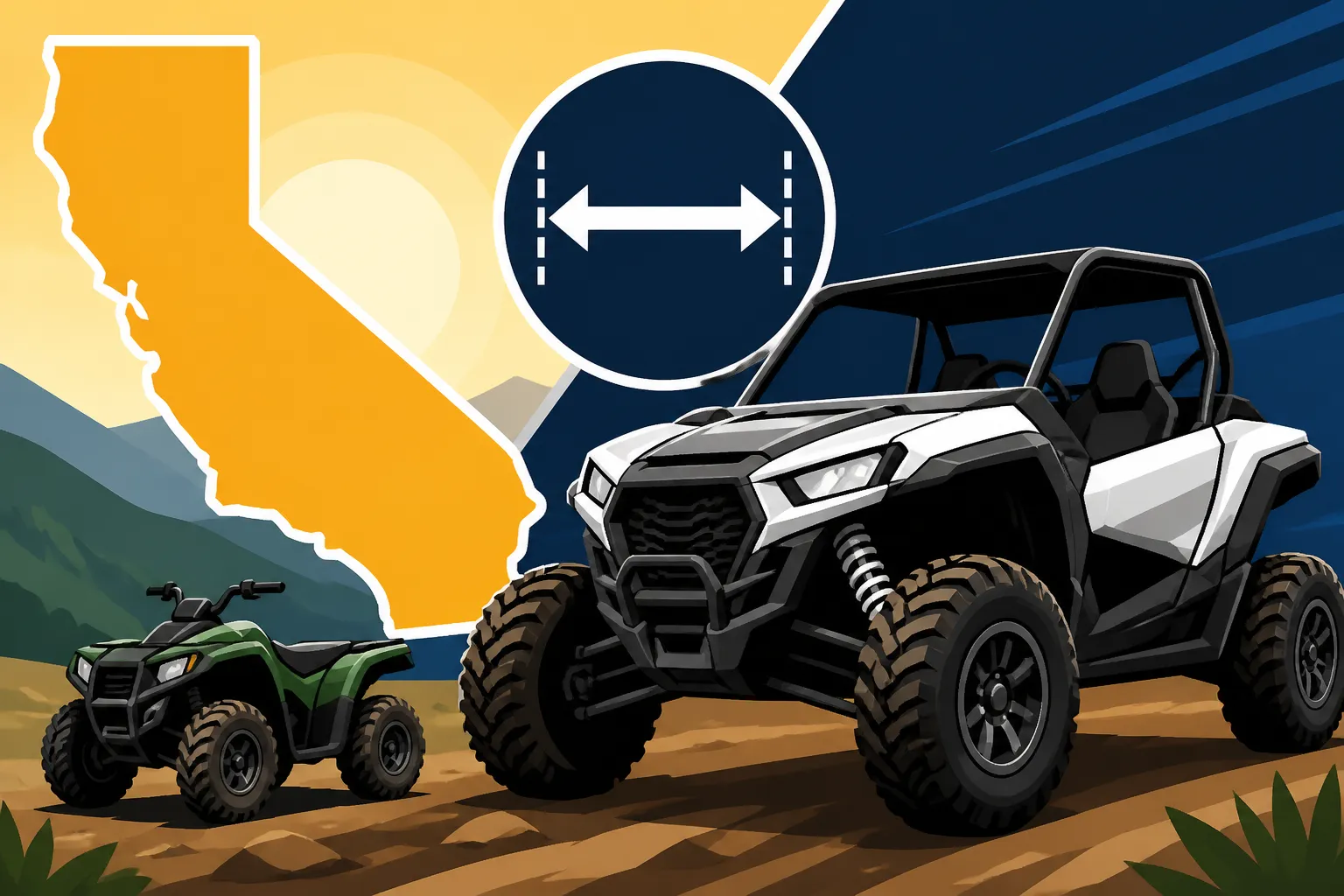
The width rule is about the route’s official designation, not just its appearance. According to the USDA Forest Service, an OHV over 50 inches wide, including many UTVs and side-by-sides, cannot use a trail designated “Open to Vehicles 50 Inches or Less in Width.” That remains true even if the machine can physically pass a gate, post, or other barrier.
In practice, a sign or map marking a route for vehicles 50 inches or less sets a limit on vehicle access. A wide machine should not enter that route to see whether it fits. The designation applies even when the trail is wide enough at the entrance, becomes wider farther along, or appears to have recent tire tracks.
The restriction is not a blanket ban on every route. A vehicle over 50 inches wide may be able to use other routes, depending on their designation and the land manager’s rules. A wide UTV’s legal access therefore depends on the specific route, not simply on whether the area is open to OHVs.
| What you see or know | What it means for a machine over 50 inches wide |
|---|---|
| A trail is marked “Open to Vehicles 50 Inches or Less in Width” | Do not ride the route in the wider machine. |
| A gate or posts seem wide enough to pass | Physical clearance does not change the route designation. |
| A map or sign identifies a different route category | Check the land manager’s rules before entering; do not assume that every category allows your machine. |
| There is no clear sign at the junction | Pause and verify the route on the official map or with the land manager. |
Rules can vary between public-land managers and between routes in the same general area. A designation shown on a Forest Service map should not be treated as a promise that a nearby route managed by another agency has the same access rules. Check the authority responsible for the land you plan to ride.
This is especially important when a trail network contains routes for different vehicle types. A machine permitted on a wider road may be barred from a narrower trail branching off it. A route that looks like a continuation may have a different designation after a junction, gate, or boundary.
For more context about trail options, see California OHV Areas in the National Forests and A Wide UTV on Narrow California Trails. The practical rule is simple: match the machine to the route designation before riding, rather than relying on how the trail looks from the vehicle.
How to check whether your machine fits the route rules
Start with the exact machine you plan to take. Width can vary by model and configuration, so do not rely on a general description such as “compact UTV” or on what another rider says about a similar vehicle. Check the manufacturer’s specifications and the machine’s documentation, then confirm with the land manager if you are uncertain how its limit applies.
Do not assume that removing an accessory, changing tires, or squeezing around a barrier makes an otherwise restricted route legal. The USDA Forest Service’s rule concerns routes designated for vehicles 50 inches or less in width; it does not make physical passage a test of eligibility. If you think a modification affects your vehicle’s classification, ask the managing agency before riding.
Then verify the route itself. On Forest Service land, consult the official Motor Vehicle Use Map, commonly called an MVUM, and follow posted signs. The USDA Forest Service advises riders to obey route signs and check the official map or land manager’s guidelines so the vehicle matches the route designation. A general recreation map, an app’s highlighted trail, or a friend’s saved track may help with navigation, but should not replace the official access information.
A practical pre-ride check looks like this:
- Identify the land manager. Determine whether the area or route is managed by the Forest Service, the Bureau of Land Management, California State Parks, or another authority. The Bureau of Land Management oversees its own public lands and OHV areas; the USDA Forest Service manages Forest Service lands.
- Confirm your machine’s width. Use the manufacturer’s specifications for your exact model and configuration. If the manager’s method for applying a width limit is unclear, ask before you arrive.
- Check the official route information. Review the current map or route guidance provided by the land manager, and note any vehicle-width designation or closure.
- Compare the route designation with your machine. Do not enter a trail marked for vehicles 50 inches or less if your machine exceeds that limit.
- Recheck at junctions and gates. A route may change designation, or a sign may clarify a restriction that was not obvious earlier.
- Choose a legal alternative if anything is unclear. Stop and confirm rather than testing the route by driving into it.
For a deeper look at route maps, see Reading a Motor Vehicle Use Map for a Forest. If you are navigating a road-and-trail network, Forest Roads Open to Highway Vehicles Only and Mixed Use Roads in a National Forest can help clarify why similar-looking routes may have different access rules.
Registration and permits do not override width limits
Registration, permits, and route access are separate questions. A valid California OHV registration or nonresident permit can address identification or permit requirements, but it does not authorize a machine to use a trail that excludes its width. In the same way, a street-legal plate or a permit from another state should not be treated as permission to ride every public-land route.
The California State Parks Off-Highway Motor Vehicle Recreation Division administers the nonresident OHV use permit program. That permit concerns the applicable California permit requirement; it does not replace the need to follow the route rules set by the agency managing the land. For background on the permit system, see California OHV Permits Explained and California’s Nonresident OHV Use Permit.
The same distinction applies to maps and permits for a riding area. An OHV area may allow off-highway riding overall while limiting particular trails by width or vehicle type. Being allowed into the general area does not mean every trail is open to every machine.
When planning a ride that crosses between different land managers, check each segment separately. A route may connect across an administrative boundary, but access rules on one side do not automatically carry over to the other. If the boundary or designation is unclear, confirm the route with the agency responsible for that segment.
A pre-ride routine for a wide UTV
A little route planning can prevent an expensive detour or an avoidable citation. Before loading, save the official map or route information for the area, identify trails that exclude your vehicle, and plan alternatives that are clearly open to it. Check again at trailheads and junctions, where posted signs may supply the most direct instruction.
If you arrive and cannot confirm whether a route allows your machine, do not use the width of the gate as your answer. A barrier can be too narrow, too wide, damaged, or positioned for reasons unrelated to vehicle eligibility. The legal question is what the route designation and land manager’s guidance allow.
It also helps to make a route plan that does not depend on a narrow trail as the only way out. Mark a route suitable for your machine and note where you may need to turn around. If another rider suggests a shortcut, verify it before following; access rules do not change because a route is commonly used.
Use this quick checklist before you ride:
- Confirm the land manager and check that manager’s official route information.
- Verify the width of your specific machine rather than estimating by sight.
- Avoid trails designated for vehicles 50 inches or less if your machine is wider.
- Treat signs and official maps as the authority, not tire tracks or physical clearance.
- Recheck route designations at junctions and boundaries.
- Keep registration or permit questions separate from route-access questions.
A wide machine is not automatically barred from California public lands, but it cannot use every trail. The dependable approach is to check the specific route, confirm that its designation permits your vehicle, and follow the land manager’s signs and guidance throughout the ride.
Sources
- California Department of Motor Vehicles — 15.085 OHV Fees (VC §§38115, 38120, 38225, 38225.4, 38225.5, 38230, 38232, 38245, 38246, 38255, 38260, and 38265) (checked November 2, 2026)
- United States Department of Agriculture Forest Service — Angeles National Forest | Off-Highway Vehicles (OHV) (checked November 2, 2026)
Disclaimer
This article is for general informational purposes only and does not constitute professional advice. Laws, prices and regulations vary by location and change over time. Consult a qualified professional for guidance on your specific situation.