Fog Mornings at Oceano
Fog can turn an easy-looking morning at Oceano Dunes into a ride where you can barely see the next rise, another vehicle, or the edge of the beach. This guide explains how to judge visibility, plan a safer route, account for tides, and decide when to wait or call off an ATV or UTV ride.
Why fog changes an Oceano ride
What coastal fog does to visibility
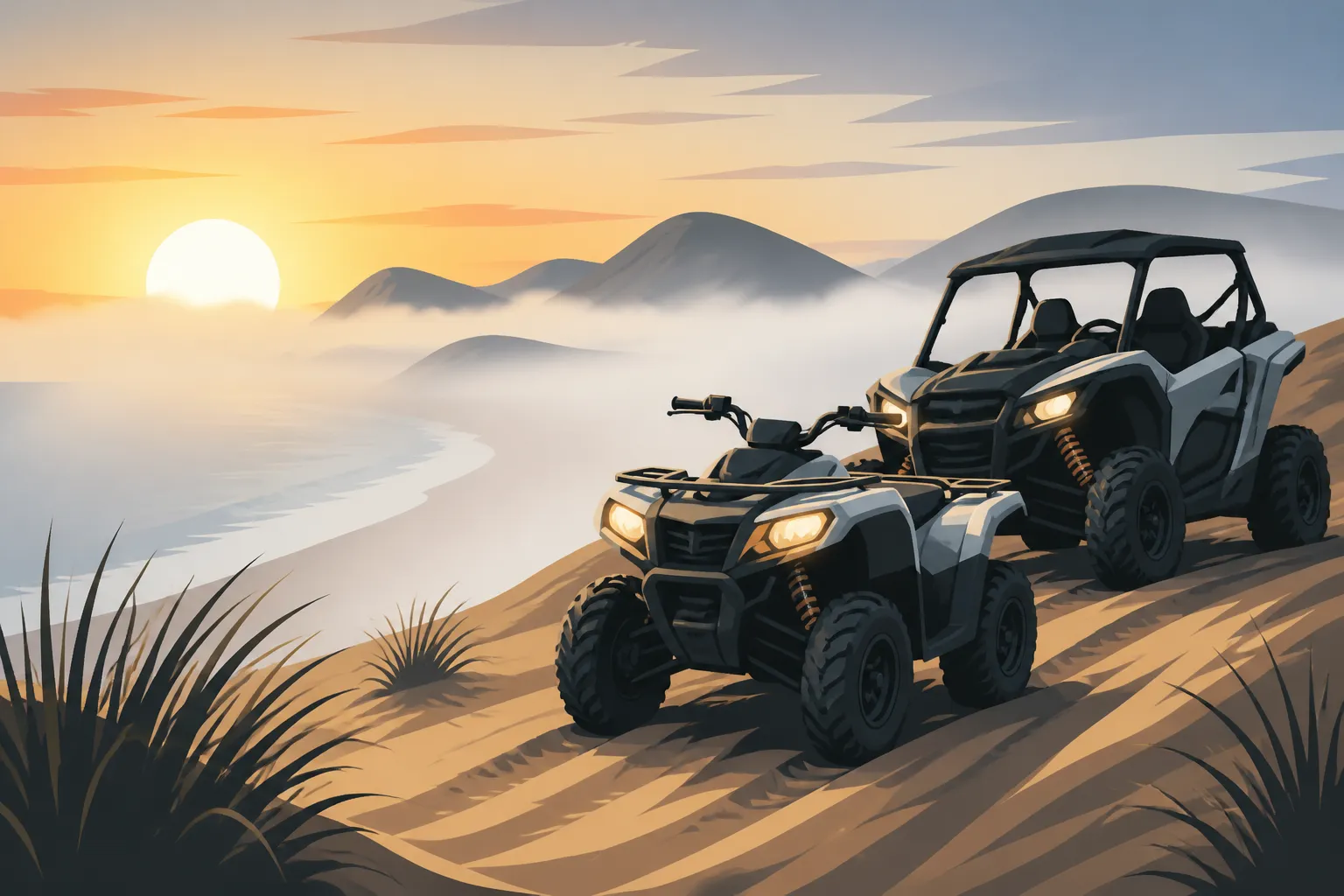
Fog at Oceano can flatten the landscape. Dune ridges that would normally help you judge distance may disappear, while a vehicle or person can seem to appear suddenly out of the gray. It can also be difficult to tell whether you are approaching a slope, a wet section of beach, or a route boundary. Sand and surf sounds may carry oddly in fog, too, which can make it harder to judge where other riders are.
The main practical problem is not just seeing less. It is losing the visual cues that help you anticipate what is ahead. A familiar route can feel unfamiliar when you cannot see its landmarks, and a small rise can hide someone approaching from the other side. Give yourself more time and space than you would on a clear day. If you cannot see far enough to stop safely, slow down or pause in a place that is clearly out of traffic.
Fog can also make a group harder to keep together. Riders may lose sight of the person ahead, especially when vehicles are spread out or the terrain changes. Agree on a simple plan before setting off: ride at a pace that keeps everyone in view, stop at safe meeting points, and do not assume the last rider knows which way the group went. If the group becomes separated, avoid searching at speed across dunes.
How to decide whether to ride, wait, or turn back
Before unloading, take a moment to assess the conditions from a safe, stationary place. Look for visibility across open ground, not just immediately around the parking area. If the fog is thick enough that you cannot clearly see the next section of your intended route, waiting for improvement may be the better choice. A delayed start is frustrating, but it is usually easier to manage than a collision or a lost rider.
If the fog is patchy, treat each clearer stretch as temporary rather than proof that the whole riding area is safe. Visibility can vary between open beach and dune terrain. Keep your route conservative, avoid unfamiliar areas, and be ready to turn back if the fog thickens. Do not climb a dune simply to get a better view if doing so would put you in the path of other riders or take you onto an uncertain route.
For a broader sense of how the riding area works, see [Oceano Dunes: California's Only Sand Beach Ride]. For local access planning, [Oceano Dunes Entry From Pier Avenue] can help you think through where your day begins. Park conditions, access rules, and closures can change, so check current official park information before traveling rather than relying on an old route description or a previous visit.
Plan the route before visibility gets worse
Choose recognizable, conservative landmarks
A foggy morning is a poor time to improvise a long route across unfamiliar dunes. Before riding, decide on a modest destination and a clear turnaround point. Use landmarks that are easy to identify from more than one direction, and avoid making a single distant feature your only navigation cue. If the fog hides your chosen landmark, stop somewhere safe and reassess rather than continuing on guesswork.
A map can help you prepare, but it is not a replacement for what you can actually see on the ground. Tools such as onX Offroad may help with advance route planning and orientation. Download or save what you need before leaving reliable service, and compare any mapped route with official access information. A track on a screen does not establish that a route is open, appropriate for your machine, or safe under current conditions.
It also helps to share the plan with everyone in the group. Tell riders the intended route, where you will regroup, and what to do if visibility drops. If one person is new to Oceano or riding in sand, keep the planned outing shorter and stay together. Avoid splitting into separate groups unless everyone has the experience, navigation tools, and communication plan to manage independently.
Set a pace and spacing that match what you can see
In fog, ride slowly enough that you can stop within the distance you can see. Leave more room between vehicles than you would in clear weather, and avoid following closely behind a machine that is throwing sand. A UTV may be easier to keep in sight than a smaller ATV, but neither machine can make poor visibility safe. Keep your attention on the ground ahead as well as the riders around you.
Do not stop in the middle of a travel path, behind a dune crest, or in a spot where approaching riders have little time to react. If the group needs to regroup, move to a broad, visible area away from active traffic and slopes. Make sure the last rider knows the group has stopped; a hand signal that is obvious in clear weather may be difficult to see through fog or dust.
If you use onX Offroad, treat it as one part of your preparation: review the route before you start, keep the device accessible, and do not stare at the screen while moving. A navigator should check it only when the machine is stopped in a safe place. Keep a paper or offline backup plan where practical, particularly if the group has limited experience or expects to cover unfamiliar ground.
Account for the beach, tides, and other riders
Keep surf and wet sand in your safety plan
Fog can make it harder to judge the distance between your route and the water. Do not assume that a broad stretch of beach will remain available throughout the ride. Tides and changing beach conditions matter, and a route that looks comfortable from one point may narrow farther ahead. Leave a generous margin from the surf and avoid riding into a section where the water or wet sand could cut off your way back.
Before heading onto the beach, learn where access is allowed and which boundaries or closures apply. Do not ride around fencing or signs because the route appears open on the other side. Areas protected for wildlife or closed for management reasons are not optional detours. [Snowy Plover Fencing and Your Route] explains why visible barriers and marked routes deserve attention, even when fog makes it tempting to take the first apparent opening.
The beach is not a place to test whether a vehicle can outrun changing conditions. If fog prevents you from confidently identifying the route back, turn around while you still have a clear path to do so. For more on how the water affects route planning, read [Tides and Riding the Oceano Sand]. A useful rule is to make the return leg at least as carefully as the outbound ride: do not let a destination, schedule, or group pressure push you farther along a narrowing or poorly visible section.
Make yourself easier to see and anticipate other traffic
Visibility is a shared responsibility. Use required safety equipment and make sure your vehicle is in good working order before riding. Keep lights in good condition, but do not assume that headlights alone make it safe to travel quickly in fog. Other riders may not see you until they are close, and glare or blowing sand can make lights less helpful than expected.
Dune flags are especially important where required because they help riders identify vehicles over terrain. Check the applicable rules before your trip and use equipment that meets them. [California Dune Flag Requirements] covers the basics. A flag does not make a blind dune crest safe to cross at speed: approach rises cautiously, stay alert for traffic coming from the other side, and never assume that a clear view in one direction means the entire crest is clear.
Expect other riders to make mistakes, particularly when conditions are difficult. Avoid sudden turns, abrupt stops in travel lanes, and fast passes in areas with limited sightlines. If you see a vehicle ahead but cannot tell what its driver is doing, slow down and give it room. A calm, predictable line is safer than trying to squeeze around someone in a foggy corridor.
A practical fog-morning checklist
Before leaving camp or the access area
Use this checklist before committing to a ride. It is meant to help you catch the small oversights that become bigger problems when landmarks disappear.
| Check | What to do | Why it matters in fog |
|---|---|---|
| Visibility | Look across the intended riding area from a safe place | A clear parking area does not guarantee clear dunes or beach |
| Route | Choose a short, familiar route with a turnaround point | Reduces the chance of navigating by guesswork |
| Conditions | Check official park notices and access information | Routes, closures, and rules may change |
| Group plan | Agree on pace, spacing, regroup points, and what to do if separated | Helps prevent riders from losing one another |
| Vehicle | Check lights, brakes, tires, fuel, and required safety equipment | Fog is a poor time to discover a preventable mechanical problem |
| Navigation | Review maps before riding and save information for offline use where possible | Connectivity may be unreliable in some areas |
| Beach route | Consider tides, surf, and the route back | Fog makes it harder to judge changing beach space |
For the navigation part of your preparation, onX Offroad can be useful for reviewing a planned route before the ride. Keep the official park map and current notices as your authority for access and closures; a recreational mapping app should not be treated as permission to ride a route. If your group is unfamiliar with the area, shorten the plan rather than trying to cover more ground because the map makes it look straightforward.
A good checklist also includes a clear decision-maker. Agree in advance that anyone can call for a stop if they are uncomfortable with visibility. That makes it easier for a newer rider to speak up without feeling they are ruining the morning. In a group, the safest choice is often the one that keeps the least experienced person within their comfort level.
When to stop riding
Stop or turn back if you cannot see far enough to identify a safe path, if you lose sight of the rider ahead, or if you are unsure whether you are approaching a boundary, steep slope, or the water. Also stop if someone in the group is disoriented, a vehicle develops a problem, or the conditions change faster than your plan allows. Move out of active traffic before regrouping.
Do not let the effort of getting everyone ready, driving to the coast, or unloading machines decide whether the ride continues. Those sunk costs do not improve visibility. A cautious pause may give conditions time to change; if they do not, ending the ride is a reasonable decision. For more general preparation around dune conditions, [California Desert Riding Safety] offers useful context, while [Fog and a Morning Rental] looks at the same visibility problem from the perspective of a rental outing.
Fog does not automatically mean no one can ride, but it does change what a sensible ride looks like. Shorten the route, lower the speed, increase spacing, and stay close to well-understood access areas. If you cannot confidently see and follow a safe route, wait or call it a day. At Oceano, being flexible is part of having a good ride—not a failure to make the most of the trip.
Disclaimer
This article is for general informational purposes only and does not constitute professional advice. Laws, prices and regulations vary by location and change over time. Consult a qualified professional for guidance on your specific situation.