Crossing at a Right Angle
It's an all too common scenario: you're out on a fantastic California trail, the sun's shining, and your quad or side-by-side is humming along, only to find your route abruptly intersected by a paved public road. That moment of hesitation, the internal debate about how to cross it legally and safely, is a real frustration for many off-road enthusiasts. This guide is here to untangle the specifics of California's "right angle" crossing rule for off-highway vehicles, ensuring you can navigate these necessary transitions with confidence and stay on the right side of the law.
Understanding California's OHV Road Crossing Rule
Navigating the various rules for off-highway vehicles (OHVs) in California can feel like trying to solve a puzzle, especially when pavement enters the picture. While the general rule is clear – OHVs are not street legal and cannot be ridden on public streets and highways – there are specific exceptions. One of the most critical, and often misunderstood, is the ability to cross a paved road. It's not just a suggestion; it's a very specific maneuver designed for safety and legal compliance.
Why the Right Angle is Critical
The "right angle" rule isn't some obscure bureaucratic detail; it's a fundamental safety measure designed to minimize risk for everyone on the road. Imagine you're riding your dirt bike or UTV and come to a paved road. If you were allowed to just meander across, or worse, ride along the shoulder for a bit before turning off, you'd be creating unpredictable situations for motorists.
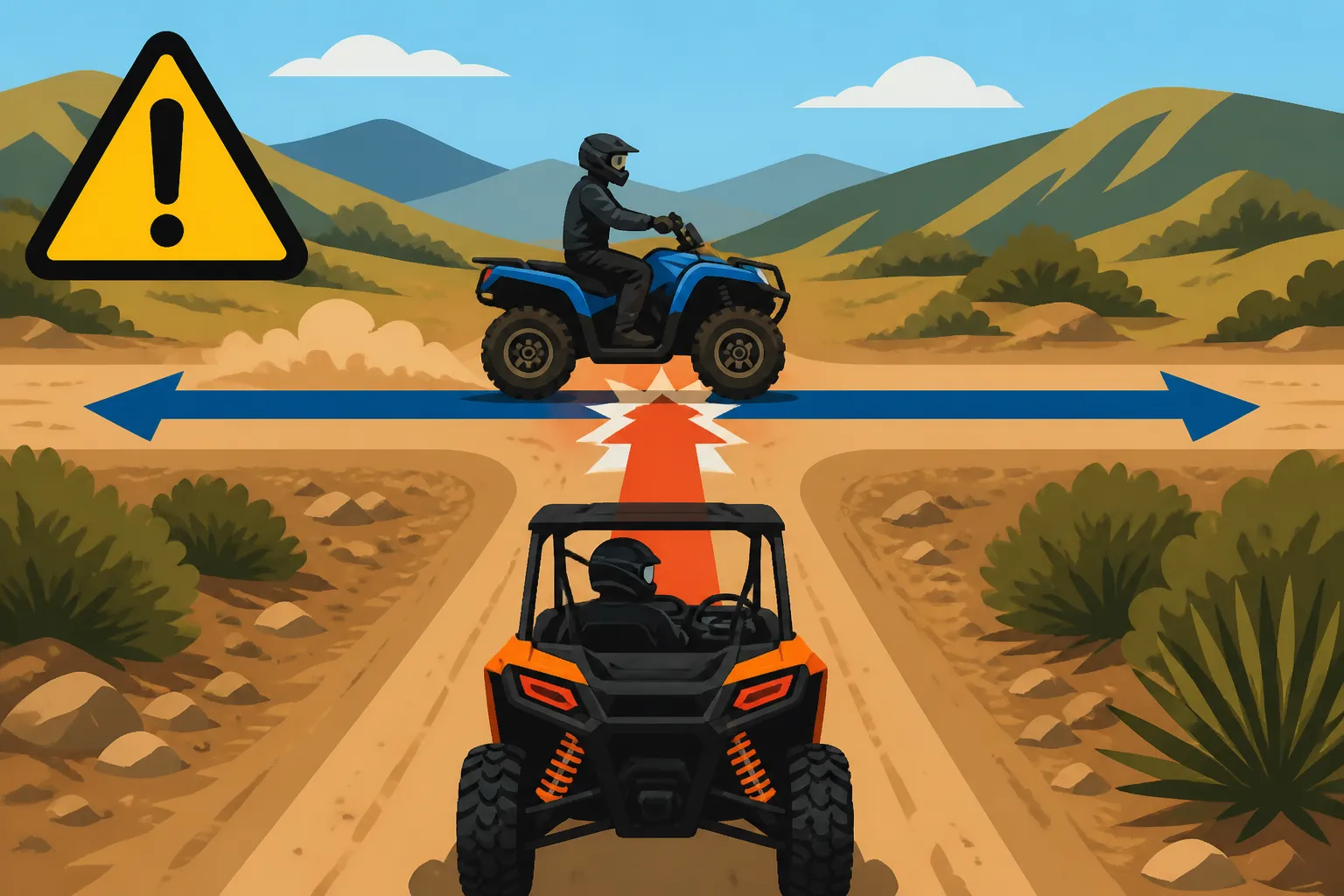
By requiring a crossing at a right angle – meaning as close to 90 degrees to the flow of traffic as possible – the intent is to get your OHV across the paved surface in the most direct, efficient, and visible way possible. This minimizes the time your off-road machine is exposed to highway traffic. For example, if you're approaching a rural two-lane road that connects two parts of your trail, a right-angle crossing ensures you enter the traffic lane, move straight across, and exit, rather than merging and traveling alongside highway vehicles. This straight-shot approach makes your intentions clear to any oncoming traffic and drastically reduces the chance of a broadside collision. It's about being predictable in an environment where OHVs are otherwise unexpected.
The Legal Framework for Crossings
The California Vehicle Code (CVC) is the backbone of all OHV regulations, and it specifically addresses these crossing scenarios. The relevant section, CVC 38026, details when and how an OHV may cross a highway, road, or trail that is otherwise off-limits. This code permits crossing, but it comes with strict conditions. You can't just cross anywhere; you must cross at a right angle, and only after yielding to all traffic. Furthermore, you cannot travel along the highway or road. It's strictly about getting from one side to the other.
This is a crucial distinction from something like a [California's Combined-Use Highways]. Combined-use routes are specially designated segments where OHVs are permitted to travel for a specific, limited distance along a paved road, usually to connect trail sections or access services. A simple right-angle crossing, however, is not a designated route; it's a brief, permitted transit across a road that is otherwise forbidden. Local agencies, like the U.S. Forest Service or the Bureau of Land Management (BLM), often identify and mark these specific crossing points on their trail maps, helping riders understand where it's safe and legal to cross. Always check local maps for designated crossing points, as just because a dirt path crosses a paved road doesn't automatically mean it's a legal OHV crossing.
Executing a Safe Right-Angle Crossing
The act of crossing a public road with your OHV needs to be performed with the utmost care and precision. It’s not a moment for guesswork; it’s a time for deliberate action and absolute awareness of your surroundings. Many riders get this wrong, either by riding on the shoulder for too long or not making a clean, straight crossing, which can quickly lead to citations or, worse, an accident.
Pre-Crossing Checklist and Awareness
Before your tires even touch the pavement, a thorough pre-crossing routine is essential. As you approach the paved road, slow down significantly. Don't just blast out onto the asphalt. Come to a complete stop at the very edge of the paved surface, ideally where you have a clear view of both directions of traffic without obstructing the roadway itself. This is your "check everything" moment.
First, look both ways – repeatedly. Even on what seems like a deserted rural road, a vehicle can appear quickly, especially around bends or over hills. Listen carefully for approaching vehicles that you might not yet see. This means taking off your helmet if it impedes hearing, or at least being extra vigilant. Assess the traffic speed and density. Is there a break in traffic long enough for you to cross safely? Consider any blind spots, both yours and those of potential motorists. If you're riding with a group, communicate clearly. Ensure everyone understands the plan for crossing and waits for the all-clear from the lead rider. Think about visibility: are you highly visible? This is where reflective gear and a tall whip flag (if in dunes or open desert) can really help. Don't pull out if there's any doubt; wait for a completely clear window.
The Act of Crossing – Step-by-Step
Once you've confirmed the road is clear, the actual crossing needs to be swift and decisive, but never reckless. Engage your clutch smoothly (if applicable) or apply throttle steadily and drive your OHV straight across the paved road at a right angle. Do not, under any circumstances, make any turns or ride along the paved surface, even for a few feet, to align yourself better with the trail on the other side. The goal is to traverse the road in the shortest distance and time possible.
Imagine the paved road as a line you must cross directly perpendicular to it. For example, if you're on a dirt trail that T-bones a two-lane highway, you'd stop at the dirt-pavement interface, check for traffic, and then drive your OHV straight across, aiming for the continuation of the dirt trail on the opposite side. Maintain control of your machine, be aware of any potential unevenness between the dirt and pavement, and don't accelerate so fast that you lose control. Your focus should be solely on getting to the other side safely. This precise maneuver is what keeps you legal and out of harm's way. This is also where good braking and steering systems, like those found in SuperATV components, can give you the confidence to execute a sharp, controlled crossing.
The "No Riding Along" Imperative
This is one of the most frequently violated aspects of the OHV crossing rule, and it often leads to citations. California law is unequivocally clear: you are prohibited from riding your OHV along a paved public road or highway, even if it's just for a very short distance, unless that specific segment has been officially designated as a [California's Combined-Use Highways]. A right-angle crossing is explicitly for transiting across the road, not for traveling on it.
For instance, if the trail on the other side of the road is fifty feet to your left, you cannot cross the road, then turn left and ride those fifty feet on the pavement to connect with the trail. That fifty-foot ride on the paved road is illegal. Instead, you would need to cross directly at the point where your trail meets the road, even if that means dismounting and walking your machine those fifty feet on the dirt shoulder, or backtracking on the dirt trail to find a legal crossing directly opposite the other trail section. This rule reinforces the intent of OHVs as off-road machines, strictly limiting their interaction with public highways to the absolute minimum necessary for safe and legal crossing. Rangers and law enforcement are particularly vigilant about this, as riding along a paved road creates a far greater risk than a simple, direct crossing.
Common Mistakes and Misconceptions
Despite the clarity of the law, many OHV riders fall into traps of misunderstanding or simple mistakes when it comes to road crossings. These errors can lead to serious consequences, from fines to dangerous accidents. Being aware of these common pitfalls can help you avoid them.
Misinterpreting "Short Distance"
One of the biggest misconceptions riders have is that "a short distance" of travel on a paved road is permissible if it leads to a trail. This simply isn't true when it comes to a standard right-angle crossing. The CVC does not define "short distance" as permission to ride along the road for any length of time. "Short distance" applies to the actual act of crossing – it should be the quickest, most direct path across the traffic lanes.
Riders might rationalize, "Oh, it's only 20 feet to the next dirt section, no big deal." But those 20 feet on pavement are just as illegal as 20 miles. The law makes a clear distinction between a designated [California's Combined-Use Highways] (where limited travel is explicitly permitted by signage) and a simple crossing point (where only traversing at a right angle is allowed). Law enforcement officers understand this distinction thoroughly. If they see you riding on the pavement, even momentarily after crossing, they will likely issue a citation. Always remember: if it's not a marked combined-use route, your wheels should only touch the pavement long enough to go straight from dirt to dirt.
Divided Highways and Intersections
Crossing a single-lane or two-lane road is one thing, but dealing with divided highways or complex intersections adds another layer of challenge and potential for error. A divided highway, by its nature, presents two distinct traffic flows, often separated by a median. When crossing such a road, you must treat each section as a separate crossing.
This means you would stop, check for traffic, cross the first set of lanes at a right angle, stop safely in the median (if it's wide enough and safe to do so without obstructing traffic), and then repeat the process for the second set of lanes. You cannot simply blast across both sections without pausing and re-evaluating traffic. [Crossing a Divided Highway] requires extra patience and vigilance. Similarly, crossing at a busy intersection with traffic lights or multiple turning lanes introduces even more variables. While generally permissible to cross at these points, you must obey all traffic signals and yield to all turning vehicles and pedestrians. The "right angle" rule still applies to each segment of the crossing, ensuring you move directly through the intersection, not turning or riding with the flow of street traffic.
What About Combined-Use Routes?
It's vital to differentiate a right-angle crossing from a combined-use route, as confusing the two can land you in trouble. A right-angle crossing is a fleeting moment of interaction with a paved road, strictly for getting from one side to the other. You stop, look, cross, and you're off the pavement immediately.
[California's Combined-Use Highways], on the other hand, are specific, often short, segments of public roads or highways that state or local agencies have explicitly designated for shared use by both licensed vehicles and OHVs. These routes are always clearly marked with specific signage indicating that OHV travel is permitted for a certain distance or between specific points. The purpose of these routes is typically to connect otherwise isolated sections of trails, allow access to staging areas, or provide a link to nearby towns for gas and supplies. If you're on a combined-use route, you will see official signs indicating OHV access. If you don't see those signs, assume you are only permitted to make a right-angle crossing, not travel along the road. Never assume a road is a combined-use route unless it's explicitly signed as such.
Essential Gear and Preparedness for Road Crossings
Even though a road crossing is brief, it’s arguably one of the most vulnerable moments during an OHV ride. Being prepared with the right gear and ensuring your machine is in top condition can make all the difference in executing a safe and legal crossing.
High-Visibility Gear
When you're crossing a paved road, you are momentarily sharing space with vehicles that are generally larger, faster, and whose drivers may not be expecting an OHV. This makes high visibility paramount. Wearing bright, contrasting colors, especially fluorescent greens, oranges, or yellows, significantly increases your chances of being seen by motorists. Beyond clothing, consider adding reflective elements to your helmet, machine, and even your backpack.
For those riding in dusty conditions or at dawn/dusk, a tall whip flag is not just for the dunes but can also improve your visibility when approaching or crossing roads. Many riders also upgrade their OHV lighting for better visibility. Aftermarket LED light bars or auxiliary lights from brands like SuperATV can dramatically improve how well you are seen by other drivers, especially if you anticipate crossings in low-light conditions. The more visible you are, the less chance a motorist will overlook you as you make your quick transit across the pavement.
Machine Readiness
Your OHV's mechanical condition is always important, but it's critically so when interacting with public roads. Before you even head out for your ride, perform a basic check. Ensure your brakes are in excellent working order – you might need to stop quickly or maintain a precise position at the edge of the road. Your steering should be tight and responsive, allowing for an immediate, straight crossing without wandering.
Check your tires for proper inflation, as this affects control and stability on paved surfaces. Your engine should be running smoothly, ready to provide consistent power for a decisive crossing. Beyond operational readiness, ensure your OHV is compliant with California's specific rules, such as having a [California Spark Arrester Rules] for riding on public lands, and meeting [California Sound Limits for OHVs Explained]. While these aren't directly about the crossing maneuver, they are part of legal operation that can be checked by law enforcement at any point, including during a roadside interaction after a crossing.
Legal Documentation
Just like you wouldn't drive your car without your license and registration, you shouldn't ride your OHV without the required legal documents. For any OHV operating on designated public lands or crossing public roads, you absolutely need to carry proof of current California OHV registration, such as a valid Green, Red, or Tan Sticker, and its corresponding registration card. If you're a nonresident, you'll need your valid [California's Nonresident OHV Use Permit].
For certain OHV types and ages, like those operating ATVs, a California ATV Safety Certificate might be required for riders under a certain age, or even for adults operating certain machines. It's also wise to carry a form of personal identification. While you don't need a driver's license to operate an OHV on most public lands, you might need one if operating a Recreational Off-Highway Vehicle (ROV) at age 16 or 17. Always keep these documents in a waterproof bag or pouch on your person or securely attached to your machine. Rangers often check for these at staging areas, trailheads, and, yes, even after a legal road crossing. Having your [Carrying Registration Paper on the Sand] ready shows you're a responsible rider.
Summary of Road Crossing Dos and Don'ts
To simplify the complex rules around crossing paved roads with your California OHV, here's a quick reference table. Remember, these guidelines are designed to keep you safe and legal, ensuring you can continue enjoying California's incredible off-road opportunities.
| Action | Permissible (Do) | Impermissible (Don't) |
|---|---|---|
| Approach to Road | Slow down, prepare to stop. | Approach at speed, assume right-of-way. |
| Stopping | Come to a complete stop at the pavement's edge. | Roll through, stop partially on the road, or creep forward without clear visibility. |
| Yielding | Yield to all highway traffic (vehicles, pedestrians). | Assume traffic will stop for you, or cross when traffic is too close. |
| Direction of Crossing | Cross at a right angle (as close to 90 degrees). | Cross at an acute angle, ride diagonally, or "cut the corner." |
| Riding on Pavement | Get off pavement immediately onto dirt/trail. | Ride along the shoulder, travel on the paved lane, or turn onto the road to find the next trail section. |
| Visibility | Wear bright colors, use lights/flags. | Rely on others to see you, ride in dark clothing, especially in low light. |
| Group Riding | Communicate and cross one at a time, if necessary. | All cross at once, or cross without confirming the lead rider has cleared the way. |
| Divided Highways | Treat each section of traffic as a separate crossing. | Attempt to cross both sections of a divided highway in one continuous movement without re-checking traffic. |
| Designated Routes | Know the difference between a crossing and a combined-use route. | Assume all paved sections that intersect trails are combined-use routes. |
| Documentation | Carry valid registration and ID. | Ride without current stickers, registration card, or necessary safety certificates. |
Disclaimer
This article is for general informational purposes only and does not constitute professional advice. Laws, prices and regulations vary by location and change over time. Consult a qualified professional for guidance on your specific situation.