California’s Ban on ATV Passengers
Let's be real, nothing sours a perfect day out on the trails or dunes faster than a confusing, or worse, violated, rule. If you're an ATV enthusiast in California, the question of whether you can bring a passenger along is probably one that's crossed your mind – and often, it's followed by a sinking feeling when you realize the answer isn't as simple as strapping on an extra helmet. This guide is here to untangle the nuances of California's specific regulations regarding ATV passengers, helping you understand why these rules exist, what they mean for your riding adventures, and how to stay compliant to avoid an unexpected ticket.
The Frustration of California's ATV Passenger Ban
It's a common scenario: you've got your quad loaded up, the sun is shining, and your excited child or spouse is ready to hop on the back for a quick spin around the dirt lot or a cruise down a wide fire road. Then, someone — maybe a well-meaning friend, or a more experienced rider at the staging area — drops the bombshell: "You can't have a passenger on that." The frustration is immediate and completely understandable. Why on earth would there be a seat on the back, or what looks like enough space, if you can't use it?
The Common Misconception: "It's Just a Seat!"
Many riders look at their ATV, especially some older models or those with slightly extended rear racks, and see what appears to be ample room for a second person. It looks sturdy, sometimes even like it was designed for two. This visual perception can be incredibly misleading. Unlike a motorcycle, which is often explicitly designed for two riders with dedicated seating and footpegs, most ATVs are fundamentally designed as single-operator vehicles. That "extra space" on the back is typically meant for cargo, a small cooler, or gear, not a person. It's not a padded passenger seat, and its presence can create a false sense of security.
The notion that "it's just a seat" often comes from riders who might have grown up in areas with less stringent regulations or who have seen people riding double in unregulated settings. However, California's Vehicle Code is quite explicit, and it doesn't leave much room for interpretation based on what looks like a passenger seat. This discrepancy between appearance and legality is a significant source of confusion and disappointment for many riders, especially those new to the sport or new to California's unique rules.
Why This Rule Catches Riders Off Guard
California has a reputation for comprehensive and often strict regulations across various aspects of life, and off-highway vehicle (OHV) use is no exception. For many, the idea that a vehicle designed for rugged terrain and adventurous recreation would have such a specific limitation on passengers comes as a surprise. Newcomers to the state or even long-time residents who are just getting into OHV riding might not think to research such a niche rule until they're already out there, ready to ride.
Adding to the surprise is the fact that regulations can vary significantly from state to state. What might be perfectly legal in Arizona or Nevada — states with popular OHV destinations — could lead to a citation in California. This patchwork of state laws means that riders often rely on their prior experience or anecdotal evidence, which can be a dangerous gamble when crossing state lines or exploring new areas. The lack of readily apparent signage in all riding areas specifically addressing the ATV passenger ban also contributes to riders being caught unawares, leading to uncomfortable encounters with rangers or law enforcement. It's not always intuitive, and if you haven't done your homework, it’s easy to make an honest mistake.
The Emotional Impact on Family Rides
For many, OHV riding is a family affair. It's about creating memories, exploring nature together, and sharing the thrill of off-road adventure. The ATV passenger ban can throw a significant wrench into these plans. Imagine promising your child a ride, only to find out you can't legally take them on your quad. Or picturing a romantic ride with your partner, only to be told it's a no-go. This isn't just a legal hurdle; it's an emotional one. It can make planning family outings more complicated, requiring multiple machines or forcing some family members to sit out.
Parents, in particular, often grapple with this rule. They want to introduce their kids to the joy of off-roading, and a smaller, easier-to-handle ATV seems like the perfect starting point for a child to ride along. However, the law is designed to protect riders, especially the most vulnerable. While the intent is safety, the practical effect can be feelings of exclusion and disappointment. This often pushes families towards other types of OHVs, like side-by-sides, which are designed to carry multiple passengers, but that's a whole different investment and riding experience.
Understanding California Vehicle Code 38506
When we talk about California's rules for ATVs, the California Vehicle Code (CVC) is the definitive source. Specifically, section 38506 lays out the law regarding passengers on ATVs. It's not just a suggestion or a guideline; it's a legally enforceable statute that all riders on public lands within California must adhere to. Ignoring it can lead to more than just a stern warning.
The Letter of the Law: What it Says
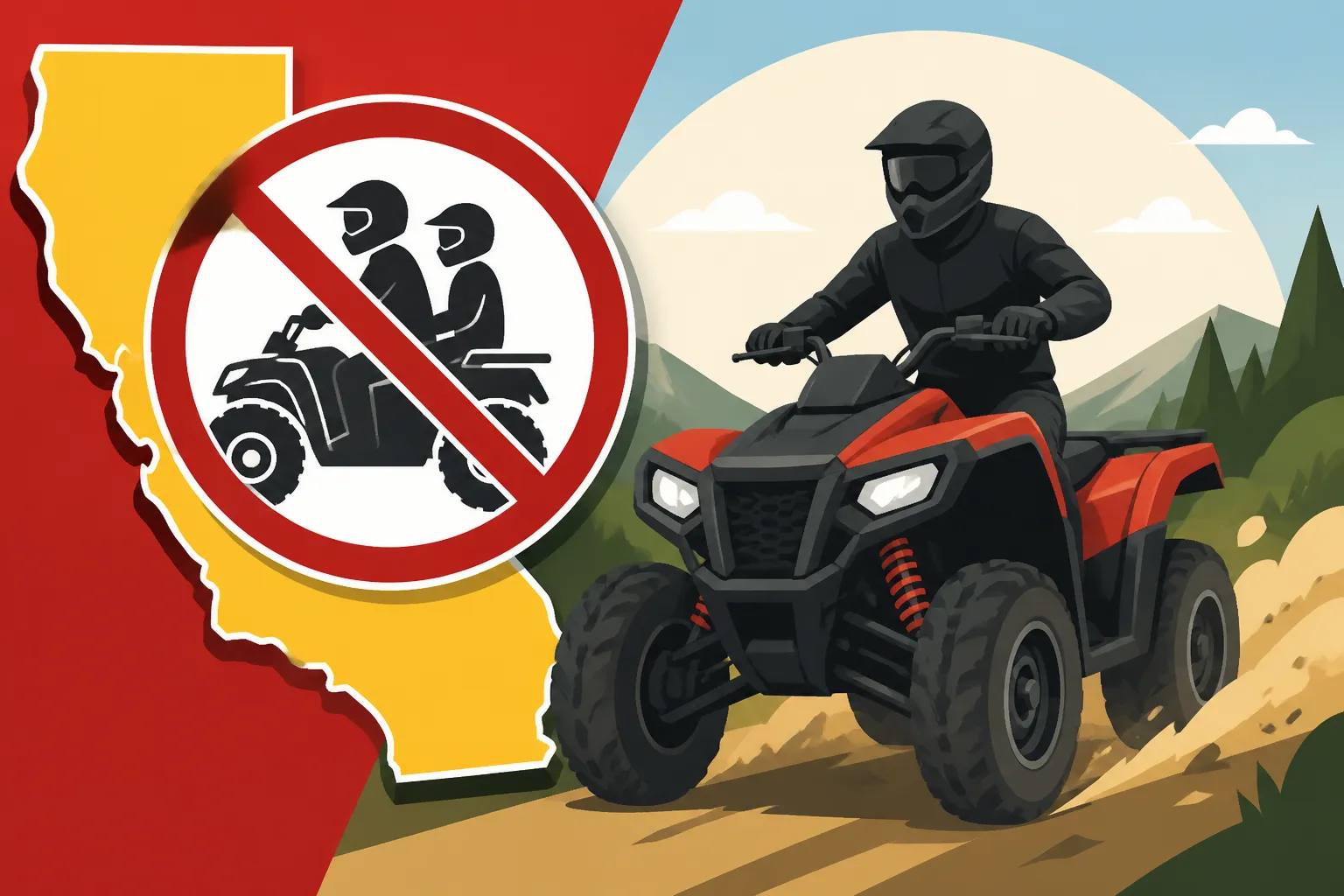
California Vehicle Code Section 38506 is quite clear: "No person shall operate an all-terrain vehicle with a passenger unless the all-terrain vehicle is designed by the manufacturer to carry a passenger, as evidenced by a seat and footpegs designed for a passenger." This single sentence contains the core of the prohibition. The crucial phrase here is "designed by the manufacturer." It's not about whether you can physically fit a passenger, or if you've added an aftermarket pad to the rear rack. It's about how the vehicle was originally engineered and sold.
The law requires clear evidence of this design: a dedicated seat and footpegs for a passenger. Most traditional, single-rider ATVs simply do not have these features. While some specialized "two-up" or "touring" ATV models do exist and are explicitly designed for two people, they are a specific category, often larger and heavier, and come from the factory with dual seats and footrests. Without that original manufacturing design for a passenger, riding double on an ATV in California is a violation of the law on public lands. This regulation is a critical aspect of [California ATV Passenger Ban Explained].
The Definition of an "All-Terrain Vehicle" in California
To truly understand CVC 38506, it's essential to know how California defines an "all-terrain vehicle" (ATV) in the first place. The CVC defines an ATV as a motor vehicle meeting all of the following criteria:
- Is designed for off-highway operation.
- Is 50 inches or less in width.
- Has an unladen weight of 1,200 pounds or less.
- Travels on three or more low-pressure tires.
- Has a seat designed to be straddled by the operator.
- Has handlebars for steering control.
This definition is key because it differentiates ATVs from other types of OHVs, most notably side-by-sides (UTVs), which are generally wider, heavier, have bucket seats or bench seats, and a steering wheel. The "seat designed to be straddled by the operator" is particularly important; it implies a single rider position, reinforcing the single-operator design philosophy that underpins the passenger ban. When a ranger pulls you over, they'll be checking your machine against these criteria to confirm it's indeed an ATV before applying the passenger rule.
How this Differs from Other States
It's a common refrain among OHV enthusiasts: "But where I'm from, we can ride two-up on an ATV all the time!" And they might not be wrong. The regulations governing OHVs, including passenger rules, vary dramatically from state to state. Some states have more lenient laws, allowing passengers if the vehicle can accommodate them, or if the passenger meets certain age or size requirements. Others might permit passengers in specific types of riding areas or under certain conditions, such as on private property with owner permission.
California, however, tends to be on the stricter side regarding ATV passengers on public lands. This strictness stems from a strong focus on rider safety and minimizing incidents, especially given the diverse and often challenging terrains found in the state's popular riding areas like Glamis, Oceano Dunes, or Hungry Valley. So, if you're coming from Oregon, Arizona, or even Nevada, what was permissible in your home state might land you a citation in the Golden State. It's always crucial to research California's specific laws, regardless of your past riding experience elsewhere, to ensure you're in compliance. This means understanding that [Does California Honor Arizona OHV Registration?] or a similar decal from another state doesn't necessarily mean all their riding rules apply here.
The "Why" Behind the Passenger Restriction
When a rule seems to limit your fun, it's natural to question its purpose. With California's ATV passenger ban, the "why" boils down to fundamental design principles, physics, and a long history of accident data. It's not about being arbitrary; it's about minimizing risk in a high-adrenaline activity. The safety of all riders is paramount, and the design of most ATVs simply isn't conducive to safely carrying a second person.
ATV Design: Single Rider Focus
Most ATVs are engineered with a singular operator in mind. This impacts everything from the chassis and suspension to the engine's power delivery and the vehicle's overall balance. The operator controls the ATV not just with handlebars and a throttle, but also by shifting their body weight. Leaning into turns, shifting weight forward or back to climb hills or descend, and moving side to side to maintain stability on uneven terrain are all integral parts of ATV operation. This dynamic weight shifting is crucial for safe control and maneuverability.
When a passenger is added, especially one who isn't experienced in anticipating the rider's movements, this delicate balance is thrown off. A passenger's weight is often static or moves independently, making it incredibly difficult for the operator to control the machine effectively. The added weight also changes the vehicle's center of gravity, making it more prone to tipping, especially in turns or on inclines. The vehicle's suspension and braking systems are also calibrated for a single rider; adding a second person can overtax these components, leading to reduced performance and increased stopping distances. The lack of proper passenger footpegs or handholds further highlights that these machines were never intended for two.
Stability and Control Issues with Passengers
The moment you add a passenger to a single-rider ATV, you introduce a host of stability and control problems. Imagine trying to ride a bicycle with someone perched precariously on the handlebars – it's wobbly, hard to steer, and dangerous. While an ATV is far more stable than a bicycle, the principle is similar. The operator needs to be able to react instantly and shift their weight without interference.
A passenger, by their very presence, can hinder the operator's ability to move freely, particularly if they are holding on tightly or are positioned awkwardly. This can lead to:
- Reduced turning ability: The ATV may "push" through turns rather than leaning effectively.
- Increased rollover risk: On side slopes or during sharp turns, the extra, often high-mounted, weight of a passenger significantly increases the likelihood of a rollover.
- Difficulty with obstacles: Navigating rocks, ruts, or sudden dips becomes far more challenging as the ATV's responsiveness is compromised.
- Overloaded suspension: This can cause the ATV to bottom out, making for a rough ride and potentially damaging components.
- Impaired visibility: A passenger can block the operator's view, especially when looking over their shoulder.
These factors combine to make an already adventurous activity exponentially more dangerous, not just for the passenger but for the operator as well.
Accident Data and Safety Concerns
The California ATV passenger ban isn't just theoretical; it's rooted in grim statistics. Accident data from across the country consistently shows that riding ATVs with passengers — especially those not designed for two — dramatically increases the risk and severity of injuries. Rollovers, collisions, and ejections are far more common when a second person is on board. Passengers, particularly children, are especially vulnerable in these scenarios as they often lack the physical strength or instinct to brace themselves or react appropriately during an accident.
Safety organizations, medical professionals, and regulatory bodies have long advocated for single-rider ATV use. The potential for catastrophic injuries, including head trauma, spinal injuries, and broken bones, is significantly higher when an ATV is operated outside its design parameters. California's law is a direct response to these safety concerns, aiming to prevent avoidable accidents and serious injuries by mandating that ATVs only carry the number of people for which they were safely designed. It's a proactive measure to protect public health and reduce the strain on emergency services, reflecting the state's commitment to rider safety, as outlined in rules like [California Helmet Law for ATV Riders].
The Crucial Distinction: ATVs Versus UTVs/Side-by-Sides
One of the biggest areas of confusion for riders, particularly those new to the OHV scene, is the difference between an ATV and a UTV, often called a side-by-side. While both are off-highway vehicles, their design, purpose, and critically, their passenger capabilities, are vastly different under California law. Understanding this distinction is paramount for staying legal and safe.
UTVs: Built for More Than One
Unlike ATVs, Utility Terrain Vehicles (UTVs) or Side-by-Sides (SxS) are explicitly designed by manufacturers to carry multiple passengers. You'll recognize them by their car-like seating, often with a bench or bucket seats situated side-by-side, a steering wheel, and usually a roll cage. These vehicles come from the factory with dedicated passenger compartments, complete with features like seatbelts, grab handles, and footwells for each occupant. They are built on a wider, more stable platform than an ATV, with suspensions and chassis designed to handle the weight and dynamics of multiple people.
The design philosophy behind UTVs is fundamentally different. They are intended for utility, recreation, and often, family outings. Brands like Polaris, Can-Am, and Yamaha produce a wide range of UTVs with two, four, and even six seats, all clearly designated for passenger use. This clear intent from the manufacturer, backed by the vehicle's structural and safety features, is what makes carrying passengers legal in a UTV where it is not in a traditional ATV. For more on this, check out [Side-by-Side Passengers and California Rules].
Seatbelts and Roll Cages: The Safety Difference
The presence of seatbelts and a robust roll cage are perhaps the most visually striking and functionally important distinctions between a UTV and an ATV when it comes to passenger safety. A UTV's roll cage provides critical occupant protection in the event of a rollover, creating a safety cell around the passengers and driver. Seatbelts (typically 3-point harnesses, and sometimes even 4 or 5-point harnesses in sport models) keep occupants secured within this safety cell, preventing ejection during violent maneuvers or accidents.
Traditional ATVs, by contrast, lack these features. There are no seatbelts (as the rider is meant to shift with the machine), and while some aftermarket roll bars or cages exist, they are not standard and often not designed to the same rigorous safety standards as factory UTV roll cages. The absence of these fundamental safety components on an ATV is a key reason why carrying a passenger is prohibited. Without the means to secure a passenger and protect them in a rollover, the risks are deemed unacceptably high under California law.
When a UTV Isn't a Street-Legal Solution for Passengers
While UTVs are designed for multiple passengers off-road, it's critical to understand that this does not automatically make them street legal in California, even with passengers on board. This is another area where a lot of riders get confused. You might see UTVs in other states with license plates, legally cruising down paved roads, but California has very specific and generally restrictive laws regarding OHVs on public highways. For the most part, UTVs are considered off-highway vehicles, just like ATVs, and are restricted from paved public roads unless on designated "combined-use" segments or for very brief crossings.
Even if you've kitted out your UTV with every street-legal accessory imaginable (turn signals, horn, mirrors, etc.), it typically won't qualify for a regular license plate in California. There are specific classifications for low-speed vehicles (LSVs) or neighborhood electric vehicles (NEVs), but standard gasoline-powered UTVs generally don't fit these categories. Trying to drive a passenger-filled UTV on a highway in California can result in serious fines and potentially impoundment, even though it's designed for passengers off-road. If you're hoping to make your side-by-side a road-worthy machine for family outings, you need to understand the nuances of [Can You Make a UTV Street Legal in California?] and [Are ATVs Street Legal in California?]. Aftermarket accessory providers like SuperATV offer a vast array of parts for UTVs, from winches to lighting, but none of these will magically confer street-legal status in California for a typical UTV.
Penalties and Enforcement: What to Expect
Ignoring California's ATV passenger ban isn't just about bending the rules; it's a legal violation with real consequences. Rangers, park staff, and local law enforcement in OHV areas are well-versed in these regulations and are often on the lookout for unsafe practices, including prohibited passengers. Understanding the potential penalties is crucial for any rider thinking about carrying an extra person.
The Financial Hit: Fines and Citations
The most immediate consequence of violating CVC 38506 is a citation, which comes with a financial penalty. While specific fine amounts can vary by jurisdiction and whether it's a first offense or repeat violation, you can expect a significant hit to your wallet. These aren't just minor parking tickets; OHV violations are often comparable to traffic infractions and can be costly. For example, a similar OHV violation might carry a base fine in the ballpark of a few hundred dollars, plus various court fees, assessments, and surcharges that can quickly multiply the total amount. It’s not uncommon for a "minor" violation to end up costing well over a hundred dollars, sometimes several hundred.
This fine isn't just an inconvenience; it's money that could have been spent on fuel for more rides, new gear, or even an upgrade for your machine. It's a stark reminder that the state takes these safety regulations seriously, and ignorance of the law is rarely an acceptable defense. You might also find yourself dealing with additional fines if other violations are observed at the same time, such as not having proper [California OHV Registration] or a spark arrester.
The Risk of Your Ride Being Impounded
In more severe cases, or for repeat offenders, law enforcement has the authority to impound your off-highway vehicle. This is a far more serious consequence than just a fine. Impoundment means your ATV is physically taken away from you, often requiring you to arrange for its retrieval from an impound lot. This process involves not only paying the original citation but also daily storage fees, towing charges, and administrative fees to the impound facility. These costs can quickly escalate, potentially running into hundreds or even thousands of dollars, making the initial fine seem trivial by comparison.
Beyond the financial burden, an impoundment means your day of riding is abruptly over. You're left stranded, needing to arrange alternative transportation for yourself and any passengers. It's a huge disruption and a major headache, designed to be a significant deterrent against unsafe and illegal OHV operation. Law enforcement officers often have discretion in these matters, and a blatant disregard for safety, like carrying a child passenger on an unsuitable ATV, might lead them to take stricter action.
On-Site Enforcement by Rangers and Law Enforcement
You're most likely to encounter enforcement of the ATV passenger ban in California's designated OHV riding areas, such as the State Vehicular Recreation Areas (SVRAs) like Ocotillo Wells, Hungry Valley, or Hollister Hills, as well as on Bureau of Land Management (BLM) lands like the Imperial Sand Dunes (Glamis). Rangers and park personnel in these areas are specifically tasked with ensuring compliance with OHV regulations. They are visible, often patrolling in marked vehicles, and are very proactive in monitoring rider behavior.
It's not uncommon to see rangers conducting routine checks at staging areas, entrance gates, or even out on the trails themselves. They will often approach riders they suspect of violations, particularly those operating with passengers. These interactions can range from a friendly warning to an immediate citation, depending on the severity of the violation, the ranger's discretion, and whether there are other issues at play. Always be respectful and cooperative, but understand that their primary goal is safety and enforcement of the law. They are there to protect the riding public and the environment. This presence is a constant reminder that [Riding Glamis on a California Green Sticker] or any other public land comes with strict rules.
Navigating the Rules: Practical Advice for California Riders
Understanding the ATV passenger ban is one thing; figuring out how to still enjoy your off-roading adventures with family and friends is another. It often requires a shift in planning and sometimes, a different approach to your equipment. But with a little forethought, you can absolutely continue to make great memories on the California trails.
Planning Rides with Multiple People
If you're dead set on group rides or family outings, the most straightforward solution is to ensure everyone has their own appropriate machine or that you bring multi-passenger vehicles.
- Multiple ATVs: If everyone in your group is an experienced rider and has their own ATV, then the passenger issue is moot. Each person operates their own machine. Remember that [California Minimum Age to Ride on Public Land] still applies, and younger riders will need appropriate safety certificates and supervision.
- UTVs/Side-by-Sides: These are the go-to choice for families or groups who want to ride together in the same vehicle. As discussed, UTVs are designed for passengers and come with the necessary safety features like seatbelts and roll cages. This allows for a shared experience, often with more comfort and storage space, making them ideal for longer trips or carrying gear. You can find many popular models from manufacturers that accommodate 2, 4, or even 6 riders.
- Ride-Sharing Strategy: If you have more people than machines, consider a "tag-team" approach where some family members ride while others engage in other activities at the staging area (like picnicking, exploring on foot, or watching from a safe distance), and then swap out. This ensures everyone gets some saddle time while staying compliant.
Careful planning before you even load up is key to avoiding disappointment and staying on the right side of the law.
Investing in the Right Machine for Your Family
For many families, the ATV passenger ban becomes the catalyst for considering a different type of OHV altogether. If your primary goal is to share the riding experience with passengers, investing in a UTV or side-by-side might be the most practical and ultimately most enjoyable solution. While the initial cost can be higher than a single-rider ATV, the ability to legally and safely transport multiple people often outweighs this factor for families.
When considering a UTV, think about:
- Number of Seats: How many people will typically be riding with you?
- Type of Riding: Are you looking for a sporty machine for fast trail riding, or a more utilitarian model for exploring and hauling gear?
- Budget: UTVs come in a wide range of price points, from entry-level recreational models to high-performance desert racers.
- Features: Look for models with comfortable seating, ample storage, and robust safety features. Aftermarket accessories, like those from SuperATV, can further enhance safety and utility, adding things like stronger doors, upgraded harnesses, or better lighting.
Ultimately, choosing a machine that aligns with California's passenger laws, especially one explicitly designed for multi-person use, removes all the guesswork and allows you to focus purely on the fun of the ride.
Education and Safety First
Beyond just knowing the rules, a foundational commitment to OHV safety is paramount. This includes:
- Taking a Safety Course: For all riders, especially youth, completing an ATV or OHV safety course is invaluable. It teaches proper riding techniques, hazard awareness, and crucial safety principles. In California, riders under a certain age are often required to complete such a course before operating an OHV on public land. Even for adults, it can be a great refresher and ensure you're up-to-date on best practices.
- Wearing Appropriate Gear: Helmets, eye protection, gloves, long pants, and sturdy over-the-ankle boots are non-negotiable for all riders, whether on an ATV or a UTV. This is not just a recommendation; it's often a legal requirement in California.
- Pre-Ride Inspections: Always conduct a thorough pre-ride check of your machine. Inspect tires, brakes, fluid levels, and ensure all controls are functioning correctly.
- Riding Within Your Limits: Know your skill level and the capabilities of your machine. Don't push beyond what you're comfortable with, especially when navigating challenging terrain or riding with passengers in a UTV.
- Staying Informed: Regulations can change. Periodically check the California Off-Highway Motor Vehicle Recreation (OHMVR) Division website or the DMV for updates to laws and rules. This commitment to ongoing education and safety will ensure that your off-road adventures are both thrilling and secure. For guidance on kids, look into [California Rules for Riding With Kids on Board].
| Feature/Regulation | All-Terrain Vehicle (ATV) | Utility Terrain Vehicle (UTV) / Side-by-Side (SxS) |
|---|---|---|
| Primary Design | Single operator, straddle seat, handlebars. Dynamic body input for control. | Multi-passenger, car-like seating (bench/bucket), steering wheel. |
| Passenger Legality | Prohibited on public land in CA unless specifically manufactured for two (with dedicated seat & footpegs). | Permitted on public land in CA, designed for 2, 4, or 6 passengers. |
| Width | Generally 50 inches or less. | Often wider than 50 inches, up to 72+ inches. |
| Steering | Handlebars. | Steering wheel. |
| Safety Features | No seatbelts, no integrated roll cage (rider uses body weight to control). | Seatbelts, integrated roll cage, grab handles. |
| Street Legal in CA | Generally Not street legal (except for very specific combined-use segments or crossings). | Generally Not street legal (except for very specific combined-use segments or crossings). |
| California Vehicle Code | CVC 38506 explicitly prohibits passengers on most ATVs. | Different CVC sections apply, generally allowing passengers if vehicle designed for it. |
| Common Use | Sport riding, trail riding, utility tasks (single person). | Family recreation, utility work, group trail riding, adventure. |
Common Misunderstandings and Exceptions
Even with the law laid out clearly, there are still lingering questions and common misconceptions about the ATV passenger ban. Riders often look for loopholes or misinterpret certain scenarios, hoping to find an exception that applies to their situation. It's important to address these directly to prevent any accidental violations.
"Just a Short Ride" Is Still a Violation
One of the most frequent arguments or justifications rangers hear is, "Oh, I was just taking them for a short ride, just around the staging area." The duration or distance of the ride has no bearing on its legality. Whether you're going five feet or five miles, if you're on public land and your ATV isn't manufactured for a passenger, you're in violation of CVC 38506. The law doesn't differentiate between a quick spin and a full-day excursion; the act of operating an ATV with an unauthorized passenger is the violation itself.
This "short ride" mentality often stems from a belief that the risk is minimal over a small distance or at low speeds. However, accidents can happen anywhere, at any speed, and often do in unexpected ways. A quick turn in a parking lot, an unseen bump, or a sudden stop can be enough to destabilize an overloaded ATV and cause an injury. Law enforcement officers are not likely to be sympathetic to the "just a short ride" defense because the safety principle remains constant regardless of distance.
No Age-Based Exemptions for ATVs
Another common question revolves around age: "What if my child is very small/light, or what if my older teen is a good rider?" Unfortunately, California's ATV passenger ban does not include any age-based exemptions for the passenger. The law applies universally to anyone who is a passenger on an ATV not designed for two. It doesn't matter if the passenger is a toddler, a young child, or a fully grown adult; if the ATV is a single-rider machine, no one else is permitted on board on public lands.
While there are specific age restrictions for operating an ATV on public land (e.g., [California Minimum Age to Ride on Public Land] and specific supervision rules for younger operators), these do not create an allowance for passengers on single-rider ATVs. The focus remains on the vehicle's design and its inherent limitations, not the characteristics of the passenger. Trying to justify a passenger based on their age is a non-starter with enforcement personnel.
The Difference with Sanctioned Events or Private Land
There are very specific, limited contexts where the public land passenger rules might not apply in the same way, though these are rare for ATVs:
- Private Land: On private property, the landowner sets the rules. If you own the land, or have explicit permission from the landowner, you might be able to carry a passenger on your ATV, as long as you understand and accept the inherent risks. However, even on private land, it's highly recommended to stick to manufacturer guidelines for safety. This exemption is strictly for private property, not public roads that traverse private land, or OHV parks. Remember, if you get injured, your insurance might not cover you if you were operating outside of manufacturer specifications.
- Sanctioned Events: Very occasionally, a highly controlled and sanctioned event might have specific waivers or permissions that temporarily alter certain OHV rules for the duration of the event. These are extremely rare for ATVs carrying passengers, as the safety risks remain too high. Any such exception would be explicitly stated and regulated by the event organizers and relevant authorities. Do not assume such an exception exists; always verify directly with event organizers and state OHMVR representatives. For example, [California Sanctioned Event Permit Explained] details the process for events, which focuses on safe and organized activities.
These are not general loopholes and should not be relied upon for typical recreational riding. The default assumption when riding in California should always be that single-rider ATVs are for single riders only on public land.
Ensuring Compliance and Enjoying Your Ride
The goal isn't just to avoid a ticket; it's to ensure a safe and enjoyable off-road experience for everyone. By understanding and complying with California's ATV passenger ban, you can plan your rides confidently, knowing you're doing your part to keep yourself, your loved ones, and other riders safe.
Pre-Ride Checks and Passenger Protocols
If you're heading out with multiple machines or a UTV designed for passengers, establishing clear pre-ride checks and passenger protocols is essential.
- Machine Readiness: Before every ride, inspect each vehicle. Check tire pressure, brakes, fluid levels, and ensure all lights are working. Make sure all safety equipment (helmets, goggles, gloves) is readily available and properly fitted for every rider and passenger.
- Passenger Briefing (for UTVs): For UTV passengers, especially new ones, a quick safety briefing can make a huge difference. Explain the importance of keeping arms and legs inside the vehicle, holding onto grab handles, and always wearing their seatbelt. Emphasize that the driver is in control and passengers should avoid sudden movements or distractions. This might sound basic, but it can prevent incidents.
- Route Planning and Communication: Discuss the planned route and any known hazards. Establish hand signals or radio communication protocols if riding in a group. For UTVs, ensure passengers know how to communicate with the driver if they need a stop or feel uncomfortable.
- Emergency Preparedness: Carry a first-aid kit, tools, and water. Ensure someone in the group knows basic first aid and where to call for help in case of an emergency. This proactive approach ensures a smoother and safer adventure for all.
The Role of Aftermarket Accessories and What's Allowed
Many riders turn to aftermarket accessories to customize and enhance their OHVs. While products from companies like SuperATV can greatly improve performance, comfort, and safety for their intended use, it's crucial to understand their limitations regarding California's passenger laws for ATVs.
- No Magic Passenger Seats: Adding an aftermarket seat, padded rack, or footpegs to a single-rider ATV does not make it legal to carry a passenger in California. The law explicitly states "designed by the manufacturer," which aftermarket modifications cannot supersede. These additions might be useful for carrying cargo or providing a more comfortable ride for the single operator, but they won't change its legal status for passengers.
- UTV Enhancements: For UTVs, however, aftermarket accessories can significantly enhance passenger safety and comfort. Upgraded seatbelts (e.g., 4 or 5-point harnesses), stronger doors, improved lighting for night riding, or even communication systems can all contribute to a better and safer experience for multiple occupants. Just ensure any modifications are installed correctly and don't compromise the vehicle's factory safety features.
- Compliance First: Before purchasing any accessory, especially if you have passenger comfort or safety in mind, always ensure it aligns with the core legal requirements for your specific machine in California. No accessory, no matter how well-made, can override a state law about vehicle design and passenger capacity.
Staying Informed About Changing Regulations
OHV laws and regulations, while often stable, can occasionally change. New safety initiatives, environmental concerns, or legislative updates can impact how and where you can ride, and who you can bring with you. It's the rider's responsibility to stay informed.
- Official Sources: Regularly check the California Off-Highway Motor Vehicle Recreation (OHMVR) Division website, the California Department of Motor Vehicles (DMV) website, and the websites for specific SVRAs or BLM districts you plan to visit. These are the authoritative sources for the most current information.
- OHV Community Forums: While not official sources, active online communities and local riding clubs can be excellent places to hear about potential changes or discussions regarding regulations. Just be sure to cross-reference any information with official channels.
- Signage at Riding Areas: Always pay attention to informational signs posted at the entrance or within OHV riding areas. These often contain crucial updates or specific local rules that might supplement state laws.
By staying proactive and informed, you can ensure that your passion for California ATV & UTV riding remains both thrilling and fully compliant with the law, allowing you to focus on the adventure rather than worrying about unexpected citations.
Disclaimer
This article is for general informational purposes only and does not constitute professional advice. Laws, prices and regulations vary by location and change over time. Consult a qualified professional for guidance on your specific situation.