Crossing Into California on an Arizona-Plated UTV
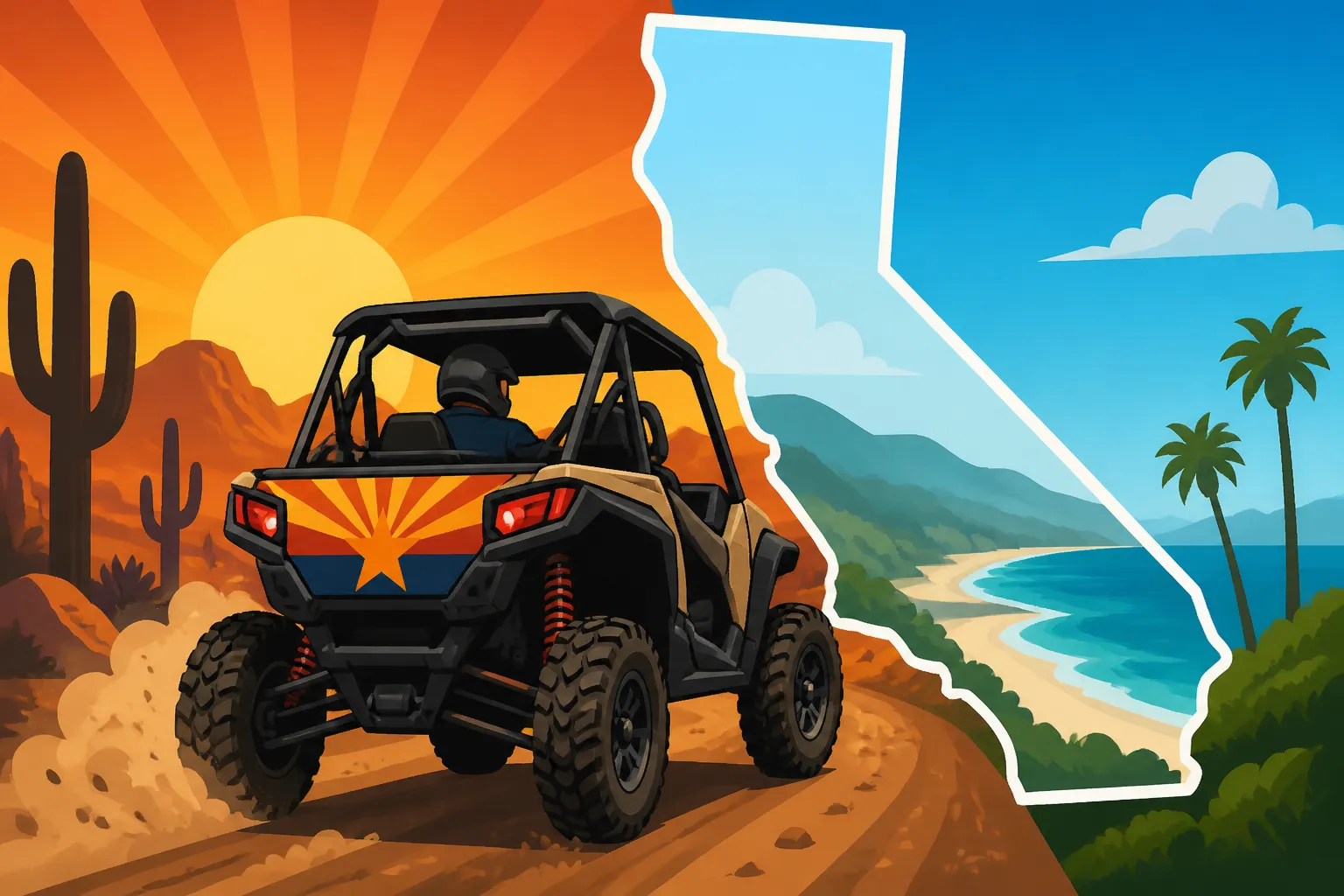
It's a common scenario: you've got a fantastic UTV back home in Arizona, legally plated for street use, and you're dreaming of cruising straight from your campsite to the trailheads in California. You might think, "Hey, it's street legal in Arizona, why wouldn't it be here?" Unfortunately, California plays by a very different rulebook when it comes to off-highway vehicles and road use, and that Arizona plate might not carry the weight you expect. This guide is here to help you understand the significant hurdles and specific rules you'll face when bringing your Arizona-plated UTV across the California border, so you can avoid an unwelcome surprise from local law enforcement.
The Harsh Reality: California's Stance on Out-of-State Street-Legal UTVs
Let's get straight to it: California has some of the most stringent regulations in the country when it comes to what can and cannot be driven on public roads, and this extends directly to off-highway vehicles (OHVs) like UTVs. While your UTV might be perfectly legitimate for street use in Arizona, that status rarely, if ever, translates directly into California. It’s a frustrating reality for many riders who’ve invested in making their machines road-ready in other states, only to find themselves effectively driving an unregistered vehicle if they venture onto California’s paved roads.
Why California Doesn't Recognize Most Out-of-State Plates
The fundamental problem lies in California's definition and classification of vehicles. What Arizona considers a street-legal UTV, California almost universally categorizes as an Off-Highway Vehicle (OHV). California law has very specific criteria for vehicles to be deemed "street legal," and most aftermarket conversions, even if extensive, simply don't meet them. We're talking about everything from crash test ratings and safety features to emissions standards that go far beyond what's typically required for an OHV to be plated in another state.
Imagine driving your Arizona-plated UTV through a small California town on your way to a popular riding area like Glamis or Ocotillo Wells. You might feel confident because you're legal in your home state, but a California Highway Patrol officer or a county sheriff often sees a different picture: an OHV operating unlawfully on a public roadway. They're looking at California Vehicle Code sections that define OHVs and prohibit their operation on highways unless explicitly designated. Your Arizona plate, while valid in Arizona, doesn't override California's own statutes for vehicles operating within its borders. This distinction is critical and often catches out-of-state visitors by surprise.
The Core Issue: CARB Compliance and Vehicle Certification
Beyond the general street-legal definitions, a massive hurdle for many UTVs attempting California road use is the California Air Resources Board (CARB) compliance. California has unique and rigorous emissions standards that all vehicles sold or permanently operated within the state must meet. This often means a specific CARB certification label that indicates the vehicle complies with California's emissions regulations. Many UTVs, even new ones, are manufactured to federal emissions standards (EPA) but not necessarily to California's stricter CARB standards.
Even if your UTV could somehow meet the physical safety requirements to be considered street-legal in California—a very tall order in itself—it would still need to prove CARB compliance for road use. This is where most converted UTVs from other states hit an insurmountable wall. They simply weren't built with California's specific emissions certifications for on-road use in mind. This is why you'll see purpose-built "low-speed vehicles" (LSVs) or "neighborhood electric vehicles" (NEVs) in California, which are specifically manufactured to meet these stringent requirements for limited road use. Your converted UTV, no matter how much you've upgraded it with turn signals, horns, and mirrors, isn't likely to have that foundational CARB certification for street operation here. A ranger at a gate, or an officer on a roadside stop, may look for these specific labels or vehicle classifications, and without them, your Arizona plate becomes largely irrelevant for California street legality.
What You Can (and Cannot) Do with an Arizona-Plated UTV in California
Given California's strict stance, it's vital to understand exactly where you can and cannot operate your Arizona-plated UTV. The key distinction is between off-highway use and on-highway use.
Riding on Designated Off-Highway Vehicle Areas
If your goal is to hit the trails, dunes, or open desert of California's world-renowned OHV areas like the Imperial Sand Dunes (Glamis), Oceano Dunes, or one of the many [California's State Vehicular Recreation Areas], your Arizona plate offers no benefit for off-highway registration. Instead, your UTV will be treated like any other out-of-state OHV. This means you will need valid California OHV identification for off-road riding.
For most out-of-state machines, including your Arizona-plated UTV, this means purchasing a [California's Nonresident OHV Use Permit]. This permit is specifically for non-California residents to ride their OHVs on designated public lands within the state. It essentially takes the place of a California Green Sticker, Red Sticker, or Tan Sticker for your time here. You'll need to display this permit on your UTV. The cost of this permit is a flat fee, and it's good for a period of time, typically a couple of years. Without it, you could face fines, even if you're only riding off-road. The bottom line is that your Arizona street-legal plate identifies it as an OHV to California for off-highway purposes, and thus requires the proper California OHV identification. Remember, even if you are street-legal in Arizona, when you're on California's off-road trails, you still need to adhere to all California OHV rules, including carrying safety equipment like proper helmets, spark arresters, and if you're in the dunes, a tall whip flag. If you're looking to upgrade your UTV with necessary safety items for California riding, like a taller whip for dune visibility or a robust light bar for night riding, SuperATV offers a wide range of accessories that are popular with riders preparing for these conditions.
The Limited World of Combined-Use Highways and Road Crossings
This is where many Arizona riders get into trouble. California does have something called "combined-use highways," which are specific, usually very short, segments of public roads that local authorities have designated for both conventional vehicle and OHV use. However, these are exceedingly rare, strictly limited, and your Arizona street-legal status does not give you a free pass. Even on a designated combined-use route, your UTV is still considered an OHV in California, and its operation is governed by specific OHV rules. The primary rule here is [California's 3-Mile Combined-Use Cap], which means you generally cannot ride an OHV for more than three miles on such a designated segment.
What this means for you: you cannot use your Arizona-plated UTV to drive through towns, on state highways, or even on most county roads simply because it's street legal in Arizona. Doing so will almost certainly result in a citation for operating an unregistered OHV on a public highway. The frustration is understandable – you have a license plate and insurance, and you're following the laws of your home state. But California's vehicle codes are very specific about what can and cannot operate on its roads. The few designated combined-use routes are usually short connectors between OHV areas or a trail and an emergency access point, and they are always explicitly signed. Outside of these very specific, limited, and clearly marked sections, operating your UTV on a paved road in California is illegal. [What California's CVC 38026 Lets an Agency Designate] lays out the framework for how these routes are established.
Trailering Is Your Safest Bet
Given the complexities and severe restrictions on UTV road use in California, the absolute safest and most legal way to transport your Arizona-plated UTV to and from California's OHV areas is on a trailer. This completely circumvents any confusion or potential citations regarding street legality. You drive your tow vehicle, with your UTV securely trailered behind it, directly to the entrance of the OHV park or staging area. Once you're inside the designated riding area, you unload your UTV and can enjoy your ride, provided you have the necessary [California's Nonresident OHV Use Permit] or California OHV registration.
Trailering removes all doubt and stress about where you can and cannot drive your UTV. It ensures that you're in full compliance with California law for both transport and off-highway use. Investing in quality trailer accessories, like durable tie-downs, ramp extensions, or even storage solutions to keep your gear secure during transport, is a smart move. Many riders turn to brands like SuperATV for robust tie-downs and cargo management systems to ensure their UTVs are safe and secure on the road, no matter the distance. This approach guarantees you a worry-free experience, allowing you to focus on the fun of riding once you reach your destination.
Navigating California's OHV Registration for Your Out-of-State Machine
Even with an Arizona plate, if you plan to ride your UTV off-highway in California, you'll need to engage with California's OHV registration system. This isn't about making your UTV street-legal in California; it's purely about legalizing its use on California's public off-highway lands.
Obtaining a California Nonresident OHV Use Permit
For most Arizona riders visiting California, the simplest and most common solution for legal off-highway use is to purchase a [California's Nonresident OHV Use Permit]. This permit is specifically designed for OHVs registered in other states that do not have reciprocity with California. At present, only Oregon and Nevada have limited reciprocity for their state OHV permits, which means for Arizona residents, this permit is absolutely necessary.
The permit is affordable and typically valid for a two-year period, aligning with California's standard OHV registration cycle. It's a small decal that you affix to your UTV, proving you've paid the necessary fees to use California's public OHV trails and areas. You can purchase this permit online through the California Off-Highway Motor Vehicle Recreation Division's website, or sometimes from authorized vendors near popular riding areas. It's truly a hassle-free way to ensure you're compliant for your off-road adventures, and it's a small price to pay for access to some of the best riding in the country. For example, before you head to the Imperial Sand Dunes, ensuring you have this permit (alongside any necessary ISDRA permits for specific areas) is crucial. [California's $30 Nonresident Permit] is the official title for this permit, clearly indicating its purpose and the cost structure involved.
Full California OHV Registration for Frequent Visitors
If you find yourself frequently visiting California for OHV recreation and want to avoid the nonresident permit cycle, you do have the option to register your UTV permanently as an OHV in California. This is an option for out-of-state machines that meet California's OHV criteria, and it essentially gives your Arizona-plated UTV a California OHV "Green Sticker" (or Red/Tan Sticker, depending on its model year and emissions).
The process involves submitting a [What California's Form REG 343 Asks For] to the California Department of Motor Vehicles (DMV), along with proof of ownership (like your Arizona title), and typically requires a [California Vehicle Verification on Form REG 31]. This verification confirms that the vehicle identification number (VIN) matches your documentation and verifies the machine's primary components. Once completed and fees are paid, your UTV will be issued a California OHV ID plate and a corresponding sticker, valid for two years. This does not make your UTV street-legal in California; it simply means it's now recognized as a California-registered OHV for use on public off-highway lands. For a detailed breakdown of this process, check out [Registering an Out-of-State Machine in California]. This can be a good option if you visit California multiple times a year and prefer the consistency of a California OHV registration.
Common Pitfalls and Misconceptions for Arizona Riders
It's easy to misunderstand vehicle laws across state lines, especially when one state has dramatically different rules. Let's clarify some common pitfalls.
"But it's Street Legal at Home!" – The Reciprocity Myth
This is perhaps the biggest point of confusion and frustration for out-of-state riders. The belief that "if it's street legal in my home state, it must be street legal everywhere" is a pervasive myth, especially when it comes to California. As mentioned, California has very limited OHV reciprocity, specifically [California OHV Reciprocity: Only Two States] – Oregon and Nevada. Even then, that reciprocity applies to off-highway permits, not street-legal status. For Arizona-plated UTVs, there is no reciprocity for street legality.
The reality is that California views your Arizona-plated UTV, if it's not originally manufactured to California's on-road vehicle standards, as an OHV. Your Arizona plate signifies its registration in Arizona, but it doesn't grant you the right to bypass California's strict vehicle code for on-road operation. Many riders are genuinely shocked and frustrated when they're pulled over for simply driving their UTV on a paved road that they assume is legal, only to find themselves facing a citation. It's a tough lesson learned, but understanding this fundamental difference is key to avoiding trouble.
Enforcement and Penalties
California law enforcement agencies, including the California Highway Patrol (CHP), county sheriffs, and park rangers, are well-versed in the state's OHV regulations. They frequently patrol areas popular with off-roaders, particularly during busy seasons and holidays. If you're caught operating an OHV on a non-designated public road or highway, you're looking at significant penalties.
A common outcome is a citation for operating an unregistered (for California road purposes) vehicle on a highway. Fines can be substantial, often running into hundreds of dollars. In some cases, especially for repeat offenses or dangerous operation, your UTV could even be impounded, leading to further fees for towing and storage, not to mention the immense hassle of getting your machine back. Ignorance of California's laws is not a valid defense, and officers will enforce the rules as written. For more details on what penalties you might face, review [California Fines for Riding on a Highway]. It's far better to err on the side of caution and ensure you're always trailering your UTV to and from designated OHV riding areas.
Here's a quick comparison of how California likely views your Arizona-plated UTV:
| Feature/Status | Arizona Street-Legal UTV (as per Arizona) | Your UTV's Status in California |
|---|---|---|
| On-Road Legal | Yes | No (Generally) |
| Requires Street Plate | Yes | No (Unless factory-built to CA road standards) |
| Emissions Compliance | EPA (Federal) | CARB (California) required for CA road use |
| Off-Highway Legal | Yes (with AZ OHV decal/registration) | Yes (with CA Nonresident Permit or CA OHV registration) |
| Reciprocity for Road Use | None with California | None |
| Reciprocity for OHV Use | None with California (needs CA Nonresident Permit) | None |
| Best Transport Method | Drive on road | Trailer to destination |
Disclaimer
This article is for general informational purposes only and does not constitute professional advice. Laws, prices and regulations vary by location and change over time. Consult a qualified professional for guidance on your specific situation.