Registering a Trials Bike in California
Bringing a trials bike into California, whether it's for competition or just enjoying those incredible technical trails, can feel like you're trying to solve a riddle. Many riders get frustrated navigating the state's unique OHV registration system for a machine that often doesn't fit the typical dirt bike mold. This guide is here to untangle that process, walking you through everything you need to know to get your trials bike properly registered and ready for California's diverse terrain.
The Unique Nature of Trials Bikes and California OHV Law
Trials bikes are magnificent machines, incredibly specialized for a very specific type of riding. But that specialization can sometimes make their place in California's off-highway vehicle (OHV) laws a bit murky. Let's break down why these bikes stand out and how the state ensures they're still accounted for.
Why Trials Bikes Are Different
Unlike your typical motocross bike or trail machine, trials bikes are engineered for precision, balance, and incredibly low-speed technical maneuvers. They often lack a full seat, sometimes don't even have a kickstand, and usually have minimal lighting, if any. Their engines are designed for torque, not top-end speed, and they typically produce very little noise compared to other off-road motorcycles. Because of these distinct characteristics, many riders assume that trials bikes might have a different registration pathway or even be exempt from certain requirements. However, in California, the general rule is that if it has an engine and is ridden off-highway, it needs to be identified.
The intended use of a trials bike is usually either closed-course competition or highly technical, low-speed trail riding. This isn't the kind of machine you'd typically take to a fast desert track or on a long-distance trail ride. Their niche design means they don't always look like what the average person, or even a DMV clerk, might picture when you say "dirt bike." This difference often leads to questions about what paperwork is truly necessary and how to properly classify them within the established OHV categories.
Despite their specialized nature, a trials bike is still, at its core, an off-highway motorcycle. California's OHV registration system is designed to identify all motorized vehicles used off public roads, ensuring they contribute to the funding of OHV recreation areas and that owners can be traced if necessary. So, while your trials bike might be a minimalist marvel, it still needs to go through a similar identification process as any other dirt bike in the Golden State.
How California Classifies OHVs and Where Trials Bikes Fit
California's Department of Motor Vehicles (DMV) and the Off-Highway Motor Vehicle Recreation (OHMVR) Division work together to categorize and register off-highway vehicles. For the most part, an OHV falls into broad categories: off-highway motorcycles (OHMs), all-terrain vehicles (ATVs), utility terrain vehicles (UTVs), sand rails, and other specialized vehicles. A trials bike, regardless of its unique design, is classified as an off-highway motorcycle. This means it falls under the same general registration rules as a dirt bike from Honda, Yamaha, KTM, or any other manufacturer.
The key for any OHV in California is obtaining an "identification" number and the appropriate sticker. This isn't the same as a street-legal license plate; it's a unique number assigned to the vehicle for identification purposes, much like a VIN. The sticker, whether green, red, or tan, then indicates its compliance with emission standards and, in some cases, its permitted riding schedule. For a trials bike, the main hurdle is simply establishing its identity and ensuring it has a legitimate Vehicle Identification Number (VIN) that can be linked to an owner.
Don't let the simplicity of your trials bike's design mislead you into thinking it can slip under the radar. Even if you only ride it on private land, you might still want to consider registration if you ever plan to transport it on public roads (even on a trailer) or use it at any publicly funded or regulated OHV park or event. The state's system is comprehensive, and understanding where your trials bike fits into the "off-highway motorcycle" designation is the first step toward smooth registration.
The Role of the California DMV and OHMVR Division
When you're trying to register any off-highway vehicle in California, including your trials bike, you're essentially dealing with two key state entities: the California Department of Motor Vehicles (DMV) and the Off-Highway Motor Vehicle Recreation (OHMVR) Division. While the DMV is the familiar face for all vehicle registrations, the OHMVR Division plays a crucial role in managing and funding California's extensive network of OHV parks and trails.
The DMV is your primary point of contact for the actual registration process. This is where you'll submit your paperwork, pay your fees, and ultimately receive your identification plate and sticker. They handle the administrative side of assigning your trials bike a unique identification number and ensuring all the ownership documents are in order. Think of them as the gatekeepers for legal vehicle identification in the state. You'll typically be working with a DMV field office or an authorized registration service to complete these transactions.
On the other hand, the OHMVR Division, which is part of California State Parks, is the entity that benefits directly from your registration fees. These fees are deposited into the OHV Trust Fund, which is then used to acquire, develop, and maintain OHV recreation areas throughout California. This division also sets many of the rules regarding OHV use, such as environmental standards, sound limits, and riding seasons. While you might not interact with them directly during registration, understanding their role helps explain why California has such a robust and specific OHV identification system. If you're looking for more details on how these agencies work together, check out [The California DMV and the OHMVR Division].
Essential Steps to Register Your Trials Bike
Getting your trials bike registered in California doesn't have to be a daunting task, but it does require attention to detail and the right paperwork. Think of it as a checklist, and once you've ticked off all the boxes, you'll be good to go.
Gathering Your Paperwork
This is arguably the most critical part of the entire registration process. Without the correct documents, your application will hit a roadblock. You'll need to gather several key items to prove ownership and properly identify your trials bike.
First and foremost, you'll need proof of ownership. This could be a Manufacturer's Certificate of Origin (MCO or MSO) if the bike is brand new and never been titled, a previous California Certificate of Title if you bought it used from within the state, or an out-of-state title if you're bringing it in. If you bought your trials bike from a private party and it didn't come with a title (which can happen, especially with older, competition-focused machines), you'll need a comprehensive bill of sale. This document should clearly state the buyer and seller's information, the vehicle's VIN, make, model, year, and the sale price. Services like LawDepot can help you generate a robust bill of sale to ensure all necessary details are included, which can be invaluable for establishing a clear chain of ownership. If you're in a situation where you don't have a title, but need to register, [California OHV Registration Without a Title] offers further guidance.
Next, you'll need a completed Application for Title or Registration (Form REG 343). This is the main form that tells the DMV who you are, what vehicle you're registering, and what services you're requesting. Make sure all sections are filled out accurately, especially the vehicle information and your contact details. Any blanks or errors can cause delays. For a detailed breakdown of what this form entails, you can refer to [What California's Form REG 343 Asks For].
You'll also need a Vehicle Verification form (REG 31). This form certifies that the VIN on your trials bike matches the ownership documents and that it's physically present. This is crucial for preventing fraud and ensuring the correct vehicle is being registered. This verification usually needs to be done by an authorized DMV employee, a licensed vehicle verifier, or sometimes even a peace officer. Understanding what they look for can speed up the process; learn more about this at [California Vehicle Verification on Form REG 31].
Finally, for newer trials bikes, especially those made after a certain model year, the California Air Resources Board (CARB) emissions label can be important. This label, usually found on the frame, indicates whether the machine meets California's stringent emissions standards. The presence of this label, or the lack thereof for older or competition-only models, dictates whether your trials bike will receive a Green, Red, or Tan sticker. While trials bikes are often minimalist, checking for this label is a key part of determining your sticker type. For general information on CARB compliance, see [What CARB Compliance Means in California].
Verification Process
Once you've gathered all your paperwork, the next vital step for registering your trials bike is the vehicle verification. This isn't just a formality; it's a physical inspection that ensures the vehicle you're attempting to register is indeed the one described in your documents and that its identifying numbers haven't been tampered with.
The verification process typically involves a DMV employee, a licensed vehicle verifier, or a peace officer (like from the CHP or a sheriff's department) physically inspecting your trials bike. They'll primarily be looking for the Vehicle Identification Number (VIN) to ensure it matches what's on your title or bill of sale. On a trials bike, the VIN is usually stamped into the frame, often on the steering head or somewhere accessible on the main frame spar. Make sure your bike is clean enough for the VIN to be easily readable before you bring it in for verification.
During the verification, they may also check for the presence of the EPA or CARB emissions label, if applicable, which helps determine the correct sticker type (Green, Red, or Tan). While trials bikes are often minimalistic, the verifier will confirm that basic identifying features align with the vehicle type. It's a quick process if everything is in order, but it's a mandatory safeguard for the state. If you are registering an out-of-state machine, this verification is absolutely critical. For more on what they examine, consult [What a Vehicle Verifier Checks on REG 31].
It’s often recommended to make an appointment for vehicle verification at a DMV field office to minimize your waiting time. Alternatively, many third-party licensed vehicle verifiers can perform this service, sometimes even at your location for an additional fee, which can be a convenient option if transporting your trials bike is difficult.
Submitting Your Application and Fees
With your paperwork in order and your trials bike verified, you're ready to submit your application and pay the necessary fees. This is the final step before you get your identification plate and sticker.
You have a few options for submitting your application. The most common is visiting a California DMV field office. As mentioned before, making an appointment is highly recommended to save you considerable time. You'll bring all your completed forms (REG 343, REG 31, proof of ownership) and be prepared to pay your fees. For more on this process, see [Taking an OHV to a California DMV Field Office]. Alternatively, you can use a licensed vehicle registration service. These private businesses can often expedite the process and handle all the paperwork submission for you, usually for an additional service fee, which can be a worthwhile trade-off for convenience.
When it comes to fees, there are several components that make up the total cost of registering your trials bike. These typically include:
- OHV Registration Fee: This is the primary fee for the two-year registration cycle. It contributes directly to the OHV Trust Fund, supporting riding areas.
- CHP Fee: A portion of your registration goes to the California Highway Patrol for their efforts in enforcing OHV laws and providing safety services.
- OHMVR Division Fees: Additional fees that further support the maintenance and development of OHV recreation lands.
While specific amounts change, the structure of these fees remains consistent. You can find a more detailed breakdown of these costs in articles like [California OHV Registration Cost] and [California's $54 OHV Registration Fee Broken Down].
In addition to registration fees, if you purchased your trials bike from a private party or brought it into California from out of state, you will likely owe California sales or use tax. This is calculated based on the purchase price of the vehicle. A clear, properly executed bill of sale (like one created with LawDepot) is essential here, as it provides the basis for calculating the tax. Without a clear purchase price, the DMV may use a fair market value assessment, which could be higher than what you actually paid. For more information on tax implications, check out [California OHV Registration and Sales Tax]. Be prepared to pay all fees at the time of submission, usually by cash, check, or debit card, although payment options can vary by location.
Understanding Your California OHV Sticker for a Trials Bike
Once your trials bike is registered, you'll receive an identification plate and, most importantly, a sticker. This sticker is your key to legal riding in California's OHV areas, and its color tells you a lot about when and where you can ride. For trials bikes, understanding the nuances between Green, Red, and Tan stickers is particularly important.
Green Sticker vs. Red Sticker vs. Tan Sticker for Trials Bikes
California employs a color-coded sticker system to identify off-highway vehicles and regulate their use, primarily based on their emissions compliance and model year. For trials bikes, knowing which sticker you'll receive is crucial for planning your rides.
The Green Sticker is the most desirable. It signifies that your trials bike meets California's stringent emissions standards or was manufactured before these standards became widely applied (specifically, pre-2002 models, and some newer CARB-compliant machines). A Green Sticker allows year-round riding in all approved OHV areas in California. Many older trials bikes, often simple two-strokes or early four-strokes, may qualify for a Green Sticker due to their age, provided they meet the initial identification requirements. If your bike qualifies for a Green Sticker, you'll have the most flexibility. Dive deeper into what the Green Sticker means with [California's Green Sticker Explained].
The Red Sticker is typically issued to trials bikes (and other OHMs) that were manufactured after 2002 and do not meet the stricter emissions standards required for a Green Sticker. Historically, Red Sticker machines faced seasonal riding restrictions, meaning they could only be ridden during certain times of the year in designated areas. However, there have been significant changes to these rules. Currently, Red Sticker machines can generally be ridden year-round in most areas, similar to Green Sticker machines, though it's always wise to check current regulations for specific riding areas. This change, which came into effect in recent years, removed a major limitation for many modern off-highway motorcycles. For a comprehensive look at these changes, refer to [Red Stickers and What Changed in California] and [Riding a Red Sticker Machine Year Round in California].
The Tan Sticker is a special category that is highly relevant for many trials bike owners. This sticker is specifically for competition-only machines that are used exclusively in sanctioned events. A trials bike, being a highly specialized competition machine, often fits this description perfectly. However, there's a significant catch: the Tan Sticker does not allow general recreational riding. It's strictly for use at approved, sanctioned competitive events. If your trials bike is primarily for competition, and you don't plan to use it for general trail riding, a Tan Sticker might be appropriate. But be aware of its strict limitations; it's not a substitute for a Green or Red Sticker for recreational use. More details on this can be found in [California's Tan Sticker Machines] and [What California's Tan Sticker Allows at Sanctioned Events].
To summarize the stickers and their general application to trials bikes:
| Sticker Type | Emissions Compliance / Model Year | Riding Privileges | Common for Trials Bikes? |
|---|---|---|---|
| Green | Pre-2002 or newer CARB-compliant machines | Year-round riding in all approved OHV areas | Yes, especially older models or compliant newer ones |
| Red | Post-2002, non-CARB compliant for Green Sticker | Year-round riding in most approved OHV areas (with recent changes) | Yes, for most modern, non-competition models |
| Tan | Competition-only machines (often with relaxed emissions standards) | Restricted to sanctioned competitive events ONLY | Yes, if used strictly for trials competitions |
For an overall view of all three sticker types, check out [Green, Red and Tan: California's Three Stickers].
Where to Display Your Sticker and ID Plate
Properly displaying your California OHV sticker and identification (ID) plate on your trials bike isn't just a suggestion; it's a legal requirement. Failure to do so can result in citations from park rangers or law enforcement. The goal is easy visibility for officials to quickly confirm your machine is legally identified.
For the OHV sticker (Green, Red, or Tan), the regulations specify that it must be prominently displayed on the left fork leg of your motorcycle. It should be affixed in a way that it's clearly visible and not obscured by cables, guards, or other accessories. Make sure the sticker is clean and free from mud or dirt that could make it unreadable. Applying it to a clean, dry surface will ensure it adheres properly and lasts through tough riding conditions.
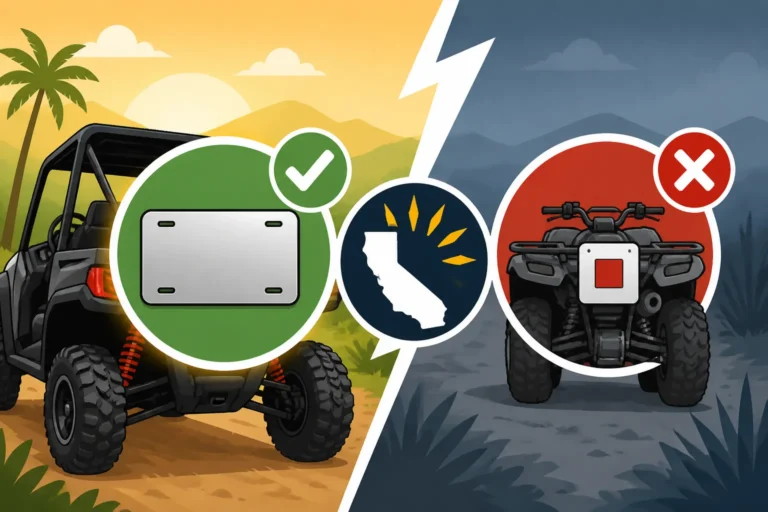
The identification plate is a small, typically square metal plate with your unique OHV identification number. On an off-highway motorcycle, this plate is required to be mounted on the rear fender, or in a location clearly visible from the rear of the machine. It needs to be securely fastened to prevent it from falling off during riding. While the title [Where the ID Plate Mounts on a Quad] gives an idea, the principle for motorcycles is the same: easily seen from behind. You might need to drill small holes in your fender for mounting, ensuring it's stable and won't flap around or get caught on anything.
It's a good practice to periodically check both your sticker and ID plate to ensure they are still securely attached and legible. Riding through rough terrain, mud, and water can sometimes cause them to peel or become damaged. A faded or missing sticker or plate is just as much an issue as not having one at all.
The Importance of Keeping Your Registration Current
Just like any other vehicle, your trials bike's OHV registration in California isn't a one-and-done deal. It operates on a two-year cycle and needs to be renewed to remain valid. Keeping your registration current is crucial for several reasons, not least of which is avoiding penalties and ensuring you can legally ride in designated areas.
California OHV registrations typically expire on June 30th of every odd-numbered year. You'll usually receive a renewal notice in the mail well in advance of this date. It's easy to overlook or forget, especially if you don't ride your trials bike frequently, but letting it lapse can lead to complications.
If you ride your trials bike with expired registration, you could face fines from rangers or law enforcement officers. Additionally, if you allow your registration to lapse for an extended period, you'll be subject to late penalties when you finally do renew. These penalties can significantly increase the cost of renewing, making it much more expensive than simply renewing on time. For details on these penalties, you can read [California OHV Late Registration Penalty].
Renewing your registration is generally a straightforward process. You can often do it online, by mail, or in person at a DMV field office or a licensed registration service. Make sure your address on file with the DMV is current so you receive your renewal notices. For guidance on how to renew, refer to [Renewing California OHV Registration]. Staying on top of your trials bike's registration ensures you're always ready to hit the trails or competition course without any legal worries.
Common Challenges and Tips for Trials Bike Registration
Registering a trials bike, while generally following the same process as other OHMs, can sometimes present unique challenges due to their specialized nature or how they are acquired. Knowing these potential hurdles and how to navigate them can save you a lot of frustration.
No Title, No Problem? (Sometimes)
One of the most frequent issues trials bike owners encounter is a lack of a traditional Certificate of Title. This can happen with older bikes, machines purchased informally, or those originally designated purely for closed-course competition where titles weren't always standard practice. While a title is always the cleanest proof of ownership, not having one isn't necessarily a deal-breaker for registration in California, but it does make the process more involved.
If you don't have a title, your primary goal becomes establishing a clear chain of ownership and proving that you are the rightful owner. A comprehensive bill of sale is absolutely critical in these situations. This document should contain:
- The full names and addresses of both the buyer and seller.
- The date of sale and the purchase price.
- A complete description of the trials bike, including its make, model, year, and crucially, its full VIN.
- Signatures of both parties.
Consider using a template from a reputable service like LawDepot to ensure your bill of sale includes all legally important fields.
The DMV will scrutinize transactions without a title to prevent fraud. They may require additional supporting documentation, such as a lien release (if applicable), or even a notarized statement from the previous owner. If the previous owner can be contacted, getting their signature on the bill of sale and perhaps a statement explaining the missing title can significantly smooth out the process. In some cases, if the bike is very old and has no record, you might need to go through a "bond in lieu of title" process, which is more complex and involves obtaining a surety bond for the vehicle's value. For more detailed information on navigating this specific challenge, [California OHV Registration Without a Title] is a valuable resource.
Competition-Only Machines and Exemptions
Many trials bikes are bought with the sole purpose of participating in competitive events rather than recreational trail riding. This brings up the question of whether these competition-only machines have different registration requirements or even exemptions.
In California, pure competition machines, especially those not manufactured to meet standard off-highway vehicle emissions or safety requirements (like having full lights), may be eligible for a Tan Sticker. As discussed earlier, a Tan Sticker explicitly restricts the bike's use to sanctioned competitive events. This means you cannot legally ride a Tan-stickered trials bike for general recreation in any OHV park or public land. It's a permit for competition, not for pleasure riding. If your trials bike falls into this category and you intend to only compete, the Tan Sticker is the appropriate identification.
It's important to understand that there are very few blanket exemptions for OHVs in California, even competition-only machines. The state generally requires some form of identification for any motorized off-highway vehicle. Even if a trials bike is designated for "closed-course competition only" by the manufacturer, if it has an engine and will be used off-highway, it still needs to go through an identification process. The Tan Sticker system exists precisely to accommodate these machines, allowing them to be tracked and ensuring event organizers comply with regulations. Never assume an exemption without concrete verification from the DMV or OHMVR Division, as the penalties for unregistered use can be significant.
What to Do if You Bought From Out of State
Bringing a trials bike into California that you purchased in another state or previously registered elsewhere requires a specific set of steps to get it legally identified in California. This process includes both registration and potential tax obligations.
First, you'll need all the standard documentation: your out-of-state title (or equivalent proof of ownership), a bill of sale (even if you had a title, it's good for showing purchase price), and your completed California Application for Title or Registration (Form REG 343). The most crucial step for an out-of-state machine is the California Vehicle Verification (Form REG 31). This verification must be performed by a California DMV employee or a licensed California vehicle verifier. Out-of-state verifications are generally not accepted. They will check the VIN and potentially the emissions labels to determine the appropriate California sticker.
Beyond registration, you'll likely be responsible for California use tax. This is equivalent to sales tax and applies to vehicles purchased outside California but brought into the state for use. The tax is calculated on the purchase price of the trials bike. If you paid sales tax in the state where you bought the bike, California may credit you for that amount, but you'll still owe the difference if California's tax rate is higher. Make sure your bill of sale clearly states the purchase price and any sales tax paid in the other state. For more on this, [Registering an Out-of-State Machine in California] offers detailed steps. Be prepared for a potentially lengthier process, as the DMV will need to verify out-of-state documents and ensure all California requirements are met.
Disclaimer
This article is for general informational purposes only and does not constitute professional advice. Laws, prices and regulations vary by location and change over time. Consult a qualified professional for guidance on your specific situation.