California OHV Emissions Label Location
Navigating the world of California off-highway vehicles (OHVs) can feel like deciphering ancient hieroglyphs, especially when it comes to the nitty-gritty details like emissions compliance. One often overlooked, yet critically important, piece of the puzzle is your machine's emissions label. If you've ever felt that pit in your stomach wondering if your pride and joy will pass muster at the DMV or a park gate, understanding this little sticker is key. This guide is here to walk you through exactly why your OHV's emissions label matters so much in the Golden State, where to find it on different types of machines, what information it holds, and what to do if it's missing or unreadable.
Why Your OHV Emissions Label is a Big Deal in California
In California, owning an off-highway vehicle isn't just about having fun in the dirt; it's also about adhering to some of the strictest environmental regulations in the nation. Your OHV's emissions label isn't just a random sticker; it's the definitive proof of your machine's environmental pedigree, and without it, you might find yourself hitting a roadblock before you even get to the dunes or trails.
More Than Just a Sticker: CARB Compliance is Key
At the heart of California's OHV regulations is the California Air Resources Board, or CARB. This powerful agency sets the standards for emissions for nearly every engine sold or operated in the state, including your ATV, UTV, dirt bike, or sand rail. The emissions label on your machine is a physical declaration from the manufacturer that your specific vehicle model was designed, tested, and certified to meet CARB's stringent requirements at the time it was built.
Think of it this way: without this label, the state has no easy way to verify that your machine isn't pumping out excessive pollutants. It's the official stamp of approval that allows your OHV to operate legally on California's public lands. If you've ever heard about [What CARB Compliance Means in California], this label is the tangible evidence of that compliance for your particular unit. It's not just a suggestion; it's a mandate that dictates your machine's legality here.
The Gateway to a Green, Red, or Tan Sticker
The emissions label is the primary determinant for which type of California OHV identification sticker your machine qualifies for. This is hugely important because these stickers dictate where and when you can ride. California employs a color-coded system: Green, Red, and Tan. Each color signifies different compliance levels and riding seasons, particularly if your machine falls under the Red Sticker category.
For example, a machine with an emissions label indicating it meets specific, newer CARB standards will often qualify for a Green Sticker, allowing year-round access to most public OHV areas. Conversely, an older machine or one that doesn't meet the latest standards might receive a Red Sticker, which traditionally comes with seasonal riding restrictions in certain areas. There's also the Tan Sticker, which has its own unique set of rules. The information emblazoned on that small label is directly fed into the DMV's registration system to assign your OHV its appropriate ID. Understanding [Green, Red and Tan: California's Three Stickers] begins with examining that label.
Pinpointing Your OHV's Emissions Label: A Deep Dive
Finding your emissions label can sometimes feel like a treasure hunt, especially if your machine has seen a lot of trail time or modifications. While manufacturers place them in generally consistent locations, wear and tear, or even previous owners, can make them hard to spot. Knowing where to look first can save you a lot of frustration when trying to get your machine ready for the trails or completing your [California OHV Registration Paperwork Checklist].
ATVs and Quads: Checking the Frame and Engine
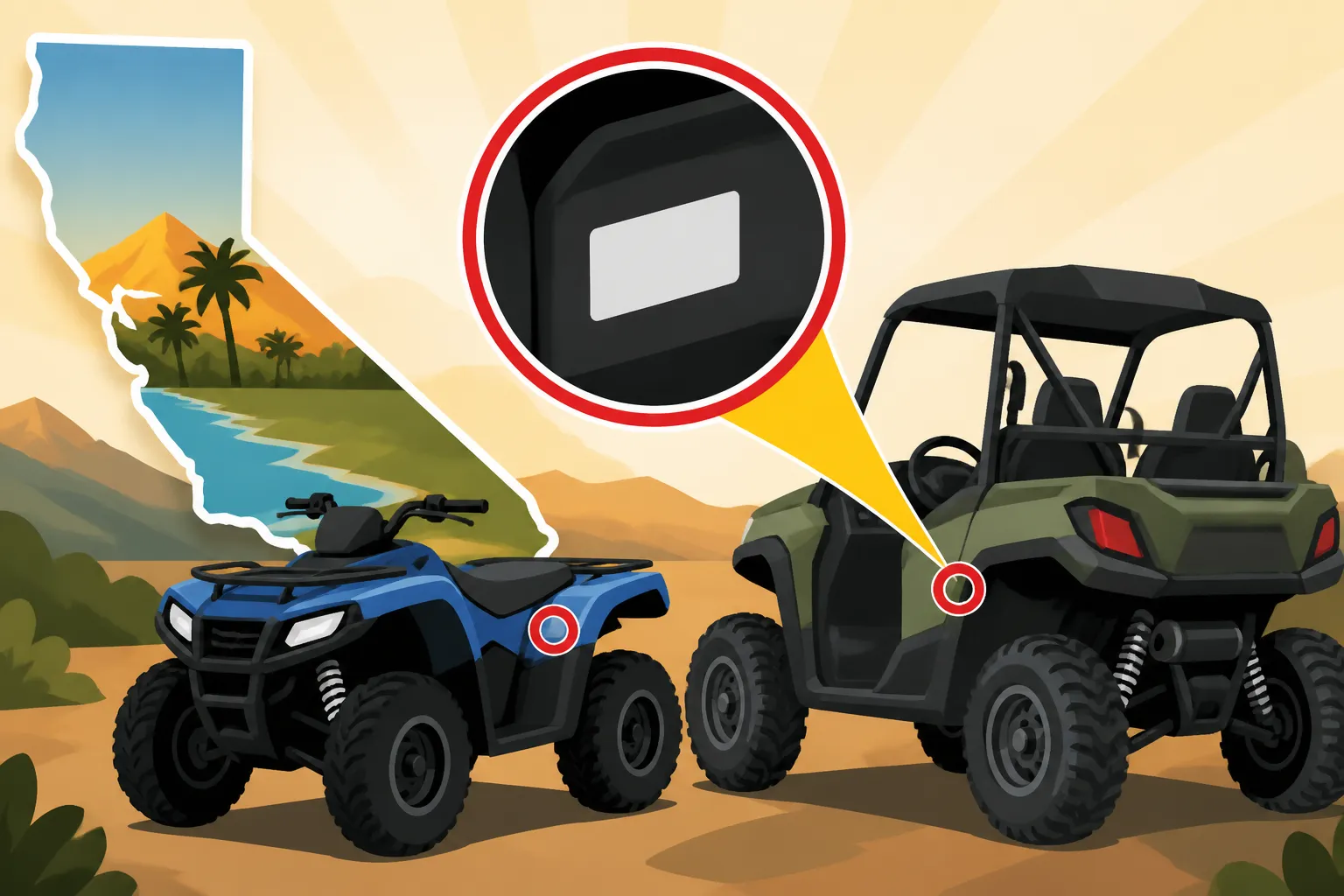
For most All-Terrain Vehicles (ATVs) and quads, the emissions label is typically a small, rectangular sticker, often made of durable metallic foil or heavy-duty vinyl.
- Frame Rail: A very common location is on one of the main frame rails, usually near the front suspension or steering head. You might need to turn the handlebars full lock to one side to get a good look, or even remove some plastic bodywork.
- Engine Case/Cylinder: Sometimes, especially on smaller displacement engines, the label might be directly affixed to the engine case itself, often near the cylinder head, spark plug, or carburetor/throttle body area.
- Under the Seat: Occasionally, it might be found on a crossmember of the frame under the seat, or even on the underside of the seat itself, though this is less common for emissions-specific labels.
It's crucial to clean the area well before inspecting, as mud, dirt, and grime can obscure the label, making it unreadable.
UTVs and Side-by-Sides: Looking Under the Hood and Beyond
Utility Terrain Vehicles (UTVs) and side-by-sides often have more bodywork and enclosed engine compartments, making the search slightly different, more akin to looking for a vehicle identification number (VIN) on a car.
- Firewall/Bulkhead: One of the most common spots is on the firewall or bulkhead separating the engine compartment from the passenger cabin. This could be visible by just opening the "hood" (if it has one) or by lifting the bed or removing an access panel.
- Frame Rails (again): Like ATVs, UTVs can also have the label on a visible section of the frame rail, often towards the front near the suspension mounts or behind the front wheels.
- Inside the Cab: Some manufacturers place a smaller, supplemental label inside the cab, perhaps on the glove box door or the dashboard, though the primary emissions label is usually closer to the engine itself.
- Engine Cover/Air Box: With the engine often tucked away, some labels can be found on a hard-to-reach engine cover or even on the airbox housing. You might need a flashlight and some contortionist skills to get to it!
Dirt Bikes and Motorcycles: The Neck or Engine Cradle
Dirt bikes, being minimalist machines, usually have fewer places to hide labels.
- Steering Head/Neck: The most prevalent location for a dirt bike's emissions label is on the steering head tube, sometimes referred to as the "neck" of the frame. It's often right next to or integrated with the VIN plate. This is where a vehicle verifier will almost always look first during a [California Vehicle Verification on Form REG 31].
- Engine Cradle/Frame Down Tube: Less frequently, it might be on one of the main frame down tubes that cradle the engine, or on a cross-member near the engine.
- Air Box: For some models, checking the air box housing might reveal a small sticker.
Always ensure the steering head area is free of any zip ties, brake lines, or cable routing that might cover the label.
Sand Rails and Custom Builds: Where to Check First
Custom builds like sand rails present a unique challenge, as they often use engines from other vehicles. The key here is to find the emissions label for the engine itself, not necessarily for the rail's frame.
- Engine Block/Valve Cover: If your sand rail uses a car engine (like a VW, Subaru, or even a larger V8), the emissions label will typically be on the engine block, valve cover, or air intake manifold. These are the original manufacturer's labels for that specific engine.
- Original Component Labels: Any major emissions-related components (like catalytic converters, if applicable, or even certain fuel system parts) might have their own small labels, but the primary engine family label is what the DMV or verifier will be looking for.
- Challenges: The biggest hurdle with custom builds is that the original engine's label might have been removed, painted over, or simply wasn't easily accessible to begin with. In these cases, you might need to prove the engine's original specifications through other means, which can be a much more involved process.
| Vehicle Type | Common Emissions Label Locations |
|---|---|
| ATV/Quad | Main frame rail (front), engine case (near cylinder/spark plug), under seat frame crossmember. |
| UTV/Side-by-Side | Firewall/bulkhead (engine compartment), front frame rails, inside cab (supplemental), air box. |
| Dirt Bike | Steering head/neck tube (near VIN), engine cradle/frame down tube. |
| Sand Rail | On the engine block, valve cover, or air intake manifold (for the engine itself). |
Deciphering the Emissions Label: What the Numbers Mean for You
Once you've located that elusive emissions label, the next step is to understand what all those alphanumeric codes and tiny print actually mean. This label isn't just a random assortment of characters; it's a compact data sheet that provides critical information about your OHV's engine and its environmental compliance, directly influencing its registration in California.
Essential Information You'll Find
While the exact layout and content can vary slightly between manufacturers and model years, most emissions labels will contain several key pieces of information:
- Manufacturer Name: The company that produced the engine (e.g., Honda, Yamaha, Polaris).
- Engine Family Number: This is a specific code assigned by CARB (and EPA) that identifies a group of engines with similar emissions characteristics. It's often a combination of letters and numbers, like "5HNXX.XXXGHV."
- Engine Displacement: The cubic centimeter (cc) or cubic inch (ci) size of the engine.
- Model Year: The year the engine was designed to meet emissions standards for, which might not always perfectly align with the vehicle's model year, though they are usually the same or very close.
- Emissions Control System Information: Codes or abbreviations indicating the type of emissions control equipment used (e.g., TWC for Three-Way Catalyst, EM for Engine Modification, HO2S for Heated Oxygen Sensor).
- CARB/EPA Compliance Statement: A clear declaration, often stating something like "THIS ENGINE CONFORMS TO U.S. EPA AND CALIFORNIA EMISSION REGULATIONS FOR OFF-ROAD MOTORCYCLES/ATVs." This is the golden ticket for California compliance.
- Idle Speed: For some machines, recommended idle RPM might be listed.
- Tune-up Specifications: Details for proper carburetor or fuel injection adjustments.
The presence of the CARB compliance statement is absolutely crucial for your machine's legality in California. Without it, or if it only mentions EPA compliance without specific CARB inclusion, you could face significant issues during registration. This is especially true when it comes to determining if your machine qualifies for a [California Green Sticker for a Pre-2002 Machine] versus something newer.
Connecting the Dots to Your California OHV Sticker
The information on your emissions label, particularly the model year and the CARB compliance statement, directly determines whether your OHV will receive a Green, Red, or Tan sticker.
- Green Sticker: Generally, machines with a model year of 2003 and newer that meet California's stringent emissions standards (often indicated by a specific CARB-compliant engine family number or a direct statement of CARB compliance on the label) will qualify for a Green Sticker. This allows year-round riding at most designated OHV parks and trails. The label is the proof that your machine is clean enough for unrestricted use.
- Red Sticker: For machines manufactured between 2003 and 2021 that don't meet the latest CARB standards, they typically fall into the Red Sticker category. Their emissions label will confirm this model year and likely lack the "latest standard" compliance. These machines traditionally had seasonal restrictions. However, it's worth noting that [Red Sticker Machines After January 2025] are seeing some significant changes in how they're treated.
- Tan Sticker: This is a less common sticker and applies to specific OHVs used exclusively for sanctioned competitions or those that meet very specific criteria. The emissions label, or often a lack thereof indicating it's built for closed-course competition, would inform this category. If you have a [A 2026 Machine and Which Sticker It Gets], the emissions label's specifics will be paramount.
In essence, that small, unassuming label is the ultimate arbiter of your OHV's fate in California. It's the key that unlocks where and when you can legally enjoy your ride.
Navigating a Missing or Unreadable Emissions Label
It’s a nightmare scenario: you’re trying to register your beloved OHV, or maybe a ranger at the entrance to Ocotillo Wells asks for your paperwork, and you realize the emissions label on your machine is either completely gone or so faded that it’s impossible to read. This isn't just an inconvenience; it's a significant problem in California, where vehicle verification hinges on these details.
The Frustration of a Faded or Lost Label
We've all been there. Years of sun, mud, pressure washing, or even just general wear and tear can take their toll on those small, vital stickers. Or perhaps you bought a used machine, and the previous owner (or owners) removed it, painted over it, or it simply fell off. This situation creates a real headache because California's DMV and authorized vehicle verifiers rely heavily on this label to classify your OHV and ensure it meets state emissions laws.
Trying to [Registering an OHV in California] without a clear emissions label can lead to delays, requests for additional documentation, or even outright rejection until the issue is resolved. It’s a frustrating hurdle, especially when you know your machine is legitimate, but you just can't prove its compliance visually.
Steps to Take for Verification
If your emissions label is missing or unreadable, don't despair immediately, but be prepared for some extra work.
- Contact the Manufacturer: Your first and best recourse is often to contact the original manufacturer of your OHV. Provide them with your VIN (Vehicle Identification Number) and engine number if available. Many manufacturers can provide a "Certificate of Origin" or a "Letter of Compliance" that explicitly states the emissions standards your specific machine or engine family was built to meet. This document can often serve as a replacement for the physical label during verification.
- Manufacturer’s Statement of Origin (MSO): If you're the original owner, or if you received an MSO when you purchased the machine, check this document carefully. The MSO often contains emissions information that can be used for verification. This document is like the birth certificate for your OHV.
- Authorized Vehicle Verifier: For registration, you'll need to go through a California authorized vehicle verifier. These individuals (or DMV personnel) are trained to perform [California Vehicle Verification on Form REG 31]. While they prefer a visible label, they might be able to find alternative identifying marks or use documentation from the manufacturer. However, be aware that without the physical label, their job becomes much harder, and they may be unable to complete the verification without additional proof.
- DMV Field Office: In some complex cases, particularly with custom builds or very old machines, you might need to schedule an appointment at a DMV field office for a physical inspection. Bring any and all documentation you have – the MSO, repair records, manufacturer letters, etc. The more information you can provide, the better your chances.
The Role of a Bill of Sale or MSO
While a bill of sale or Manufacturer's Statement of Origin (MSO) doesn't replace the emissions label, they are crucial supplementary documents. A well-prepared bill of sale, especially if it includes the VIN and other identifying features, can help establish the machine's history and potentially guide the verifier to other ways to identify its emissions compliance. If you're buying a used OHV, always ensure the bill of sale is thorough and includes as much detail as possible. Services like LawDepot can help you generate comprehensive, legally sound bills of sale quickly, which could be invaluable if you run into label issues down the road.
If you don't have an MSO and the manufacturer can't provide a letter, you might be in for a more significant challenge. This is why when purchasing a used OHV, verifying the presence and legibility of the emissions label, along with obtaining a proper bill of sale (which a resource like LawDepot can help with), is so incredibly important. It can save you untold headaches and ensure your machine gets its proper [California's Green Sticker Explained] or other appropriate identification, allowing you to hit the trails without worry.
Understanding and locating your OHV's emissions label is a critical part of being a responsible rider in California. It's the key to hassle-free registration, smooth entry into OHV parks, and ultimately, more time enjoying the incredible riding opportunities our state has to offer. Make sure you know where yours is and what it says – it's a small detail that makes a huge difference.
Disclaimer
This article is for general informational purposes only and does not constitute professional advice. Laws, prices and regulations vary by location and change over time. Consult a qualified professional for guidance on your specific situation.