Can a 16-Year-Old Drive a Side-by-Side in California?
A sixteen-year-old may be able to drive a side-by-side in California without an adult, but the answer depends on the vehicle and whether supervision is provided. The key distinction is between a recreational off-highway vehicle and an ATV. Here’s how the age rule works and what to check before riding.
The age rule for a California side-by-side
California’s rule for a recreational off-highway vehicle, commonly called a UTV or ROV, sets the minimum age for unsupervised operation at 16. According to the California Department of Parks and Recreation’s Off-Highway Motor Vehicle Recreation Division, a person must be at least 16 to operate an ROV without adult supervision.
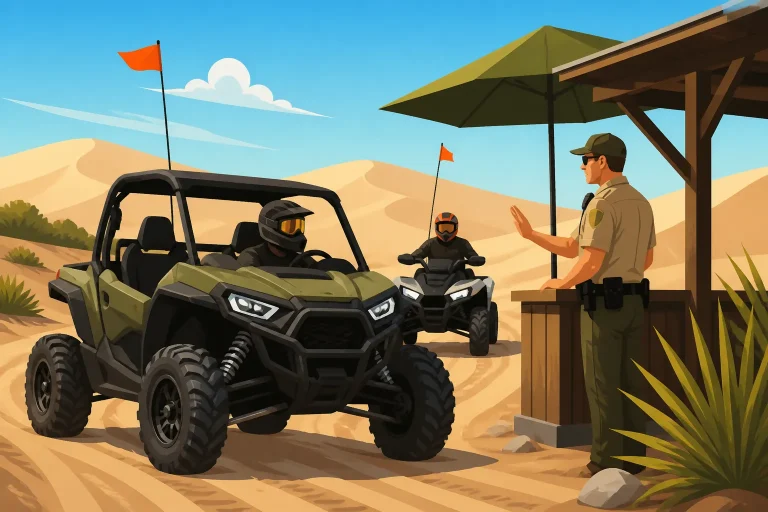
A younger operator is not automatically barred from driving. According to the same division, a person under 16 may operate an ROV if a parent or guardian, or an adult authorized by them, directly supervises the operator in the vehicle. In practical terms, this is an in-vehicle supervision requirement, not simply an adult watching from a campsite or following in another vehicle.
| Operator | California rule for an ROV or side-by-side |
|---|---|
| At least 16 | May operate without adult supervision, according to the California Department of Parks and Recreation’s Off-Highway Motor Vehicle Recreation Division. |
| Under 16 | May operate with direct supervision in the vehicle by a parent, guardian, or adult authorized by them, according to the same division. |
| Any occupant | Must wear a seatbelt or safety harness while the ROV is in motion, according to California State Parks. |
So, if the driver is 16, the age requirement for unsupervised operation is met. That does not mean every other requirement disappears: the machine, its occupants, and the place where it is ridden still matter. For the age rule in more detail, see California ROV Operators at Sixteen and California ROV Operator Age Limit.
Don’t substitute the ATV rule
A side-by-side and a quad may both be off-highway vehicles, but California’s age rules do not treat them as interchangeable. The ATV rules include separate provisions for riders under 18, including safety-certificate and adult-supervision conditions. The ROV rule, by contrast, sets the unsupervised minimum age at 16 and allows a younger operator to drive with direct supervision in the vehicle.
That difference matters when a family has both a quad and a side-by-side. A safety certificate that satisfies an ATV requirement should not be assumed to replace the ROV’s age or in-vehicle supervision rule. If the vehicle’s classification is unclear, check the manufacturer’s vehicle information and the applicable California State Parks guidance before the ride. More on the separate ATV requirements is covered in California Rules for Riders Under 18.
What direct supervision means for a younger driver
For an operator under 16, the adult’s role is more than being nearby. The adult must be directly supervising the young person in the vehicle, and the qualifying adult must be the operator’s parent or guardian or someone authorized by them, according to the California Department of Parks and Recreation’s Off-Highway Motor Vehicle Recreation Division.
That means arrangements such as an adult riding in a separate side-by-side, watching from a trailhead, or checking in by phone should not be treated as a substitute for supervision in the vehicle. If the adult cannot stay with the young driver in the vehicle, the young person should not be treated as eligible to operate under the supervised exception.
Before handing over the controls, sort out who is supervising and what that person’s role will be during the ride:
- Confirm the operator’s age and whether the ride will be supervised or unsupervised.
- If the operator is under 16, have the qualifying adult ride in the vehicle and supervise directly.
- Make sure everyone knows who is driving and who is responsible for supervising.
- Plan to keep that arrangement in place for the whole ride, rather than only during the first part.
The rule gives the adult a specific role; it does not make the adult’s presence a substitute for safe driving practices. A new driver still needs to understand the controls, follow the route, keep a speed suitable for conditions, and stop if the group becomes separated or visibility worsens. Choosing an easy route and going over hand signals and stopping points before setting out can help a young operator manage the ride without confusing supervision with skill.
Keep passengers within the vehicle’s design
A side-by-side’s seats and restraints are part of its passenger capacity. California requires all occupants to wear seatbelts or safety harnesses whenever an ROV is moving, according to California State Parks. The driver should not set off until each occupant is seated in an appropriate place and properly restrained. See California Seat Belt Rules in a UTV for more on restraint requirements.
Do not carry someone in a cargo area or another improvised spot just because the vehicle has room. Read the vehicle’s labels and manual for its seating and occupant limits, and keep passengers in the positions intended for them. A young driver may meet the age rule and still need help managing the added responsibility of carrying passengers, so a solo practice ride may be a sensible first step when the vehicle and site allow it.
Check the machine and paperwork before the ride
The operator’s age is only one part of planning a California ride. Before leaving home, confirm the vehicle’s status, the paperwork that applies to it, and the rules of the riding area. Requirements can vary with the machine’s registration and the type of land, so do not assume that a sticker, permit, or document from one situation automatically covers another.
For a California-registered OHV, the California DMV issues an identification certificate, also known as a registration card, as proof of valid registration. Keep the appropriate paperwork with the vehicle and make sure the driver or supervising adult knows where it is. If you are still sorting out the vehicle’s status, California OHV Registration for a Side-by-Side explains the registration topic, while California Nonresident OHV Use Permit covers the separate permit question for visiting riders.
For a nonresident, the California DMV says a valid out-of-state driver’s license establishes residency, and proof of current home-state OHV registration or its equivalent is needed to operate without a California permit. If you cannot establish that the vehicle qualifies for that arrangement, check the California nonresident permit rules before riding. The nonresident permit program is administered by California State Parks’ Off-Highway Motor Vehicle Recreation Division.
Before the trip, check the following:
- Vehicle category: Verify that the machine is an ROV or UTV, rather than assuming the ROV rule applies to every off-highway vehicle.
- Registration and permit status: Confirm what paperwork the particular vehicle and riding area require. Carry the relevant documents rather than relying only on a verbal explanation.
- Restraints: Check that each occupant has a working seatbelt or harness and knows how to use it. California State Parks requires all ROV occupants to wear a seatbelt or safety harness while the vehicle is moving.
- Equipment: Make sure the vehicle is in working condition and that required equipment is present. For example, California requires at least one headlight capable of illuminating objects 200 feet ahead and one red taillight visible from 200 feet when an OHV is operated on public lands between sunset and sunrise, according to the California Department of Parks and Recreation’s Off-Highway Motor Vehicle Recreation Division.
- Route rules: Check whether the land manager allows the vehicle and the intended route. A registration card does not itself grant access to a closed route or make all public land open to riding.
A quick walk-around can catch problems before they become a trail-side issue. Check the tires, steering, brakes, controls, lights if the ride could continue after sunset, and the condition of the seatbelts or harnesses. Have the young driver practice starting, stopping, turning, and using the controls in a safe place before joining other riders. These checks do not replace the age rule or the land manager’s requirements, but they make it easier to spot an obvious problem before the vehicle is moving.
Riding conditions still matter
A 16-year-old who meets the unsupervised age requirement is not exempt from ordinary OHV rules. The route, land manager, machine condition, and conduct of the driver all matter. The Off-Highway Motor Vehicle Recreation Division provides statewide leadership for OHV recreation and manages state vehicular recreation areas and designated trails within California State Parks. The Bureau of Land Management oversees its own public lands and OHV areas. Check the specific area’s rules before setting out; permission to ride one property does not establish that a nearby road or trail is open.
Some operating rules are particularly useful to review with a young driver:
- Speed near people and campsites: In California, the maximum OHV speed within 50 feet of a campsite, campground, or group of people or animals is 15 miles per hour, according to the California Department of Parks and Recreation. Slow down early, keep a safe distance, and follow any stricter posted rule.
- Noise: California limits OHVs manufactured on or after January 1, 1986, to 96 dBA, and machines manufactured before that date to 101 dBA, measured from 20 inches, according to the California Department of Parks and Recreation’s Off-Highway Motor Vehicle Recreation Division. A loud exhaust is not merely a comfort issue; check the applicable sound requirements for the machine and area. See California Sound Limits for OHVs Explained.
- Spark arresters: The USDA Forest Service requires a properly installed, approved spark arrester for OHVs operated on National Forest lands. Confirm the requirement for the land you plan to visit and check that the arrester is installed correctly. See California Spark Arrester Rules.
- Alcohol and drugs: Operating an OHV under the influence is illegal under California Vehicle Code Section 23152, which applies on and off highway, according to the Department of Motor Vehicles. A young driver should not operate after drinking or using drugs, and an adult should not supervise while impaired.
A route plan can make the age rule easier to follow in real conditions. Pick a route suited to the driver’s ability, decide where the group will stop, and establish what to do if the driver is uncomfortable or the group gets separated. For an operator under 16, that planning does not replace direct supervision in the vehicle. For a 16-year-old riding without an adult, the young driver should understand where the route goes and who to contact if plans change.
The main takeaway is straightforward: a 16-year-old can operate a California side-by-side without adult supervision under the ROV age rule. A younger operator needs direct supervision in the vehicle from a parent, guardian, or adult authorized by them. Confirm that the vehicle is actually an ROV, follow restraint and equipment rules, and check the registration, permit, and route requirements for the specific ride.
Sources
- California Department of Parks and Recreation, Off-Highway Motor Vehicle Recreation Division — FAQs for ROVs (checked November 2, 2026)
- California Department of Parks and Recreation, Off-Highway Motor Vehicle Recreation Division — OHV Sound Regulations (checked November 2, 2026)
- Department of Motor Vehicles — Section 9: Alcohol and Drugs (checked November 2, 2026)
- California Department of Parks and Recreation, Off-Highway Motor Vehicle Recreation Division — Operation / Equipment Requirements (checked November 2, 2026)
- California Department of Parks and Recreation Off-Highway Motor Vehicle Recreation Division — ATV Safety Training & FAQs for ROVs (checked November 2, 2026)
Disclaimer
This article is for general informational purposes only and does not constitute professional advice. Laws, prices and regulations vary by location and change over time. Consult a qualified professional for guidance on your specific situation.