California Rules for Crossing Private Land
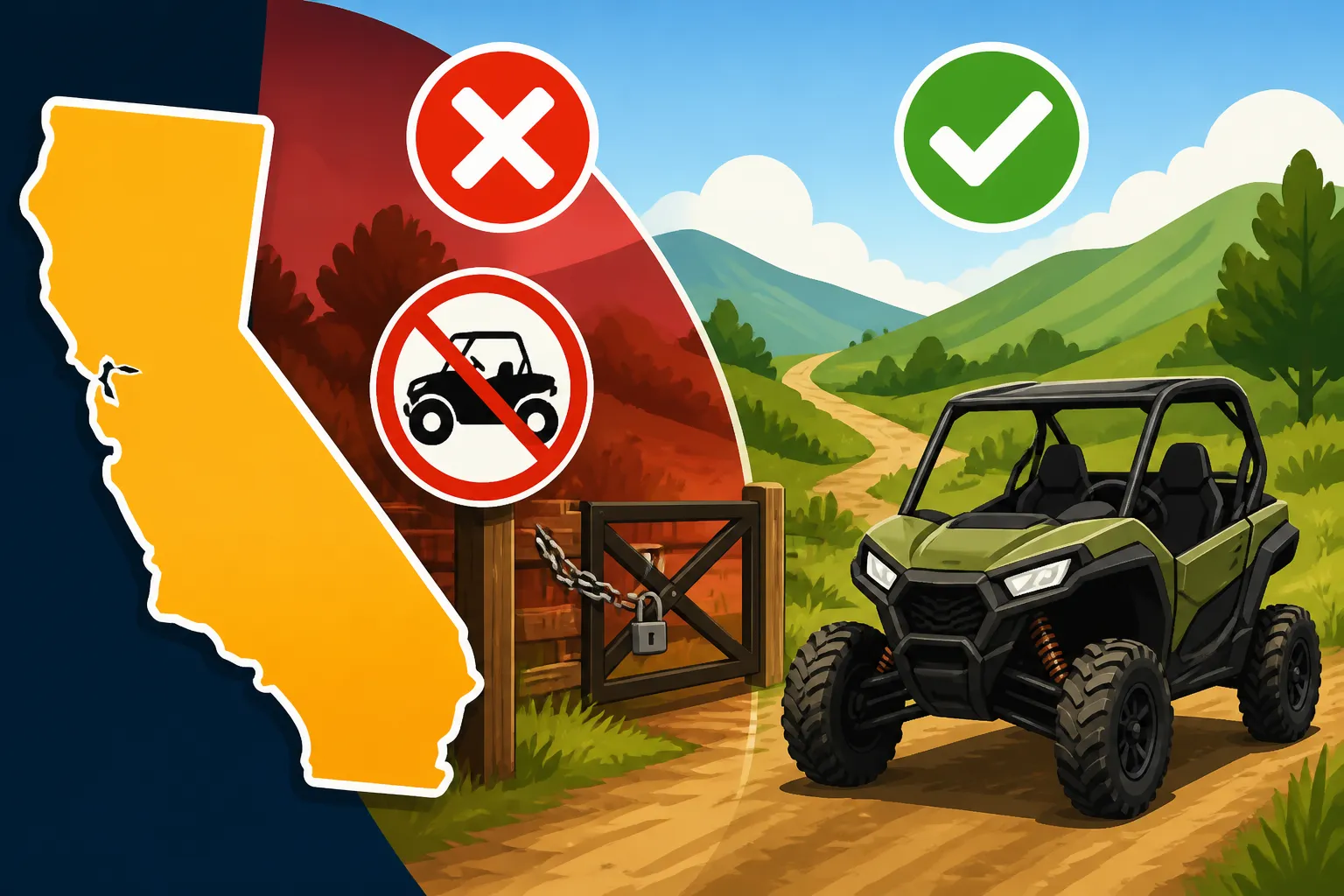
California’s trails and desert routes can pass close to private ranches, farms, homes and mining claims. A track on a map, an open gate or a route used by other riders does not necessarily give you the right to cross. The key is to confirm that you have permission or a valid public access right before riding onto private land.
The basic rule: permission or a public right of access
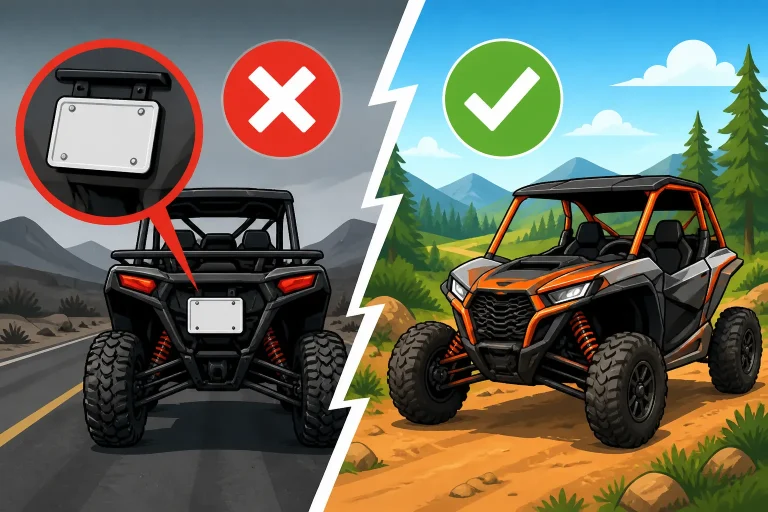
In California, riding an ATV or UTV across private property generally requires the owner’s permission unless the route is covered by a legal public right of way or another valid access arrangement. Your OHV registration, permit, insurance or safety certificate does not give you permission to enter someone else’s land. Those documents address other requirements; they do not establish a right to cross a parcel.
Permission can come directly from the owner or from someone authorized to manage the property. Depending on the land, that might be a ranch manager, leaseholder, land trust or public agency that has an access agreement. Ask about the specific route and the conditions attached to it. Permission to enter for one purpose, such as retrieving a disabled vehicle, may not include permission to ride recreationally or bring a group.
A route may also be legally accessible through an easement or public right of way. An easement can allow travel across private land while the surrounding land remains privately owned. But an easement’s location, permitted users and allowed uses can be limited. A route intended for walking, utility work or local access does not automatically allow motorized recreation.
There is an important distinction between land ownership and the right to travel over land. A road or trail may cross a private parcel but remain open to certain users under a recorded easement or other agreement. Conversely, a road that looks public may be private and closed to general use. Check the route’s status rather than guessing from its appearance.
| What you see | What it does and does not tell you |
|---|---|
| A trail appears on a map | It helps you navigate, but does not by itself prove public access or motorized use is allowed. |
| A gate is open | It does not necessarily mean the owner has invited riders through. |
| Tire tracks or other riders | They are not proof of permission. Others may have access, or they may be trespassing. |
| A road crosses private land | It may have an easement or public right of way, but the terms and allowed vehicle use still matter. |
| An OHV registration or permit | It may satisfy a vehicle or riding-area requirement, but it does not grant access to private property. |
| A landowner’s clear authorization | It can allow access within the stated limits; confirm the route, dates and conditions. |
A route can change character along the way. A public trail may approach a private boundary and then continue on private land, or a dirt road may shift from a public segment to a private one. For more on that situation, see When a Dirt Road Crosses Private Land. If you are following a road that turns into a trail, do not assume that the new segment has the same access status; Riding a Road That Becomes a Trail explains why checking each section matters.
How to check a route before you ride
The safest time to resolve access questions is before unloading the machines. Start with the land manager or official map for the area, then check the specific segment where the route may cross private property. A general recreation map can be useful for planning, but it may not show property boundaries, easement terms, seasonal restrictions or whether motorized use is allowed.
Identify who manages each section
A route may cross more than one type of land. It could run through public land, private holdings and a county road in a short distance. Look for the responsible agency or landowner for each part, and use their current route information where available. A route being open on public land does not settle access across an adjoining private parcel.
Maps are best treated as planning tools, not permission documents. Property lines shown on a consumer map may be approximate, and a marked route may reflect a trail’s physical location rather than its legal status. If the map and signs conflict, stop and verify rather than treating the map as authority.
For public-land routes, check the applicable route designation and closures as well as ownership. A forest road, for example, may have rules that differ from those on a nearby private road. See Riding a California Forest Service Road for the importance of confirming a road’s designation, and Riding Off a Designated California Trail for why leaving an approved route can create a separate access problem.
Ask for permission in clear terms
If the route crosses private land and you cannot confirm a public access right, contact the owner or authorized manager. Describe the machines, number of riders, planned route and timing. Ask whether riding is allowed for that purpose, whether permission extends to everyone in your group, and whether there are limits on speed, hours, noise or where you may travel.
For a group ride, do not assume one rider’s permission covers every participant. Make sure the person who granted access understands the size and nature of the group. Keep a record of the arrangement, such as a written message that identifies the property or route and the relevant dates. Written permission is a practical way to avoid misunderstandings, even when the owner has given clear permission verbally.
Ask about conditions that may not be obvious from the trail. The owner may require riders to stay on a particular track, close a gate, avoid a field or turn around during certain operations. Permission is only useful if riders understand and follow those limits.
Plan for uncertain boundaries
If you cannot tell where public access ends, do not ride forward in the hope that the track will become public again. Stop at a safe place, check your location and contact the appropriate owner or land manager. When the boundary remains uncertain, turn back or use a confirmed legal route.
A phone map can help you locate yourself, but relying on a signal or a live map in remote terrain is risky. Download route information before leaving coverage, carry a backup map when practical and record important contact details. A waterproof map case from Amazon may help protect a paper map from sand or weather, but it cannot verify a property boundary or replace permission.
Before departure, it can help to use this simple process:
- Trace the full planned route, including connectors between riding areas, campgrounds and trailheads.
- Check which agency or owner manages each segment and look for access restrictions or closures.
- Confirm motorized access where a route crosses private land or where ownership is unclear.
- Share the route and any access conditions with everyone in the group.
- Save a legal alternate route in case a gate is locked or access is withdrawn.
How to cross private land when you are authorized
Permission is not a blank check to ride anywhere on a property. Follow the exact route and conditions that were agreed to. If authorization is limited to a connecting road, do not explore side tracks, cut across a field or continue onto an adjoining parcel.
Stay on the established track unless the owner specifically directs you elsewhere. Riding around a wet, rough or blocked section can widen the route, damage vegetation or take you onto land that was not included in the permission. If a route is impassable, stop and contact the owner or manager instead of creating a detour.
Treat gates and fences as instructions to stop
A fence or gate marks a boundary, but it does not tell you who is allowed through or on what terms. An open gate is not an invitation. A closed gate may be part of an authorized route, but only cross it if you have permission and know what the owner expects you to do.
If the agreed instructions are to close a gate behind you, make sure the entire group has passed and the gate is secured as requested. Do not damage a fence, bypass a lock or move a barrier. A locked gate on a road that appears public can raise a complicated access question; do not force entry or assume it is acceptable to ride around it. See Locked Gates on a Public Road for how to handle that uncertainty.
Be especially careful around livestock and working ranches. Move slowly, avoid sudden noise and follow any instructions about stopping or waiting. Do not chase, crowd or separate animals, and do not ride through a herd unless the owner has specifically approved the route and given directions. California Rules for Riding Near Livestock covers the additional care needed around animals.
Keep the impact low
Private-land access often depends on maintaining a good relationship with the owner. Ride at a controlled speed, keep noise reasonable, avoid unnecessary stops and pack out anything you bring in. Do not leave trash, spill fuel, disturb gates or drive through crops, landscaped areas or livestock enclosures.
If a landowner has set a group-size limit or restricted riding to certain hours, follow it even if the route appears empty. If you notice damage, a new hazard or an animal in trouble, tell the owner or manager rather than trying to resolve it in a way that could make the situation worse.
If an emergency forces you off the authorized route, such as avoiding an immediate hazard, get back onto the permitted route as soon as it is safe and contact the owner afterward. An emergency detour should not become a reason to continue exploring. If you need help with a disabled machine, Riding Out to a Broken-Down Machine discusses the access considerations involved in reaching a stranded vehicle.
What to do when access is unclear or denied
When you do not have permission and cannot confirm a public right of access, do not cross. A route’s convenience, its history of use or the presence of tracks does not make it legal. If an owner or authorized manager tells you to leave, turn around calmly and use a confirmed route. Do not argue at a gate, continue riding while permission is disputed or try another way across the same property.
Trespass questions can depend on the property, the route and the circumstances, so do not rely on a single visual clue to decide that access is allowed. Signs, fencing and verbal instructions can all be relevant, but the absence of a sign does not establish permission. For more on the issue, see [California Trespass Rules for OHV Riders].
If the dispute concerns a route you believe is public, do not try to settle it by riding through. Record the location, note the relevant signs or gate, and contact the agency or local authority responsible for the route. Ask for confirmation of the public status and permitted vehicle use. In the meantime, choose another route or trailer the machine to an area where riding is clearly allowed. Trailering Instead of Riding in California is useful when the road connection itself is not a legal riding route.
A practical decision rule is:
- Permission confirmed, route and conditions clear: Cross only as authorized.
- Public right of way confirmed, motorized use allowed: Stay within the designated route and follow its restrictions.
- Access unclear, owner unavailable or map information conflicts: Stop, verify or turn back.
- Access denied or gate locked without clear authorization: Do not enter, force the gate or ride around it.
If your trip also involves public OHV land, check that area’s separate requirements. A California OHV permit or registration may be needed for the machine or riding area, but it does not substitute for private-property permission. The same is true of an out-of-state credential: reciprocity and access are different questions. California OHV Reciprocity Rules explains which out-of-state credentials may matter for California riding, while private-land access must still be resolved separately.
Disclaimer
This article is for general informational purposes only and does not constitute professional advice. Laws, prices and regulations vary by location and change over time. Consult a qualified professional for guidance on your specific situation.