Riding Out to a Broken-Down Machine
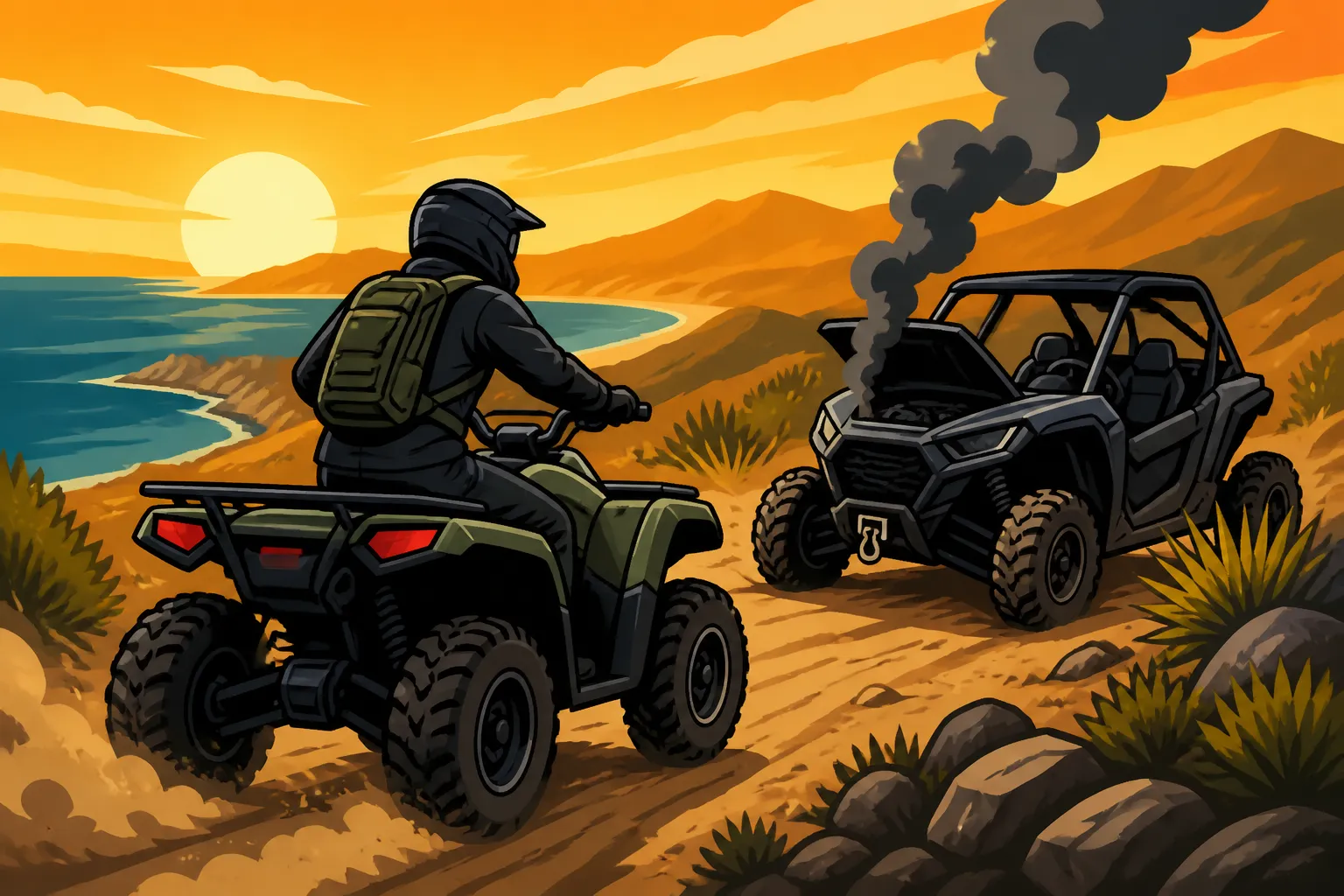
A broken-down ATV or UTV can turn a quick ride into a stressful recovery, especially when the shortest route back crosses a road, a gate or land with different access rules. In California, a disabled machine does not automatically make an otherwise restricted road legal to ride. This guide explains how to reach it safely, choose a lawful recovery route and decide when to tow, winch or call for help.
Start by making the breakdown safe
Check the people before the machine
If someone is injured, lost, overheated or in immediate danger, deal with that first. Move riders away from traffic, unstable slopes, deep water, fire risk and other hazards. If the machine has stopped on or close to a traveled road, don’t stand behind it or in a blind corner while trying to diagnose the problem. Make yourself visible and contact emergency services or the responsible land manager if there is immediate danger.
For a mechanical failure in a remote area, take stock before sending another rider out. Share the machine’s location as precisely as you can: a marked trail junction, campground, numbered road, GPS pin or recognizable landmark is more useful than “somewhere past the wash.” Note how many people are with the disabled machine, whether anyone is hurt, and what conditions are changing. Heat, fading daylight, wind-blown dust and an approaching storm can make a recovery more urgent than the mechanical issue itself.
Keep the group together where it is safe to do so. A rider left alone with a disabled machine may be difficult to find if phones lose service or trail markers are confusing. If the group must split, agree on who is going for help, which route they will use, and when they will check back. Don’t let a second breakdown turn one stranded rider into several.
Identify where the machine stopped
Before deciding how to reach the ATV or UTV, work out exactly what kind of route it is on. It could be a designated OHV trail, a road open to motor vehicles, a private road, a route closed by a gate, or a paved public road that OHVs may not use. The fact that a road is unpaved—or that other vehicles have driven it—does not by itself show that it is open to your machine.
In California, access depends on the specific route and its signs, maps, land manager rules and local designations. A fire road, for example, may be open to highway vehicles but not to OHVs. Check the route information for the area and look for posted restrictions before setting out. These guides explain the distinction between [Fire Roads and California OHV Access] and [Riding a County Dirt Road in California].
Also note whether the machine is obstructing a traveled route. If it is, move it only if that can be done without putting people at risk or damaging the vehicle further. If the route is narrow, steep or used by other riders, warn approaching traffic from a safe position and arrange help rather than trying an improvised pull that could tip the machine or block the trail completely.
Decide whether to ride, walk or call for help
A working machine and a capable rider do not make every route a lawful or sensible recovery path. If the only way to reach the disabled vehicle would involve riding on a road that is not open to OHVs, don’t treat the breakdown as permission to use it. Use an authorized route, contact the land manager, or arrange for a permitted recovery vehicle to reach the location.
Walking may be the simplest option for a short distance on a safe, open trail, but it is not always the safest. A steep slope, soft sand, extreme heat, poor visibility or a remote route can make a hike risky. If there is no reliable way to reach the machine without putting people or another vehicle in danger, call for assistance and give the operator the clearest location details you have.
For public-road questions, read [California Rules for Crossing a Public Road] and [What a California Sheriff Checks Roadside]. A road crossing, an authorized combined-use segment and a road closed to OHVs are different situations; don’t assume that rules for one apply to another.
Choose a recovery method that fits the route
Ride in only where your machine is allowed
If you plan to ride another ATV or UTV to the disabled machine, first confirm that your route is open to that type of vehicle. Check signs at the trailhead and junctions, the area’s official map, and any temporary closures. A route can change status along its length, so finding an open trail at the start does not prove the entire trip is open.
Make the recovery ride a separate, deliberate trip. Carry water, a charged phone or radio, basic tools, and any documents or equipment required for that riding area. Tell someone who is not going what route you intend to take and when you expect to return. If you’re riding near [Hungry Valley SVRA North of Los Angeles], [Hollister Hills, California's Oldest SVRA] or [Ocotillo Wells: California's Free SVRA], check that area’s rules and notices rather than assuming the same access conditions apply statewide.
If the disabled machine is on a route that your recovery vehicle cannot legally enter, stop at the last authorized point and ask the land manager what options are available. It can be frustrating to leave a vehicle where it is, particularly when it seems close. But riding around a gate or onto a closed road can create a bigger problem than the original breakdown. See [Riding Around a Gate in California] for why a blocked route should be taken seriously.
Tow only when the route and equipment make it safe
A tow can work on a suitable, open trail if both vehicles are capable, the connection is secure and the terrain is manageable. It is not automatically safe on a steep grade, in deep sand, through a narrow turn or near other trail users. A disabled machine may have locked wheels, damaged steering or a drivetrain fault that makes it difficult to control. Before pulling, check whether it can roll freely and whether the person on it can steer and brake.
Use equipment designed for vehicle recovery, such as a properly rated strap or winch setup, rather than a rope, improvised chain or tie-down strap. Keep people out of the line of tension and away from pinch points. Pull slowly, keep the connection as straight as conditions allow, and stop immediately if either vehicle starts to slide, lift, jackknife or lose control. If the failed machine cannot be steered or stopped reliably, don’t tow it with a rider aboard.
Winches and recovery accessories from companies such as SuperATV may be part of a planned setup, but the product must match the machine and the task. Read the manufacturer’s instructions, use compatible mounting and connection points, and understand safe winching practice before an emergency. SuperATV equipment does not make a closed route legal or turn an unsafe recovery into a safe one.
Use a trailer or authorized recovery vehicle when needed
Trailering is often the better answer when the machine cannot roll, the route is too steep or narrow, or a tow would put riders at risk. The practical challenge is getting the trailer close enough without driving onto a road or trail where it is not allowed. Plan the access point first, then confirm that the trailer and tow vehicle can reach it legally and safely. [Trailering Instead of Riding in California] covers why transporting the machine can be a better choice than riding it out.
If the machine is deep in a remote area, ask the land manager whether a recovery vehicle is permitted and whether a particular route or time is required. Don’t assume a private recovery operator can enter every trail, park or public-land area. Tell the operator the machine type, approximate weight, terrain, location, access restrictions and whether a trailer can reach the pickup point.
| Situation | Safer next step | Avoid |
|---|---|---|
| Machine stopped on an open, manageable trail | Assess steering and brakes, then consider a slow, controlled tow | Pulling before checking whether the wheels roll |
| Machine stopped on a closed route or behind a gate | Contact the land manager and ask about authorized recovery | Riding around the gate because the machine is nearby |
| Machine is on or near a public road | Move people to a safe location and get appropriate help | Standing in traffic or trying an improvised roadside pull |
| Machine has a locked wheel or steering damage | Arrange a suitable recovery vehicle or professional help | Towing it with a rider who cannot control it |
| Heat, injury or darkness makes waiting dangerous | Prioritize people, share your location and call for help | Sending someone alone without a route and check-in plan |
Plan the recovery trip before setting out
Confirm access, closures and route conditions
A recovery route should be checked from end to end. Review the official map for the riding area, pay attention to route designations and read posted signs at the entrance and intersections. Closures can be temporary, seasonal or related to fire, weather, maintenance or resource protection. A route shown on an older map may not be available today.
If the recovery involves a public road, don’t assume an OHV can use it because another road user does. California has limited situations where specific routes or segments may be designated for combined use. The designation applies to the route or segment, not to every nearby street or connecting road. Learn the relevant rules through [California's Combined-Use Highways] and check the exact route with the responsible agency.
Ask practical questions before leaving: Can the recovery vehicle reach the location? Is there a gate, soft sand, a narrow turn or a steep grade? Is the trail suitable for a loaded machine or trailer? Does the recovery plan require crossing private land? If access is unclear, get permission or choose another plan rather than relying on a guess.
Pack for the return trip, not just the ride in
A recovery can take longer than the original ride. Bring enough water and basic supplies for the people involved, along with a way to communicate and a light source if there is any chance you’ll be out near dusk. Carry suitable tools, a tire repair kit if appropriate, and recovery gear that is in good condition and rated for the intended use. Keep a first-aid kit accessible rather than buried under cargo.
Make a simple recovery plan with the group. Assign one person to supervise the tow or winch, another to watch the route and other traffic, and a machine operator to maintain control of the disabled vehicle if that is safe. Agree on a stop signal everyone understands. Bystanders should stay clear of the vehicles, straps and cables, not gather around to watch.
SuperATV recovery gear is one example of equipment riders may consider when outfitting a machine, but good preparation also means knowing how to use the gear. A winch cable or strap can store dangerous energy under tension. Practice in a controlled setting, follow the equipment’s instructions and replace worn or damaged components. Carrying gear without understanding its limits can create a false sense of security.
Know when to stop trying
Stop a recovery attempt if the machine slides toward a drop, the pulling vehicle loses traction, the attachment point shifts, a strap or cable is damaged, or anyone cannot remain in a safe position. Reassess rather than adding more throttle or more people to the pull. A small mechanical problem can become a rollover, injury or trail obstruction when a recovery is rushed.
Call for help when the machine is beyond the group’s ability, when access rules are unclear, or when people are at risk. Give the responder a precise location, explain the terrain and describe what has failed. If your phone has no service, use the group’s agreed emergency plan, travel only by an authorized route, and avoid leaving an injured or vulnerable person alone.
If a sheriff, ranger or land manager approaches, explain what happened and what you are doing to recover the machine. Be prepared to show where you are and describe the route you used. Rules for registration, permits and road access can differ depending on the location, so review [California OHV Insurance Requirements] and the riding area’s requirements before your next trip.
Reduce the chance of another breakdown
Do a basic pre-ride inspection
A few minutes of inspection can prevent some common failures from becoming a recovery job. Check tires, wheels, steering, brakes, fuel, battery connections and visible leaks. Look for loose hardware and damaged straps or winch components. Make sure the machine has the safety equipment required for where you’ll ride, and don’t ignore a warning light or unusual noise simply because the group is ready to leave.
Match the ride to the machine’s condition. A vehicle that has been sitting for months may need more attention than one used regularly. If you are riding in sand, mud or rocky terrain, consider how those conditions affect cooling, traction and the ability to turn around. Pack tools and spares that suit your machine rather than carrying a random collection of items you do not know how to use.
Share a route and recovery plan
Before heading out, tell someone where you’re going, who is riding, what machines are involved and when you expect to be back. Within the group, identify who has navigation, who carries first aid and who knows how to use recovery equipment. Agree on what to do if riders become separated or a machine stops beyond cell coverage.
A simple plan is especially useful in large riding areas where landmarks can look alike. At places such as the Imperial Sand Dunes, drifting sand and changing light can make it harder to recognize a route on the return. Keep track of junctions, note your location periodically and avoid relying on a phone map as the only navigation tool.
Keep the goal in perspective
The goal is not always to get the machine back under its own power. Sometimes the safest and most responsible choice is to leave it in a secure place, protect the people with it, and arrange a recovery that follows the land manager’s rules. That can feel inconvenient, especially after a long drive or a carefully planned weekend, but a lawful, controlled recovery is better than risking an injury or a citation by taking an unauthorized shortcut.
A broken-down ATV or UTV does not erase road and trail restrictions. Confirm where the machine is, choose an authorized route, and stop if the recovery exceeds your equipment or experience. Those decisions make it more likely that everyone—and the machine—gets home safely.
Disclaimer
This article is for general informational purposes only and does not constitute professional advice. Laws, prices and regulations vary by location and change over time. Consult a qualified professional for guidance on your specific situation.