California OHV Permit for Out-of-State Riders
Out-of-state riders can’t assume their home registration or license plate is enough to ride California trails. Whether you need a California OHV permit depends on how your machine is identified at home, and California recognizes only limited reciprocity. Here’s how to check your situation, get the right permit, and avoid confusing vehicle identification with other riding requirements.
When an Out-of-State Rider Needs a California OHV Permit
California generally requires an off-highway vehicle operated in designated OHV areas to display valid identification. For a California machine, that usually means California OHV registration. A nonresident may instead rely on qualifying OHV registration or an off-highway permit from a state California recognizes. If neither applies, the rider generally needs a California nonresident OHV use permit.
The permit is tied to the vehicle, not a substitute for the rider’s driver license, safety training, or permission to use a particular riding area. It also does not turn an OHV into a street-legal vehicle. Think of it as one part of the machine’s required identification for riding off-highway in California.
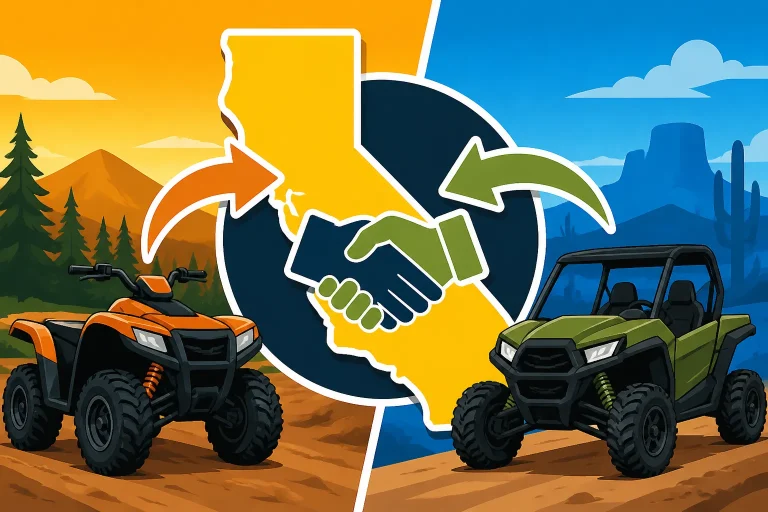
California’s reciprocity is narrow. Oregon and Nevada are the two states whose qualifying OHV credentials California recognizes. A registration, sticker, or permit from another state does not automatically count just because it is valid at home. The details matter: the credential must be the kind California accepts for OHV use, and it must be current and displayed as required. See [California OHV Reciprocity Rules] and Why Only Oregon and Nevada Count in California before deciding you are covered.
| Your machine’s situation | What to check before riding in California |
|---|---|
| Qualifying Oregon OHV credential | Confirm it is current and meets California’s requirements |
| Qualifying Nevada OHV credential | Confirm the decal or registration is valid and displayed correctly |
| OHV credential from another state | Do not assume California recognizes it; check whether you need a California permit |
| Standard street-legal plate only | A road registration may not satisfy OHV identification rules for off-highway use |
| No current qualifying OHV credential | Arrange a California nonresident OHV use permit before riding |
A common source of confusion is the difference between a machine’s road registration and its OHV identification. A license plate can allow a vehicle to travel on public roads under applicable rules, but that does not automatically establish that the vehicle meets California’s OHV identification requirements at a trail or recreation area. The rules can depend on how the vehicle is registered and where it will be operated. Review Why a Street-Legal Plate Does Not Substitute if your machine has a plate but no separate OHV decal or permit.
Do not rely on a seller’s assurance that a sticker from another state “works everywhere.” Check the state and credential type, then verify that it is current. If it does not qualify under California’s reciprocity rules, apply for the California permit rather than trying to resolve the issue at a checkpoint.
How to Get the California Nonresident Permit
If your machine does not have qualifying California, Oregon, or Nevada OHV identification, the California nonresident OHV use permit is generally the route to consider. The permit is issued for a defined period, and its expiration and display instructions should be clear on the permit itself. Confirm the current application process and requirements through an official California channel before submitting an application. California’s Nonresident OHV Use Permit explains the purpose of the permit, while How to Buy a California Nonresident OHV Permit covers the purchase process.
Prepare the vehicle information the application asks for. Depending on the process, you may need details such as the machine’s make, model, year, and vehicle identification number. Use the information shown on the machine and its ownership documents, and check that the VIN is readable before you start. If numbers on the machine and paperwork do not match, resolve that discrepancy before applying or traveling.
A practical checklist:
- Identify the machine. Confirm that it is an OHV and note its VIN and identifying details.
- Check its home-state credential. Determine whether it is a qualifying Oregon or Nevada OHV credential, rather than assuming any registration or plate will qualify.
- Review the California permit requirements. Check the official application instructions for current eligibility, required information, payment method, and delivery or printing options.
- Complete the application accurately. Enter the vehicle details exactly as requested and keep a copy of any confirmation.
- Install or carry the permit as instructed. Follow the display directions supplied with it. A permit kept in a bag may not meet a requirement to display it on the vehicle.
- Check its validity before each trip. Make sure the permit is still current and legible, and bring the associated paperwork if the instructions or riding location call for it.
The cost and application details can change, so check the provider for current figures and procedures rather than relying on an old receipt, forum post, or another rider’s experience. The permit is specific to the rules stated for it; it should not be treated as a general pass to every California riding area.
If you are carrying documents for a weekend trip, keep your permit information accessible and make sure it matches the vehicle you brought. Carrying Paperwork on the Sand offers practical advice for keeping proof available while riding.
What the Permit Does and Does Not Cover
A California nonresident OHV permit addresses vehicle identification. It does not replace other requirements that may apply to the rider, machine, or location.
For example, riders under 18 may have separate safety certificate, supervision, or equipment requirements. These rules depend on the rider’s age and the type of vehicle. Check What a Rider Under 18 Must Carry in California and California Safety Certificate for Visiting Riders if a young rider is joining the trip. Carry required documents and make sure the person supervising a minor meets the applicable requirements.
The permit also does not provide access to land that is closed, restricted, or subject to a separate fee or permit. Recreation areas can have their own entry procedures, vehicle rules, seasonal closures, and use restrictions. A California OHV permit does not override a closure or allow riding outside designated routes.
Dune riding is a good example of why these requirements should be checked separately. The vehicle’s OHV identification is one question; area-specific access rules are another. At the Imperial Sand Dunes, riders should check the applicable recreation permit and display requirements in addition to making sure the machine’s OHV identification is valid. See California Rules for Riding Imperial Sand Dunes for the area-specific rules.
Nor does a nonresident OHV permit make a machine street legal. Riding on public roads is governed by separate vehicle and road-use rules. A rider should not use an OHV permit as permission to travel along a road, connect between riding areas, or cross a highway except where the law and route designation allow it.
Before leaving home, check these separate items:
- Vehicle identification: Does the machine have California identification, qualifying Oregon or Nevada credentials, or a current California nonresident permit?
- Rider requirements: Do riders meet applicable age, supervision, and safety certificate rules?
- Area access: Does the destination require an additional entry permit or have specific access conditions?
- Route status: Are the trails or roads you plan to use open and designated for your vehicle?
- Equipment: Does the riding area require or restrict particular equipment, such as a helmet or spark arrester?
- Proof and display: Is the permit attached as instructed, and can you show any other required documents?
Checking each item separately is more reliable than treating “registration” as one all-purpose document. It also helps identify a problem before you arrive at a gate or trailhead.
Common Mistakes to Avoid Before You Ride
The most avoidable mistake is assuming that a credential valid at home must be accepted in California. California recognizes limited OHV reciprocity, so riders from other states should verify their exact credential rather than relying on a generic out-of-state plate or sticker. If the state or credential type is not covered, determine whether you need the California permit.
Another mistake is confusing the vehicle permit with the rider’s qualifications. A valid permit does not mean a rider is old enough to operate that machine, has completed any required safety training, or may carry a passenger. Check the relevant rules for each rider and vehicle.
Also avoid waiting until the day of the trip to deal with a permit. Application processing, delivery, printing, or display instructions may require planning. Confirm how the permit is obtained and whether you must attach a physical permit before riding. Do not assume that an email receipt or phone photo will replace a required decal; follow the official instructions for the credential you receive.
Finally, check the permit and vehicle details together. A credential that belongs to a different machine, has expired, is damaged, or cannot be matched to the vehicle can create questions during an inspection. Keep the machine’s identifying information consistent with the application and carry related records where appropriate.
A quick pre-trip check can prevent most confusion:
- Confirm that the OHV credential is accepted in California.
- If it is not, obtain the appropriate California nonresident permit.
- Read the permit’s validity and display instructions.
- Confirm rider age, safety, and supervision requirements.
- Check additional rules for the destination and planned routes.
- Keep relevant documents available and make sure they match the machine.
When a rule is unclear, use official California information and describe the machine accurately: its type, home state, and the exact credential it carries. That is more useful than asking whether “out-of-state registration” is accepted in general, because the answer depends on the specific OHV credential.
Disclaimer
This article is for general informational purposes only and does not constitute professional advice. Laws, prices and regulations vary by location and change over time. Consult a qualified professional for guidance on your specific situation.