Why a California OHV Plate Is Not a License Plate
One of the most persistent misunderstandings for off-highway vehicle (OHV) enthusiasts in California is the exact nature and purpose of the identification plate issued by the state. Many riders, especially those new to the sport or moving from other states, mistakenly believe that this plate functions like a standard vehicle license plate, granting them the freedom to cruise down public roads. This guide aims to clear up that confusion, explaining why a California OHV plate is fundamentally different from a street-legal license plate and what that means for your riding adventures.
The Fundamental Difference: Purpose and Authority
It’s easy to look at a piece of metal with numbers and letters attached to a vehicle and assume it serves the same purpose as the plate on your car or truck. However, for OHVs in California, that couldn't be further from the truth. The state's Department of Motor Vehicles (DMV), in conjunction with the Off-Highway Motor Vehicle Recreation (OHMVR) Division, has established a clear distinction rooted in how these vehicles are manufactured, used, and regulated.
What a California OHV ID Plate Represents
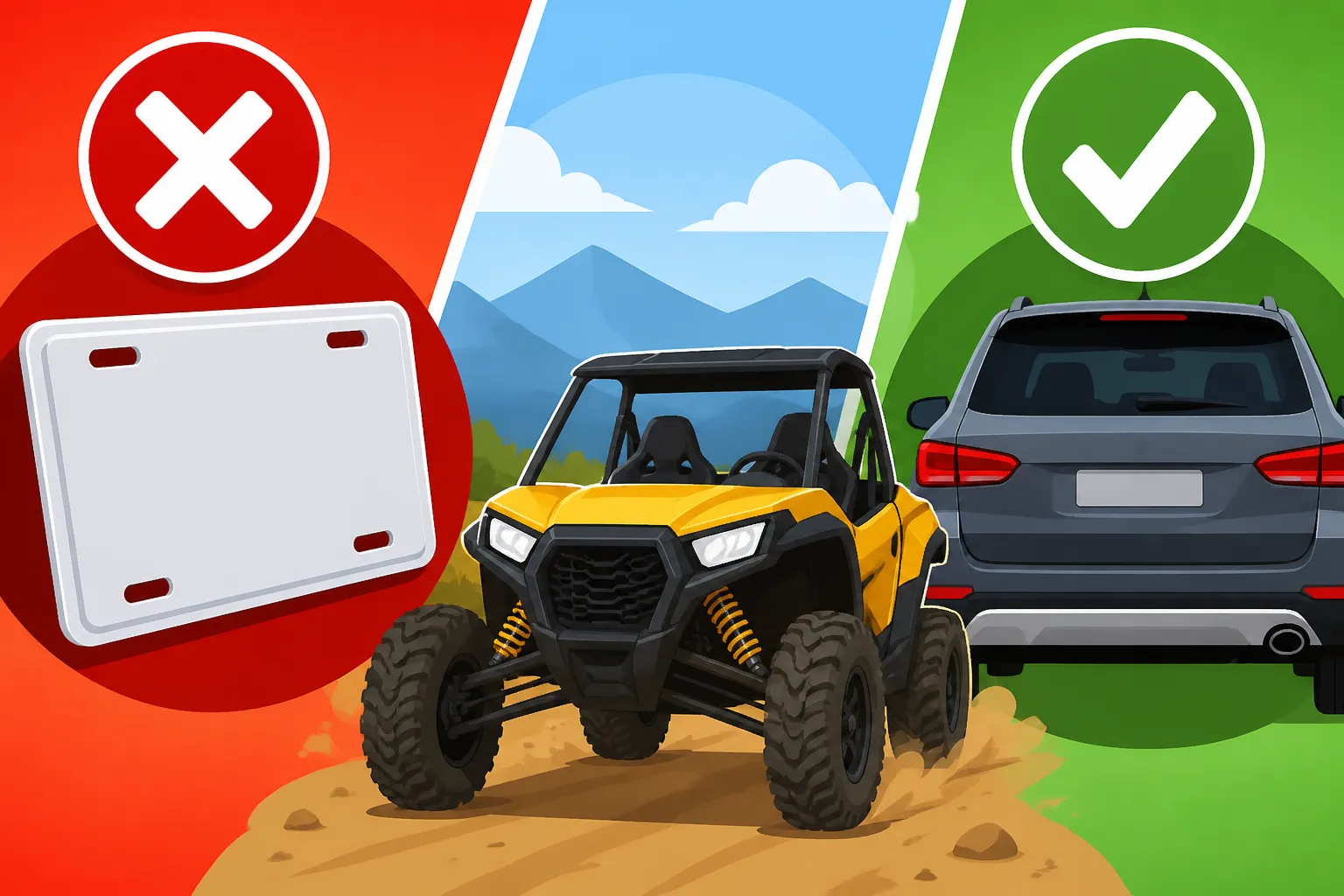
A California OHV ID plate, often referred to simply as an OHV plate or identification plate, is essentially a specialized registration tag for off-highway use only. It’s issued to ATVs, UTVs, dirt bikes, and other machines specifically designed and manufactured for operation off public roads. The plate, along with the corresponding Green, Red, or Tan Sticker, signifies that your vehicle is properly registered to operate on designated public lands within California, such as State Vehicular Recreation Areas (SVRAs), Bureau of Land Management (BLM) lands, and specified routes in National Forests.
This registration system is crucial for a couple of reasons. Firstly, it provides a means of identification for law enforcement and land managers. In the vast stretches of desert or dense forests, knowing who owns a machine and if it’s legally permitted to be there is vital for safety, theft recovery, and responsible land management. Secondly, the fees collected through this registration directly fund the OHMVR Division, which is responsible for maintaining and expanding riding opportunities, enforcing regulations, and promoting safety education. Your [$54 OHV Registration Fee Broken Down] contributes to these efforts, ensuring that future generations of riders have places to explore.
What a California License Plate Signifies
In stark contrast, a standard California license plate is the ultimate symbol of street legality. It’s issued to vehicles that meet a comprehensive set of federal and state requirements for operating on public highways, streets, and roads. These requirements cover everything from emissions standards set by the California Air Resources Board (CARB) to intricate safety features like headlights, taillights, turn signals, mirrors, windshields, seatbelts, and crashworthiness ratings. When your car, truck, or motorcycle has a California license plate, it means that vehicle has been certified to safely and legally share the road with other traffic.
The authority behind a license plate is rooted in the California Vehicle Code (CVC) which governs all aspects of on-highway operation. It dictates everything from vehicle construction and required equipment to driver licensing, insurance mandates, and traffic laws. A vehicle with a license plate is fundamentally different in its legal standing and intended purpose compared to an OHV. It's built for commuting, errands, and traversing the vast network of paved roads, not primarily for tackling dunes or rugged trails, though some 4×4 trucks certainly see their fair share of dirt. This distinction is paramount in understanding [Street Legal ATVs in California: The Short Answer].
Legal Frameworks Governing Plates
The divergence between OHV plates and license plates isn't just a matter of different colored metal; it's enshrined in the very fabric of California's legal system. The California Vehicle Code (CVC) meticulously defines various vehicle types and their allowable uses, creating distinct categories that prevent the casual interchangeability of plates.
The California Vehicle Code and OHVs
The CVC treats Off-Highway Vehicles (OHVs) as a distinct class of vehicles. Section 38000 of the CVC, for instance, specifically defines "off-highway vehicles" and establishes the rules for their identification and operation. This section clarifies that OHVs are generally not designed or intended for use on public highways and are therefore subject to a separate registration and identification system. This is why you receive an "ID plate" rather than a "license plate" for your ATV or UTV. The ID plate serves to identify the vehicle for off-highway use, ensuring it's properly registered with the state for access to designated riding areas. Without this identification, you wouldn't be allowed on most public lands designated for OHV recreation.
Furthermore, the CVC establishes the OHMVR Division's role in managing and regulating OHV recreation. This division, part of California State Parks, oversees the funding, planning, and operation of SVRAs and coordinates with other land management agencies like the BLM and U.S. Forest Service. The entire system is built around the premise that OHVs are a unique class of vehicle with specific needs and impacts, requiring dedicated management and a separate legal framework. This ensures that the beautiful yet fragile environments where we love to ride are protected, and that riders have safe, legal places to enjoy their sport. Knowing [What California's Form REG 343 Asks For] is a good first step in understanding the registration process.
On-Highway Vehicle Regulations
Vehicles designed for on-highway use, on the other hand, must comply with a far more extensive and stringent set of regulations under the CVC. These regulations dictate everything from the type of tires, braking systems, lighting, and mirrors required, to complex emissions standards designed to reduce air pollution. For example, a street-legal vehicle must meet federal motor vehicle safety standards (FMVSS) which cover crash protection, occupant restraints, and vehicle integrity in collisions. These are standards that ATVs and UTVs, by their very design, simply do not meet.
California's emissions rules, specifically those enforced by CARB, are among the strictest in the nation. To be street-legal, a vehicle must demonstrate compliance with these emissions standards through rigorous testing and certification. Most OHVs, while they do have emissions labels, are certified under different, less stringent standards for off-highway use. This is why attempting to modify an OHV to meet street-legal standards is an incredibly difficult, if not impossible, task in California. The vehicle must be manufactured to street-legal specifications from the ground up, not merely adapted with aftermarket parts. This is a critical distinction, especially when considering [What CARB Compliance Means in California].
Limitations and Capabilities of Each Plate Type
The type of plate on your vehicle directly dictates where and how you can operate it legally. Understanding these limitations is not just about avoiding a ticket; it's about staying safe and respecting the laws designed to protect both riders and the environment.
Where an OHV ID Plate Allows You to Ride
Your California OHV ID plate, paired with its corresponding sticker (Green, Red, or Tan), is your ticket to hundreds of thousands of acres of designated off-highway riding areas across California. These include the state's amazing SVRAs like Oceano Dunes, Hungry Valley, and Ocotillo Wells, where you can ride everything from challenging technical trails to expansive sand dunes. It also grants you access to vast stretches of BLM land in the desert, as well as designated trails and routes within National Forests, provided those areas are specifically open to OHV use. Each type of sticker has its own rules, with a [California's Green Sticker Explained] generally offering the most flexibility for year-round riding on public lands.
However, the key phrase here is "designated off-highway riding areas." Your OHV ID plate does not permit you to ride on paved roads, sidewalks, bicycle paths, or any other public way primarily intended for licensed, street-legal vehicles. Riding an OHV with just an ID plate on a public street is considered illegal operation and can result in significant fines, impoundment, and other legal consequences. Even if you're just trying to get from your campsite to a nearby store, or cross a short stretch of pavement, the OHV ID plate offers no legal protection for such actions outside of very specific, limited exceptions.
The Scope of a Standard License Plate
A standard California license plate, conversely, opens up the entire network of public roads, highways, and freeways to your vehicle. When your vehicle displays a legitimate license plate, it signifies that it meets all necessary safety and emissions standards for on-road operation, and that it is properly registered for that purpose. You can drive from Eureka to San Diego, traverse busy city streets, or simply take your kids to school, all under the legal umbrella of your license plate.
This freedom, however, comes with its own set of responsibilities. Vehicles with license plates are subject to all traffic laws, including speed limits, lane designations, signal requirements, and parking regulations. Drivers must also hold a valid California driver's license and maintain appropriate insurance coverage. The scope of a license plate is broad for paved roads but does not typically extend to the dedicated off-highway trails and dunes where an OHV thrives. While a licensed 4×4 truck can navigate dirt roads, it often cannot enter restricted OHV trails or designated dune areas without proper OHV identification or a specific exception.
Understanding "Combined-Use" Routes
California does have a very limited concept of "combined-use" routes, which can sometimes be a source of confusion. These are specific, clearly designated segments of public roads where certain OHVs are permitted to operate for short distances to connect trails or access services. However, it's crucial to understand that these routes are rare, highly regulated, and come with strict limitations. They are NOT a pathway to making your OHV street-legal, nor do they confer the same rights as a standard license plate.
Typically, these routes are very short, often no more than three miles, and are explicitly marked by signage. An example might be a short paved section used to link two dirt trail systems within a national forest, or to allow access from a campground to a gas station near an SVRA. Even on these designated routes, riders must often adhere to specific rules, such as wearing helmets (even for adults in some cases) and operating the OHV safely and responsibly. You absolutely cannot simply decide a road is a "combined-use" route yourself. These are official designations by land management agencies, and operating an OHV on any other public road is illegal. It's important to remember [What Happens When You Hit the 3-Mile Limit] on these routes.
Why You Cannot Just "Plate" an OHV for the Street
The desire to make an OHV street legal is understandable. Imagine riding your UTV from your garage directly to the trailhead, or even using it for quick errands around town. But in California, this dream largely remains just that—a dream. The obstacles are deeply embedded in vehicle design, safety regulations, and emissions laws.
Manufacturer Design and Safety Standards
Off-Highway Vehicles like ATVs and UTVs are designed from the ground up for performance and durability in rugged, off-road environments, not for crash protection on asphalt. Their suspension systems are built for absorbing large impacts and traversing uneven terrain, not for stable, high-speed cornering on paved roads. Their tires are aggressive, providing grip in dirt and sand but offering poor traction and rapid wear on pavement, while also contributing to unstable handling. Crucially, they lack the advanced safety features mandated for street-legal vehicles, such as airbags, crumple zones, reinforced cabins, and specific lighting configurations.
Think about the structure of a typical side-by-side. While roll cages provide some protection in an off-road rollover, they are not engineered to withstand the forces of a high-speed collision with a passenger car. The braking systems, designed for slower speeds and variable traction, are often not adequate for consistent, rapid stops on hard pavement. Even aftermarket components, like those from SuperATV that enhance off-road performance or add accessories like turn signals, do not magically transform an OHV into a street-legal machine. These modifications are generally for improving safety and functionality off-road or for meeting minimum requirements for limited road crossings in states with more permissive laws, not for full street legality in California. It all comes back to [Why a Stock UTV Cannot Be Plated in California].
Emissions Compliance and CARB
California's Air Resources Board (CARB) sets extremely stringent emissions standards for all new vehicles sold for on-highway use in the state. These standards are designed to significantly reduce pollutants that contribute to smog and other air quality issues. Vehicles must undergo rigorous testing and certification to prove they meet these limits before they can be registered for street use. Most OHVs, while they do have emissions controls and an emissions label, are certified under less strict off-highway emissions standards.
The fundamental issue is that an OHV, by its nature and the way its engine is tuned for off-road performance, is not built to meet CARB's on-highway vehicle emissions requirements. You cannot simply add a catalytic converter or tweak the engine and expect it to pass. The entire powertrain and exhaust system would need to be re-engineered and certified, which is an incredibly complex and expensive process usually reserved for manufacturers. This is why you won't find a kit that makes a standard OHV pass California's street-legal emissions tests. The difference in regulatory categories means that even if you could somehow address all the safety concerns, the emissions hurdle alone is almost insurmountable for an OHV manufactured solely for off-road use.
The DMV's Stance on Conversions
The California DMV is unequivocal on this matter: it does not "convert" Off-Highway Vehicles to street-legal status. There is no application form, no inspection process, and no set of modifications that will allow you to take an OHV ID plate and exchange it for a standard California license plate. The DMV's role in OHV registration is specifically for off-highway identification, not for street-legal approval.
The process for registering a vehicle for street use is distinct and requires proof that the vehicle was manufactured to meet all federal and state highway safety and emissions standards. This proof typically comes from the manufacturer in the form of a Certificate of Origin or a title that designates the vehicle as "on-highway" or "motorcycle." An OHV's paperwork will clearly state its off-highway designation. Any attempts to present an OHV as a street-legal vehicle to the DMV will be rejected because it simply doesn't fit the regulatory criteria for on-road vehicles in California. You might be able to find examples of homebuilt buggies or custom vehicles that have gone through a highly specialized and expensive "specially constructed vehicle" process, but this is a rare and arduous path, generally not applicable to mass-produced ATVs or UTVs.
Practical Implications for Riders
Understanding the strict differences between OHV ID plates and license plates is crucial for every rider in California. Ignoring these distinctions can lead to serious consequences, not just legally, but financially and personally.
Avoiding Misconceptions and Legal Trouble
The most significant practical implication is the absolute necessity of adhering to the designated use of your OHV. Riding your ATV or UTV on a public street, road, or highway in California with only an OHV ID plate is illegal. Period. Many riders from other states, where "street-legal UTVs" or "plated ATVs" are common, often arrive in California with this misconception. Unfortunately, what's legal in Arizona or Utah is typically not legal in California. A [Utah Plate That Means Nothing in California] for street use is a common example of this misunderstanding. Law enforcement, including the California Highway Patrol (CHP) and local sheriff's departments, are well aware of the state's strict OHV laws and actively enforce them, especially around popular riding areas.
The penalties for operating an unregistered or improperly plated OHV on a public road can be severe. This can include substantial fines, impoundment of your vehicle (which comes with towing and storage fees), and even misdemeanor charges in some cases. Furthermore, if you are involved in an accident while operating an OHV illegally on a public road, your insurance coverage may be voided, leaving you personally liable for damages and injuries. This could lead to a financial catastrophe that far outweighs the convenience of a short street ride. It's a risk simply not worth taking.
What to Do If You Need to Cross a Road
While full street legality is generally out of reach for OHVs in California, there are specific, limited circumstances where you might legally cross a public road. These rules are detailed in the California Vehicle Code (CVC) Section 38025 and are very strict. An OHV may only cross a highway (meaning any public road) at an approximate right angle, when the crossing can be made safely and without interfering with vehicular traffic. The crossing must be made at a place where a highway designated for the use of off-highway vehicles intersects a highway not designated for that use.
This means you cannot just cross anywhere. You must have a clear line of sight, yield to all traffic, and execute the crossing swiftly and directly. You cannot travel along the road for any distance, even a short one, unless it is a specifically designated "combined-use" route as discussed earlier. These crossings are generally meant for moving from one designated off-highway area to another when a public road naturally separates them. Always remember: safety first. Stop, look both ways multiple times, and only proceed when you are absolutely certain it's safe to do so. For more details, consult [Riding a Quad Across a Paved Highway].
When a "Street-Legal" Kit Doesn't Make You Street Legal
A common point of confusion arises from the marketing of "street-legal kits" for ATVs and UTVs. These kits, often sold by aftermarket companies like SuperATV, typically include components like turn signals, horns, rearview mirrors, license plate brackets with lights, and sometimes even windshields or DOT-approved tires. While these accessories are necessary for a street-legal vehicle, installing them on your OHV does not make your machine street-legal in California.
The issue isn't just about having the right parts; it's about the vehicle's fundamental design, manufacturing certification, and emissions compliance. California's laws require a vehicle to be manufactured to street-legal standards and certified as such by the manufacturer, not merely retrofitted with a collection of add-ons. These "street-legal" kits are often designed for states with far more permissive laws regarding OHV conversions, where adding these specific accessories does satisfy the local requirements. In California, however, they are insufficient. While these modifications might make your OHV safer or more convenient for off-road use or very limited road crossings, they will not allow you to legally register and operate your OHV on California's public roads as a licensed vehicle. Understanding this distinction is vital to avoid potential citations and disappointment.
Disclaimer
This article is for general informational purposes only and does not constitute professional advice. Laws, prices and regulations vary by location and change over time. Consult a qualified professional for guidance on your specific situation.