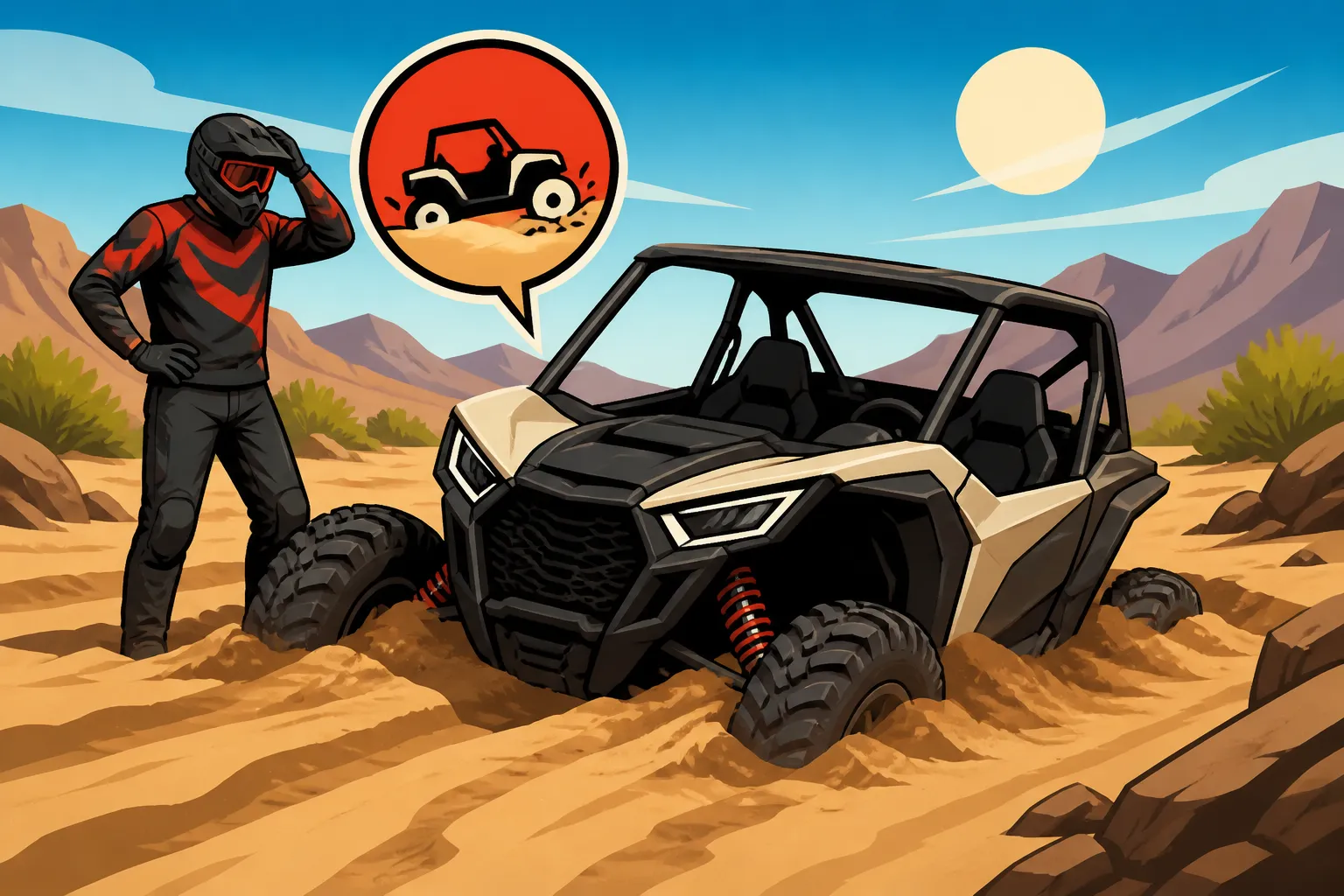
Getting Stuck in a Sand Wash
A sand wash can look like the easiest way across the desert until your ATV or UTV starts digging in, loses momentum, or settles onto its frame. Getting unstuck safely is less about adding throttle and more about protecting people, avoiding damage, and choosing a recovery method that suits the machine and the terrain.
Why ATVs and UTVs get stuck in a sand wash
Loose sand, soft edges, and hidden obstacles
Sand washes can change from firm, packed ground to deep, loose sand within a few vehicle lengths. A surface that looks solid may have a soft layer underneath, especially where wind has piled sand against a bank or where water has recently shifted the wash. The tires may spin before the driver realizes the ground has changed.
Wash edges can be deceptively soft too. A rider may steer toward the side to find firmer ground, then sink a tire into a sandy bank. Rocks, branches, ruts, and buried debris can also sit beneath the surface. Even a small obstacle can stop a low-clearance ATV or drag a UTV’s undercarriage into the sand.
Speed alone does not solve the problem. Charging through a soft section can make a vehicle harder to control, while spinning the tires in place quickly digs holes. If you ride places such as Ocotillo Wells or the Imperial Sand Dunes, expect the terrain to vary and avoid assuming that a familiar-looking wash will stay firm from one trip to the next. For a broader look at preparation and desert-specific hazards, see California Desert Riding Safety.
A vehicle can be stuck in different ways
A quad with one buried rear tire may need a different approach from a UTV sitting on its skid plate. Before trying to move, figure out what is actually holding the vehicle. Are the tires buried? Is the frame resting on the sand? Is a wheel against a rock or bank? Is the vehicle tilted in a way that could make it unstable?
Also consider whether the vehicle is merely losing traction or is genuinely immobilized. If it can move a short distance without digging deeper, a careful, straight reposition may be enough. If the tires are spinning and the machine is settling, stop. Continuing to apply throttle can bury the tires farther, strain the drivetrain, and make recovery more difficult.
The driver’s position matters as much as the vehicle’s. A rider who is stuck in a narrow wash with a blind bend ahead has a visibility problem, not just a traction problem. Before anyone attempts a recovery, check for approaching riders, nearby machines, unstable banks, and signs that water could flow through the wash.
Know when not to enter or cross a wash
A dry wash is not automatically a safe route. Desert storms can send water and debris through drainage channels, sometimes after rain has fallen elsewhere. Never ride into flowing water, and do not treat a wash as a safe place to wait out a storm. If rain, thunder, or fast-changing weather is nearby, move to higher ground when it is safe to do so and stay clear of channels that could flood.
Route legality matters as well. A visible wash may cross private land, a closed route, or an area where riding is prohibited. Check the applicable map and signs before choosing it as a shortcut. Riding a Wash in California explains why a natural-looking route is not necessarily an authorized riding route, while California Trail Closures to Check First can help you think through closures before you head out.
What to do as soon as your machine bogs down
Stop spinning the tires and assess the scene
The instinct is often to give the throttle a little more. If the tires are already spinning without moving the vehicle, resist that urge. Let off the throttle, keep the machine stable, and avoid sudden steering inputs. On a UTV, set the parking brake when appropriate and follow the manufacturer’s guidance for securing the vehicle. On an ATV, keep your body clear of unstable parts and do not stand downhill or in the vehicle’s likely path if it shifts.
Take a moment to look around. Is the wash clear of other riders? Is the machine on a slope? Is sand sliding from the bank? Is there any risk of water, fire, or heat exposure? If the vehicle is in a dangerous location, move people away from it before working on the machine. A recovery can wait; preventing a collision or injury cannot.
Next, identify the simplest safe option. If the vehicle is on level ground and only lightly bogged down, clearing loose sand from in front of the tires may be enough. If the vehicle is high-centered, has a wheel trapped, or is leaning precariously, do not try to force it free with repeated throttle. You may need help, equipment, or a different recovery plan.
Clear sand and try a controlled self-recovery
If the machine is stable, begin by removing sand from around the tires and beneath the parts of the frame that are resting on the ground. A shovel is useful, but even a compact tool can make a difference when the sand is not packed hard. Clear a gradual path in the direction you intend to travel rather than digging a steep hole in front of the tires.
If you have traction boards, place them as directed by their manufacturer, with a clear path for the tires to climb onto them. Keep hands, feet, and loose clothing away from moving wheels. If the vehicle moves, use smooth, measured throttle and steer as straight as the terrain allows. Stop if the tires begin digging again. Repeated attempts that deepen the holes usually make the next attempt harder.
A gentle rocking motion may help in some situations, but it is not suitable for every vehicle or every stuck position. Follow the machine’s operating guidance, avoid abrupt forward-and-reverse changes, and do not ask a passenger to push from a dangerous position. If the tires are buried to the hubs, the vehicle is resting on its frame, or the machine is unstable, skip the repeated self-recovery attempts and reassess.
Check tire pressure without making a new problem
Tire pressure can affect how a machine behaves in soft terrain, but there is no universal pressure that is right for every ATV, UTV, tire, load, and riding surface. Use the vehicle and tire manufacturers’ recommendations as your baseline. If you are considering a pressure change for sand, make it cautiously and stay within the equipment’s limits.
A tire that is too low can come off its bead, become damaged, or handle poorly. A UTV carrying passengers, tools, or other cargo may need different considerations from a lightly loaded ATV. Do not bleed air from a tire simply because another rider says a certain setting worked for them. You also need a way to restore pressure before returning to firmer ground or riding at higher speeds.
For a more detailed discussion of how pressure affects traction, see Soft Sand and Tire Pressure. If you use a route-planning tool such as onX Offroad, check the route and surrounding terrain before the ride, but do not treat a map as a substitute for reading the ground in front of you. Conditions in a wash can change quickly and may not be visible on a mapped route.
Safe recovery methods for a stuck ATV or UTV
Choose a recovery point and equipment that fit the machine
If a basic self-recovery does not work, use equipment designed for the vehicle and recovery task. A winch, recovery strap, shackles, and rated attachment points must be compatible with the machine and one another. Use the vehicle’s designated recovery points rather than attaching to a suspension part, bumper that is not rated for recovery, axle, or an improvised tie-down point.
Before a pull, read the equipment instructions and inspect the gear for damage. Make sure everyone understands who is operating the pulling vehicle and who is directing the recovery. Keep bystanders well away from the line of pull and never stand between two vehicles connected for recovery. Do not wrap a strap around someone’s body or use a person as an anchor.
A winch can offer more control than a quick tow in some situations, but it still creates serious hazards. Keep people away from a loaded line, use any recommended line dampener, and operate the winch from a safe position. If you are unfamiliar with the equipment or cannot identify a suitable recovery point, stop and seek help rather than improvising.
Make the pull slow, straight, and coordinated
Before pulling, clear the intended path and decide where the stuck machine should go. The driver should know whether to steer, use gentle throttle, or keep the vehicle in neutral, depending on the recovery setup and manufacturer guidance. The person directing the recovery should stand where they can be seen without being in the path of the cable, strap, or vehicle.
Start with a slow, controlled pull. A sudden jerk can damage attachment points, break recovery gear, or cause a vehicle to lurch into an obstacle. If the machine does not move, stop and reassess rather than adding more force. It may still be high-centered, the recovery angle may be wrong, or the anchor may not be suitable.
When the machine is free, do not immediately accelerate away. Stop in a stable area, check for damage, and look for sand packed around the brakes, cooling components, or other vulnerable parts. Inspect tires and recovery gear before continuing. If something feels wrong—such as steering that pulls, unusual noises, or a warning light—do not ignore it just to get back to camp.
Decide when outside assistance is the safer choice
There is no prize for getting a machine out without help. Call for assistance if the vehicle is at risk of tipping, is badly damaged, is stuck in a location with poor visibility, or cannot be recovered with the equipment and experience available. A stuck vehicle near extreme heat, an approaching storm, or a route where other riders cannot see it deserves prompt attention.
Keep the group together and make sure someone knows your location. Share a map pin or coordinates when possible, and describe recognizable landmarks rather than relying only on a trail name. If your phone has service, a navigation app such as onX Offroad may help you record or share a location, but coverage can be unreliable in remote desert areas. Do not split up without a clear plan, especially in hot weather or after dark.
If you are stranded, conserve water, protect yourself from heat, and keep clear of active routes. A machine can be repaired or recovered later; dehydration and exposure can become urgent problems. For desert-specific preparation around temperature and exposure, read Heat Risk on Desert Sand.
How to reduce the chance of getting stuck again
Read the wash before committing
Look ahead before entering a soft section. Watch for loose, pale sand, deep tire tracks, steep banks, and abrupt changes in texture. If you cannot see what lies beyond a bend or dip, stop where you have a clear view and assess the route rather than charging in. A short walk to inspect the next section may be safer than discovering a deep pocket from the driver’s seat.
Choose a line that avoids obvious holes and sharp turns in the loosest sand. Keep enough momentum for the surface without driving faster than your visibility and control allow. If another rider is already struggling ahead, leave space and wait until the route is clear. Following too closely can put you in the same soft patch and leave little room to maneuver.
A GPS track can help with general orientation, but it cannot tell you whether a particular patch of sand is firm today. Use California Trail Maps and Where to Get Them to plan your route, then combine that planning with current signs, posted closures, and what you can see on the ground. Apps such as onX Offroad can be useful for reviewing a route and saving navigation details before you lose cell service; verify access and conditions through the appropriate land manager as well.
Carry recovery basics and make a group plan
A compact recovery kit is easier to use when everyone knows where it is and how it works. Depending on your vehicle and riding plans, useful items may include a shovel, traction boards, gloves, a tire-pressure gauge, an inflator, a compatible recovery strap or winch gear, and a first-aid kit. Check that the gear is in good condition and that your machine has appropriate recovery points.
Before the ride, agree on a simple plan: who carries the recovery equipment, how you will communicate, and what the group will do if someone becomes separated or a vehicle breaks down. Pack enough water and supplies for the route, not just the expected riding time. In desert conditions, a minor delay can become a much bigger problem if the group is unprepared.
Finally, match the route to the least experienced rider and the least capable machine in the group. A narrow, soft wash that an experienced driver can manage may be a poor choice for a novice rider or a loaded UTV. Turning around is often the most practical recovery decision you can make before anyone gets stuck.
| Situation | Safer first step | Avoid |
|---|---|---|
| Tires spin but the machine is stable | Stop, inspect the sand, and clear a gradual path | Applying more throttle until the tires dig deeper |
| The frame is resting on sand | Clear sand beneath the frame and reassess | Pulling hard before the machine can move freely |
| The vehicle is leaning or near a steep bank | Move people to a safe position and plan carefully | Standing downhill or beside a vehicle that could shift |
| A recovery pull is needed | Use compatible gear and designated recovery points | Improvised attachment points or standing near a loaded line |
| Weather is changing near a wash | Move away from the drainage when safe | Waiting in the wash or riding into flowing water |
| You lack suitable gear or experience | Call for help and share your location | Attempting a risky recovery just to avoid a delay |
Disclaimer
This article is for general informational purposes only and does not constitute professional advice. Laws, prices and regulations vary by location and change over time. Consult a qualified professional for guidance on your specific situation.