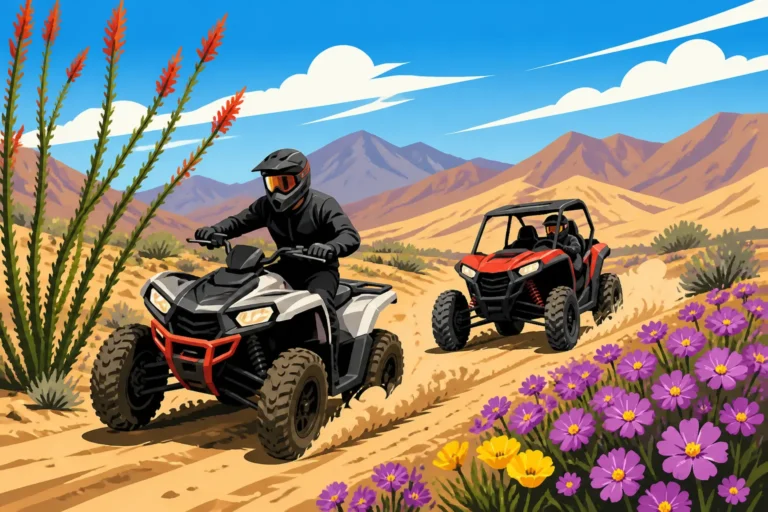
Shell Reef and Blow Sand Hill
Shell Reef and Blow Sand Hill are two very different reasons to ride in Ocotillo Wells: one is a striking natural landmark, while the other is a soft-sand challenge. This guide explains how to plan for both, choose suitable machines, navigate responsibly, and avoid common desert-riding mistakes that can turn a fun outing into a difficult recovery.
Understand the Two Ocotillo Wells Landmarks
Shell Reef is a place to slow down and look
Shell Reef is known for the shell material visible in the desert landscape. It is a sightseeing stop, not an obstacle course. Riders often arrive expecting to explore the feature up close, but the more considerate approach is to stay on designated routes, take in the area without disturbing it, and leave shells and other natural materials where they are.
That matters because a landscape can look rugged and resilient while still being vulnerable to repeated vehicle traffic and casual collecting. A quick stop for photos can become damage if riders leave marked routes, climb onto fragile formations, or move material around. Keep your vehicle in an appropriate stopping area and follow posted signs if access is restricted or redirected.
Shell Reef is also a useful reminder that a desert ride is not only about driving. Plan time to stop, drink water, check your surroundings, and let other riders pass safely. If you are riding with children or a group that includes new drivers, agree in advance on where to regroup so nobody feels pressured to keep moving through an area they would rather view on foot.
Blow Sand Hill is a soft-sand riding challenge
Blow Sand Hill is a different kind of stop. Its loose sand and slopes can test traction, throttle control, vehicle setup, and judgment. A hill that looks manageable from the bottom may feel much steeper once you are climbing it, especially when the sand is churned up or visibility is reduced by other vehicles.
You do not have to climb every feature to have a good ride. Watch the hill for a while before deciding whether to attempt it. Notice where riders are climbing and descending, whether traffic is crossing your intended line, and whether you have a clear way to stop or turn around. If the approach is crowded, the sand is too soft for your machine, or you are uncertain about your ability, skipping the climb is a sound decision.
Blow Sand Hill should not be treated like a guaranteed test of skill for every rider. A recreational ATV, a youth quad, and a side-by-side can behave very differently in deep sand. The machine’s power and size do not remove the need to choose a line carefully, maintain space from other vehicles, and avoid climbing directly into someone else’s path.
Plan each stop for a different pace
It is tempting to put Shell Reef and Blow Sand Hill into one continuous riding objective, but they reward different approaches. Shell Reef calls for a careful, low-impact visit. Blow Sand Hill calls for observation and a deliberate decision about whether the terrain is appropriate for you and your machine.
Before leaving camp or a staging area, make sure everyone understands the plan. Set a meeting point in case the group becomes separated, and avoid relying on one rider’s memory of the route. A paper map or saved offline mapping can help when cell service is unreliable. Tools such as onX Offroad may be useful as a supplemental navigation reference, but compare any app information with current land-management maps and posted signs. For more trip-planning context, see California Trail Maps and Where to Get Them.
Choose a Route and Prepare Your Machine
Check maps, signs, and closures before riding
Ocotillo Wells has a broad network of riding opportunities, and route conditions can change. Do not assume that a track shown on a phone is currently open, that a visible path is an authorized route, or that every route is suitable for every vehicle. Follow signs at the site and check the relevant official maps and closure information before setting out.
This is especially important when the terrain looks open. Desert washes, hillsides, and bare-looking ground can tempt riders to cut across country, but an unmarked line may cross a protected area or a closed route. Stay on routes open to your vehicle and stop before a sign or barrier rather than treating it as a suggestion. A navigation app such as onX Offroad can help you review your planned route, but it should not overrule site signage or land-management instructions.
A practical planning routine is to check the map before the trip, confirm the day’s route at the staging area, and keep a backup plan that does not depend on reaching one particular landmark. For additional closure-planning advice, read California Trail Closures to Check First and California OHV Areas After a Storm.
Match the route to your ATV or UTV
A route that feels comfortable on a compact quad may be awkward for a wider side-by-side. Width, turning room, ground clearance, tire condition, passenger load, and the driver’s experience all affect how a machine handles in sand. Do not judge suitability by engine size alone. A powerful machine can still bog down, slide sideways, or become difficult to control if the driver enters loose terrain too quickly.
For a side-by-side, consider whether you can turn around safely and whether other riders will have room to pass. A wide vehicle may need more room on a narrow route, while a heavily loaded machine may respond differently on a slope than it does on firm ground. On a quad, make sure the rider can maintain control without being pushed into a climb that exceeds their ability. For registration questions, see Registering an OHV in California, California OHV Registration for a Dirt Bike, or California OHV Registration for a Side-by-Side, depending on what you ride.
Give the machine a basic pre-ride check. Inspect tires and wheels, fuel, controls, lights, brakes, and visible leaks. Carry the tools and recovery equipment appropriate to your vehicle and experience. If you are unsure how to use a recovery strap or winch safely, learn before the trip rather than trying to improvise after a vehicle is stuck.
Carry navigation and essentials that work without a signal
Desert navigation should not depend on a live phone connection. Save the information you need before leaving service, bring enough battery power for the day, and carry a backup map. If you use onX Offroad, check that your intended map area is available offline before your ride and know how to read it without searching menus while moving.
A useful navigation setup is simple: identify your starting point, route options, a turnaround point, and the way back. Share that plan with the group. If one rider is following another, agree on how often to regroup and what to do if someone loses sight of the group. A designated lead and sweep rider can help, but the sweep should not be expected to rescue a group that has separated without a plan.
Carry more water than you expect to need, along with food, sun protection, a first-aid kit, and a way to communicate in an emergency. Pack tools and recovery supplies suited to your vehicle. Keep important items secure so they do not shift or fall out on rough ground. For broader trip preparation, California Desert Riding Safety covers the kinds of practical precautions worth considering before a desert outing.
Ride Blow Sand Hill With a Clear Safety Plan
Watch traffic before committing to a climb
Before you attempt a sandy slope, spend a few minutes watching how traffic moves. Look for riders beginning their climb, descending, stopping, or turning across the hill. Choose a time when the line you intend to use is clear, and wait if another vehicle is already on it. A slope can become hazardous quickly when riders approach from different directions or disappear in a cloud of dust.
Do not start a climb if you cannot see enough of the route to make a sensible decision, or if you are unsure where you will go if the vehicle loses momentum. Keep a generous gap from the vehicle ahead. Following too closely leaves little room to react if the rider slows, turns, or becomes stuck. If you lose momentum, avoid making a sudden move across another rider’s line.
Riders should also agree on a simple signal and regroup plan before the climb. A group that spreads out across the slope can create confusion for everyone. If a rider is uncomfortable, let them wait in a safe spot with a clear view rather than urging them to try again immediately.
Use steady control and respect your limits
In soft sand, abrupt steering and sudden changes in throttle can make a vehicle harder to manage. Approach at a controlled pace that suits the terrain and the machine. Avoid making a climb a race, and do not copy another rider’s speed without knowing how their vehicle is set up or where their line leads.
If the vehicle is not responding as expected, do not keep pushing simply because you are already partway up. A poor line, loss of traction, or unfamiliar machine can turn a manageable attempt into a dangerous one. Stop only where it is safe to do so, keep clear of other traffic, and seek help from your group if needed. Riders should know how to use their vehicle’s controls and recovery equipment before attempting challenging terrain.
Passengers in a UTV should be seated and secured according to the vehicle’s equipment and applicable rules. A passenger should not lean out, stand, or distract the driver during a climb. Operators should make sure everyone understands that the driver may choose to turn around or skip the obstacle at any point.
Reduce risk if someone gets stuck
A stuck vehicle can attract other riders, but extra people and machines around it can make the situation more dangerous. Move bystanders to a safe location, keep the route clear, and make sure no one stands in the path of a tensioned strap or cable. Use recovery equipment only as intended, and do not attach it to an unsuitable point on the vehicle.
Avoid spinning the tires repeatedly in the same spot. That can dig the machine in deeper and make the recovery more difficult. If the vehicle cannot be freed safely with the equipment and knowledge available, stop and get appropriate help rather than escalating the attempt. Be especially cautious about recovery on a slope, where a vehicle can shift unexpectedly.
When the group is ready to move again, reassess the route. A recovery can use time, energy, and water, so it may be sensible to shorten the ride and return by a familiar route. It is better to arrive back safely than to continue toward a planned landmark after conditions or the group’s energy have changed.
Make a Responsible Visit to Shell Reef and Blow Sand Hill
Respect the land and other riders
Stay on open routes and avoid creating new tracks. Keep a safe distance from other vehicles, and slow down near stopped riders, pedestrians, and sightseers. At Shell Reef, give people room to look around without vehicle traffic crowding the area. At Blow Sand Hill, wait for a clear line instead of joining a busy climb simply because others are attempting it.
Leave natural features undisturbed. Do not take shells, move rocks, carve into formations, or leave trash behind. A small impact repeated by many visitors adds up, and it can also change what future riders come to see. Pack out everything you brought, including food wrappers and broken equipment.
Follow the applicable rules for your machine and riding area, including registration, sound, and spark-arrester requirements where they apply. The details can depend on the machine and where you ride, so check the relevant guidance before the trip. Helpful background includes California Spark Arrester Rules, California Trail Closures to Check First, and Ocotillo Wells and California’s Thirty-Day Camping Rule.
Choose timing with comfort and visibility in mind
Desert conditions can make a familiar route feel very different. Heat can drain energy faster than expected, while wind and dust can reduce visibility and make it harder to keep track of other vehicles. If conditions are uncomfortable or visibility is poor, change the plan. A shorter ride, a later start, or a decision to return to camp can be the right choice.
Spring can bring pleasant riding conditions, but seasonal weather and ground conditions still vary. Before heading out, check current local information and be prepared to adjust. Ocotillo Wells in Spring offers additional seasonal context. If your group includes less experienced riders, avoid turning the day into a long push between distant stops. Build in water breaks and give everyone permission to call for a pause.
Keep an eye on the group, not only the route. A rider who is quiet, unusually slow, or struggling to focus may be tired, overheated, or stressed. Stop in a safe place, offer water and shade where possible, and reassess whether it makes sense to continue. Riding within the group’s comfort level is part of good trip planning, not a failure to complete the itinerary.
Use a simple pre-ride checklist
A short check before departure can prevent avoidable problems later. Confirm that every rider knows the route plan, meeting point, and turnaround option. Make sure vehicles are suitable for the planned terrain, and review the day’s conditions and any posted restrictions. If you use a phone app such as onX Offroad, verify your saved map before service becomes unreliable and keep a second navigation option available.
| Before you ride | What to check |
|---|---|
| Route | Open routes, signs, closures, turnaround points, and a backup plan |
| Vehicle | Tires, controls, brakes, fuel, lights, and recovery equipment |
| Riders | Experience, protective gear, passenger readiness, and group signals |
| Supplies | Water, food, sun protection, first aid, tools, and battery power |
| Conditions | Heat, wind, visibility, surface conditions, and the group’s energy |
| Land care | Stay on designated routes, respect restrictions, and pack out trash |
Shell Reef and Blow Sand Hill offer different experiences within the same desert riding area: one rewards a careful stop, and the other asks for a thoughtful decision about terrain and ability. Plan with current maps and signs, ride within your limits, and leave room in the day to change course. Those choices make the visit safer and help keep the area enjoyable for the next group.
Disclaimer
This article is for general informational purposes only and does not constitute professional advice. Laws, prices and regulations vary by location and change over time. Consult a qualified professional for guidance on your specific situation.