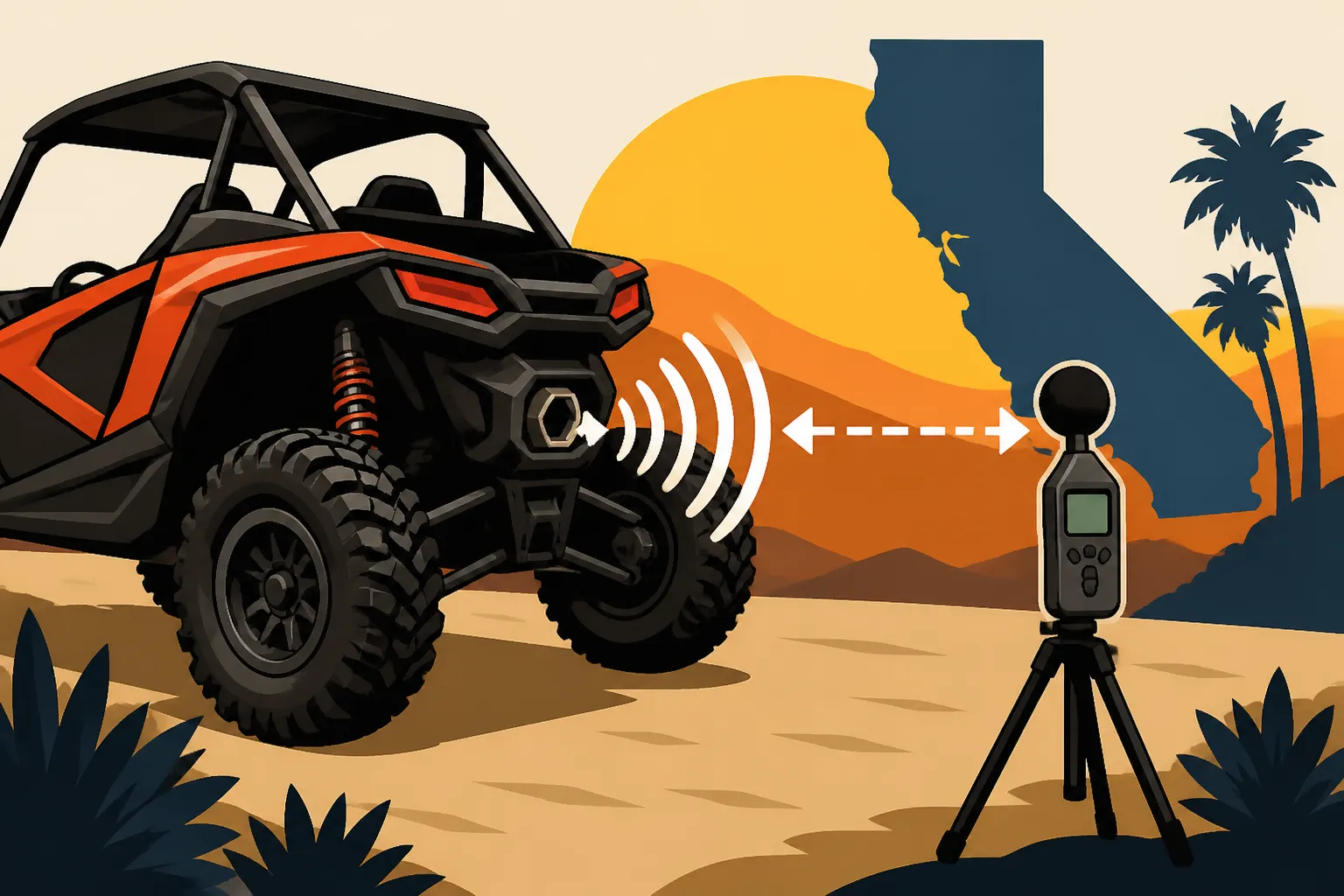
Measuring Sound at 20 Inches
A California sound check can turn a ride into a frustrating stop if an ATV or UTV is too loud, even when it sounds normal to its rider. The 20-inch measurement is a specific test setup, not a casual judgment made beside the trail. Understanding where the meter goes, what can affect the reading and how to prepare helps you avoid preventable problems.
What “measuring sound at 20 inches” means
The 20-inch distance describes where a sound meter’s microphone is positioned for a stationary exhaust-noise test. It is measured from the exhaust outlet, not from the machine’s body, the rider’s ear or the edge of the trail. The test is intended to make readings more consistent by using a defined position and procedure.
California OHV sound rules apply to more than machines registered in California. If you ride public land in the state, your machine may need to meet the applicable sound limit even if it is from out of state or you have the right permit for your visit. A permit or registration does not make an excessively loud exhaust acceptable.
The sound check is also not the same as measuring noise from a machine speeding past. A moving vehicle’s sound changes with distance, direction, throttle and nearby terrain. A stationary test focuses on exhaust noise at a controlled engine speed and microphone position.
A typical 20-inch setup places the meter beside the exhaust outlet, at an angle and height specified by the applicable test procedure. The exact positioning and engine speed matter. A reading taken with the microphone much closer, pointed at the wrong place or taken while the engine is revving inconsistently may not be comparable with a proper test.
California’s sound rules include different limits for different machine categories and model years. Don’t assume that one number applies to every ATV, UTV, dirt bike or competition machine. For an overview of the limits, see California ATV Sound Limits Explained. Related rules and categories are covered in California Sound Limit for ATVs, California Sound Limit for Older Machines and Competition Machines and California Decibels.
How the 20-inch test is set up
The distance is only one part of the test. The position of the microphone, engine speed, exhaust condition and surrounding environment can all influence the meter reading. A sound test needs to follow the applicable procedure rather than rely on someone standing nearby and deciding that a machine sounds loud.
In a standard stationary test, the meter is placed a set distance from the exhaust outlet and oriented at the specified angle. The engine is then brought to the test speed required by the procedure. That speed is not necessarily idle, full throttle or the same RPM for every machine. The applicable procedure determines how the test speed is selected.
The test setup is designed to reduce some sources of variation. It does not remove every variable. A hard surface can reflect sound; wind and nearby engines can interfere; and a loose or damaged exhaust can produce a different reading than a properly maintained one. For that reason, a single number from a consumer meter may not tell you whether your machine will pass an official check.
| Test detail | Why it matters | What to keep in mind |
|---|---|---|
| Microphone distance | Sound level changes as the microphone moves closer to or farther from the exhaust | The 20 inches is measured from the exhaust outlet |
| Microphone angle and height | Direction and position can change the reading | Follow the applicable test procedure rather than aiming by eye |
| Engine speed | Exhaust noise changes with RPM and throttle | Don’t rev the engine arbitrarily during a test |
| Exhaust condition | Leaks, loose parts or damaged packing can increase noise | Inspect and repair the exhaust before riding |
| Surroundings | Wind, walls, vehicles and other noise can affect readings | A quiet, suitable testing area gives more useful results |
| Meter and operator | Equipment settings and technique affect consistency | A phone app or inexpensive meter is not a substitute for an official procedure |
A sound meter gives a reading in decibels, commonly expressed as dBA for these tests. The scale is logarithmic, so a small numerical change does not translate neatly into a small change in perceived loudness. More importantly, a reading has meaning only in relation to the test setup and the limit that applies to that machine.
If you want to understand the test sequence in more detail, see California Sound Test Procedure. For how enforcement checks may work in practice, How a Ranger Measures Your Exhaust Noise explains why the meter position and engine operation matter.
Why angle and height matter
Sound does not travel evenly in every direction from an exhaust outlet. The outlet’s direction, the shape of the muffler and nearby surfaces can influence what reaches the microphone. That is why a prescribed angle and height are part of a consistent test rather than minor details.
The outlet may point rearward, downward or slightly sideways, depending on the machine. Don’t measure from a convenient spot on the fender or muffler body if the procedure specifies the outlet. If you are doing a maintenance check at home, use the correct reference point and treat the result as a rough comparison, not a guarantee.
Why engine speed matters
A quiet idle does not prove that a machine will pass. Exhaust noise typically increases as the engine works harder, and the prescribed test speed is meant to evaluate the machine at a repeatable operating point. A test at full throttle can also be misleading if the official procedure calls for a different RPM.
If you do not know the required test speed for your machine, avoid guessing. Check the applicable procedure or ask a qualified shop familiar with OHV sound testing. The rules can depend on the vehicle category and other details, so a generic RPM recommendation may not fit.
What can cause a high reading
A sound check can go badly even when the exhaust looks intact from a distance. The most common practical issue is a change in the exhaust system: an aftermarket muffler, a missing or altered insert, worn packing, a damaged spark arrester or a leak at a joint can all affect noise.
A louder exhaust is not automatically an illegal exhaust, and an aftermarket part is not automatically too loud. The relevant question is whether the complete machine meets the limit that applies to it when tested correctly. A manufacturer’s description, a label on a part or a seller’s claim is not a substitute for a measured result.
Before a ride, check the following:
- Muffler and joints: Look for cracks, loose clamps, missing fasteners, soot marks or gaps that may indicate a leak.
- Packing and internal parts: Some mufflers use packing that can wear or deteriorate. A muffler that was quiet when new may become louder over time.
- Inserts and baffles: Confirm that any required insert or baffle is installed and secured. A removable part left out for a track day can create trouble on a public-land ride.
- Spark arrester: Check that the arrester is present, intact and appropriate for the machine and riding area. Sound compliance and spark-arrester compliance are separate questions.
- Recent modifications: Replacing a header, changing an exhaust outlet or removing internal components can affect both performance and sound.
- Loose bodywork: A rattling panel may not be exhaust noise, but it can make a machine seem louder and can mask an exhaust problem during an informal check.
A sound meter sold through a retailer such as Amazon can help compare one setup with another, but a consumer meter is not automatically accurate enough for enforcement or calibrated to the official test. A phone app is even less reliable as proof of compliance. Use those tools, if at all, to spot a noticeable change after maintenance—not to certify that the machine will pass.
If you are considering an exhaust change, keep the original components where possible and confirm the replacement is suitable for your exact machine and intended use. A part that works well at a closed-course event may not be appropriate for public land. For more on modifications and testing, see Aftermarket Exhaust and California Sound Checks.
A simple pre-ride check
You do not need special equipment to spot many problems. With the engine off and cool, inspect the muffler, outlet, clamps and visible connections. Check that the machine’s sound-control parts are present, secure and not obviously damaged. If the exhaust has recently become louder, investigate before heading to a riding area.
Do not put your hand near a hot exhaust or try to block the outlet while the engine is running. Avoid testing at high RPM in a crowded camp, near other riders or beside a wall that can reflect sound. If a shop has suitable equipment and experience with the relevant procedure, a controlled test is more useful than repeated revving in a driveway.
How rules apply to visitors, permits and different machines
The sound requirement is a separate issue from registration, an out-of-state permit or reciprocity. A visitor may need the correct California permit or other accepted identification to ride, but that document does not certify the machine’s exhaust. Likewise, a machine’s home-state registration does not automatically establish that it meets California sound rules.
This distinction is easy to miss when planning a trip. Riders often focus on whether their paperwork is valid, then discover that equipment rules are checked separately. Before traveling, confirm both the riding-access requirements and the sound rules that apply to the machine. [California OHV Reciprocity Rules] explains the permit and reciprocity side; it does not replace equipment compliance.
The applicable sound limit can depend on machine type and model year. ATVs, UTVs, motorcycles and competition machines may not all be treated identically. If a machine is old, modified or built for competition, look for the rule that specifically fits it rather than borrowing a limit from a different category. The overview in California’s ATV Sound Limits Explained can help you identify which category to investigate.
A UTV can also create a different practical testing challenge from a small ATV. Its exhaust outlet may be higher, angled differently or partly enclosed by bodywork. That does not change the need to use the specified reference point. It does mean that a casual measurement from beside the vehicle may not reproduce a proper test.
If the machine is a competition model, do not assume that the word “competition” gives it a blanket exemption from sound rules on public land. A track’s own testing policy may differ from the requirements for a state riding area, forest road or other public location. Verify the rules for the specific place and activity.
Preparing for a check and responding to a failure
The most reliable way to reduce the chance of a problem is to keep the exhaust in good condition and avoid unverified modifications. If you know the machine is close to the applicable limit, have it tested using the correct method before a long trip. An informal test can identify a clear problem, but passing a home test is not a guarantee of passing an official one.
If an enforcement officer or riding-area employee checks the machine, stay calm and follow directions. Don’t argue over a reading before you understand where the microphone was placed, how the engine was operated or which limit applies. If the check appears inconsistent, politely ask what procedure and vehicle category are being used. A disagreement is easier to resolve with specific questions than with a running engine and a crowd gathering around.
If a machine fails, ask what the next step is and whether you may correct the problem or need to stop riding. The answer can depend on the location and the circumstances. Do not assume that you can continue riding after a failed check simply because you have a permit, a registration card or a sound-reducing part in your toolbox.
A practical response is to:
- Confirm the machine and category. Make sure the test is being applied to the right type and model year of vehicle.
- Ask about the procedure. Clarify the microphone position and the test conditions, without obstructing the check.
- Inspect for an obvious fault. A loose clamp, damaged muffler or missing insert may explain an unexpectedly high reading.
- Follow the site’s instructions. If you are told not to ride, don’t try to move the machine under its own power through the area.
- Arrange a proper repair or retest. Have the exhaust examined by a qualified shop and retest it under suitable conditions before returning to public riding.
A failed sound check can have consequences beyond being asked to make a repair. Enforcement outcomes depend on the circumstances and the applicable rules, so don’t rely on assumptions about warnings or penalties. See Failing a Sound Check at a Gate and California Fines for a Loud Machine for more on those issues.
Keep relevant paperwork accessible, but remember that documents do not prove sound compliance. A photo of a registration card may help with an identification check; it cannot establish that an exhaust met a sound limit. For general document-carrying advice, see Carrying Paperwork on the Sand.
When to ask a shop for help
A shop is especially useful if the sound changed gradually, the muffler has serviceable packing, or the machine has a nonstandard exhaust. Ask whether the shop can test the machine using the procedure relevant to California OHV use, not just whether it can install a replacement part.
Bring the machine in its normal riding configuration. If you remove an insert for transport to the shop or change the exhaust after a test, the result may not reflect the setup you take to the riding area. Keep a record of repairs and parts, but treat that record as maintenance history rather than proof of a passing reading.
Don’t make a last-minute exhaust change based only on a guess. A replacement can be louder, quieter or simply different from the original. Confirm fitment and intended use before the purchase, and test the completed setup.
Frequently Asked Questions
Is the microphone placed 20 inches from the muffler?
The reference is the exhaust outlet, not simply the muffler casing. The test procedure also specifies other details, including microphone orientation and engine speed.
Can I use a phone app to prove my ATV meets the limit?
No. A phone app can provide a rough comparison, but it is not reliable proof that the machine passes a properly conducted test.
Does an out-of-state permit exempt my machine from California sound rules?
No. Access paperwork and equipment compliance are separate. A permit does not certify an exhaust system.
Will an aftermarket exhaust automatically fail?
Not automatically. The outcome depends on the complete machine’s measured sound, the applicable limit and whether the test is conducted correctly.
Should I test the machine at full throttle?
Not unless the applicable procedure calls for that engine speed. Use the required test method; guessing or revving arbitrarily can produce a misleading result.
Disclaimer
This article is for general informational purposes only and does not constitute professional advice. Laws, prices and regulations vary by location and change over time. Consult a qualified professional for guidance on your specific situation.