Out-of-State Safety Certificates in California
Out-of-State Safety Certificates in California
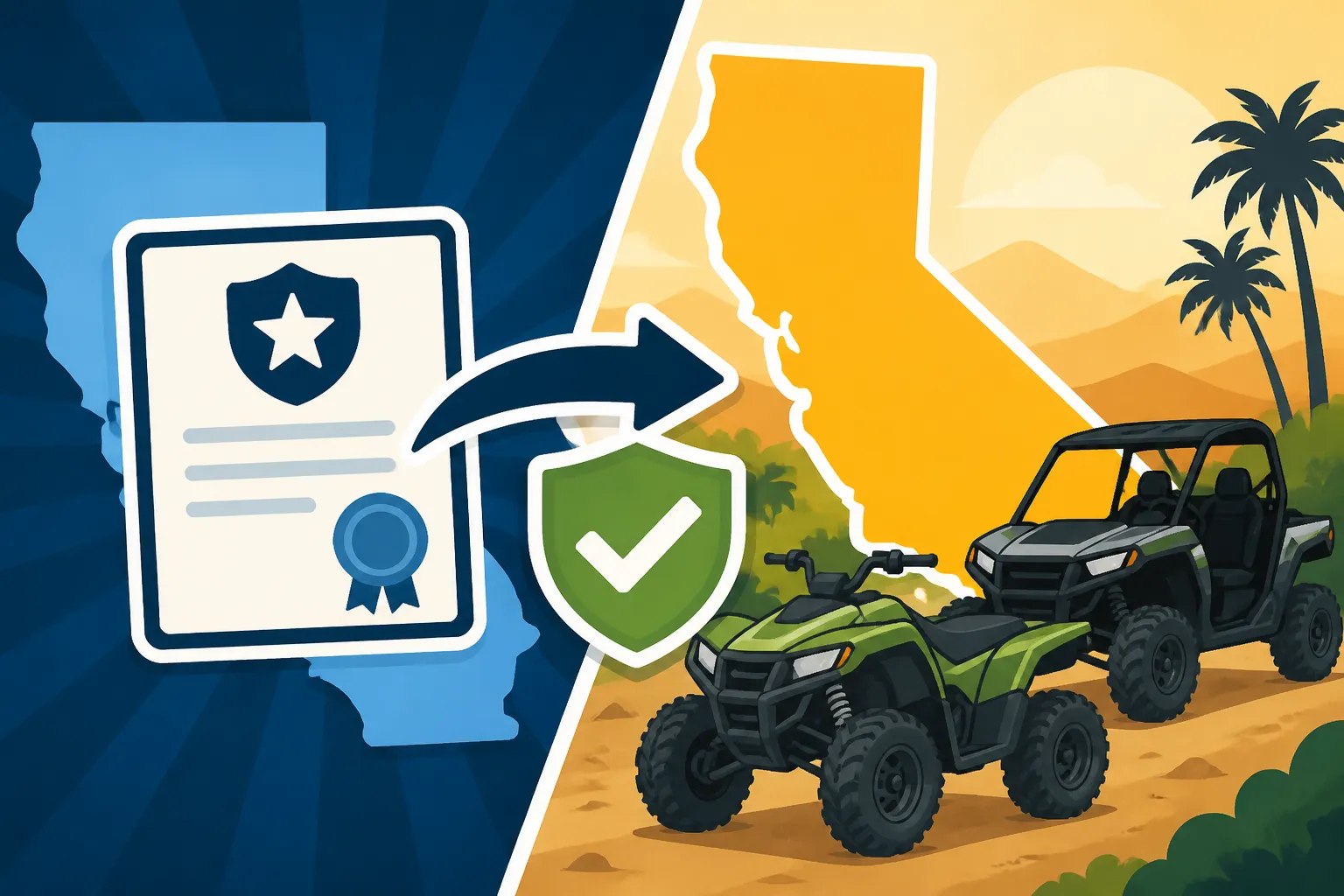
If a rider under 18 has completed an ATV or OHV safety course in another state, it is reasonable to ask whether that certificate counts in California. In many cases, an equivalent out-of-state certificate can meet California’s youth safety-certificate requirement. The key is to carry proof, check that it applies to the machine being ridden, and remember that a safety certificate is not a riding permit or vehicle registration.
The short answer: an equivalent certificate may count
California requires young OHV riders to meet safety-training or supervision rules when riding in places where those rules apply. A certificate earned outside California may be accepted if it is a valid OHV safety certificate that meets the applicable requirement. A course completion record, general driver-education certificate, or proof that someone has ridden for years is not necessarily equivalent.
For a visiting family, the practical question is not only whether the rider took a course. It is whether the document identifies a recognized course or credential, belongs to the rider, and applies to the vehicle the rider will operate. When any of those details are unclear, check with the relevant California State Parks OHV office or the land manager before the trip.
| What the rider has | What to check before riding |
|---|---|
| An OHV safety certificate from another state | Whether California accepts that certificate for the rider and machine type |
| A course completion card or email | Whether it is a certificate, and whether it shows the rider’s name and course |
| A driver’s license or learner’s permit | It does not, by itself, prove completion of an OHV safety course |
| An adult with a safety certificate | Whether the rider may operate under supervision and what “supervision” requires |
| An out-of-state registration or decal | Whether the vehicle also needs a California nonresident permit or other identification |
| A rental agreement | Whether the rental operator has separate age, training, or supervision conditions |
The certificate rule is only one part of preparing to ride. California’s youth requirements can depend on the rider’s age and whether the vehicle is an ATV or a recreational off-highway vehicle, often called an ROV or side-by-side. For a broader explanation, see [California ATV Safety Certificate Requirements] and California Rules for Riders Under 18.
A certificate also does not replace the paperwork required for the machine itself. Registration, an out-of-state permit, or a site-specific pass may still be necessary. The distinction matters because riders often assume that carrying one document settles every requirement. It does not.
What makes an out-of-state certificate useful
An out-of-state certificate is most useful when it clearly establishes that the named rider completed an OHV safety course or holds a safety credential that California recognizes for the relevant vehicle. A card with the rider’s full name, issuing state or organization, course information, and identifying number is easier to assess than a bare receipt or an email saying that a course was purchased.
Do not assume that every course called “ATV safety” has the same scope. Training can be designed for a particular vehicle category, age group, or operating setting. A course focused on a youth ATV may not automatically document training for operating a side-by-side. Likewise, a general off-road course may not meet a requirement that specifically calls for an ATV safety certificate.
When reviewing a certificate, check these details:
- Rider’s name: It should match the young person who will operate the machine. A parent’s or sibling’s certificate cannot be used as the rider’s own credential.
- Course or credential type: The document should indicate OHV, ATV, or relevant vehicle safety training, rather than a general driving class.
- Issuing organization: Note which state agency, training provider, or program issued it. This can help a California official or site employee determine whether it is comparable.
- Machine category: Check whether the course applies to an ATV, an ROV, or another type of OHV.
- Proof of completion: Keep the actual certificate or official record, not just a booking confirmation or payment receipt.
- Any conditions: Look for age restrictions, expiration information, or limitations stated on the credential.
If a certificate is incomplete or hard to interpret, contact the issuer for an official replacement or confirmation before traveling. A parent’s explanation may help answer questions, but it is not a substitute for documentation. For specifics on visitors, see California Safety Certificate for Visiting Riders.
It is also sensible to have a backup copy. Keep a paper copy with the rider’s other trip documents and a legible digital copy on a phone. A digital copy can be useful if a paper document is misplaced, but do not assume every ranger, park, rental counter, or event organizer will accept a phone image in place of the certificate. Ask the relevant office or operator what form of proof it accepts.
The certificate should be available to the rider or supervising adult while riding, not buried in luggage at a distant campsite. If a ranger or site employee asks for proof, the rider should be able to present the document promptly. More information about carrying documents is in What a Rider Under 18 Must Carry in California.
A certificate is different from a permit
A safety certificate shows that a person has completed training or meets a safety-credential requirement. A permit or registration addresses the machine’s eligibility to operate in a particular place. They serve different purposes, so one does not replace the other.
For example, a nonresident may need to check California’s rules for an OHV registered elsewhere, even if every rider has a valid safety certificate. California’s reciprocity rules for vehicle identification are separate from recognition of safety training. See California’s Nonresident OHV Use Permit and California OHV Reciprocity: Only Two States for those separate questions.
The same separation applies to site access. A recreation area may require an entry pass, event permit, or other authorization in addition to vehicle identification and rider credentials. Check the rules for the specific riding area rather than treating the safety certificate as an all-purpose pass.
Age, supervision, and the kind of machine
A young rider’s certificate is not the only factor California may consider. Age, machine type, and supervision can affect what is allowed. A rider who meets a training requirement may still be too young for a particular machine, may need an adult’s direct supervision, or may be subject to additional restrictions at a particular location.
That is why it is risky to reduce the rule to “under 18 needs a card.” The correct question is: what does this rider need to operate this machine, at this location, under these circumstances? The answer may involve a certificate, qualified adult supervision, age limits, or more than one of those conditions.
Younger riders may have added supervision requirements
For younger children, supervision rules deserve special attention. The adult may need to remain close enough to supervise effectively, and some rules may be more specific than simply having a qualified adult somewhere in the group. Do not assume that an adult riding ahead, waiting at camp, or supervising several machines from a distance satisfies the requirement.
Before the ride, confirm:
- The rider’s age category under the current California rules.
- Whether the rider needs an individual certificate or may ride under the supervision of a qualified adult.
- Whether the adult must hold a safety certificate.
- What level of supervision is required for the rider’s age and machine.
- Whether the riding area imposes stricter rules than the general statewide requirement.
The phrase “direct supervision” can matter in practice. It may not mean that an adult simply gave permission or is available by phone. Read Direct Supervision by a Certified Adult in California for the supervision issue, and check the current official guidance if the trip depends on a particular age exception.
ATV and side-by-side rules are not interchangeable
An ATV is typically operated by a rider seated astride the machine, while an ROV or side-by-side has seating and controls more like a small off-road vehicle. These categories can have different operating rules, including age requirements. A certificate that clearly covers one category should not be assumed to cover the other.
This matters especially when a family plans to switch vehicles during a trip. A teenager may be trained and permitted to ride an ATV but still need to meet separate requirements before operating an ROV. Rules for passengers are separate again: permission to operate a machine does not automatically allow a young person to ride as a passenger in every vehicle.
Check the specific machine’s category and the rider’s age before choosing a vehicle. If the youth plans to operate a side-by-side, review ROV Operators at Sixteen in California rather than relying only on an ATV course card.
The riding location may add its own conditions
California’s statewide requirements are not the only rules a rider may encounter. A state recreation area, federal land manager, organized event, rental business, or private riding facility may have its own conditions. Those rules may address age, supervision, equipment, documentation, or which vehicles are allowed.
A certificate can satisfy a training requirement and still fail to meet a separate site rule. For example, an event organizer may require a specific form of proof, while a rental company may require its own orientation before handing over a machine. Confirm the requirements with the operator or land manager, especially for a group trip or a destination with controlled entry.
How to verify and carry the certificate
A few checks before departure can prevent a last-minute dispute at a gate or rental counter. Start with the document itself, then verify the applicable California requirement and any destination-specific conditions.
- Identify the machine. Confirm whether the young rider will operate an ATV, an ROV, or another OHV. Do not rely on a general label such as “quad” if the actual vehicle has different seating or controls.
- Confirm the rider’s age and role. Rules can differ for an operator and a passenger, and age can affect whether a certificate or adult supervision is required.
- Read the certificate. Make sure it belongs to the rider and shows a relevant OHV course or credential. If details are missing, contact the issuing organization.
- Check California’s current guidance. If it is unclear whether the out-of-state credential qualifies, ask the appropriate California State Parks OHV office before the trip.
- Ask the destination. Contact the recreation area, event organizer, or land manager about its proof and supervision requirements.
- Carry the document. Bring the certificate or official record in a form the destination accepts. Keep an accessible copy rather than relying on a document stored elsewhere.
- Check the vehicle paperwork separately. Confirm registration, decals, permits, and any required site pass for the machine.
- Recheck rental conditions. If the machine is rented, ask the rental business about its age policy, required training, supervision, and acceptable proof.
If an official or operator cannot confirm that a particular certificate is acceptable, do not wait until the day of the ride to resolve the question. Contact the issuing provider for a clearer record, take a recognized course if needed, or arrange for a qualified adult to supervise only if the applicable rules allow that option. A rental shop’s willingness to rent a machine does not necessarily establish that all public-land requirements have been met.
Keep copies separate from the originals when practical. A certificate can be damaged by water, sand, or handling, so a protective sleeve helps. For a group trip, keep each rider’s record clearly identified; a stack of unnamed course cards is difficult to match to riders during a check.
Common mistakes on an out-of-state trip
The most common trouble comes from treating different credentials as if they were interchangeable. A safety certificate, driver’s license, registration, nonresident permit, and entry pass answer different questions. Carrying one does not prove that the others are unnecessary.
Assuming any course card will do
A card from a class may not say what the course covered, who issued it, or which vehicle category it applies to. If an out-of-state certificate is vague, ask the issuer for a more complete record before travel. Do not assume that a course receipt or an online account page is enough.
Using one person’s certificate for another rider
Safety credentials are personal. A parent’s certificate does not transfer to a child, and a sibling’s course record does not cover a second rider. Each young operator should have the proof required for that individual or meet a valid supervision exception.
Confusing supervision with permission
An adult’s consent is not necessarily the same as legally required supervision. If a rider depends on an adult’s certificate, check who must supervise, how closely, and whether the adult must be present during operation. The rules may also differ by age and machine.
Treating vehicle reciprocity as safety-certificate reciprocity
A state registration, decal, or plate may affect whether a machine needs California identification or a nonresident permit. It does not establish that a young rider has completed an accepted safety course. For the vehicle side, consult California OHV Reciprocity: Only Two States and the relevant permit guidance.
Assuming private land and public land have identical rules
Rules can differ depending on where the machine is operated. A private riding area may have its own operating conditions, while public lands are subject to applicable state and land-manager requirements. Ask the property owner or facility about its rules, and do not assume that a private-land exception follows the machine to a public trail or recreation area.
Relying on a rental counter to settle every legal question
A rental operator can explain its rental requirements and may provide safety instruction, but that does not necessarily resolve separate public-land obligations. Ask what the rental includes and what documents the rider must bring. The requirements for renting also may not match the requirements for operating a personally owned machine. See California Rules for a Rented Machine.
Frequently Asked Questions
Does California accept every out-of-state ATV safety certificate?
No. The certificate needs to be valid and applicable to the rider and machine. If the course or issuing organization is unclear, verify acceptance with the relevant California office or riding-area manager before the trip.
Does a safety certificate replace a California nonresident permit?
No. A safety certificate concerns rider training or a youth safety requirement. Vehicle identification and nonresident permit rules are separate. Check both before riding.
Can a parent’s certificate cover a child?
Not as the child’s personal certificate. A qualified adult’s certificate may matter under a supervision option where that option applies, but the adult must meet the supervision requirements. Check the rules for the child’s age and vehicle.
Should the rider carry a paper copy?
Carry proof in a form the relevant riding area accepts. A paper copy is useful, and a digital backup can help, but confirm whether a phone image is accepted as proof.
Disclaimer
This article is for general informational purposes only and does not constitute professional advice. Laws, prices and regulations vary by location and change over time. Consult a qualified professional for guidance on your specific situation.