Towing a Disabled Quad on a Road
A disabled quad on a California road can turn a simple ride into a stressful safety and legal problem. The right response depends on where you stopped, whether the road is open to OHVs, and what you can use to move the machine safely. This guide explains when to recover it yourself, when to call for help, and why towing does not make an otherwise prohibited route legal.
First decide whether you are actually on a road open to OHVs
Identify the road before attaching a tow strap
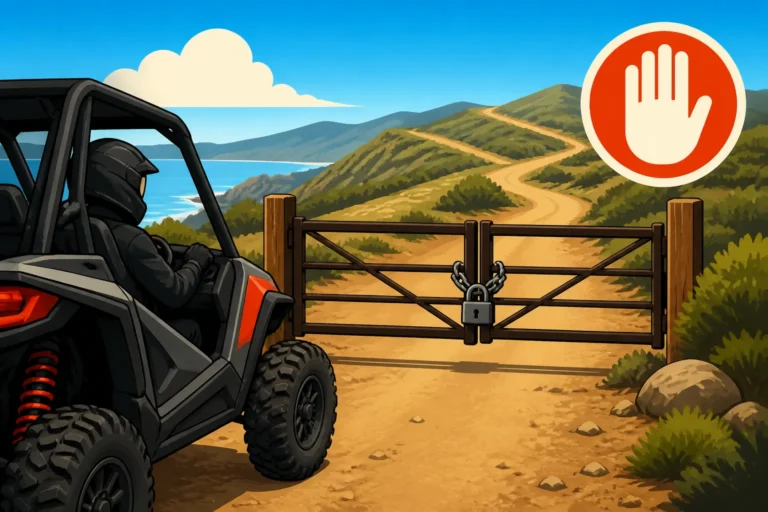
“Road” can mean a public highway, a designated OHV route, a forest road, a private access road, or a route inside a recreation area. Those categories do not all have the same rules. Before moving the quad, check posted signs, gates, maps, and the land manager’s route information. A dirt surface or tire tracks do not, by themselves, mean the route is open to motorized use.
If the machine stops on a designated route, recovery may be possible, but check that the route remains open to your type of vehicle and that towing is allowed there. On a public road where OHVs are not permitted, an emergency does not automatically make it lawful to continue riding or towing along the road. The safer choice may be to move the machine only far enough out of immediate danger, then arrange transport.
Road status can change at intersections, gates, and property boundaries. A forest road that allows highway-legal vehicles may connect to an OHV trail, for example, without making the whole route open to every vehicle. For more on how different road designations affect access, see [California's Combined-Use Highways] and [Riding Unincorporated County Roads in California].
Towing does not make a closed or unauthorized route legal
A disabled quad being pulled by another machine is still part of a motorized trip. A tow strap does not turn an OHV trail into a road open to quads, and it does not grant permission to use a closed route. If you are on a roadway where OHV access is restricted, towing along it can create the same access and enforcement concerns as riding there.
There are limited situations where a rider may need to cross a road or use a designated segment. Follow the route’s signs and requirements, and do not assume that a nearby open trail authorizes travel along the connecting roadway. The guidance in [California Rules for Crossing a Public Road] is useful when the problem is a crossing rather than a longer tow.
If the disabled quad is blocking traffic, creating a hazard, or stopped somewhere with poor visibility, prioritize safety over a roadside repair. Warn other riders, move people to a protected location, and contact the appropriate land manager or emergency service if the machine cannot be moved safely. Avoid dragging it farther down a public road just because a tow vehicle is available. For route-specific concerns, [What CHP Looks for on a Combined-Use Route] explains why riders should pay attention to the route’s designation and conditions.
Decide whether to recover it or transport it
A short, controlled recovery on a permitted route may be reasonable when the machine rolls freely, the tow vehicle is suitable, the route is open, and both riders can communicate. A quad with a locked wheel, damaged steering, a failed brake, or a broken axle is a different problem: pulling it can make the damage worse or cause it to veer unpredictably.
When there is uncertainty about road access, traffic, or the machine’s condition, trailering is usually the more controlled option. It avoids towing a loose machine along the road and lets you transport it without relying on the disabled quad’s steering or brakes. See [Trailering Instead of Riding in California] for the broader distinction between road travel and transporting an OHV.
Make the recovery as safe as the situation allows
Get people out of danger before working on the quad
First look for traffic, blind corners, loose shoulders, steep slopes, and other hazards. If the quad is in or near a travel lane, do not stand behind it while another vehicle approaches. Move riders well away from the road where possible, and use hazard lights or other appropriate warnings if the vehicle has them. Keep children and bystanders clear of the tow line and the space between the machines.
Do not ask someone to sit on a disabled quad while it is being pulled unless the machine is designed for that use, the rider can safely control it, and the route and circumstances permit it. A rider may be unable to steer or brake effectively, especially if a component has failed. Never put a person in a position where a snapped strap, shifting quad, or sudden stop could pull them into either vehicle.
Before connecting equipment, identify why the quad stopped. A dead battery may be very different from a seized drivetrain or a broken wheel. Check for obvious leaks, smoke, unusual heat, loose parts, or damage that could catch on the ground. If anything suggests a fire risk or serious mechanical failure, do not attempt a tow that could worsen the situation.
Use properly rated recovery equipment and suitable attachment points
Use a purpose-made recovery strap or winch equipment that is appropriate for the machines and the expected load. Do not substitute a chain, rope, or improvised tie-down simply because it is nearby. Check the equipment for cuts, fraying, damaged hooks, or other visible wear, and follow the equipment maker’s instructions for connecting it.
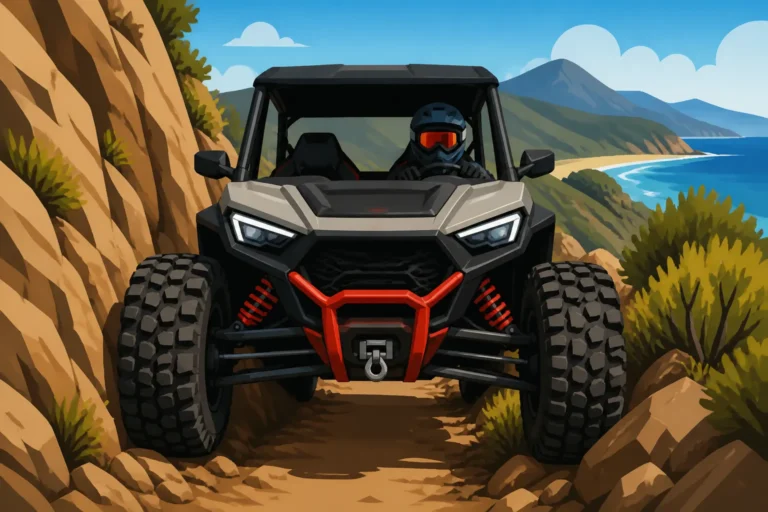
Attach only to suitable recovery points specified for the machine. A rack, bumper, axle, suspension arm, or hitch may not be designed to take a recovery load. Pulling from an unsuitable point can damage the quad or cause the connection to fail. If you are considering replacement recovery gear, SuperATV is one brand riders may encounter when researching powersports accessories; check the equipment’s intended use and compatibility rather than assuming any strap or mount will suit every machine.
Keep everyone away from the line of pull. A strap under tension can injure someone if a connection breaks or comes loose. Avoid sudden jerks: take up slack gradually and move at a controlled pace. If the disabled quad will not roll smoothly, stop rather than increasing force. A winch also needs a stable anchor and a suitable connection point; it is not a fix for an unsafe route or a machine that cannot be controlled.
Match the tow method to the failure
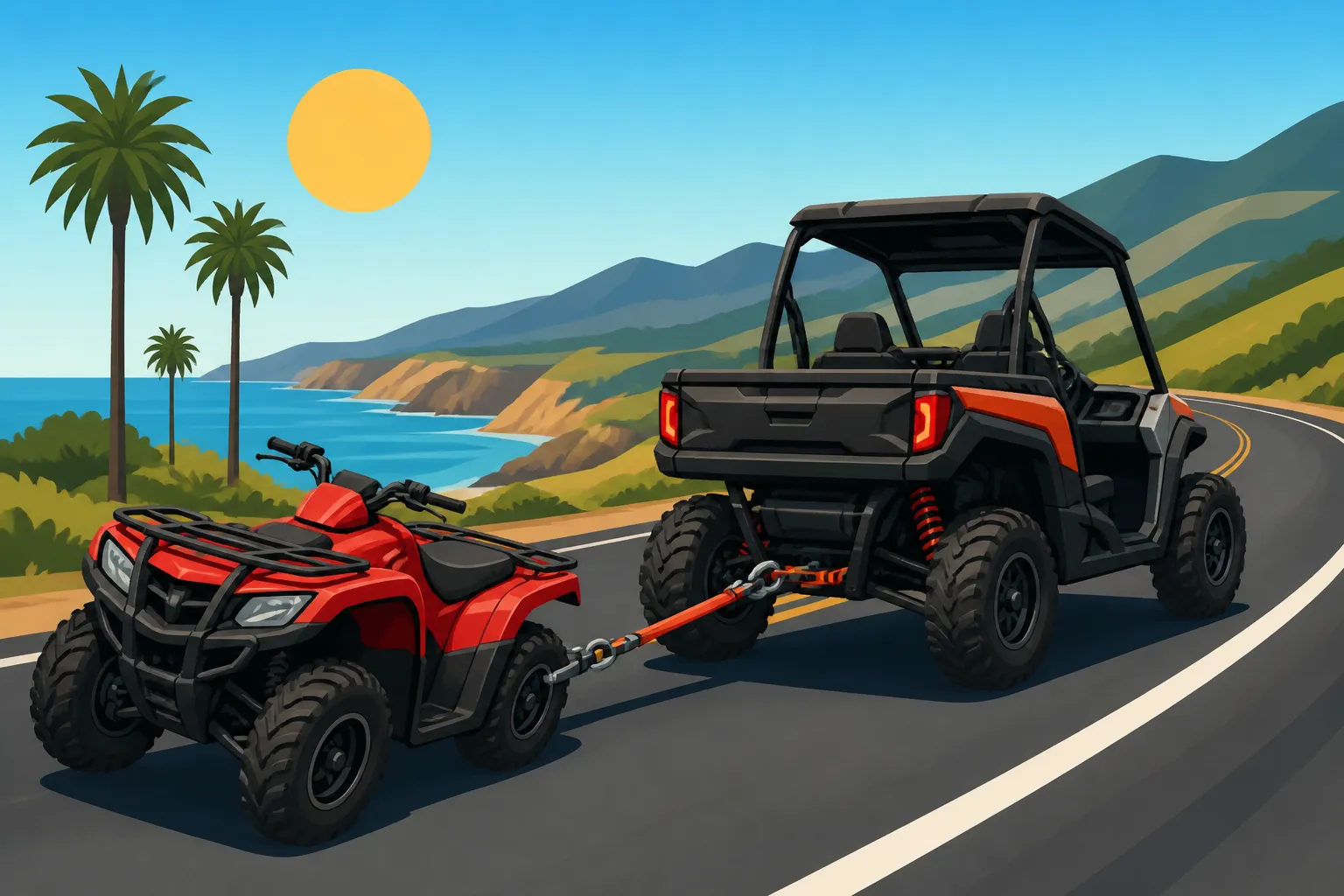
A quad that can steer, roll, and brake may be suitable for a very short, slow tow on a route where the movement is permitted. The operator should stay seated only if they can maintain control, and both riders need a clear way to signal a stop. Keep the tow line as short as practical without creating a collision risk, and avoid sharp turns, steep descents, loose sand, and crowded areas.
If steering or braking has failed, do not treat the quad as a rolling trailer. The tow vehicle may not be able to keep it aligned, and the person being towed may have no way to avoid an obstacle. A locked wheel can also drag, dig in, or cause the machine to tip. In those cases, a trailer, recovery vehicle, or professional assistance is generally safer than a strap tow.
For a side-by-side or other larger machine, check the manufacturer’s guidance before using it to pull a quad. The tow vehicle’s size alone does not prove that its hitch, frame, drivetrain, or brakes are suitable for the task. Even when the machines appear compatible, low speed and gradual movement matter. SuperATV recovery accessories may be worth comparing when outfitting a machine, but the product’s stated application and your vehicle’s approved attachment points should guide the choice.
| Situation | Safer next step | Main concern |
|---|---|---|
| Quad rolls, steers, and brakes on an open route | Consider a short, controlled tow with suitable equipment | Keep speed low and maintain communication |
| Steering or braking is damaged | Avoid strap towing; arrange a trailer or recovery assistance | The quad may become uncontrollable |
| A wheel is locked or the drivetrain may be seized | Stop and assess; do not pull harder | Dragging can worsen damage or cause a tip |
| Quad is stopped on a public road not open to OHVs | Move out of immediate danger only if safe, then arrange transport | Towing does not authorize road use |
| Quad is blocking traffic or creating an immediate hazard | Contact the relevant emergency service or land manager | Rider safety and traffic exposure |
| Route is closed or status is unclear | Do not continue the trip along it; verify access or transport out | Closed routes and access restrictions |
Choose between a strap tow, winch, trailer, or outside help
When a short strap tow may make sense
A short tow is most appropriate when the quad is mechanically capable of rolling and being steered, the tow vehicle is suitable, and the route is clearly open to the vehicles involved. Keep the plan simple: move the quad to a safe pullout, staging area, or approved loading location rather than attempting to tow it all the way back to camp along an uncertain route.
Agree on signals before moving. A raised hand or agreed radio call should mean stop immediately. Move slowly enough that the towed rider can react to bumps and turns, and maintain enough distance to avoid bumping the tow vehicle. Stop if the strap slackens, the quad sways, a connection shifts, or the rider loses control. Do not tow through traffic, crowded staging areas, or a blind section merely to save time.
If the route includes pavement, first confirm that the vehicles are allowed there and that the planned movement is lawful. California’s road and OHV rules depend on the type of vehicle and the specific route; a tow setup does not replace required registration, permits, or road-use authorization. [California OHV Insurance Requirements] offers related context for riders planning to use routes where road travel is allowed.
When a winch or trailer is a better choice
A winch can help with a controlled pull onto a trailer or out of a limited obstacle, provided the anchor, winch, connection point, and machine are suitable. It should not be used to haul a quad along a public roadway as a substitute for an appropriate transport vehicle. Before winching, clear people from the line of pull, use the equipment as directed, and stop if the load shifts or the anchor moves.
A trailer is often the cleanest answer when the quad has a serious mechanical problem or must leave an area where OHV travel is restricted. Load it with a suitable ramp and tie-down points, and secure it for transport rather than relying on a tow strap to hold it in place. If you are far from the truck, ask the land manager or local recovery provider what access is available rather than driving a second OHV onto an unapproved road to retrieve it.
Think about the whole recovery before starting. Can the truck and trailer reach the machine legally? Is there a safe place to load? Will the disabled quad roll up the ramp? If not, a recovery service or another approved method may be needed. A plan that gets the quad out without creating a second disabled vehicle is worth the extra time.
When to stop and call for help
Call for assistance if the quad is in a traffic lane, on a blind bend, near a steep drop, leaking fuel or fluid, or too damaged to steer and brake. The same applies if you cannot identify a safe attachment point, the recovery equipment is damaged or unrated for the task, or the route’s access rules are unclear. If anyone is injured or exposed to immediate danger, contact emergency services.
For a non-emergency breakdown inside a recreation area, contact the park, land manager, ranger, or designated recovery provider. Give a clear location: trail or road name, nearby junction, mile marker, gate, landmark, and the machine’s condition. Tell them whether the quad is blocking access and whether anyone is injured. A precise location can reduce delays and help responders choose an appropriate vehicle.
Keep documents and route information accessible when traveling. If the recovery takes place on a designated route, remain within the authorized area and follow instructions from officials. If you discover that the route is closed, do not continue along it simply because the quad is already disabled. [Riding a Closed Route in California] explains why route status matters even when a rider is trying to get home.
Prevent a breakdown from becoming a roadside emergency
Prepare the quad and recovery kit before leaving
A basic pre-ride check can catch problems that are much easier to address at camp than beside a road. Check tire condition and pressure, controls, brakes, steering, lights where fitted, visible fasteners, and fluid leaks. Carry tools suited to the machine, a charged phone or radio where service is unreliable, and a map or route information that can be used offline.
If you ride with a group, decide in advance how you will handle a breakdown. Agree that one person will stay with the disabled machine while another seeks help only if the location is safe and the group has a reliable communication plan. Avoid leaving someone alone in a hazardous place or splitting up without agreeing on where to meet.
A recovery strap, gloves, and a basic first-aid kit can be useful, but the kit should match the machines and the terrain. SuperATV is one potential source to research for recovery-related accessories, alongside other suppliers and your machine manufacturer’s recommendations. Check the stated use, compatibility, and safe working instructions before carrying or using any equipment.
Keep access, registration, and route rules in view
Before a ride, verify whether the route is open to your machine and whether any registration, permit, equipment, or insurance requirements apply. Carry the paperwork and contact details you may need if you have to stop or arrange recovery. For route-specific rules, start with the managing agency’s signs and official map rather than relying on a track recorded by another rider.
If a route becomes impassable or you encounter a closure, turn around where it is safe. Do not bypass a gate or ride across land simply because the quad is disabled. Where travel on a road is permitted only under specific conditions, make sure the trip—including any recovery movement—fits those conditions. The articles [California Rules for Crossing a Public Road] and [Trailering Instead of Riding in California] can help clarify two common situations that riders confuse.
A breakdown is frustrating, especially when the group is ready to head back and the machine is close to the trailhead. Still, the safest recovery is not always the fastest-looking one. Confirm that the route is open, protect people from traffic and tow-line hazards, and choose a method that does not depend on a damaged quad behaving normally. If those conditions are not in place, stop and arrange transport or professional help.
Disclaimer
This article is for general informational purposes only and does not constitute professional advice. Laws, prices and regulations vary by location and change over time. Consult a qualified professional for guidance on your specific situation.