Why Two Up Is Illegal on Public Land
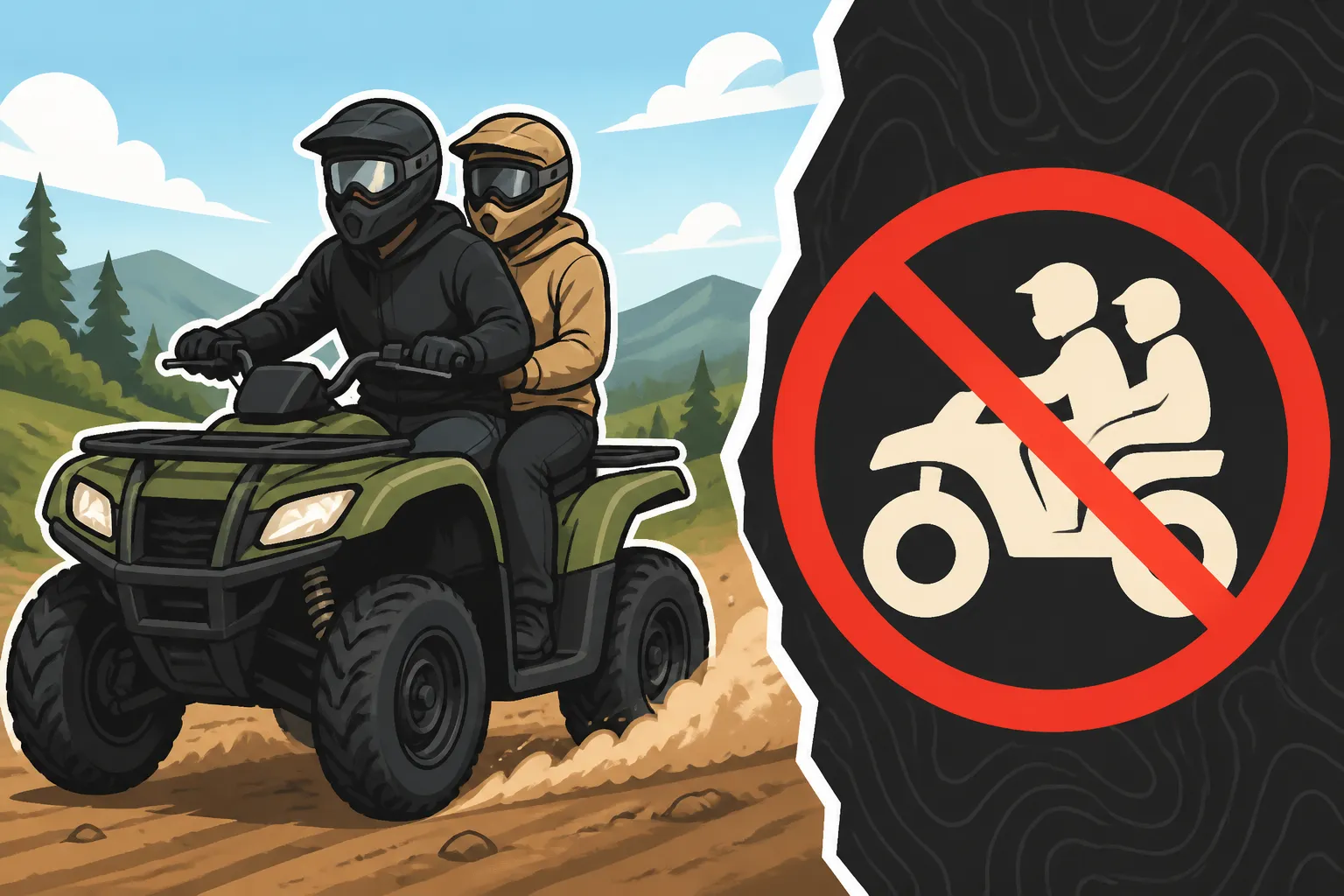
Oh, the age-old question that sparks many a debate around the campfire and sends shivers down the spines of many an off-road parent: "Can I really not take my kid (or my buddy, or my spouse) for a ride on the back of my ATV?" It's a common scenario. You've got your quad, the sun is shining, and you just want to share the thrill of the trail or the open dunes. But time and again, you've heard the whispers, seen the signs, or even gotten a stern look from a ranger. This guide is going to peel back the layers of frustration and confusion, explaining precisely why riding two-up on an ATV is illegal on public land here in California, and what that really means for your riding adventures.
The Fundamental Rule: Why Most ATVs Are Single-Rider Machines
Let's get straight to the heart of the matter: the vast majority of All-Terrain Vehicles (ATVs), often called quads or three-wheelers, are designed and built for a single operator. This isn't just some arbitrary decision by the manufacturers or a quirky California rule; it's fundamental to the vehicle's engineering and safety. Imagine the design process: engineers meticulously calculate weight distribution, center of gravity, suspension travel, and steering response, all based on the assumption of one rider controlling the machine.
When you add a passenger, even a small one, you instantly throw all those carefully balanced dynamics out of whack. The ATV's handling characteristics change dramatically. It becomes more unstable, harder to steer, and significantly more prone to tipping or rolling over, especially on uneven terrain, during turns, or when accelerating and braking. The manufacturer's labels and warnings are there for a reason, often explicitly stating "Operator Only" or similar language. This isn't about limiting your fun; it's about preventing serious accidents. [California ATV Passenger Ban Explained] is a deeper dive into the specific legal text.
The Manufacturer's Intent and Labels
If you take a close look at your ATV, you'll likely find a sticker or a molded warning near the seat, or certainly in the owner's manual, clearly indicating it's a "single rider vehicle." These aren't just suggestions; they're the result of years of research, accident data, and industry safety standards developed by groups like the ATV Safety Institute (ASI). Manufacturers design the seating, foot pegs, and handholds (or lack thereof) specifically for one person. There isn't a second set of foot pegs or a grab handle for a passenger because the vehicle simply isn't engineered to carry one safely.
Consider the saddle-style seat itself. It's designed for the operator to shift their weight dynamically with the machine, leaning into turns, absorbing bumps, and maintaining balance. When a passenger is clinging on behind you, their weight becomes a static load, making it almost impossible for the operator to properly shift and control the ATV. This is especially true on challenging terrain like sand dunes at Glamis or rocky trails at Hollister Hills, where rider input is crucial for stability.
Weight Distribution and Stability Concerns
The physics behind why two-up riding on a single-rider ATV is dangerous is pretty straightforward. ATVs are short-wheelbase vehicles with a high center of gravity relative to their footprint. They require the rider's active weight shifting to maintain balance and control, particularly during turns or when climbing and descending hills. When you add a second person, you're not just adding weight; you're often adding it high and to the rear of the machine, further raising the center of gravity and making the ATV extremely top-heavy.
Imagine trying to navigate a steep, rutted climb at Hungry Valley with a passenger on the back. The front end, already light, becomes even lighter, making it prone to lifting or losing steering control. On a downhill, the added rear weight can push the front end, making it harder to brake effectively and increasing the risk of an end-over-end rollover. These aren't hypothetical risks; they are common scenarios that lead to injuries when ATVs are ridden outside their design parameters. Even for accessories, while brands like SuperATV offer fantastic upgrades for many off-road vehicles, their products are designed to enhance existing capabilities, not to fundamentally alter a single-rider ATV into a safe two-rider machine.
Understanding California's ATV Passenger Ban
California takes off-highway vehicle (OHV) safety very seriously, and the prohibition against ATV passengers on public land is a cornerstone of those safety regulations. It's not about being restrictive; it's about protecting riders and preventing severe accidents. The rules are pretty clear, and they apply across all of the state's amazing riding areas, from the vast expanses of the Imperial Sand Dunes to the tighter trails of the State Vehicular Recreation Areas (SVRAs).
The specific regulation you're likely to encounter is part of the California Vehicle Code (CVC) related to off-highway vehicles. It states that an all-terrain vehicle shall not be operated on public lands "carrying a passenger when the vehicle is designed by the manufacturer to carry only the operator." This means if your ATV came from the factory built for one, it stays for one when you're riding in public areas.
Legal Basis in California Vehicle Code
The legal framework for this ban is rooted in the California Vehicle Code. Specifically, CVC Section 38506 addresses the operation of ATVs on public lands. It clearly states that an ATV cannot be operated with a passenger unless it's specifically designed by the manufacturer to carry more than one person. For most traditional ATVs, this simply isn't the case. The intent here is unequivocally safety. The state legislature, in collaboration with the California Off-Highway Motor Vehicle Recreation (OHMVR) Division, has identified that carrying passengers on single-rider ATVs significantly increases the risk of accidents and injuries.
This code is enforced by various agencies, including the California Highway Patrol (CHP), local sheriff's departments, and state park rangers. They're not just looking for speeding; they're also checking compliance with basic safety regulations like this one. A ranger at Oceano Dunes, for example, isn't going to overlook a child perched precariously behind you on a quad designed for one. [California ATV Passenger Ban Explained] covers this in more detail.
Distinguishing ATVs from Side-by-Sides
It's crucial to understand the difference between an ATV and a side-by-side (SxS), also known as a Utility Terrain Vehicle (UTV) or Recreational Off-Highway Vehicle (ROV). This is where a lot of confusion comes in. Side-by-sides are designed from the ground up to carry multiple passengers, typically two, four, or even six people. They have a steering wheel, foot pedals, bucket or bench seating, seat belts, and usually a roll cage. Their stability and design are inherently different from an ATV.
Because side-by-sides are built for multiple occupants, carrying passengers in them is legal, provided everyone has a seatbelt on and follows other rules like age restrictions for drivers and passengers. [Side-by-Side Passengers and California Rules] dives into the specifics for UTVs. This distinction is vital: if you want to ride with family or friends on the same machine, a multi-passenger side-by-side is your legal and safe option on California public lands, not attempting to modify a single-rider ATV. While you might see great aftermarket accessories from companies like SuperATV for UTVs that enhance their passenger comfort or utility, these are for vehicles already designed for multiple occupants.
Who Enforces These Rules and Where
You'll encounter enforcement of these rules at all California public OHV riding areas. This includes the massive Bureau of Land Management (BLM) managed areas like Glamis (Imperial Sand Dunes Recreation Area), the State Vehicular Recreation Areas (SVRAs) such as Hollister Hills, Ocotillo Wells, and Hungry Valley, and even on designated multi-use trails within National Forests.
Rangers and law enforcement officers are regularly present at staging areas, entrance gates, and out on the trails themselves. They conduct checks for proper registration (Green Sticker, Red Sticker, etc.), spark arresters, helmets, and yes, passenger compliance. If you're pulled over or stopped at a checkpoint, and you have a passenger on a single-rider ATV, you will likely receive a citation. They are not just looking for things like [California OHV Permits Explained], but also basic operational safety.
Safety Concerns: More Than Just a Rule
Beyond the legal aspect, the biggest reason for the ATV passenger ban is plain and simple: safety. Riding an ATV is an inherently active and dynamic experience. It demands constant engagement from the operator, requiring them to shift their weight, maintain balance, and react quickly to changes in terrain. Introducing a passenger compromises every single one of these critical safety factors. It's not just a minor inconvenience; it significantly elevates the risk of injury for both the operator and the unauthorized passenger.
Many riders, especially those new to the sport or families wanting to include younger children, often underestimate the skill and physical demands of safely operating an ATV. Adding a passenger, particularly a child, who might not be able to hold on properly or understand the need to lean with the driver, creates a recipe for disaster.
The Dynamics of Riding with a Passenger
When you add a passenger to a single-rider ATV, the machine's center of gravity shifts higher and often further rearward. This dramatically reduces stability and makes the ATV much more prone to rollovers, especially in turns, on sidehills, or over obstacles. The operator's ability to shift their own weight to counteract these forces is severely limited, if not impossible, with another person on board.
Think about turning: the rider needs to lean into the turn, shifting their weight to the inside. With a passenger, this action is either hindered or the passenger's weight acts as a counterweight, fighting the necessary lean and making the ATV want to tip to the outside of the turn. On rough terrain, the passenger's uncontrolled movements can further destabilize the machine, making it harder for the operator to maintain control. This isn't just theory; it's a major contributing factor in ATV accidents involving passengers. Even with advanced suspension systems or wider stances, the fundamental design for a single, active rider remains.
Increased Risk of Injury
The statistics and accident reports speak for themselves: riding two-up on a single-rider ATV is incredibly dangerous. In the event of a rollover or an uncontrolled maneuver, both the operator and the passenger are at a much higher risk of serious injury. Passengers, especially children, are often ejected from the vehicle, leading to impacts with the ground, rocks, or even the ATV itself. They lack the control and protective positioning that the operator might have.
Common injuries in such scenarios include head trauma, broken bones, internal injuries, and spinal cord damage. While wearing a [California Helmet Law for ATV Riders] is mandatory and critically important for safety, it cannot fully mitigate the increased risks associated with an inherently unstable riding situation. The potential for catastrophic injury is simply too high, which is precisely why California, and most other states, have implemented these passenger restrictions. It's a tough lesson to learn, but one that could save lives.
| ATV Type | Passenger Capacity (Manufacturer Design) | Legal on California Public Land |
|---|---|---|
| Standard Sport ATV | 1 Operator Only | No |
| Standard Utility ATV | 1 Operator Only | No |
| Two-Up ATV | 1 Operator + 1 Passenger | Yes (if factory designed) |
| Side-by-Side (UTV) | 2+ Passengers (with seatbelts) | Yes |
Note: "Two-Up ATVs" are a specific, less common category of ATV that is factory-designed with a longer wheelbase and often a raised, separate passenger seat, footrests, and handholds. These are rare compared to traditional ATVs.
The Consequences of Riding Two-Up on an ATV
Breaking the rules, especially those rooted in safety, comes with consequences. When you're out riding on California's public lands, having a passenger on an ATV not designed for one can lead to more than just a stern lecture. You could be looking at citations, fines, and even a forced end to your day of riding. It's a disruption and an expense that nobody wants when they're trying to enjoy the great outdoors.
Beyond the immediate legal repercussions, there are other, less obvious but equally significant consequences, like the impact on your insurance coverage and the potential liability in case of an accident. These are factors every rider should seriously consider before thinking about bending the rules.
Citations and Fines
If a ranger or law enforcement officer observes you operating a single-rider ATV with a passenger, they are within their rights – and indeed, their duty – to issue you a citation. These aren't just slaps on the wrist; they come with fines that can quickly add up, easily putting a significant dent in your wallet. The exact amount of the fine can vary by jurisdiction and the specific circumstances, but you can expect it to be a deterrent, not just a minor annoyance.
Consider a typical weekend at Ocotillo Wells: rangers are actively patrolling. If you're caught with a child on the back of your quad, you might not only receive a fine but also be asked to either remove the passenger from the riding area or cease riding altogether. This can quickly ruin a planned family outing. These fines are designed to discourage unsafe behavior, reinforcing the message that California takes OHV safety seriously. It's not just about [California Fines for Riding on a Highway], but for unsafe practices on the trails too.
Insurance and Liability Implications
This is a critical, often overlooked consequence. Your off-highway vehicle insurance policy is likely predicated on you operating the ATV as per the manufacturer's design and in compliance with state laws. If you're involved in an accident while illegally carrying a passenger on a single-rider ATV, your insurance company could deny coverage for injuries or damages. This means you would be personally responsible for all medical bills, repair costs, and any liability claims from your injured passenger.
Imagine the scenario: you're riding with a friend on the back of your ATV at Prairie City SVRA, you hit an unexpected rut, the ATV rolls, and your friend breaks an arm. If your insurance company finds out you were carrying an unauthorized passenger, they could refuse to pay for your friend's medical expenses. Suddenly, a fun day out turns into a massive financial and legal headache. This personal liability can be financially devastating, far outweighing the cost of a fine. Many riders don't realize that simply having insurance doesn't cover actions that violate the terms of their policy or state law.
The Message We Send to Other Riders
Beyond the personal costs, there's a broader impact. When people see others riding two-up illegally on ATVs, it normalizes the unsafe behavior. It can lead new riders, or those less familiar with the rules, to believe it's acceptable or even standard practice. This creates a ripple effect of increased risk throughout the riding community. Part of being a responsible OHV enthusiast in California is adhering to the regulations that are in place for everyone's safety, including things like [California's Safety Certificate Rules] and [California Minimum Age to Ride on Public Land].
By following the rules, you're not just protecting yourself and your family; you're contributing to a culture of safety that benefits all riders and helps ensure continued access to our precious public riding lands. Rangers and land managers are often fighting to keep trails open, and a rise in accidents due to non-compliance can unfortunately be used as an argument to restrict access further. Let's all do our part to keep our riding areas safe and accessible for generations to come.
Disclaimer
This article is for general informational purposes only and does not constitute professional advice. Laws, prices and regulations vary by location and change over time. Consult a qualified professional for guidance on your specific situation.