How California Golf Cart Routes Work
Navigating the specific rules for golf carts on California's public roads can feel like trying to hit a moving target – it's often confusing and full of local nuances. Many of us see golf carts zipping around certain communities and wonder, "Can I do that where I live?" This guide is here to untangle the complexities of how California's unique golf cart routes actually work, helping you understand where and how these convenient little vehicles can legally share the asphalt.
Understanding California's Approach to Golf Carts on Public Roads
California has a particular stance when it comes to golf carts and their place on public roadways. Unlike traditional cars or even certain modified Off-Highway Vehicles (OHVs), golf carts aren't generally built or intended for widespread street use. The state's vehicle code acknowledges their existence but places strict limitations, leaving much of the practical implementation up to local municipalities. It's a system designed to balance convenience for residents with crucial safety considerations for everyone on the road.
The Legal Distinction: Golf Carts vs. OHVs vs. NEVs
When we talk about golf carts, it's easy to lump them in with other small, electric, or low-speed vehicles. However, California law makes some very clear distinctions. A "golf cart" is specifically defined as a motor vehicle designed to transport persons and golf equipment, with a maximum speed of 15 miles per hour. This speed limit is key because it immediately differentiates them from most other vehicles you might encounter.
Compare this to an OHV, like an ATV or a UTV, which is designed for off-road use and is subject to completely different registration and operating rules. You'd never take your ATV to the golf course, and you certainly wouldn't expect it to be street legal without extensive, often impossible, modifications. Then there are Neighborhood Electric Vehicles (NEVs), sometimes also called Low-Speed Vehicles (LSVs). These are purpose-built for street use, have a maximum speed of 25 mph, and come equipped with specific safety features from the factory, making them eligible for [California Low-Speed Vehicle Registration]. While NEVs might look similar to a beefed-up golf cart, their legal classification and the roads they can use are distinct. Golf carts are generally slower and have fewer standard safety features than an NEV, which means their street access is much more limited and dependent on specific local rules.
Why Designated Routes Are Necessary
So, why can't a golf cart just drive anywhere a car can, especially if it's got headlights and turn signals? The primary reason is safety. A vehicle topping out at 15 mph is simply not compatible with the flow of traffic on most public streets, where speed limits are typically 25 mph or higher. This speed differential creates a significant hazard, increasing the risk of rear-end collisions and frustrating other drivers. Furthermore, standard golf carts often lack essential safety features like crumple zones, advanced braking systems, or robust occupant protection, making them vulnerable in any collision.
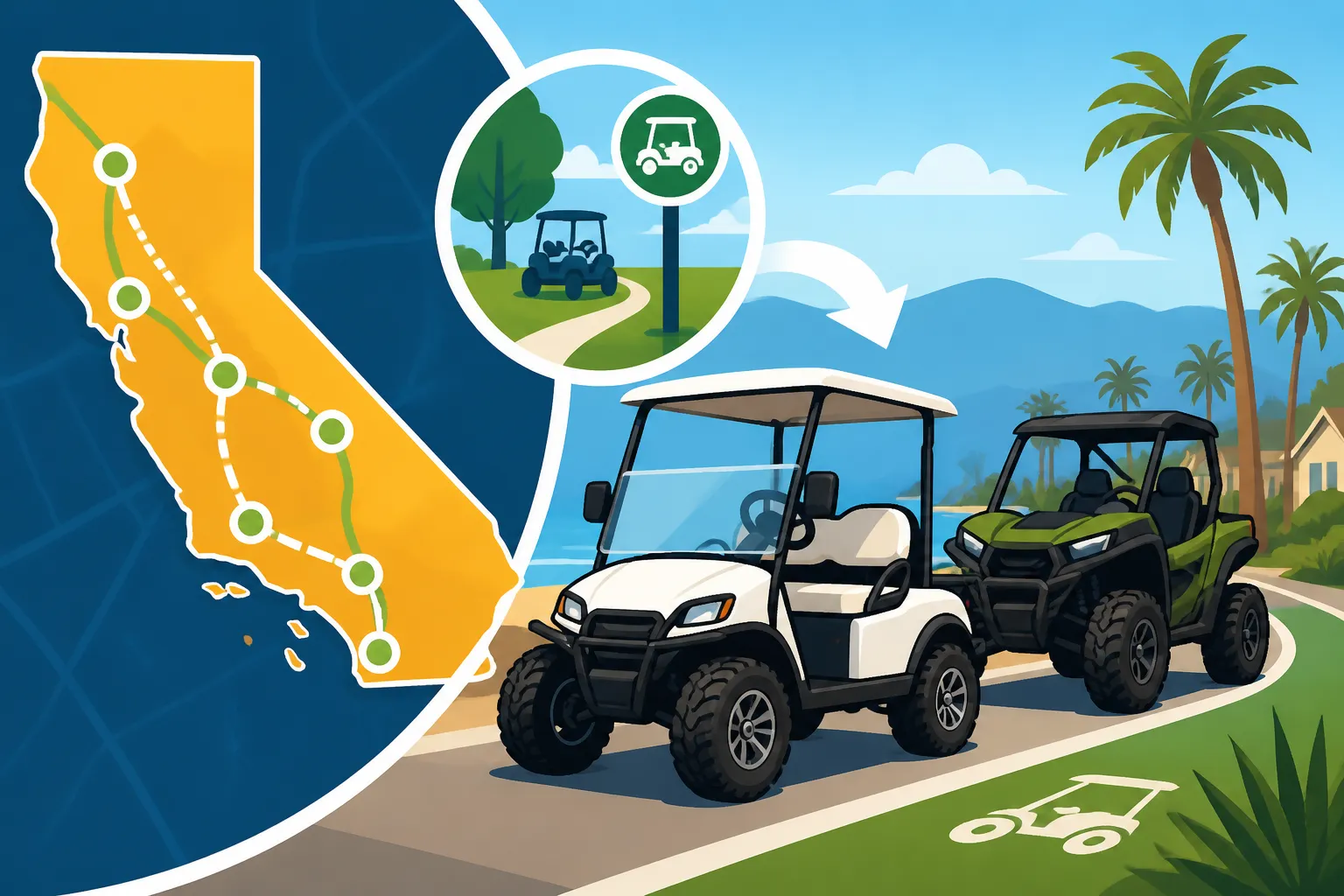
Because of these inherent safety concerns, the state requires local jurisdictions to actively designate specific roadways or segments as "golf cart lanes" or "golf cart routes." This isn't a passive process; it involves a local agency, like a city council or county board of supervisors, conducting thorough studies to ensure the proposed routes are safe for golf cart use. These studies consider factors such as traffic volume, road width, speed limits of other vehicles, and the presence of bike lanes or shoulders. Without such a designation, a golf cart is generally confined to private property or the immediate vicinity of a golf course, which we'll delve into more later. It’s a deliberate effort to create safe pathways for these vehicles rather than granting blanket access that could lead to accidents.
How Cities and Counties Establish Golf Cart Routes
The process of opening up public streets to golf carts in California is a testament to local governance and community planning. It's not something that happens overnight or through a statewide mandate. Instead, it's a careful, deliberate journey taken by individual cities and counties, often in response to specific community needs or existing infrastructure.
The Designation Process
When a local jurisdiction decides to explore establishing golf cart routes, they typically embark on a multi-step process outlined by the California Vehicle Code. First, there's usually a preliminary study to identify potential routes that could safely accommodate golf carts. This involves evaluating roads with lower speed limits (typically 25 mph or less), minimal traffic volume, and often, connections to golf courses, community centers, or residential areas. Engineers and traffic planners will assess line of sight, turning radii, and the potential impact on pedestrian and bicycle traffic.
Next, the proposed routes are subject to public review and discussion. Residents, business owners, and local advocacy groups have the opportunity to voice their opinions, concerns, and suggestions. This input is crucial in shaping the final plan. Once the routes are finalized and deemed safe by traffic experts, the local governing body—a city council or county board—must pass a specific ordinance to formally designate these roads for golf cart use. This ordinance will specify the exact streets or segments, the hours of operation, and any other unique local rules. It's a rigorous process because the safety of all road users is paramount, ensuring that golf carts are integrated thoughtfully into the existing transportation network.
Examples of Designated Communities
California is dotted with communities that have embraced golf cart transportation, often in areas with a strong golf culture or a desire for alternative, low-speed mobility. One of the most well-known examples is Palm Desert. This city in the Coachella Valley has proactively developed an extensive network of designated golf cart lanes, making it incredibly convenient for residents to traverse the community, visit shops, and access numerous golf courses without ever getting into a car. Their system is a prime example of successful integration, featuring clearly marked lanes and signage, and reflecting years of planning and community investment. [Palm Desert's Golf Cart Lanes] are not just an afterthought; they are a fundamental part of the city's infrastructure.
Another noteworthy example, though often leaning more towards NEVs than traditional golf carts, is the city of Lincoln. While their focus broadened to include these slightly faster electric vehicles, the underlying principle is similar: a local government identifying a need and establishing specific routes to meet it. These designated areas often arise in master-planned communities or retirement communities where residents appreciate the ease and environmental benefits of low-speed personal transport. These communities demonstrate that with proper planning and clear regulations, golf carts can play a vital role in local transportation.
Rules and Regulations for Golf Cart Operation on Approved Routes
Once a city or county designates specific routes for golf carts, simply having the designated road isn't enough. Riders need to understand and adhere to a strict set of rules and ensure their golf cart meets specific equipment requirements to operate legally and safely. These regulations are in place to protect not only the golf cart operator but also pedestrians, cyclists, and other drivers.
Equipment Requirements for Street Use
Think of it this way: the golf cart you use on the greens is likely not the golf cart you can legally drive on a designated public street. For a golf cart to be allowed on a publicly designated route in California, it must be equipped with a range of safety features that go beyond the basics. These typically include:
- Headlights: Functional headlights are required for visibility, especially during dawn, dusk, or in inclement weather.
- Taillights: Red taillights, visible from a specific distance, are crucial for being seen from behind.
- Stop Lamps: When you apply the brakes, these lights need to illuminate clearly.
- Turn Signals: Front and rear turn signals are essential for indicating your intentions to other drivers.
- Rearview Mirror: At least one mirror that provides a clear view of the road to the rear is mandatory.
- Windshield: A sturdy windshield can provide protection from debris and elements.
- Horn: A working horn is necessary for signaling warnings to others.
- Fenders: Fenders help prevent water or debris from being sprayed up by the tires.
- Seat Belts: If the golf cart is equipped with seat belts, they must be worn. Many carts modified for street use will have them installed.
Many golf cart owners turn to aftermarket solutions to bring their vehicles up to code. Companies like SuperATV offer a variety of accessories, from full lighting kits to mirrors and windshields, that can help meet these requirements. It's vital, however, to ensure that any modifications comply with local ordinances and state vehicle code, rather than just adding accessories indiscriminately. Always check with your local DMV or city planning department to confirm specific requirements before hitting the road.
Driver Requirements and Operational Rules
Beyond the vehicle itself, the operator of the golf cart also has specific responsibilities and must meet certain qualifications. Generally, to drive a golf cart on a designated public street, the operator must hold a valid California driver's license. This isn't a free-for-all for anyone who can reach the pedals; it's treated like operating any other motor vehicle on a public road.
Operational rules are equally important and are designed to integrate golf carts safely into the local traffic flow. Here's what you typically need to know:
- Speed Limits: On designated golf cart routes, the maximum speed limit is usually 25 mph. However, the golf cart itself cannot exceed 15 mph. This means you must operate your golf cart within its design limitations, even if the road's posted speed is higher.
- Following Traffic Laws: Golf cart operators must obey all standard traffic laws, including stop signs, traffic lights, and right-of-way rules. You are sharing the road, and you are expected to be a responsible driver.
- Passenger Limits: Golf carts are typically designed for a specific number of passengers. Overloading the vehicle is not only illegal but also incredibly dangerous, affecting stability and braking.
- Designated Paths: You must stay on the designated golf cart routes. Veering off onto non-approved streets can result in citations and fines.
- Hours of Operation: Some local ordinances might restrict golf cart operation to certain daylight hours, though many allow night use if the cart has proper lighting. Always check your local rules.
Understanding [California Golf Cart Street Rules] is crucial. Remember, while a golf cart might seem like a toy, when it's on a public road, it's a vehicle subject to serious regulations. Failure to comply can result in fines and potentially endanger yourself and others. A California sheriff or local law enforcement officer will conduct checks similar to those for any other vehicle, so be prepared with your driver's license and ensure your cart is up to snuff. [What a California Sheriff Checks Roadside] can include ensuring proper lighting, driver licensing, and adherence to designated routes.
Where You Can and Cannot Ride a Golf Cart in California
It's a common misconception that if a golf cart has been modified with lights and signals, it can automatically be driven on any street. In California, this is simply not the case. The rules are quite precise, determining not just how a golf cart can be operated, but where. Understanding these boundaries is critical to avoiding fines and ensuring your safety.
Understanding the 1-Mile Radius Rule
Beyond the specifically designated city or county routes, there's a particular provision in the California Vehicle Code that allows for limited golf cart use on public roads near a golf course. This is often referred to as the "1-mile radius rule." Under this rule, a golf cart may be operated on a street or highway that has a posted speed limit of 25 mph or less, if the street is within one mile of a golf course. The purpose of this provision is quite practical: to allow golfers to drive their carts from their homes or parking areas directly to the golf course without having to trailer their vehicle.
However, there are still conditions. The cart must still be equipped with basic safety features like headlights, taillights, turn signals, and a rearview mirror. And, of course, the driver must possess a valid driver's license. It's important to stress that this 1-mile rule is an exception for specific circumstances around golf courses, not a general license to roam. It doesn't mean you can drive your golf cart to the grocery store five miles away, even if the road has a 25 mph speed limit, unless that route is part of a formally designated golf cart network. This rule directly addresses the practical need of linking a golf course to its immediate surroundings. [Golf Carts Within a Mile of the Course] explains these nuances in more detail.
Limitations and Prohibited Areas
The vast majority of California's public roadways remain off-limits to golf carts. This includes:
- High-Speed Roads: Any street or highway with a posted speed limit exceeding 25 mph is generally prohibited. The speed differential with other vehicles makes it too dangerous.
- State Highways and Freeways: These are absolutely off-limits. Golf carts are not designed for the speeds or the traffic volume found on these major thoroughfares. Attempting to ride one on a freeway would be incredibly hazardous and illegal.
- Non-Designated City Streets: Even if a street has a 25 mph speed limit, if it hasn't been formally designated as a golf cart route by the local authority, or if it falls outside the 1-mile golf course radius, it's prohibited. This is where many people get confused, assuming low speed equals legal access.
Riding a golf cart in a prohibited area can lead to significant penalties. You could face fines for illegal operation, and if an accident occurs, liability issues could become extremely complex. [California Fines for Riding on a Highway] are substantial for a reason – these rules are about safety. Moreover, it's crucial to remember that a golf cart is not an OHV. It cannot be used on off-road trails, in sand dunes, or in State Vehicular Recreation Areas (SVRAs) like an ATV or UTV. Trying to take a golf cart onto these terrains would not only be unsafe but also illegal, as it lacks the design, suspension, and power for such environments.
The Practicalities of Owning and Operating a Golf Cart for Road Use
Deciding to use a golf cart for local transportation on designated routes brings with it a few practical considerations. Beyond understanding the rules of the road, you'll need to think about how your golf cart is legally recognized and how you might need to adapt it for safe and compliant operation. It's more than just getting in and driving; it's about being prepared for the realities of shared roadways.
Insurance and Registration Considerations
Unlike OHVs, which almost universally require [Registering an OHV in California] with the DMV to receive a Green or Red Sticker for public land use, traditional golf carts typically do not require formal registration with the California Department of Motor Vehicles (DMV) if they remain under the "golf cart" definition (max 15 mph). This is a key distinction from Neighborhood Electric Vehicles (NEVs), which do require registration and specific license plates because they operate at higher speeds (up to 25 mph) and are built to stricter standards.
However, while state registration might not be mandated for a golf cart, insurance is a different story, and it's something you absolutely should not skip. If you're operating your golf cart on public roads, even designated ones, it's wise to carry liability insurance. Accidents can happen, and without insurance, you could be personally responsible for any damages or injuries. Many homeowner's policies might offer some limited coverage for golf carts used on private property, but once you take it onto a public street, even a low-speed one, a dedicated golf cart insurance policy or an endorsement on your auto policy might be necessary. Check with your insurance provider to understand your specific coverage options and ensure you're adequately protected.
Modifying Your Golf Cart for Street-Legality
If you own a standard golf course cart and wish to use it on designated public routes, you'll almost certainly need to undertake some modifications. As discussed earlier, a basic golf cart lacks many of the safety features required for even low-speed road use. Here's a rundown of common modifications:
- Lighting Kits: The most fundamental upgrade involves adding a full lighting package: headlights, taillights, brake lights, and turn signals. These are non-negotiable for visibility and communication with other drivers.
- Mirrors: You'll need at least one rearview mirror, and often side mirrors are highly recommended for better situational awareness.
- Windshield: A clear, unobstructed windshield provides protection from the elements and road debris.
- Horn: A working horn is essential for warning others.
- Tires: While golf cart tires are sufficient for the course, if you're regularly on pavement, consider upgrading to street-specific tires for better longevity and traction.
- Seat Belts: If your cart doesn't have them, consider adding retractable seat belts for all occupants, especially if it's a multi-passenger vehicle.
- Speed Controller (if applicable): While the maximum speed limit for golf carts is 15 mph, some older or modified carts might exceed this on their own. Ensure your cart's speed is properly limited to stay within the legal definition of a golf cart for public road use.
Aftermarket companies are a great resource for these upgrades. For instance, SuperATV provides a range of UTV and ATV accessories, but you might also find similar universal or golf-cart-specific parts from them or other specialized golf cart parts suppliers. When making modifications, always prioritize safety and compliance. It's not just about bolting on parts; it's about ensuring they function correctly and meet the standards set by your local ordinance. Always ensure the modifications are done correctly and safely to avoid any unforeseen issues on the road.
Golf Cart, NEV, and OHV Comparison
To help clarify the differences between these types of vehicles and their legality on California roads, here's a handy comparison table. This should make it easier to see why each type has distinct rules.
| Feature | Golf Cart (Street-Modified) | Neighborhood Electric Vehicle (NEV) / Low-Speed Vehicle (LSV) | Off-Highway Vehicle (OHV) (e.g., ATV, UTV) |
|---|---|---|---|
| Max Speed | Typically 15 mph (by definition) | Up to 25 mph | Varies widely, often much higher |
| Primary Use | Golf course, short-distance local travel on designated routes | Local street travel on roads 35 mph or less | Off-road trails, dunes, deserts, SVRAs |
| Road Legality | Limited to designated local routes or within 1-mile of golf course | Permitted on roads with speed limit 35 mph or less, some exceptions | Generally NOT street legal; limited road crossings or combined-use routes only |
| Registration (CA) | Generally NOT required (unless local ordinance demands it) | REQUIRED (with license plate) | REQUIRED for public land use (Green/Red/Tan Sticker ID Plate) |
| Driver's License | REQUIRED | REQUIRED | Generally REQUIRED for public land use |
| Safety Equipment | Headlights, taillights, turn signals, mirrors, horn (often added) | Factory-equipped with full lighting, seatbelts, VIN, etc. | Helmet, spark arrester, sometimes whip/flag for dunes |
| Emissions | Electric or small gas engine, low emissions | Zero emissions (electric only) | Varies (gas engines, subject to CARB compliance) |
| Examples of Use | Running errands in Palm Desert, commuting to golf course | Short trips to stores, schools in planned communities | Riding trails at Hungry Valley, dunes at Glamis |
This table highlights that while all three can be fun and useful, their intended purpose and legal operating environments are vastly different. Trying to use a golf cart like an NEV or an OHV will quickly lead to legal trouble and safety risks.
Disclaimer
This article is for general informational purposes only and does not constitute professional advice. Laws, prices and regulations vary by location and change over time. Consult a qualified professional for guidance on your specific situation.